Nine Games that Made Football
- and the Tenth the Modern Game.
That the initial international in 1872 (1) was pivotal to the Scottish and therefore the World game is beyond doubt. It, as number one of the nine, was the first to have an obvious defined defence, the two full-back, two half-back box - 2-2 - that was to epitomise for a decade and half football North of the Border and much of Northern England as well. Indeed for half a dozen seasons it was ubiquitous in the game everywhere before new thinking in the form of 2-3-5 emerged from Wales, albeit at club level only, in a regularly-applied form, rather than the simply experimental one recorded earlier and elsewhere.

But in 1882 (2) that would change. The Pyramid, as the new formation would come to be known, would be employed, the second game of the nine, for the first time at a higher level and by Wales in the international encounter with England, where it would win for the first time, 5-3, with goals from an Owen, a Vaughan, a Jones and a Morgan, but one an English own-goal. We'll leave you to find out which one. And it would be followed, if not exactly replicated in 1883 (3), the third of the nonet, in the final of the FA Cup. In 1882 that final had been between Blackburn Rovers, the first participation of a northern club, and Old Etonians (OE). The latter had won; the last southern club to do so for almost two decades. Both had lined up at 2-2-6. But the following season with OE there once more the opposition was provided by the team from across the Lancashire town, Blackburn Olympic. And it had made preparations. First it had brought in from the Sheffield game as player/coach the England international Jack Hunter. Second it found a way to finance a stay by the squad for the fortnight before the match away from work and in Blackpool. There Hunter drilled into team-mates his way of playing, in a 2-3-5, with him at left-half, with a passing game in the middle of the formation and the two wingers supplying long cross-balls. Moreover it worked. OE were defeated, albeit by the best of just three with the winning goal coming only in the second half of extra-time.
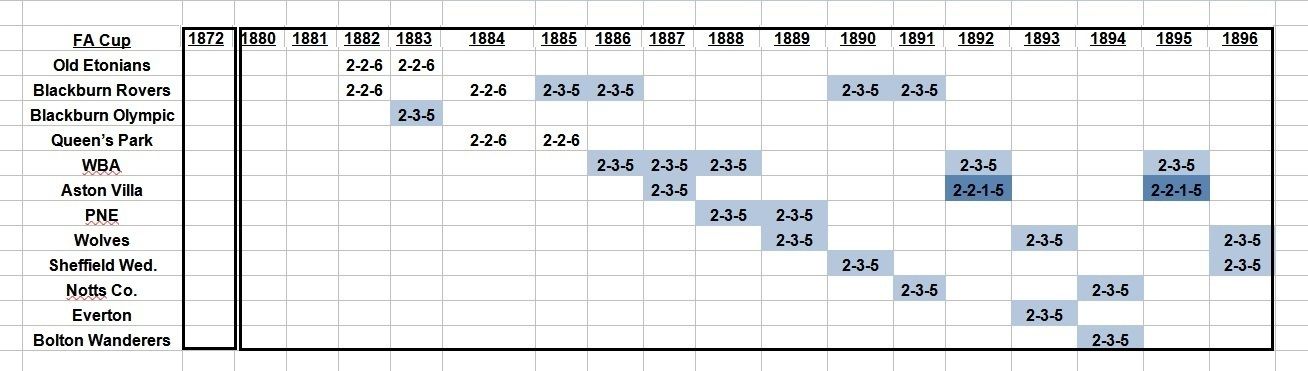
And that seemed to be at least and for the moment a partial trigger. In international matches in 1884 (4), whilst Wales actually reverted to 2-2-6, Ireland and England used both it and 2-3-5, including for the English, in the fourth match of note, for the first time against the Scots, albeit they did with a Scot, a Gaelic-speaking Highlander, Stuart MacRae at centre-half and still lost, if only by a single and very early goal. However, 1885 (5) was to see partial become almost whole. At international level Wales, England and Ireland would all turn fully to it. And In the FA Cup final, a repeat of the previous year's between again Blackburn Rovers and Queen's Park, the English side, but with four Scots in the side including centre-half, would employ it also and win. Only the Scots Scotland would defer. Both in the internationals and for the Glasgow team 2-2-6 would continue as the formation of choice.
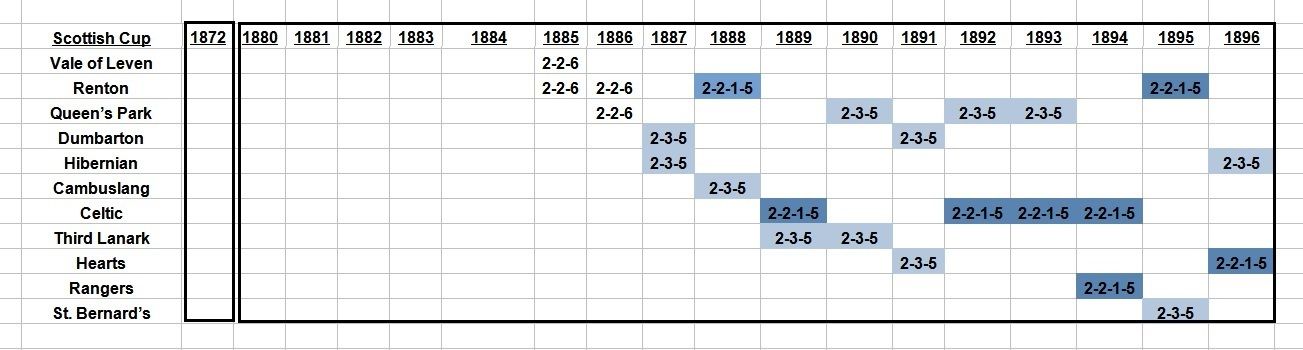
And this would continue to be the case until 1887. In the sixth match of our set, the one, which also in 1885 (6) would see the re-emergence of Renton in beating Vale of Leven in the Scottish Cup Final both outfits remained traditionally set-up. And the same would be true the following season as the final was once more reached but the Dunbartonshire club was vanquished by Queen's Park. However, in the 1887 (7) showpiece, the seventh of our base nine, both Hibernian, perhaps unsurprisingly as an East Coast side, and even West-Coast Dumbarton had switched. It looked as if 2-2-6 was about to be confined to the past as, indeed, it was but not in quite the way that might have been expected.
In the Renton Cup-Final teams of 1885 and 1886 James Kelly had played as a forward. Now in the 1888 (8) final, Renton there once more this time to face a 2-3-5 Cambuslang side and our eighth spotlighted match, he was notionally at centre-half in the what looked 2-3-5 also. But it wasn't. Kelly was actually playing in a new position of false-forward between and so behind the remaining five of the attack and in front of the still box-four defence. The formation was thus 2-2-1-5 with him as the link between the two, and also the team-pivot, a passer and header with a tackle.
And it worked unimaginably well. That season, before Kelly would for the next season, indeed the rest of his career, join newly Celtic, Renton after taking both the Glasgow Charity and the Cup Finals would go on first in the last of our base-nine to defeat to English Cup winners, West Bromwich, thus declared "World Champions", and then, having suffered defeat the year before, the following season's English Double-winners, Preston North End.
Which leaves the tenth game, the one that changed the World. The full development and implementation of the "Kelly" role, what was to become the specifically Scottish Centre-Half, took for a number of seasons. Impediments were notably amateurism both on- and off-field, the rapid expansion from 1888 of the English league-system and its demand for players and the continuation of the residence qualification for international players therefore eliminating Anglos. It meant for seven seasons many of the best Scottish players were not available for their country, even as England played three what would today be considered Scots in Goodall, Stewart and Weir. Results inevitably suffered. Indeed they would not revive until on April 4th 1896 (10), amongst others, Ned Doig, of Sunderland via Letham Angus, was back in goal and Jimmy Cowan from the Vale of Leven but by then at Aston Villa came in to fill Kelly's shoes, the first of three with then Raisbeck and Thomson to do so and begin the game's, the Scottish game's transfer to the modern era.
Back to the SFHG Home page