(Alcock) & Marindin
In the period covered by SFHG there were numerous presidents of the Scottish Football Association but only four of the London-based, English equivalent.
The first, for a decade, was the rowing-solicitor, Ebenezer Morley, with his seemingly light, cooperative touch and considerable help at the organisation's inception in 1863 and again in 1866-7, when it was in danger of death in infancy, from his fellow lawyers and founders of Sheffield football and its FA. And the last was a Sheffield-man himself, another lawyer, Charles Clegg. He, as a player, had been one of the four non-southerners in the England team in the first international in 1872. He also remained a staunch advocate of amateurish throughout his life and thus, whilst he was largely responsible for England joining FIFA in 1905, Scotland, Wales and Ireland(Northern Ireland) following in 1910, and, after the gesture exit in 1919, the re-joining in 1924, a year after he took the reins, it was also he who then managed to take all four nations out once more. That would be in 1928 over potential shamateurism at the Olympics, a problem resolved by FIFA by the invention the following year of the World Cup, first played in 1930 but a competition the Home Nations could then not take part in for a further eighteen years.
And then there are the two in between, who are by a curious seeming coincidence both buried Scotland. In the case of Lord Kinnaird, the all-embracing story of whom is to found in the book by Andy Mitchell, Arthur Kinnaird - First Lord of Football, there was a straight-forward reason. Although born and brought up in London he was from a Scottish noble family and is buried on its estate at Kinnaird, overlooking the Tay between Perth and Dundee. But in the case of Sir Francis Marindin it is a little more convoluted.
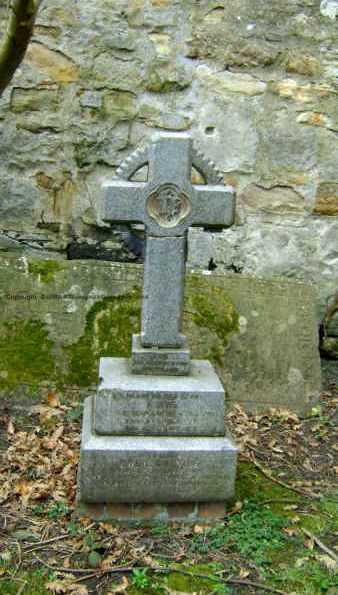
Following his death at sixty-one in 1900 Sir Francis A. Marindin K.c.m.g. was buried, with Kathleen, his wife, who survived him by thirty-nine years, and other family in the grounds of the ruins of Old Crombie Church, by Torryburn on the north bank of the Forth in Fife. But he had been born in Weymouth in 1838, his father a vicar and, given the surname, of probably French Huguenot origin, his mother born in Beckenham but with a complicated, wealthy and, shall we say, not very salubrious Scottish background. In 1851 her Edinburgh-born father was listed as a land-owner but had been a plantation and slave-owner in the West Indies and with John Gladstone had then imported indentured labour to the region.

Sir Francis himself had when very young moved with the family to another parish in Somerset, from where he was sent to Eton, then the Royal Military Academy and from where at sixteen he joined the Royal Engineers. At seventeen he was serving in The Crimea and then from 1860 was A.D.C. and private secretary to the Governor of Mauritius, also serving in Madagascar. Indeed it would be also in Mauritius that he married the Governor's daughter, Elizabeth Stevenson, they themselves having, in 1865 and by then back in London after returning two years earlier, a single daughter.
And by then a twenty-five year-old Marindin, having re-joined his regiment in about 1863, had been involved, if not in the actual foundation of its football club then its very early days. And that involvement would continue for a decade including appearances in the first FA Cup Final in 1872 and again in 1874, the same year he assumed the FA Presidency. But he must have filled the role initially from something of a distance. Again in 1874 he had been posted to Harwich, there founding and at thirty-six playing for Harwich and Parkstone F.C.. It meant that from then until 1877, when he was seconded to the Board of Trade as an Inspector of Railways, stepping back from the army in 1879, day-to-day London operations were inevitably left in the hands of Kinnaird and Charles Alcock.
However, as a Railways Inspector Marindin was known for his "plain-speaking, coupled with a complete mastery of his subject and great discriminating capacity" so it seems unlikely as FA President he would have been any different. Indeed those characteristics may well have been responsible for the smoothness, with which Sheffield's was in 1877-8, albeit due to problems internal to the Steel City's own game, only initially partially subsumed, along with a number of its far more sensible rules, into London's, and twice over, in 1885 and 1888, the avoidance of conflicts, which might well have resulted in schisms with Northern and Midland clubs over professionalism. But it does not explain the allowing of Lane Jackson's 1882 attempt with the formation of Corinthian F.C. at sporting eugenics, unless, of course, Marindin was in agreement or simply and somewhat bizarrely given his burial place just anti-Scots. But then a biographer is quoted as saying,
"Refereeing the [FA] final in 1888 he entered the winners dressing room, West Bromwich Albion's, and asked if it were true that they were all Englishmen (in fact they all came from Staffordshire) and being assured it was so gave them the match ball which he was entitled to keep - political correctness then was unknown."
West Brom had just beaten Preston North End with seven Scots and a Welshman in its team.
However, what he certainly did was to establish a high standard of game-officiation. He was in 1880 and from 1884 to 1890, the year he stepped down the FA Cup Final referee, so at that time still, with two umpires, one representing each team on the pitch, the arbiter in the stand. He was in his era considered to have a knowledge of the game's rules like no other but also perhaps conservative. Today's system of an on-pitch referee and two linesmen would be introduced from 1891.
As Marindin had stepped up to the FA Presidency Charles Alcock had already been there as Secretary for four years. Furthermore he would be still there for five years after "the Major" would stand down. And in that period of twenty-five years he is initially credited with the introduction of both international football and competitive club football in the form of the FA Cup, neither accolade being completely correct.
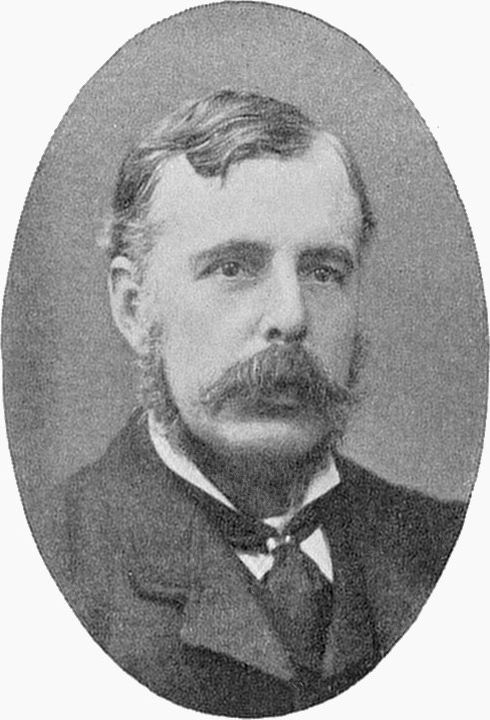
It is true that Alcock was the signatory to the challenges issued in 1870 for the five unofficial international matched that followed and for first official one in 1872, but then he should have been. He was FA Secretary, having in the former case just taken over. And whilst he would, again in the former case, be the England captain, both he and Secretary for the previous three seasons, Robert Graham, who remained on the FA Committee until 1871 were responsible for team selection.
Moreover, the selectors of the Scottish team were initially Kinnaird and James Fitzpatrick, the Quiet Baron, who was also captain in that first game and the one that followed. Kinnaird would captain in the third. And both Diasporan Scots would also be committee members with the impression thus being that it was very much a joint effort.
And with regard to the FA Cup there is a very good argument that it was a borrowed initiative. Already in 1867 in Sheffield the knock-out Youdan Cup had been played with the concepts of both extra-time and the Golden Goal introduced. Twelve local clubs had taken part. Fifteen would start the first FA Cup, thirteen local to the South of England, plus one from the Midlands and Queen's Park from Scotland. Then the next season the Cromwell Cup followed but with just four participants but then it had been restricted only to teams under two years old, perhaps a sign of rifts to come.
So where does that actually leave Alcock? On the one hand and conventionally he was a marketing genius, who took the game forward in leaps and bounds. But on the other perhaps he was not as innovative as some and perhaps he would like us to believe. Indeed there is perhaps an argument that he, whilst he had seen off, on- and off-field, the first potential challenge from the English North-East in the shape of Sheffield, he, and indeed Marindin, failed to do the same on-field from Scotland. And then he found the FA largely rendered permanently toothless off-field by the Midlands and North-West, once more of England, in the form of the Football League. The choice is yours but whilst in Scots terms it makes little or no difference perhaps the following quote from Alcock himself and 1891, so as the Renton-created, Scottish-Game was sweeping South, might help you. It is remarkable for its complete Anglo-centric myopia, indeed its pure gas-lighting:
"The perfection of the system which is in vogue at the present time however is in a very great measure the creation of the last few years. The Cambridge University eleven of 1883 were the first to illustrate the full possibilities of a systematic combination giving full scope to the defence as well as the attack"
Back to the SFHG Home page