Anwoth
- the oldest, known football ground in the World confirmed!
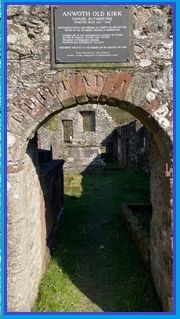
That football, although, of course, not yet the Association version, was played and in Kirkcudbright almost exactly 400 years ago has been known at the very least for almost one hundred and fifty years. The fact, albeit in passing, was restated in 1886 by a J.G. Barbour in his ‘Unique Traditions Chiefly of the West and South of Scotland’, reiterated on-line on The Modern Antiquarian with the original source being nigh on impeccable. It was to be found in the papers and letters of a certain Samuel Rutherford, Presbyterian Minister of Anwoth Kirk, now the ruined Old Kirk, and later a theologian of some distinction at St. Andrew's University, who arrived to take over the parish in 1627 and was appalled to find his parishioners playing the game on the Sabbath.

Now the site existed and still exists. The Modern Antiquarian visited it as just such and Barbour's telling or re-telling of the tale, to which can be added that more stones, fourteen in all, were laid, at the behest of Rutherford presumably, across the ground to stop the heinous practice, is fine but today we can do more, much more, now with the emphasis not on folklore but sport.
And that is exactly what Ged O'Brien, one of the founder members of SFHG, has done. He too located and visited the site but has done so with two experts from no less than Archaeology Scotland.
And they confirm firstly that the stone row has neither the form nor the nature of a medieval or post-medieval agricultural feature. Nor has it appeared on historical mapping as having any of those attributes, i.e. the rocks were not intended to mark a boundary, or croplands, or to help pen in livestock. And from analysis of the sub-soil that the stones were indeed placed deliberately across the ground,
“These small interventions showed that the stones were loosely set on an older ground surface and not in cut slots.”
Moreover, soil analysis suggests that the arrangement dates back some 400 years, to very much about when Rutherford voiced his objections.
So what does this mean? It tells us that a form of football was certainly played on a piece of identifiable ground in South-West Scotland two hundred and fifty years before Association football's rules were first compiled in 1863 in London. But it is what the new evidence implies that is still more important. Apart from the ground itself being roughly football-pitch shaped with dimension that are also about those of the small football grounds, on which early Scottish "soccer" was, often by necessity, played, there are the further implications. Anwoth's football was played at least weekly. It meant there was drawing on an established group of players, who turned up regularly. In other words it was organised. It was also known to be on a Sunday with work on Monday. That meant injury needing to be kept to a minimum, which in turn implies agreed rules to avoid such undesired outcomes. They might not have been written down. Who knows if the participants could even write. But they, the rules, were understood. And finally it looks as if it was a summer past-time, because it was played in the evenings and, if we know our weather, a flat piece of ground on top a Scottish hill would in winter be an unplayable bog. Unless, of course, they had early Astroturf!
PS: And this is how Television Francaise, the French equivalent of BBC 1, reported Anwoth in its coverage of the Women's Euro Cup Final. On BBC 1 and BBC Scotland there was zip, whereas on French TV the story is right out there as an "Historic Discovery" -GO.
Back to the SFHG Home page