Bill Struth
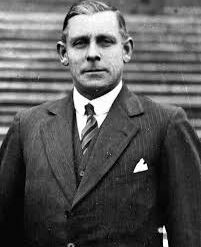
William "Bill" Struth despite being the most successful manager in Scottish football history was never a player of any note. He, like his father, was a stone-mason to trade but also the very Scottish phenomenon of a professional runner. Born in 1876, not 1875 as elsewhere stated, on the borders of Edinburgh and Leith he was brought up there, in his father's home village of Milnathort in Kinross and then back in Auld Reekie, marrying there in 1898 to local girl, Catherine Forbes. And it was shortly after that into the new century that he is said to have started to find work as a trainer with Hearts.
Whether the training came because the Struths were by then staying within a couple of hundred yards of Tynecastle or they moved there because of the work is unclear but he clearly made enough of an impression to attract attention from Glasgow, specifically in 1908 from Clyde, where from the following year until 1912 he worked under the managership of the youngest of the Maley brothers, Alex.
The family then moved itself to within half a mile of the Shawfield stadium, remaining there until, with Maley already gone in 1912, Rangers in 1914 appointed him as Assistant Manager to William Wilton and the Struths moving to Copland St. across the road from Ibrox. And there he would remain in place and position until the somewhat bizarre drowning of manager William Wilton in 1920, at which point he would simply step up, to stay in place for thirty-four years until retirement. And it is in that period that he and his club would win eighteen league championships, ten Cups and many other trophies, starting from his first full season and playing a style of football that was based on the standard Scottish game but with a Rangers twist. It was the rotation in attack and defense around first and ending with Meiklejohn, the Scottish Pivot and then, from the mid-1930s with Simpson, around the centre-back. All of which begs the questions, first, was the Rangers' system originally a product of the successes of the Wilton era or of Struth, the answer to which is unclear, and, second, how was it perpetuated, where the method seems to have been with Struth making sure of maximum fitness through the club's flow of senior professionals.
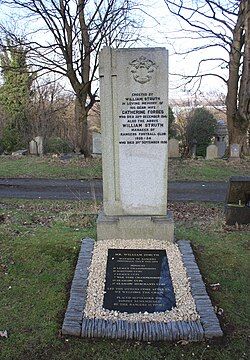
Bill Struth would lose his wife in 1941, she being buried in Craigton Cemetery. He would step back from Rangers in 1954 at the age of seventy-seven, by then a director, to be sunsequently appointed club vice-president and moving to Dumbreck. And it was there two years later that he passed away, aged eighty and to be buried alongside Catherine in a grave that had been allowed to deteriorate but has now been fittingly restored by The Rangers' Graves Restoration Project. As a side-note it is to be found very close to the burial-place of Rangers' founders, the McNeil brothers, Moses and Peter.
Birth Locator:
1875 - 25, Balfour St., Leith, Edinburgh
Residence Locations:
1881 - 7, Drummond St., Edinburgh
1891 - 21, Hill St., Milnathort, Kinross
1901-5 - 8, Wheatfield St., Edinburgh
1909-12 - 102, Polmadie Rd., Glasgow
1914-15 - 184, Copland Road, Glasgow
1914-21 - 7, Edmiston Terrace, Copland Road, Glasgow
1930-54 - 193, Copland Road, Glasgow
1955-56 - 27, Dalkeith Ave., Glasgow
Death Locator:
1956 - 27, Dalkeith Ave., Glasgow - company director
Grave Locator:
Back to the SFHG Home page