Plinths & Plaques, Statues and Graves
As with not just this but all our trails, local, national and country, we hold the view that merely recording or even putting on-line is a start but not enough. To do justice to the pioneers, as have a few clubs, even countries, to which they went, as in Scotland in the case of Tommy Donohoe and following the lead of Brazils's Bangu, Busby has too and as has SHFG again in Scotland, but also in England and Northern Ireland, there should be, both at home and elsewhere, place for more statues, golden or otherwise, restored, maintained graves, busts on plinths and if not them then plaques.
So, whilst we research and provide biographical and other details of as many of those Scots, native and Diasporan, who through deed and feet spread globally and uniquely the footballing word, we also look at where, in places from which they came or they rest, and as visual expression of our contemporary, national pride in them and those same localities, some form of physical, outdoor recognition would be both appropriate and feasible.
Dunbartonshire Rangers
+ some Queen's Park, Renton & Birmingham
Football came not just to but from Dunbartonshire early. After its foundation in 1867 one of the second wave of members of Queen's Park was John Carson. In June 1970 in the initial one of five then still non-Association matches that year, the club's fourth game ever, he scored against Airdrie in a 4-0 victory. But he was not Glaswegian. He had come to work as a clerk in the city and from Helensburgh inthe parich of Rhu.
And, whilst John Carson would be a first, he would soon be followed by another, Henry McNeil, the eldest of four brothers from nearby Shandon by Rhu itself, following almost the same route but in the case of Harry not at first to Scotland's doyen club but to its new neighbour and rival, Third Lanark for the 1972-3 season before moving the half mile or so across for the next and the nine campaigns that followed.
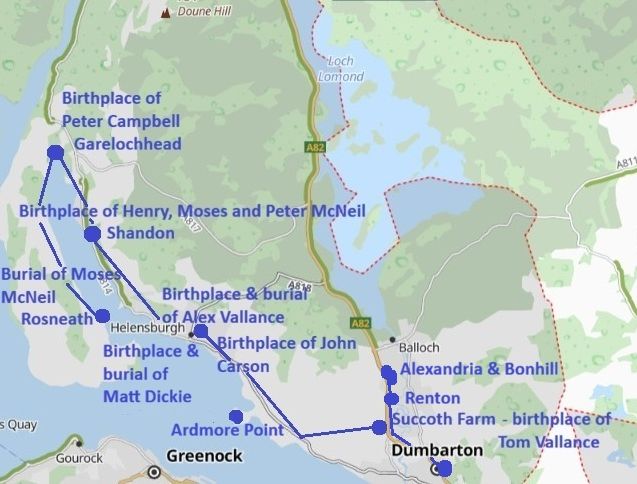
Meantime, the three other McNeil brothers, Peter, William and Moses, with Perthshire-born, William McBeath, again all new arrivals, had been instrumental in the formation in early 1872 of a team that they would first call Glasgow Argyle but soon change its name to Rangers.
And it would be, as the Rhu area now is having formally been Dunbartonshire, this Argyll connection that seems to have been the attraction for several more of the early, great players for Rangers in particular. The Vallance brothers, Tom, actually born by Renton and a future internationalist, and Alex from Helensburgh, who had already set a similar trail. Then two decades later Matt Dickie, also from Helensburgh, would start as a goal-keeper with more local Renton for two seasons before joining the Ibrox club for eight more, and also with success internationally.
_________________________________________________________________________________________________________
John Carson
John Carson had been born in Helensburgh in 1848, his father a gardener from Kirkudbright. And he would grow up in the town on George and Princes Sts., before moving to Glasgow and back by 1871, working as a clerk. But after that there was no sign of him until 1873, by when he was in Birmingham, finding employment still as a clerk and getting together with another, and another Scot, the originally Rugby-playing John Campbell Orr, to form in October 1873 the city's first recognised club, the amateur Calthorpe F.C., essentially a West Midlands clone of The Spiders.
Calthorpe would exist until 1887 but Carson would stay with it only a couple of seasons before, it is said, he turned his sporting attention away from club football to bowls and then football refereeing. But here is the intruiging thing. John Carson would die in 1931 in retirement in Lyme Regis in Dorset in a house he called Ardmore, Ardmore Point being just outside Helensburgh. But having married and raised a family in Birmingham he would, although having no known, direct connection with it, spend most of his working life living within a few hundred yards of the grounds of another Birmingham team. It had been founded, seemingly coincidentally, in 1875 and called Small Heath Alliance. It in 1888 was renamed simply Small Heath, then in 1905 Birmingham and in 1943 became today's Birmingham City.
_________________________________________________________________________________________________________
Henry McNeil
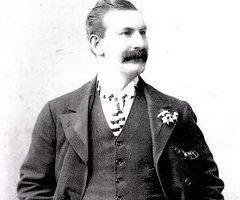
Henry "Harry" McNeil, born in 1849, was just a year younger than Carson and had arrived in Glasgow like him to work as a Clerk, living initially in Anderston. There in 1871 he stayed with his elder brother and sister, James and Elizabeth, and two of his younger brothers, William and Peter, also working in the city but with each of the boys born in Rhu, in fact specifically in Shandon in Dunbarton-shire.
They were the children also of a gardener father, this time from Perthshire, and a mother from County Down in Ireland. And it would be intruiging to know if Carson and the McNeils ever met. It seems likely. The fathers shared a profession. Helensburgh and Shandon are just four or so miles apart.
And it would be the following year, 1872, that Harry would be involved as what is described as a guest player with Peter, Willam and a third brother, Moses, in the foundation of Rangers. It took place in March with its first match in May. But, unlike the other three, he did not stay with the nascent team. When later in the year in December the Third Lanark Rifle Volunteers Regiment, several of whose territorials had been in the Queen's Park team that had formed the Scotland eleven in the previous month's first international, founded it own club he became part of it. And such was his on-field prowess that by the next season he too had been recruited by Queen's Park, perhaps even with Carson involvement, remaining as a Hampden player for the next decade, whilst also winning between 1874 and 1881 ten Scotland caps, netting half a dozen times.
_________________________________________________________________________________________________________
Peter McNeil
Peter McNeil was the fourth of the McNeil brothers, the third of the footballing ones. He was born in 1855 and like them all also in Shandon but by 1871 and just sixteen was staying with his siblings in Anderston in Glasgow, also working as a clerk.
And it was he with younger brother Moses, Peter Campbell and William McBeath, all at the time still in their mid-teens, who in 1872 came up with the idea to form the football club that would soon become Rangers. McBeath stayed across the landing at the McNeil's 17, Cleveland St. address.
Peter McNeill would play in the first Rangers game in May 1872, remain in the team until 1877 and then continue to be Match Secretary. In the late 1870s he would go into business with elder brother, Henry, opening two what were essentially sports shops.
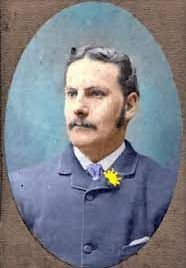
Peter McNeill would marry in 1885, the couple having two children. But with the business partnership with his brother ending and the shops eventually folding in the 1890s the financial pressure seems to have caused a breakdown to the point that by the time of his death in 1901 at the age of just forty-seven in Hawkshead Asylum he had been certified insane.
_________________________________________________________________________________________________________
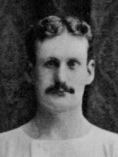
William McNeil
William was a second of the McNeil brothers to die relatively young in 1908 aged fifty-five. He was was elder brother of Moses and Peter, born like them in Shandon and coming to Glasgow as a Seedsman, later Florist, in business with another of his brothers, the older John. He was thus nineteen when Rangers was founded and was also owner of the ball that literally first allowed it all to roll.
William appears to have played on until 1877. In 1881 he was staying still with his siblings. In 1883 he married in Glasgow, his wife Mary Ferrier. The couple was to have six sons, remaining in the city until his death, with her surviving him by fully forty years.
_________________________________________________________________________________________________________
Moses McNeil
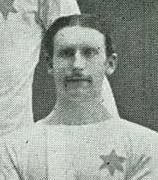
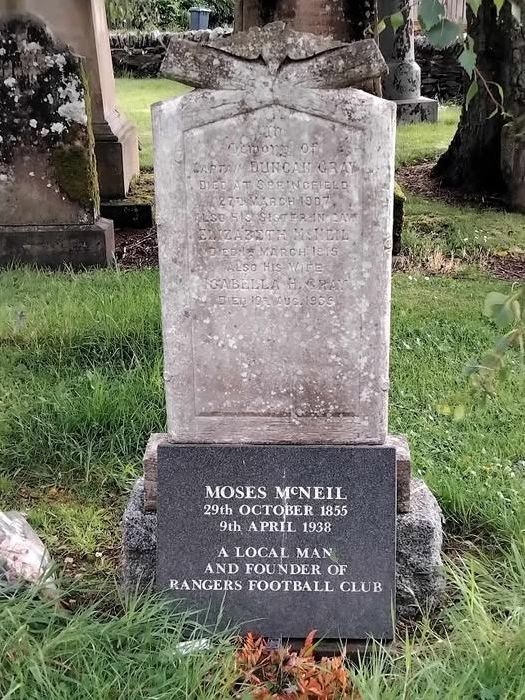
Born once more in Shandon and in 1855 Moses McNeil, the youngest of the brothers, would again have a ten-year playing career, this time solely with with Rangers, also winning two caps. In 1871 he had not been living with his siblings, arriving only in time at sixteen to form the club and then moving in. Indeed in 1891 he was still living with his elder sister and working as a Commercial Traveller, before in 1901 lodging away but still in Glasgow, as he would, not marrying, until retirement back to across the water from Rhu in Clynder. And it was there, although his death was in Dumbarton, that at Craig Cottage he was staying on his passing in in 1938 at the age of eighty-two to be buried in neighbouring Rosneath along with two of his sisters, the still spinster, Elizabeth, and the married Isabella Gray and her husband.
_________________________________________________________________________________________________________
Tom Vallance
By 1850 the Vallances, Thomas and Janet, had arrived in Dunbartonshire via Glasgow. He had been born in Lesmahagow, she on a farm above Newmilns, both in Ayrshire, and they had come to take up the tenancy of a hill farm of 56 acres at Succuth midway between and above Dumbarton and Renton. In 1849 they had had a first child, a son, Thomas, who, it seems, did not survive. And in 1856 after two daughters had been born they had, still on the farm, another son, to whom they gave the same name.
As it happens the Vallances did not stay in agriculture for long. By 1860 Thomas Snr. had found work as a Road Surveyor and had moved the family the eight miles or so to by Helensburgh and then to Shandon, which is where the second Thomas Jnr. grew up by the water, a tall man, 6 ft 2 ins, and initially a rower, an oarsman.
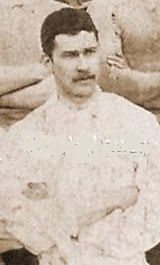
But by 1873 both Tom and younger brother, Alex had moved to Glasgow to take up engineering apprenticeships, with again by then Alex known to have been playing in goal for Rangers Second XI with Tom'a attention perhaps not yet fully on football. His time with the the game and the club is said only to have begun in 1874. But once in place as a full-back he would remain there, captaining the side, until 1882 and also winning seven Scotland caps in the process. He would then take work in India for two years until sickness brought him home once more, being elected club president in 1883 and trying for a season to take up where he had left off but now no longer able on-field to compete physically. Instead he remained in office off-field for six seasons, became a Wine and Spirits Salesman, eventually a Restaurenteur, meantime marrying the sister of a former teammate. The couple would have two sons, living out the rest of their lives in Glasgow. Tom would die in the city in 1935 at the age of seventy-eight.
_________________________________________________________________________________________________________
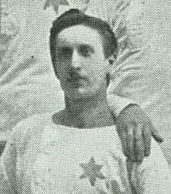
Peter Campbell and John and James Campbell
Peter Campbell came from a family of seafarers and it was the sea that took him young, when his ship foundered in the Bay of Biscay in 1883 in a January storm. He was just twenty-six.
He was born in 1857 in Garelochhead, where his sea-captain father was harbour-master living at Craigellen House. The house is still there.
It meant that when, with two of the McNeil brothers and William McBeath he would in January 1872 be one of the founders of Rangers, where his elder brother, John, and younger brother, James, also would play, he had been just fourteen, fifteen when the new club played its first game, he having just come to Glasgow to take up a five-year Ship-yard Apprenticeship at Stubscross.
In fact he continued to play for Rangers until 1879, continuing also to work in the ship-yard for two years more after qualification and in that period winning two caps. That is until the end of 1878-9 notably and only just having turned twenty-one he became the first Gers' player to take the English shilling. As one of the first ever half dozen Scots to have turned professional for the following campaign he would turn out, as the first from North of the Border to do so, for Blackburn Rovers, in doing so pioneering a path for Hugh McIntyre, Fergus Suter and Jimmy Douglas the following one.
However, by 1880 the increasing success of a family shipping-business was to cause him to give up the game and draw him first back North and then to Wales. The boat from which he drowned, the St. Columba, was carrying coal from Penarth. And it there that a plaque has been placed In the Italian Gardens to honour him as well as, whilst his body was never recovered, a memory of him him being recorded on the family grave in Rosneath's Old St. Moldan's Churchyard.
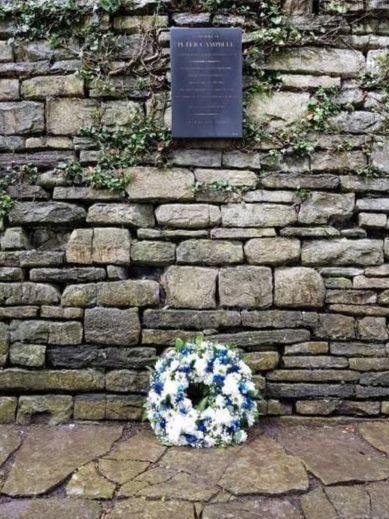
Peter Campbell Plaque, Penarth
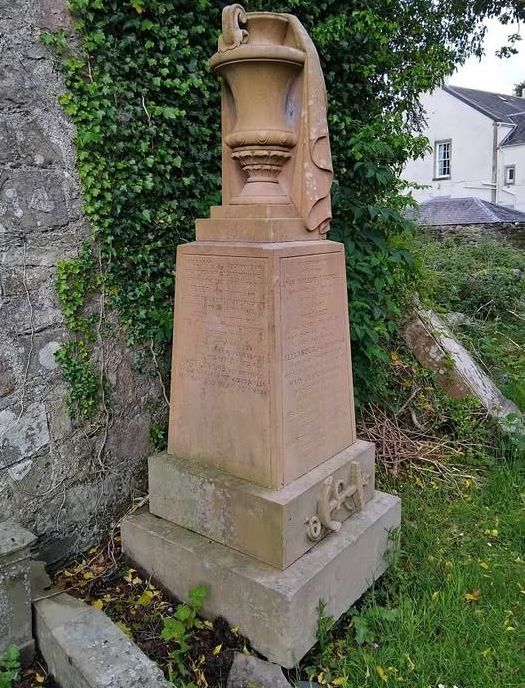
Peter Campbell Memorial, Rosneath
_________________________________________________________________________________________________________
Alex Vallance
Alexander Vallance, younger brother of Tom was born in 1860 in Helensburgh. It is there that he is buried too. Having then grown up just up the coast in Shandon he had probably left the family home at about the same time as his sibling and at just fourteen years old, both to take up engineering apprenticeships at the same Clutha shipyard. And it was at that early age too he became involved in football and probably before Tom, already in 1873 recorded as second-eleven goalkeeper. Moreover, by 1876 he is said both to have been briefly first-team captain until his brother took over and to have suggested the club move to Kinning Park.
And he would remain in the top starting eleven until 1879, aged still only nineteen but with the apprenticeship already completedof the apprenticeship, taking part in that year's Cup Final at right-back to his brother on the left. Moreover he would in sporting mode be associated still with the club until at least 1886. That year representing it he finished first in the 120 yard hurdles and the Place Kick at the Hearts Sports event at Tynecastle and second in that first event at the Scottish Athletics Championship.
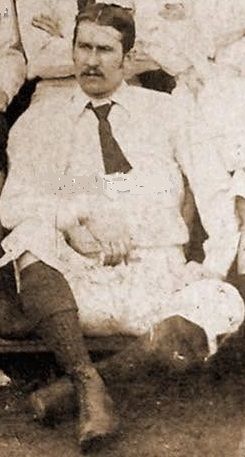
However, this period of his life is otherwise cloudy except that he remained a Rangers Committee member throughout, indeed until his passing. He only seems to reappear in the record in 1891, by when he was working as a Commercial Traveller and staying with his parents back in Shandon. And it was from there that later that same year he married, his bride Mary Cameron, four years his junior, the daughter of a local Garelochhead hotelier. They were to have two daughters, both both in Glasgow. But the marriage was to be short with his passing in August 1898 at the age of just thirty-eight.
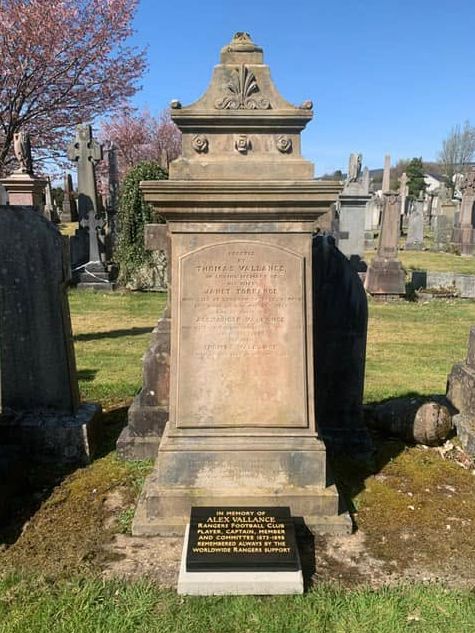
By then he was a Spirit Merchant running a pub, now The Courtyard Bar then the Red Lion at 84, West Nile St. in the centre of the city. The place of death was the family home Terregles Avenue in Glasgow in Pollokshields, the cause three days of delirium tremens and cerebral haemorage. And he would be buried not locally but back from where he had come, in the cemetery at Helensburgh in a grave, restored again by Rangers supporters and with an accompaning plaque, and which he shares with both his parents. He would be survived by Mary by almost sixty years. She would die at the age of ninety-two in 1955 at what has now become Glasgow's Grosvenor Hotel.
_________________________________________________________________________________________________________
Matt Dickie
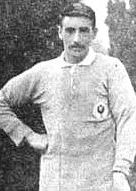
Matthew "Matt" Love Dickie was born on James St. in Helensburgh in 1873, his father a Coachbuider turned Confectioner cum Restauranteur, both parents originally from Paisley. At seventeen Matt was recorded a clerk but by then also playing in goal for Helensburgh Victoria. That is before at twenty-one in 1894 moving on for two seasons across the hill at by then somewhat struggling Renton.
And it was from there he was to be picked up by Rangers, staying six seasons in the course of which, still living in his home-town and as Wikipedia succinctly puts it, he "won four Scottish Football League Championships (including the perfect season of 1898–99 in which he played in every match), three Scottish Cups, five Glasgow Cups and two Charity Cups with Rangers, and represented Scotland three times", that is between 1897 and 1900.
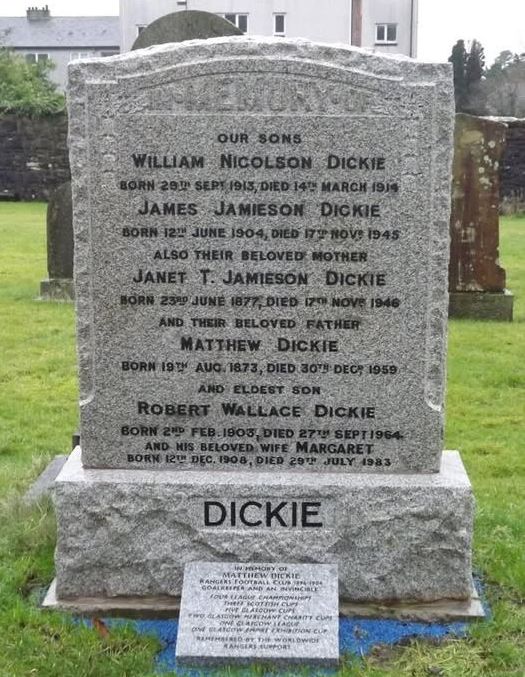
Yet at still only thirty he moved on to spend still in Glasgow three seasons at Clyde before retirement from the game altogether to run a Tobbacconist and sometime Billiard Hall back in Helensburgh, having in 1901 in Dunoon married Jennie (Janet) Jamieson, born in Liverpool but from the Ayrshire town. They were to have three sons and live out their lives in the Dunbartonshire coast. Janet would pass away in 1949 and be buried again in Helensburgh Cemetery and Matt would on his death at the age of eighty-six and exactly a decade later be placed beside her.
Back to The Vale of Leven
and the SFHG Home page