Earliest Knockings
- or Scots Enlightenment despite The QP fallacy
For many years it was assumed, because that was what been the message for as long as could be remembered, that Queen's Park F.C., although it was far from clear when, apart from sometime in the early 1870s, and how it happened, had been the instigator not of passing in football (it existed earlier and elsewhere) but of an overall way of playing football specific to North of the Border, its distinctively Scottish Passing-Game. Indeed the message was a cornerstone of Scottish football's creation-myth. Now, however, on the one hand, it appears that it may have been, let us say, inaccurate and, on the other, we have thanks to Stewart Mathers, his The Beautiful Dribbling Game and news-paper digitalisation if not a single replacement source then at least now not just a Vale of Leven but also a Glaswegian inflection-point.
So, first, with regard to Queen's Park that the club until the end of the 1872-3 season, the first in the Scotland, with two exceptions, one being the first international, initialy played and then continued to play the English dribbling-game predicated on the equally English 1-2-7 formation. The evidence is clear, comes from Press reports at the time and is shown in the graphic below with the club, as a Scottish one in blue but its playing-style in English red. This was whilst the newly-formed, also blue Vale of Leven club throughout played the innovative, again blue and "entightened" 2-2-6 system that was to become until 1888 the bed-rock, the first standard, tactical formation, of Scotland's dominance by results and players of not just home but wider British and therefore World football. Moreover, it was the system (again see graphic below) also adopted immediately on formation in the middle of that first season by Glasgow's then second most powerful team, Clydesdale. It may even have been a cause of a Queen's Park, internal split. Robert Gardner, Queen's Park and Scotland's captain, was with others to leave The Spiders and join the newbies. Futhermore Clydesdale was to make the adoption even as the newspaper report of their earliest known game, one against Granville, (see below right) on 15th March 1873, continued firstly, to praise the English and still Queen's Park manner-of-play, and, secondly, Granville seemed to go a stage further. It was seemingly already trialing a 2-2-1-5 formation that would, fifteen years later, from 1888 become The Cross, the second, again "enlightened" iteration of the Scottish standard, bringing with it a recognisable mid-field and thus not just after adjustments for settling-in a further wave of international success but, arguably, also the birth specifically of our modern game.
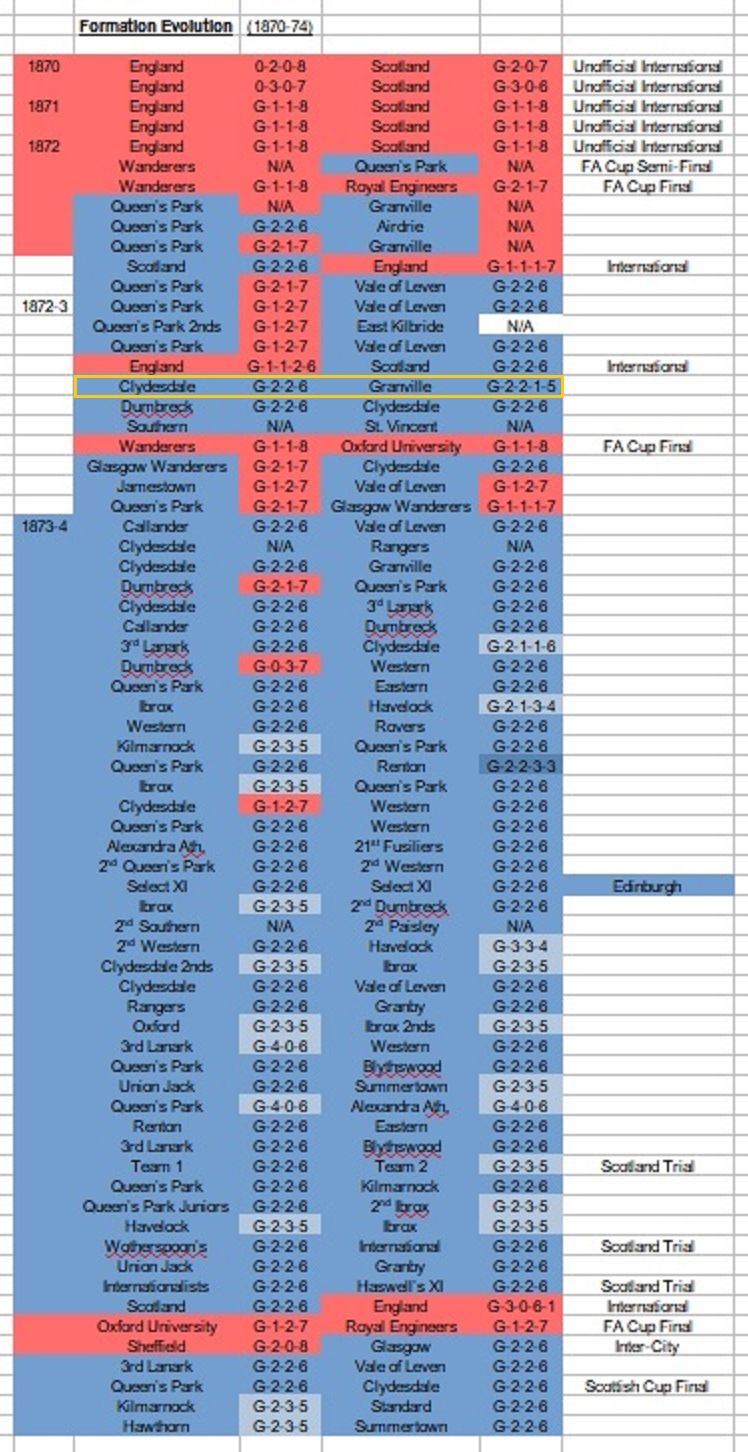
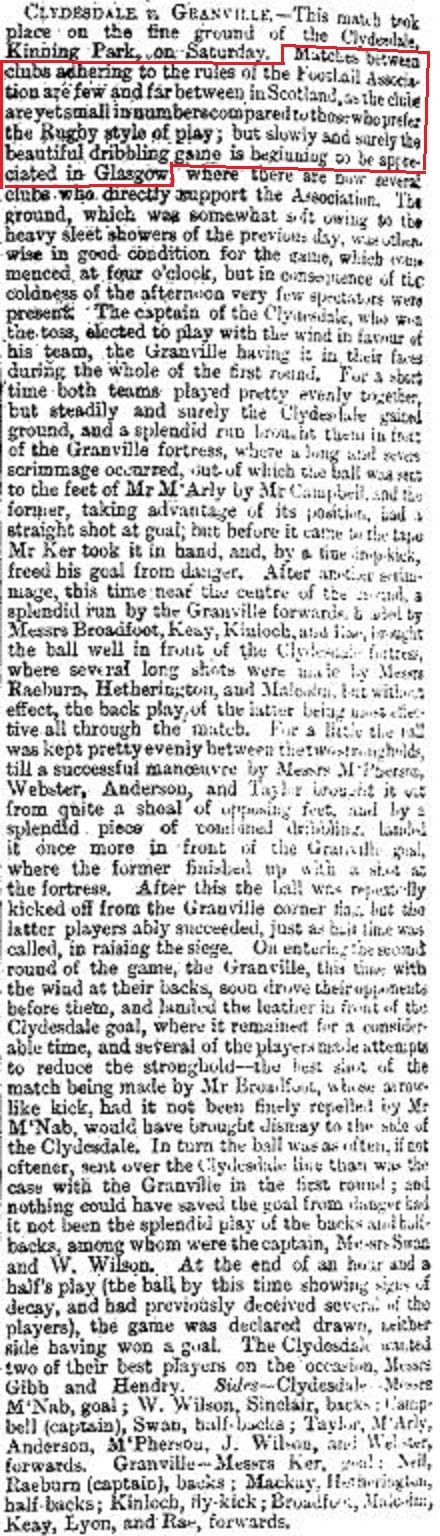
Glasgow Herald report of Clydesdale versus Granville. 15th March 1873.
Moreover, whilst by the following 1873-4 season most clubs, very much including Queen's Park, had taken to 2-2-6, or even in Renton's case 2-2-3-3, and North of the Border the English style was more or less extinct there was, understandably in a new sport with new participation by clubs and players, considerable further experimentation taking place almost, as the graphic above illustrates, match-by-match. Most notable was with 2-3-5, with its also fallacious yet again mythical status in the World game. It has been a system that was generally thought to have emerged from North Walian Wrexham in about 1878 to be adopted by them, then in Eastern Scotland, notably Edinburgh, from 1883 in England, particularly the Midlands and then the South, and in Ireland. But there it is already, fully five years earlier than Wales, being employed by some clubs in Glasgow and even in a Scotland trial-game. So it seems now that 2-3-5 was neither Welsh, definately not English but an observably Scottish tactical innovation too!
Back to the SFHG Home page