Formation Evolution (1872-74)
or when the dribbling-game became the passing -game.

Word has been that it was Queen's Park F.C. invented the Scottish passing-game, even the passing-game per se. The latter has shown to be untrue. There is no doubt that passing in round-ball football existed in Sheffield in its non-Association game from at least the mid-1860s and from later in the decade in the Association game with the Royal Engineers. And now the former is also under considerable pressure.
Association football arrived in Scotland as a "beautiful dribbling game" the Press in 1873 has telt us so. The exact quote from the a Glasgow Herald article of 15th March that year reporting on a game that had taken place at Kinning Park between the Clydesdale club and Granville from Myrtle Park is as follows.
"Matches between clubs adhering to the rules of the Football Association are few and far between in Scotland so the clubs are yet small in number compared with those that prefer the Rugby style of play; but slowly and surely the beautiful dribbling game is beginning to be appreciated in Glasgow."
Yet there is a problem. The English dribbling game had been and would continue to be based on over-whelming, individualistic forward-play based on formations, when actually considered and noted, that were 1-1-8, 1-2-7 or perhaps 2-1-7. But whilst Queen's Park, the doyen of Scottish clubs had, with a couple of notable exceptions, continued to play that way North of the Border (see the graphic below) on that day in March neither of the clubs on the field followed suit. In fact one of the teams - Clydesdale - already included a player, Anderson, who had previously been at Queen's Park and was about to be the recipiant of several more, notably Robert Gardner, erstwhile Spider's and Scotland captain, all unhappy at what was happening at Hampden, perhaps off-field, perhaps on- formationally and tactically, maybe a mixture of both. There is an argument to be made that Gardner, having had the team play 2-2-6 wanted to continue to do so but was prevented from doing so by Anglo-centric members, which caused him to leave to play the system he wanted elsewhere, i.e. at Clydesdale.
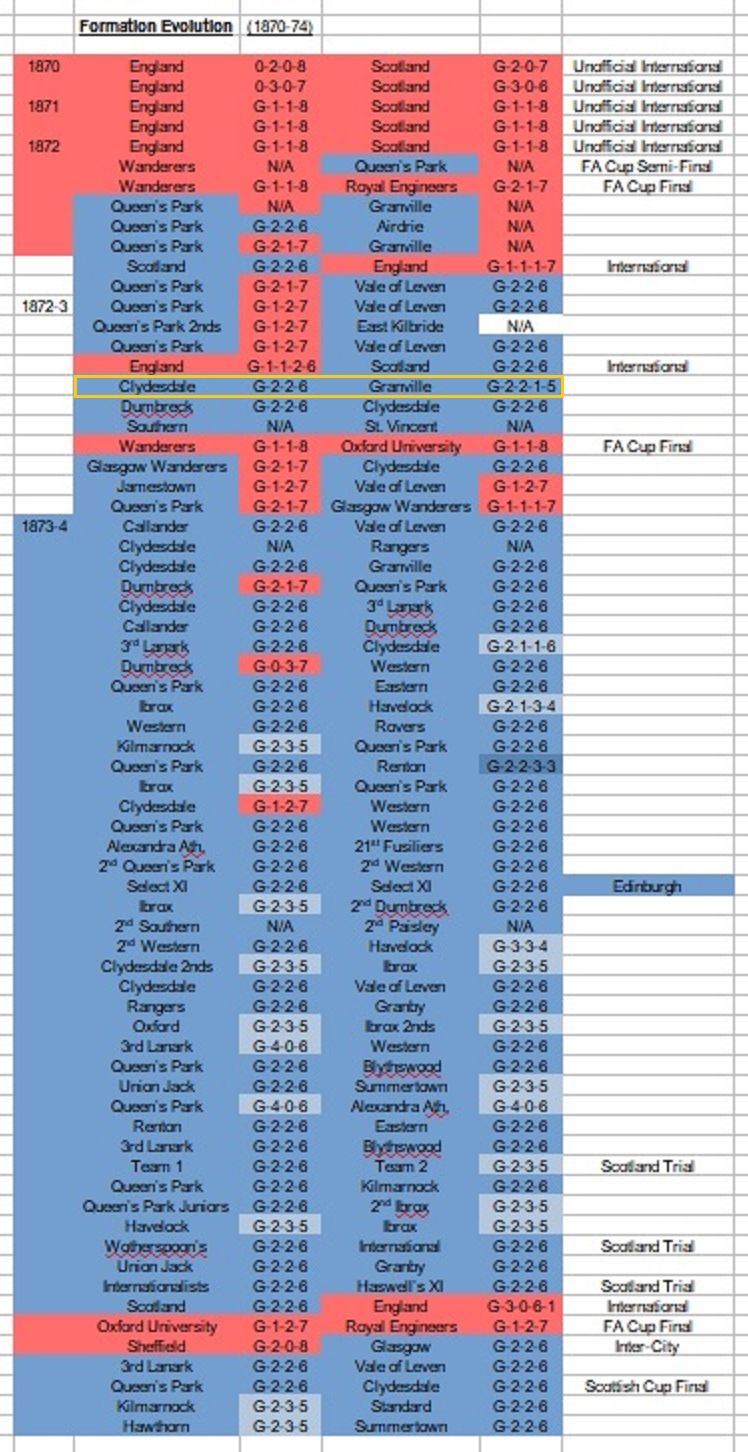
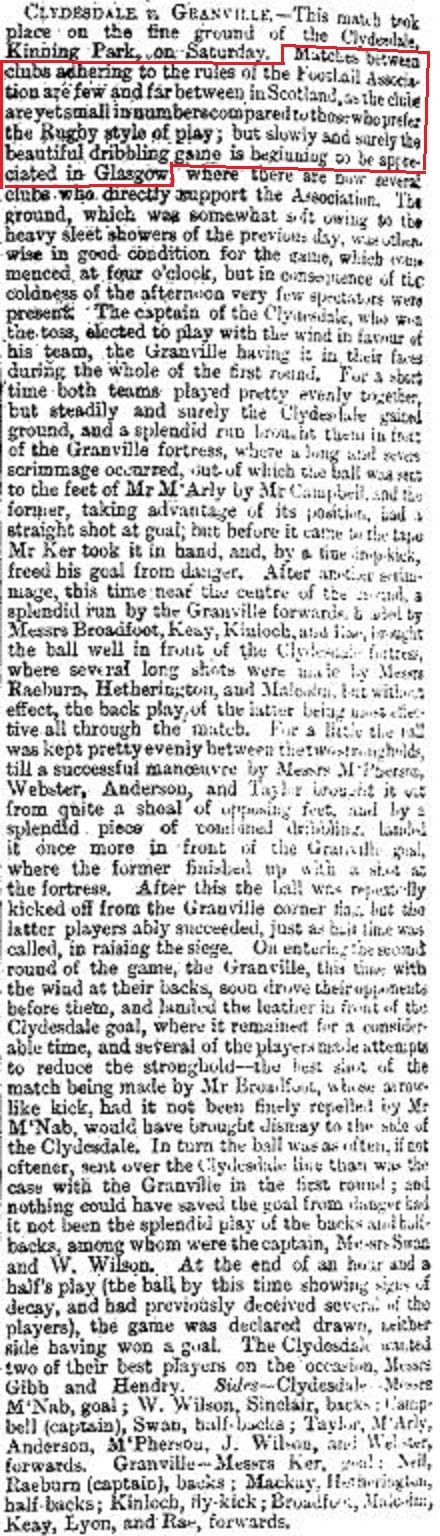
Glasgow Herald report of Clydesdale versus Granville. 15th March 1873.
However, it seems Gardner had been right in his assessment, one presumably based on the simple fact that 2-2-6 was not just more canny but worked better. And the rest of Scottish football both in the Vale of Leven, perhaps if not the source of the original idea then the inspiration, and then in Glasgow had largely or would very soon agree with him. The Vale, Renton and Dumbarton would never play anything else and within months even Queen's Park had had to come around. Only the Drumbreck club but from Govan and not the Southside seemed to hold out a little longer.
Back to the SFHG Home page