"Modern Football" -
its Real Founders and Facilitators
If you have have been hooked by this article's title and read on, hopefully it has been with a snort or similar of derision. And, if that were the case, it was probably for at least three reasons. The first is the question of what is football; there have been and are so many variants, round-ball and other. Then there is the definition of "modern". And finally there is whole unknowable concept of founders for a game that goes back hundreds if not thousands of years.
So it is time for some precision. By football is meant the round-ball version that by some is called Soccer, the Association Game. Then by "modern" is the iteration of it not from 1863 but the one that is not only played today globally but, as this site is dedicated to de-gas- and spot-lighting, a form derived largely and specifically post-1872 from Scotland and the Scots-game. And so in terms of "founders" what results consequentially is the men, for they were that, Scotsmen, who formed the club in Dunbartonshire's Alexandria, which allowed our contemporary, competitive ball to roll.
That club was Vale of Leven Football Club, "The Vale", which the Lennox Herald reported as coming into being on 20th August, 1872 with its first practice of what was by then fully seen as a winter-sport then and there scheduled for the middle of October and reported by the same august organ as having taken place on the 19th of that very month.
So back to 20th August. On that day in Alexandria a first club meeting elected the following officers - President: Donald McFarlane, Vice-President: W. B. Thomson, Secretary: J. B. Wright, Treasurer: Joseph McEwan and Custodier (Groundsman): R. Cameron.
Now at this point there is inevitably a measure of guesswork but Donald McFarlane appears to have been a twenty-year-old Mercantile Clerk, living at home at "Myrtle Bank" on Main Street. He had been born in 1851 nearby on Bank St., the son of a locally-born father, a Druggist (Pharmacist) and a mother from Forres. But during the next decade he was to move away. As a Cotton and Yarn salesman he would in 1880 marry in Birmingham, the couple returning to stay back in Dunbartonshire but in the town of Cardross. And W.B. Thomson, William Thomson, who had been born in Alexandria, trained as a tailor in Glasgow, married there but at twenty returned to Bank St. and seems to have remained there for much of the rest of his life.
Then there was John B. Wright, John Barr Wright. He had been born in Balloch, so a mile and half to the north, was eighteen, also staying on Bank St. and working, as he would until retirement, as a Clerk. Moreover he would die in 1932 on Main St. to be buried again locally across the river, the River Leven, in Bonhill. Which leaves McEwan and Cameron. Joseph McEwan was a little older, born in 1848 so twenty-three and a Calico Printer. But by 1881 he had moved to Glasgow, working as a Clerk in a Bolt Manufacturer and eventually a Manufacturer himself. He would die in 1917, aged sixty-nine and is yet another of the important, early footballing figures to be buried in Cathcart cemetery.
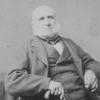
John Cameron
But, whilst all of the above would be office-holders and also identfiable as players, no football club can exist without a ground. And this is where the Camerons came in. R. Cameron, custodien, seems to have been Robert, youngest son of John. The former was eighteen, a Printfield Worker and a player. The latter was born in Perthshire, in fitba' country, sixty, from age and the picture to the left clearly not a player, a "Cow-Keeper" and thereby the unknowing facilitator of finally home- opposition for Scotland's oldest club, Queen's Park. It and The Vale would play four matches in the four months from December 1872, using throughout the 2-2-6 formation it may even have created or at least inspired and which became Scotland's. In doing so it would not only catalyse the Scottish- but ultimately much of the British- and World-Games.
In fact, whilst both John and Robert lived in the family-home on Church St. on McLachlan's Land, the family itself owned a dairy on Main St., for which the former's cows supplied milk but needed pasture, part of which he was prepared to set aside, perhaps just temporarily, for his boy's new sporting passion. Cameron Park, as that field would become known, would be The Vale's ground for a couple of seasons, before the move to its second at North St.. John Cameron, himself, would see the transfer, indeed the club's most successful years. He would die in 1885 still in Alexandria at the age of seventy-five. By then The Vale had lost two Scottish Cup Finals but won three. And Robert would also remain locally. In 1880 he would marry Mary Fletcher, they having two children. But she would die in 1889 and Robert, now a Coal Merchant, would remarry the following year to Margaret Bulloch nee McNaught, have four more children, dying in 1918. His grave is another of the major, early footballing figures also to be found in Bonhill Burial Ground.
Back to the SFHG Home page