Recreativo de Huelva
(A Compendium)
___________________________________________________________________________
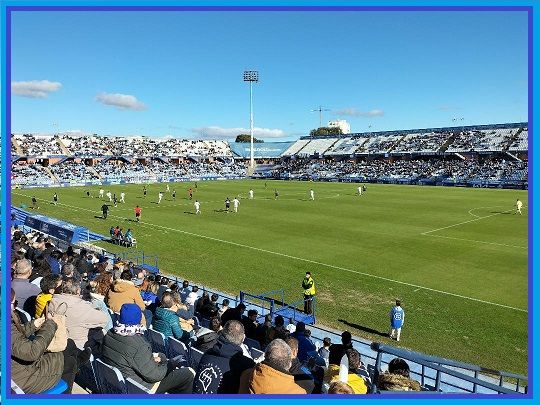
Recreativo v Aguilas
i.e. Spanish Scotland v Spanish Scotland
Top-of-the table Aguilas came to Huelva today, Sunday 30th, playing out a 0-0 draw. Game excellent, grass pitch perfect, winter sunshine beautiful. Just like beloved East Fife!!
___________________________________________________________________________
V.
The Caledonian Clash
- Spanish Style
This season something unusual has happened. Spain's two Scottish teams find themselves in the same division, the Segunda Federacion - Group 4. It means they will face each other twice, the second on 8th February next, at Aguilas, founded originally as Sporting Club Aguileno, in 1896 and by Kelso and Edinburgh's John Gray. But the first, at time of writing, is just four weeks away at 5pm on Sunday, 30th November at the Nuovo Colombino. It is the home stadium in the Andalusian city of Huelva of Recreativo, Spain's oldest still existing football club, the country's doyen, its equivalent of our Queen's Park and founded in 1889 by Lybster's William Alexander Mackay and Paisley's Charles Adam. And we shall be there.
Yet since then and a drop of a level the Scottish connection has persisted and needs to be encouraged. There are three clubs n Spanish football that owe their origins to Scots; in Barcelona CE Jupiter, Aguilas FC from Murcia with its beautiful blue and white ground, the oldest in the country, and Recreativo from Huelva in Andalusia, again with its shimmering, blue and white stadium, the oldest club still playing throughout all the national tiers. But they are forever tied to our country by history, whereas Eibar's connection is by choice, a right choice but one which might wither if not fed. And nothing in football at all clubs feeds better than income; ticket money through the turnstiles. And youse can contribute. Recreativo is and hour and a half coach-ride crossing the border directly from Faro Airport and less by from Seville by train. CE Jupiter is seven stops on the metro from Catalunya, four from Sagrada Familia. Aguilas is more difficult; an hour by hire-car from Murcia Airport, a good two from Alicante but three times that by public-transport. And by contrast Eibar is a doddle - a couple of hours from Bilbao airport but access also possible from Santander, Pamplona, Vitoria and even Biarritz across the border in France. Rock up and watch a game. Youse might even consider The Spanish Trail, a week or ten days of travel to a couple, even to all four; from Huelva and the Spanish Atlantic via the Mediterranean to Eibar and the Bay of Biscay or vice versa. - IPCW
___________________________________________________________________________
The Plight of Huelva, Spanish "Mercantalizacion" and a Scottiish Counter
Spanish football has two Scottish clubs - Recreativo de Huelva and Aguilas. Both were founded by Scots and one, Recreo, is in real trouble. It has debts of E20 million (£17m) and would probably have gone out of business the best part of a decade ago but for two measures. The first was that in 2016 it was "expropriated", i.e. removed by law from the hands of commercial owners into those of the city by Huelva Council. The second is that it, as the oldest football club still playing in Spain, the doyen, the equivalent of Queen's Park, was granted a status translated as an "Asset of Ethnological Cultural Interest" (AECI). In other words it was made a national treasure, something that again protects it from what in Spanish is called, with biblical overtones of exploitation, "mercantalisation", what we would call over-commercialisation, but with whatever term is used fans simply side-lined.
And as such it is not without potential parallels, certainly in English football, and to an increasing extent in the Scottish game. Does Dunfermline really have to be owned by two Las Vegas businessmen? How long are they and others going to last in the face of potential, global recession?
However, that is not the story just now and it, with two strands to the tale, does not end there. The first is that other Spanish football clubs are also interested in AECI status. On the list are Valencia and Levante but top and just fifty-five miles away is Huelva's Andalusian neighbour, Sevilla. The United Supporters of SFC have already begun the process and fans of Scottish clubs might take a leaf out of its book, with possibly Historic Scotland and the like the places to start. That is unless football is not culturally high-brow enough. The Minister not of sport but Culture might think about it too, starting not at the top nor in the ever rapacious, big cities but with the wee clubs outwith and country-wide. A Golspie or a Greenock, a Vale of Leven or an Arbroath perhaps.
And the second takes us back to Spain. Earlier this year the commercial company, the one that built up much of the debt, managed to get the courts to reverse the "expropriation", despite the now-released "commercial" president having been jailed for falsifying the club accounts. So, whilst the reversal is not yet a done deal (it will go to appeal) perhaps there is something that can be done here meantime as a gesture of friendship, indeed round-ball fraternity, club to club, even the SFA to club. After all did not Huelva begin with working-class Scots wanting to kick a ball around in exactly the same way as at Forfar, Brora, Stranraer or, dare I say it, Rangers, Hibs or Aberdeen? Moreover, in today's football money E20 million is not a lot of lucre; just an averagely good player or two for the bigger boys.
So the suggestion is that Scottish football find a way a supporting what is effectively its own history by putting out an appeal under the auspices of fellow clubs, those of the SFA, or perhaps even the Scottish Government, to raise the money and gifting it via the city council to what would cease then to be just a Spanish national treasure but become an international one. Perhaps even Scottish football or even Government might see itself to buying the Recreo ground, the Nuevo Colombino, for, say, £17 million, and gifting it to the club in perpetuity or, say, as long as sport continues to be played there. After all, it is not as if there is not a precedent, and a Scottish one too. In 1915 John "Juan" Gray completed the purchase of a piece of ground and with that same stipulation of sport in perpetuity gave it to the club he had formed and coached to invincibility and to the town where he had lived and prospered for the previous decade and half. The land is now El Rubio stadium, a little piece Caledonia in Murcia. That town is Aguilas and Gray was born in small-town Kelso and raised in big-town Edinburgh.
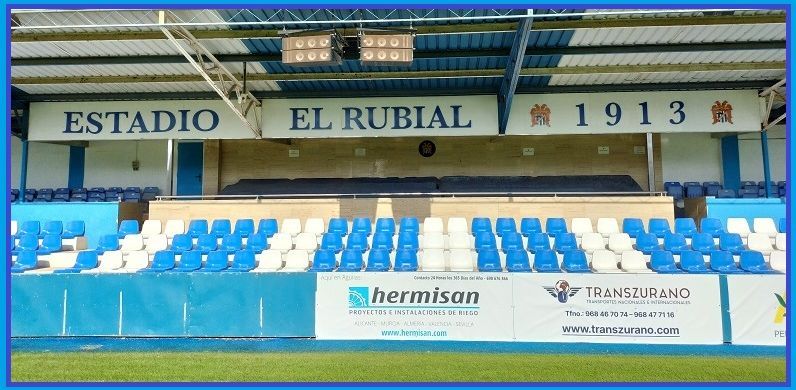
Oh, and an alternative thought. Why can't the ones who started all the off by first taking those footballing Scots to Southern Spain, i.e. the Rio Tinto Mining Company, now the multi-national conglomerate, Rio-Tinto, dip into its small-change jar and simply pay the bill. It could look on it as a wee bit of compensation for, well, whatever. - IPCW
___________________________________________________________________________
Adam, Mackay & Recreativo de Huelva
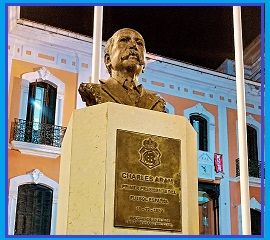
The bust of Paisley's Charles Adam in front of the Casa Colon, Huelva.
The oldest club in Spain still in existence and playing, the doyen of Spanish football, the exact equivalent of our Queen's Park, is Recreativo, founded in 1889 and by Scots in the Andalusian port-city of Huelva. And it knows how to celebrate its origins. In front of the Casa Colon, a building from that era and still at the centre of the town is a bust on a plinth. It is of Charles Adam, its first President, the Chairman of the then local gas company, who gave land for the first ground. However, that he is not forgotten there in is direct contrast to Paisley where he was born and brought up.
And then there is the man at the root of the club's foundation, William Alexander Mackay, who arrived to tend to the medical needs of the growing, British population brought to the city by ore-mining, found time over the best part of forty years to minister to the locals too and for whom sport meant health for all. And minister was right for he was the son of the manse. Born in Lybster in Caithness, he retired to Ross-shire and is buried at Logie Easter by Invergordon with in neither place anything to mark him or the impact he had in Southern Iberia before many even British clubs had come into existence.
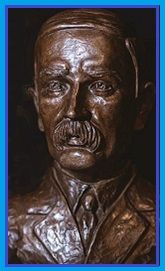
The bust of Lybster's William Alexander Mackay given as an honorarium by Receativo de Huelva, the club he founded and of which Charles Adam was the first President.
But Recreativo de Huelva know how to honour. In a gala held in December 2023, indeed the William Alexander Mackay Gala, to those it deemed worthy was given as the club's highest honour an inscribed bust of the man himself. - IPCW
___________________________________________________________________________
Back to the Spanish Trail
or the SFHG Home page