Renton, The Vale and The Scottish Game
Episode 1 - The Making
(with massive thanks to the incredible London Hearts Supporters Club archive)
Episode 1: The Making
So the story begins not in late but early 1872. In March Queen's Park, having from November 1871 received byes to the semi-final of the first London FA Challenge Cup, the FA Cup, travelled to London to face The Wanderers. The result was a draw and, with the visitors unable to finance travel to the replay, they had to default and the home team went on to take the trophy.
Yet the one meeting that did take place tells us several things. The first is that, in order to take part Queen's Park had agreed a twofold acceptance; that Association football was a winter game and the London rules rather than its own would from now on apply. The second is two facts emerge, a) we know the Queen's Park team - Gardner, Edmiston, Hepburn, Ker, Leckie, J Smith, R. Smith, Taylor, Walker, Weir and Wotherspoon - and b) just now we do not know the formation. Moreover, we are also aware from contemporary source that, whilst the internationals between England and Scotland, now designated as unofficial, all of which had taken place also in London, the first in March 1870 and last just a month earlier, had had not inconsiderable Press-attention, this club-match generated still more but also actually not much on-field activity. A month later a single match - also a nil-nil draw - was played by Queen's Park against Granville, newly officially-formed just up a few hundred yards up the road at Myrtle Park. But that was it.
In fact the game after that was not to be until 28th August and the one after that on 19th October; initially against Airdrie, an emphatic 6-0 win, and then Granville once more, again a win, 4-0,. But there was a difference. In both cases we have the teams - Gardner, Wotherspoon, Taylor, Thomson, McKenzie, Leckie, Weir, Ker, McKinnon, Rae and then Thomson, Taylor, Gardner, Hepburn, Leckie, Weir, Wotherspoon, Grant, Rhind, McKinnon and Rae respectively with captain, Robert Gardiner, in the first playing in goal and in the second as a half-back. But crucially we also have the formations. In the second match, just as The Vale is reported as in Alexandria holding its first practice, Queen's Park, according to The Glasgow Herald, seems to have played, as was the case with English teams of the era, 1-2-7 but in the former, again from the Herald, it had been a completely innovative 2-2-6, the same shape that was to be employed, in the penultimate encounter of the year, played now in Glasgow and the World's first official international.
Now at this point we have to wind back slightly. At some point still in 1872, said to have been in the Summer or Autumn but seemingly before December, Queen's Park, as part of its programme of demonstrating specifically the Association game and creating opponents had travelled to the valley of the Dunbartonshire Leven, specifically to the Park Neuk recreation-ground in Alexandria. No-one knows exactly when it was but Vale of Leven Football Club is said to have been formed on 20th August, suggesting, albeit as a longish shot, it may have been then with the possibility that it could even have been the source of the formational experimentation just a fortnight later.
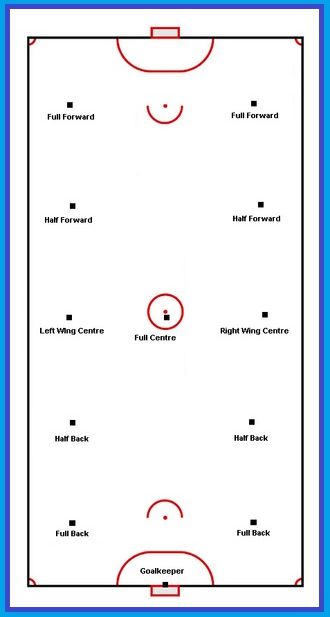
And the reason may well be Scotland's ancient game of shinty, now finally start-ing to achieve rightful recognition as an origin of ice-hockey and even golf. In the upper valley of the Leven, where the Orr Ewing brothers, Alexander and John, had in the 1830s founded their calico printing-works, employing often near-Highland labour, it had become the winter game. The first recorded shinty match between the two establishments had been in 1852. In 1870, so just two years before the visit of Queen's Park, 2,000 or so spectators are said to have come to the annual encounter. They and the young men on the field-of-play were thoroughly versed in the old game and its stands to reason that they would have approached the new one with it in mind. It is even said that when they were invited to take the field at Park Neuk to play against the Glasgow men first they did so in shinty formation.
That said, even today with shinty formations differing between the north and south Highlands, the former regarded, in the slightly tongue-in-cheek words of Hugh-Dan MacLennan, as "hell for leather wing play", two things stand out from the Southern one as being not just potentially transferable but one hundred and fifty years ago actually transferred to the football field. The first is the block-four defence; what turns out to have been Queen's Park captain Gardner's perhaps novelty but one he might already have been aware of, picked up from the shinty he must have seen or even played in Glasgow, his home-town, or Paisley, that of his parents, but with the possibility it had on Park Neuk been noted for its effectiveness and adopted. The second is the vertical forward pairings.
Here the use of the words "perhaps novelty" should be explained. Reason one is it is well-documented that in the World's first official football international, played in Glasgow on 30th November 1872 between an England team and a Scottish one, captained by Robert Gardner and drawn mainly from Queen's Park, the English played 1-1-1-7 and we 2-2-6, i.e. the block-four. Reason two is because on the 21st December 1872 The Vale travelled to Glasgow to Queen's Park for the first of four encounters over the rest of the 1872-3 season. Again we know the team - William Ker, Joe Taylor, David Wotherspoon, James Thomson, Jimmy Weir, Bob Leckie, Alex Rhind, Willie Mackinnon, Andrew Spiers, William Keay and Archie Rae but no Gardner - and that Queen's Park would win easily, 3-0 but just now have no formation. However, that would not be the case for the remaining three encounters and here is the crux. Queen's Park, even with Gardner back in the elevens as twice goalkeeper and then a forward and contrary to myth, played 1-2-7 again twice and then 2-1-7, i.e. Queen's Park went back, indeed backwards, to the English way. Yet their up-country, newly-come opponents took the field on all three occasions as a 2-2-6, the apparently new Scottish way, either because they were either very good and fast learners (as incidentally Clydesdale must have been also) or because, it has to be said once more, it was what they already knew from old, were comfortable with and, having passed it on once for it just now to be seemingly rejected, ensured, whether deliberately or not, it was to be carried forward and ad infinitum. Even today it is the foundation, on which a back three, four or five plus matching mid-field is laid with the steps from then to now quite clearly discernible.
In fact Queen's Park, after the third Vale match, two draws and a Queen's Park win, was that season to play just one more fixture, a home win, 1-0, over Glasgow Wanderers from this time just down the road in Cathcart. Moreover, it seems also to have been the last one for The Spiders for Bob Gardner. There was to be an extensive falling out, whether generated within the club or perhaps by international defeat in early March 1873 in London, where England played 1-1-2-6 and Scotland 2-2-6 once more, is unknown. But by October 1873 Gardner's friend, Wotherspoon, had moved the mile or so across to equally near neighbours, Clydesdale, to be joined later by Gardner himself. A J. Gardner plays there at full- or half-back on 15th November behind Wotherspoon, as had a Gardner for almost equally nearby Dumbreck nine months earlier, but that may be, rather than a mistake in the initial, simply another or even his elder brother, James. An R. Gardner definitively first plays between the sticks and as captain on 13th December, by when the Titwood Park club, having previously again played English-style had re-adopted 2-2-6, as, whilst Vale continued with it, had Granville and another and still newer club was seen from the start to be using it too. It was Renton.
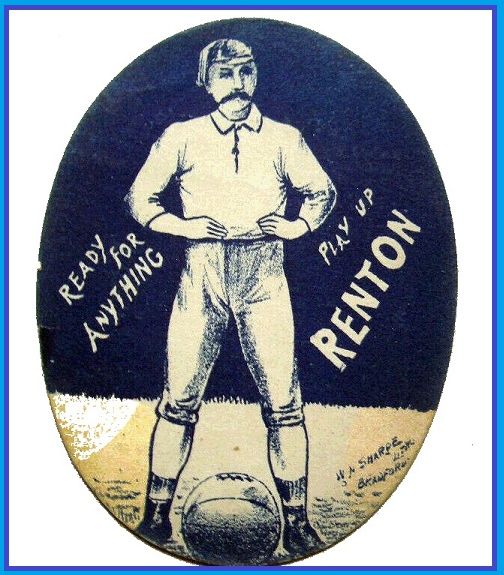
Whilst Renton F.C. was clearly not in the very first wave of Scotland's football clubs (it had not been a founder member of the SFA) and its actual foundation-date is un-known it was one of the entries seven month's later into the first Scottish Cup. Moreover, at that initial attempt it would reach the Quarter-Final, losing only to Queen's Park, the eventual title winners, 2-0. Furthermore it would do it with a team that we know in detail (see below), one which included, for later reference, a Melville and remained largely unchanged when the club would the following year go all the way to the final, held at the first Hampden Park and won by the home team once more, this time 3-0.
But here again there is something else that is, if anything, more worthy of notice. In that December 1873 encounter with Queen's Park both teams lined up as notionally 2-2-6 but in a contemporary report in The Scotsman no less more detail of Renton's positioning is given.
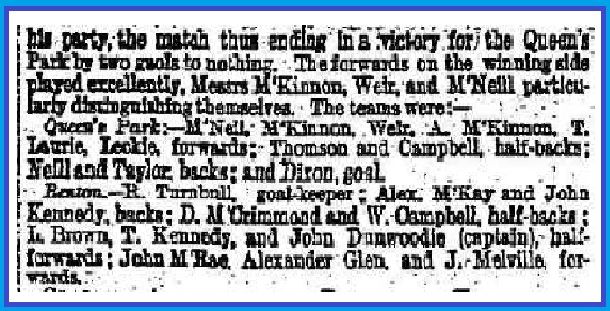
Alex McKay and John Kennedy were the full-backs, McCrimmond and Campbell the half-backs. But in front of them were three "half-forwards" and beyond them three "forwards". In other words there were firstly three pairs and secondly they were not horizontal across the pitch but vertical. The Renton formation was actually 2-2-3-3 and still more to the point, like the block-four defence, the term "half-forward" comes straight from Southern shinty with full-forwards in front of them.
In other words Renton was observed as a first playing football using an almost fully Camanachd formation that retained the full-centre (see again above), added another but was, in order to reduce to eleven players, less the two wing-centres.
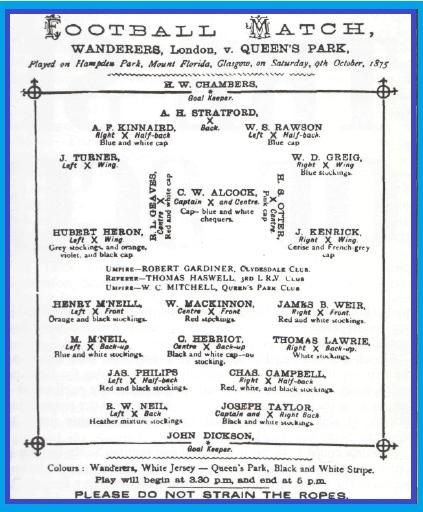
Moreover, the horizontal to vertical adjustment clearly worked, with more to come and the following implications. From these new tactics and not known passing, used in any case for two millennia in the ancient game, would rapidly emerge a, in fact THE, distinctively Scottish style of play, which can and in both parts be seen almost as quickly to be adopted by other teams; even if Queen's Park proved to be one of the most tardy. The earliest reporting of it and vertical forwards would be on 9th October 1875. It was versus The Wanderers once more and this time with both Arthur Kinnaird and Charles Alcock in the Londoners' line-up. Lawrie, in front, and Weir were on the right, McKinnon and Herriot in the middle and the McNeill brothers, Harry, a known shinty-player, and Moses, on the left. FYI Queens at home at Hampden won 5-0.
At this point Queen's Park had been and would remain undefeated. But that was to change and it was to be The Wanderers, which were first to make it happen. In the follow-up friendly to the above game and four months later in February 1876 they back in London would be victorious by 2-0 but then Queen's Park, playing essentially with ten men, had something of an off-day, rectified with a 6-0 win away against the same opposition in November that same year. However, that was to be just seven weeks before invincibility in Scotland also came to an end. It happened on 30th December in the Scottish Cup and at the hands of Vale of Leven. It had, after the Ferguson affair, essentially seen elimination from the first two Scottish Cups, but had been building up a head of steam. In its first year it had gathered a pool of twenty-four or so players that was then reduced over three seasons to a squad of sixteen to twenty, Ferguson included; one which essentially knew each other's game. They were drawn from the same calico works that had previously supplied the shinty players. In fact, a number of them were also accomplished at the game. And they would soon constitute the World's first consistently successful, working-class club. Renton, equally if not more working-class, had had its moment first but, having just eliminated Scotland's previously unvanquished doyen, The Vale would not only take that Scottish Cup that year and but for two more consecutively after that and in 1878 in beating the English FA Cup holders, The Wanderers once more, be ipso facto the first best club in the World.
(Here the work done at Stirling University, as shown in Scottish Football Origins, in examining the back-grounds of the players from the Vale of Leven, including Dumbarton, from the valley's three main teams, makes the point far better than we can.)
That is, however, not to say, meantime and a mile and a half down the road Renton had been just a one-off wonder. It too was prospering. Whilst in 1875-76 it had been knocked out of the Scottish Cup in just the second round and by The Vale it not only had an established group of players but one which it was able to re-build still from local talent. And, although it would in 1876-77 be eliminated in round one again locally by Dumbarton, in 1877-8 with the new squad it too would find a wave, one of its own, making it all the way to the penultimate round and only lose to Third Lanark on a replay, this as The Vale had been granted a semi-final bye. Who knows how it might have turned out had it been the other way round but it is not inconceivable, as Renton was about at last in Tontine Park to have its own, proper ground, that first, the final would have been all-Leven and, second even, that Renton might in winning have gone on instead to become both Scottish and World champions. Such are the fine margins of footballing fate.
Known Renton, Renton Thistle, Vale of Leven and other Upper Vale Teams
- N/A
- N/A
- N/A
- N/A
- N/A
- N/A
- N/A
- N/A
- N/A
- N/A
- N/A
1872-3
_________________________________________
- Cunningham
- Wylie
- Fergus
- Ferguson
- MacDermid
- Moodie
- Graham
- McKechnie
- MacDonald
- Lang
- Edmunds
1872-3 - Jamestown
_________________________________________
- Robert Parlane
- Archie Michie
- J. M. Campbell
- James White
- John C. McGregor
- George McGregor
- Robert Lindsay
- Robert Jardine
- J. McNichol
- John Ferguson
- J. Campbell
McLay, Ewing, Bryan, Sandy McLintock, Wright, (Robert) Paton, Partington, Colquhoun, Duncan Cameron, D. MacFarlane, Matthew Nicholson, Charles Glen, William Kinloch, William Thomson, John Wright, Joseph McEwan
1872-3 Vale of Leven
_________________________________________
- Robert Turnbull
- John Kennedy
- Alex. Mackay
- W. Campbell
- Andrew Strachan
- (James) Brown
- John McCrae
- Lachlan Brown
- J. (G)Mel(ville)in
- Alexander Glen
- Findlay Kennedy
D. McCrimmon(d), T. Kennedy, John Dunwoodie, N (M). Campbell, D. Kennedy, J. McRain (McCrae?)
1873-4 Renton
_________________________________________
- James Cameron
- Robert Cameron
- George McKay
- William Ralston
- John Shankland
- John Watt
- N/A
- N/A
- N/A
- N/A
- N/A
_________________________________________
- Robert Parlane
- Archie Michie
- R. Paton
- D. McFarlane
- A. Mcintoal(McIntyre)
- W. MacDonald
- M. McGregor
- George McGregor
- Duncan Cameron
- J. McGowan
- Robert Lindsay
John Ferguson, J. M. Campbell, T. Wood, John McNichol, Sandy McLintock, John McGregor, John McInlay, James Williamson, (A.) McEwan, Matthew Nicholson
_________________________________________
- Robert Turnbull
- Mackay
- J. Kennedy
- (James) Sca(u)llion
- McGregor
- (Mc)Rae
- Melville
- J. Brown
- M. Kennedy
- Alexander Glen
- Lachlan Brown
_________________________________________
- William McLennan
- P. McKinlay
- P. Docherty
- J. M'Nichol
- A. M'Kinley
- R. Milne
- H. Irvine
- J.McAllister
- P. McAllister
- John McDougall
- George Smith
James Peters, James McDougall, George Neil [John Forbes, Robert Atherley, A. McEwan, J. McPherson, J. McNichol, playing for Star of Leven.]
_________________________________________
- Robert Parlane
- Archie Michie - to Dumbarton
- A(ndrew). McIntyre
- J. M. McIntyre
- James Baird
- (Charles) Glen
- Partington
- Robert Paton
- McDougall
- B. Russell
- John Baird
John Ferguson, Sandy McLintock, Robert Lindsay, (John or James) McDougall, James Williamson, McGregor
1874- 5 Vale of Leven
_________________________________________
- Turnbull
- McKay
- (J) Kennedy
- Scallion
- Jenkins
- L. Brown
- (M) Kennedy
- J. Brown
- Glen
- Melvin
- (James) McRae
(Peter) Joyce, Miller, Nelson, McCrimmon
_________________________________________
- McCrimmon
- Grant
- P. McGregor
- Davidson
- Cameron
- Burnholme
- (McIn)Tyre
- Grant
- J. McGregor
- McRae
- Ritchie
_________________________________________
- (William) Wood
- (Will) Jamieson
- A. McIntyre
- (James) McIntyre
- Sandy McLintock
- (John or James) McDougall
- John Campbell Baird
- James Baird
- McGregor
- (Robert) Paton
- (John) Ferguson
Lamont, (Robert) Lindsay
1875-6 Vale of Leven
_________________________________________
- W. Kennedy
- Grant
- Turnbull
- McArthur
- M. Kennedy
- Miller
- McRae
- McCrimmon
- Burnham
- Grant
- (James)(John) McIntyre
1876-7 Renton
_________________________________________
- White
- McPherson
- McLeish
- Jones
- McEwan
- McFarlane
- McLean
- Strachan
- Russell
- Burns
- Lamont
_________________________________________
- William Wood
- Andrew McIntyre
- Archie Michie
- Will Jamieson
- Sandy McLintock
- John Ferguson
- John McGregor
- David Lindsay
- Robert Paton
- John McDougall
- John Baird
John McPherson, Robert Parlane, James McIntyre, John McFarlane, James Baird, Jones, May
1876-7 Vale of Leven
_________________________________________
- Kennedy
- Grant
- McKay
- N/A
- McArthur
- Miller
- McRae
- Burns
- N/A
- McCrimmon
- McAllister
Colquhoun - from Dumbarton, McLearie, (Denton), Grant, Loy, Fagans, Davidson, Fraser, McIntyre
_________________________________________
- N/A
- N/A
- N/A
- N/A
- N/A
- N/A
- N/A
- N/A
- N/A
- N/A
- N/A
1877-8
_________________________________________
- Robert Parlane
- Andrew McIntyre
- James McIntyre
- John McPherson
- Will Jamieson
- John Ferguson
- Robert Paton
- John McDougall
- James Baird
- John Campbell Baird
- Johnny McFarlane
Sandy McLintock, John Baird, Strathearn John McGregor, May, Jones, George McGregor
_________________________________________
- McIntyre
- W. Grant
- McArthur
- Colquhoun
- McLearie
- Burman
- McCrimmon
- Fagan(s)
- A. Grant
- McRae
- Loy
McKinnon, Kennedy, Cameron
_________________________________________
- Woodroe
- Moir
- Collins
- R. Sharp
- W. Sharp
- Brown
- More
- McIntyre
- McCulloch
- Lindsay
- Stewart
_________________________________________
- Robert Parlane
- Andrew McIntyre
- Sandy McLintock
- Will Jamieson
- John McPherson
- John Campbell Baird
- John McDougall
- James Baird
- John McGregor
- John McFarlane
- John Ferguson
Robert Paton, W. Strathearn, H. McLeish, J. McIntyre, Paton, P. Logan, T. Taylor, W. Taylor, J. Stewart, J. Murie (Murray), (Andrew Hunter)
_________________________________________