One Lion on the Shirt
When the first World Cup was played the Final was competed for by two teams, Uruguay and Argentina, whose football could be traced diredtly to Scots and the Scottish-game. And in the two following finals the runners-up could do the same either again directly or through the filter of Jimmy Hogan, already a subject for another place and day. But Italy was the winner on both occasions and, whilst administratively Geo Davidson was in that country instrumental no similar on-field claim would have any justification. There Vittorio Pozzo was playing his for two-tournaments-unchallenged, still more defensive version of the English-game.
However, the Scots-game would reassert itself in 1950, was expected to do so in 1954 with the Hungarians but stumbled to the inscrutible at the Battle of Berne but came again in 1958 and 1962. Yet that was to be it. Apart from arguably 1974, 1978 and 2016, the discussion being about how Scots was Dutch Total Football, again one for another place and time. Otherwise in the interim World Cup Finals have either been largely non-Scots or a face-off between Scots and non-, the latter with parity until recent times when non-Scots seemed with 2006 and Italy and France and France and Croatia in 2018 to have gained the upper-hand. Certainly in the last ten World Cups the champions have non-Scots six times, whereas in the first ten it was four.
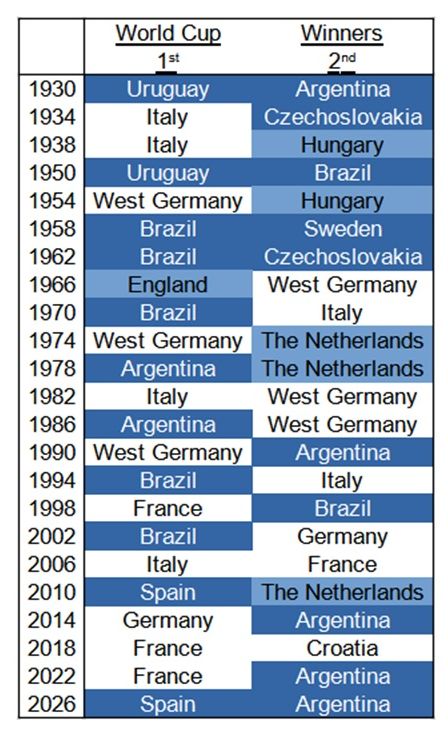
But with this World Cup there has been change, reversion even. For the first time since 1962 two teams - Spain and Argentina - with football of impeccably Scots origin face each other in the Final. In the former's country's case its oldest team, its doyen, the equivalent of our Queen's Park, Recreativo de Huelva, was founded by three of our countrymen, its oldest ground, that of newly-promoted Aguilas is in theory still owned by a long-dead Scot but bequeathed to the town as long as sport, football, continues to be played on it, and Barcelona football would probably not exist without first Paisley's Borgonya and then F.C. Escoces. In the case of the latter its was not one but four and twelve plus Scots or Scots Diaporans respectively, who each in their way but through a Caledonian passion for it gifted the game to both shores of the River Plate; the quartet to Uruguay's Montevideo and in Argentina a baker's dozen to first Rosario, the home-town of Messi, and then to Buenos Aires, Cordoba and beyond. So this year for the first time in almost three quarters of a century it is literally and also purely no Scots, no Soccer and, even if we as a national team this time fell at the first hurdle, the game we, wee Scotland, not just promulgated but created is still there; alive and kicking.
Back to the SFHG Home page