The Scotch Professor
- Facts and Numbers and the obvious question
- Why?
When not football, for it was already long here, but specifically Association football came to Scotland in 1872 there had from its London inception in 1863 already been Scots playing the game Down South; Diasporan members of England's Southern middle- and upper-classes; a couple a year on average. And how do we know that? Because we have researched and counted them. Moreover we have continued to do so to the beginning of the Second World War on the basis that after that it has been not our but the Scottish Football Museum's de facto but inexplicably limited remit to know the figures. Moreover we have graphed all seventy-six of those annual totals.
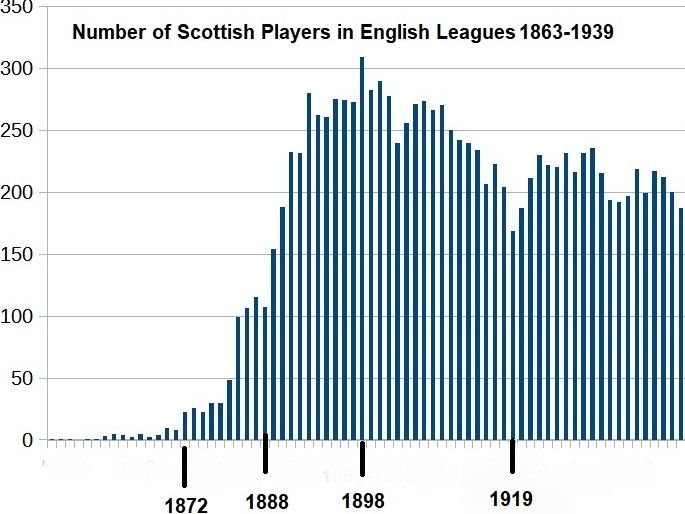
And that graph is nothing if not exceptional. The decade from 1873 shows, admittedly from a low start, a ten-fold increase of the average., 1883-4 alone a tripling of that figure in a single year and in it and the next four seasons doubling. And nor did it stop there. In the decade from 1888-9, the first professional decade in World football growth was almost three-fold, peaking at over three hundred, and even when being paid to pay became the norm the annual count before The Great War was two-hundred and fifty and between the wars still two hundred plus.
So the question can only be why? And the answer, or rather the answers are initially demand resulting from qualitative observation and results and then pure success-driven capitalism. Or to put it simply, on-field at club, representative and international levels Scottish players time and time again proved themselves to be technically and tactically superior, with English clubs prepared and then compelled to buy in.
Indeed such were those superiorities that it would soon lead to those players coming down from the Scottish earning the soubriquet, the "Scotch Professor", the pioneer of whom, the forerunner of many, was probably Hugh McIntyre. He had in 1879 been a Scottish Cup Finalist with his third Glasgow club, Rangers. He joined Blackburn Rovers in 1880. He would be an FA Cup Finalist in 1882 and three times FA Cup winner, in 1884, 1885 and 1886 before time finally forced retirement. But the interesting point had been back in 1884. That year in the Scotland-England fixture, won by Scotland, at the for-England, new position of centre-half had been Stuart McCrae, a name you might note with interest and rightly so. McCrae was a Gaelic-speaking Scot, a Highlander, a future clan chieftain of the McCraes of Conchra, who is buried in the clan cemetery on Loch Duich. But he had been born in India so was until 1887 in football terms "English".
However, later that season McCrae had his leg broken in a game, his footballing career was over and for the equivalent fixture the following season his place was taken by James Forrest. He played for Blackburn Rovers. At nineteen in the 1884 Cup Final he had been at half-back beside Hugh McIntyre, in the 1885 Final he would be at left-half with McIntyre at centre-half and in 1886 at right-half with again McIntyre inside him. Yet for England in 1885 he was at centre-half. He had moved across to the McIntyre position. And to do so he was using the knowledge that had been passed to him, as a "student" of just twenty, from a by then twenty-nine year old, definitively-Scots, then recognised and now easily-argued, first true academic of our Beautiful Game.
Back to the SFHG Home page