Scotch Professors
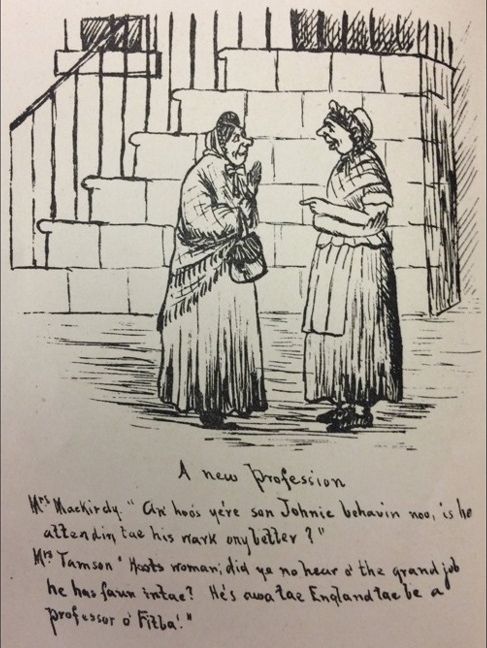
Within the SFHG group there is deal of discussion of and, indeed, disagreement about the much-bandied term "Scotch Professor", whether he/they really existed at all and, if they did, what was their actual role and impact in early English, indeed, in British football and when.
The term seems to have come from a cartoon (See left) published in about 1882. For non-Scots the translation is:
Mrs. McKirdy (McHardy) "So, and how's your son, Johnny, getting on? Is he being more serious about work?".
Mrs. Thomson: "Goodness, have you not heard about the great job he has managed to find. He's gone to England to be a Professor of football."
The first thing to bear in mind is that early football was a young man's game. The earliest clubs were often founded by teenagers and Scotland was no exception. Eighteen or nineteen year-olds were first-term players. And it is also important to note that the age of consent was then twenty-one so young men were often tied to home legally and financially, whether they liked it or not, until that age. Moreover, despite belief to the contrary, the first "football" professional was very probably not a Scot. And the reason is that when the first of our countrymen, Jimmy Lang and Peter Andrews, went South for the English shilling in 1876, already by then it looks as if Jack Hunter, twenty-one already in 1872, was being paid to play.
But there is a caveat. He was in home-town Sheffield, where the game there already had a ten-year start on Scotland's, and it was to that city's rules, so not the Association game, that he plied his trade. Professional footballer he might have been but professional, Association footballer he was not until a move to Lancashire, to Blackburn Olympic, in 1882. Moreover, this same caveat would apply to Lang and Andrews, which then raises the further question of who actually was the first to be paid play the Association game. And to that the answer is probably nobody knows but that it might well have been delayed until Jimmy Love, not quite twenty-one but with no family constraints, and then Fergus Suter, who was about to turn twenty-one, so both with perhaps no more than two and a maximum of three seasons of experience, took themselves from Glasgow to Lancashire in the autumn of 1878.
However, there is a further complication. Peter Andrews had been born in 1845, J.J. Lang in 1851 so in 1876 the former was already thirty and the latter twenty-five. Neither was young, Andrew in footballing terms positively ancient. Both are known to have four years playing behind them and therefore might to said to have been approaching, if not professorship, then certainly the status of lecturer. Indeed, with both remaining in Sheffield until their mid-thirties, they could even be said to have achieved at least professorship by their returns to Scotland, Andrews to Paisley, Lang to Glasgow, but in what? Sheffield's own non-Association football would more or less implode by the beginning of the 1880s and not really recover for the best part of a decade and half. And during that same period Association in football north of the border and even elsewhere in England and Wales had moved on without any suggestion of them keeping up.
So when was it that the first Association football professors actually would find work in an Association-football-playing area? In fact this is the area of greatest discussion with one view believing it was early-on and the other not accepting that it happened until certainly 1885 or perhaps later still, in and around 1888. And the turning-point was probably 1882, the year of the cartoon with the implication that it was perhaps to a large degree ironic.
That year the Lancashire FA attempted to do something about the number of Scots descending on their clubs. In fact it was a non-problem. They numbered perhaps eight with the real bones of contention, concentration and inter-club rivalry. There were by then some twenty clubs but of the Scots three were at ambitious Blackburn, two each at Preston and Accrington, one at Darwen and it was that which provoked moves by essentially the others to introduce constraints in the form of artificial, residential requirements. But all that resulted was a spot-light being shone on already existing shamateurism and more Scots being attracted. By season 1883-4 the number in the South had doubled to forty with eighteen in the catchment in question. In 1884-5 it would be ninety and sixty respectively.
However, those that came south now had in the main three characteristics. Very few of them were from the major Scottish teams in Glasgow and the Vale of Leven. They came largely from Ayrshire and Edinburgh. And that they mostly twenty-one or very much thereabouts. In other words they were far from the best players that Caledonia could produce either in terms of source or experience. In fact what they had was a basic understanding of the Scottish Game and its advantages and in a good number of cases an ability to learn on the job with the Rosses and the Goodalls later the perhaps most observable examples. Indeed it was them and players like them, who might be said to have become by the time of the next, the second English professionalism crisis in 1885 in limited numbers professorial and by the time of the third in 1888 to be, if you like, head of faculty. By then both John Goodall and Nick Ross were twenty-five with seven top-fllght years behind.
However, that year with the all-conquering achievements of Renton both north and south of the border that was to change. At the start of the 1887-88 season some ninety were now plying their trade South of the Border. In 1888-9 it was one hundred and thirty-five and two season later still it passed two hundred. And for the moment they were of a different ilk. The Vale of Leven, Renton, "The Vale" and Dumbarton had largely been stripped of its talent, its mature talent of much the same vintage as Ross and Goodall or older still. These were players who not only knew what they were doing but brought with them a novel way to play the game. And they were gradually joined by others from a much wider, Scottish catchment into a widening English pool but who had also adopted the new Scottish Game, two hundred and seventy in 1883-4, and they too were older, lecturers at least, as in, for example, James Cowan, a professor of the near future.