The Absurdity of the Parochial
At the beginning of the month an excellent report on some origins of the beautiful game was put out as a news item on television. It is neat, slick and informative and can be seen just now by clicking on:
https://www.itv.com/watch/news/birthplace-of-football-shares-its-history-in-bid-for-heritage-status/byn6sbv
But it is also disingenuous because it seeks not just to connect but also deliberately to confuse "Foot-Ball" and "Foot Ball" with what we play today, the Association Rules game. The item was on ITV, English ITV. Its source was Sheffield, from where in recent years has come laudably deep and important research on the former locally-played, Sheffield Rules version of the game and now has emerged a campaign for UNESCO recognition of it, seemingly, as the sole place of origin for football in its modern form.
Now it might seem to be dancing on a pin-head but, as the the article above on the SFA not knowing where it started, accuracy matters. So let us try to impart some. There were four stages, all in Britain, to the initial creation of what is today's football.
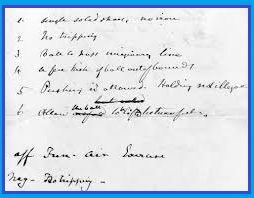
The first was the local, ad-hoc mass games what we in Scotland called "fitba" but existed throughout these islands. The second was the foundation of the first "Foot-Ball" clubs (note the hyphen) with codified and written rules. There is an argument that this first took place in Scotland in Edinburgh in 1824, lasted until 1841 with one copy of its hand-written rules shown as an example.
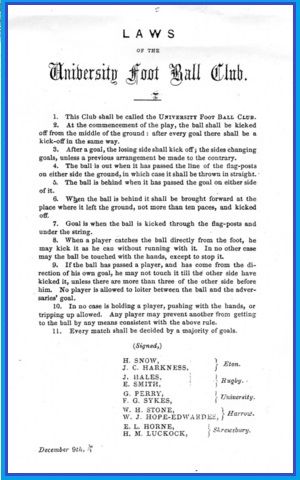
Then, third, there are the Cambridge Rules, of which there were several iterations, with the printed 1856 version illustrated. But note two things. First, the iterations did not flow on one from another. They seem to have been separate codification attempts with differing drivers. Second, they were, as illustrated, for a "Foot Ball" club, no hyphen, and again subject to change and addition, not least in 1861 by the Forest Football Club, later to be known as The Wanderers and future five-time Football Association Cup winners, including the first playing.
The second took place at Rugby School in 1845 with the writing down of the rules of its in-house game. Those rules, thirty-seven in all, were as follows.
- Fair Catch, is a catch direct from the foot.
- Off side. A player is off his side if the ball has touched one of his own side behind him, until the other side touch it.
- First of his side, is the player nearest the ball on his side.
- A knock on, as distinguished from a throw on, consists in striking the ball on with the arm or hand.
- Try at goal. A ball touched between the goal-posts may be brought up to either of them, but not between. The ball when punted must be within, when caught without the line of goal: the ball must be place-kicked and not dropped, even though it touch two hands, and it must go over the bar and between the posts without having touched the dress or person of any player. No goal may be kicked from touch.
- Kick off from middle, must be a place.
- Kick out must not be from more than ten yards of goal if a place-kick, not more than twenty-five yards, if a punt, drop, or knock on.
- Running in is allowed to any player on his side, provided he does not take the ball off the ground, or take it through touch.
- Charging is fair, in case of a place-kick, as soon as a ball has touched the ground; in case of a kick from a catch, as soon as the player's foot has left the ground, and not before.
- Off side. No player being off his side shall kick the ball in any case whatever.
- No player being off his side shall hack, charge, run in, touch the ball in goal, or interrupt a catch.
- A player when off his side having a fair catch is entitled to a fair knock on, and in no other case.
- A player being off his side shall not touch the ball on the ground, except in touch.
- A player being off his side cannot put on his side himself, or any other player, by knocking or throwing on the ball.
- Touch. A player may not in any case run with the ball in or through touch.
- A player standing up to another may hold one arm only, but may hack him or knock the ball out of his hand if he attempt to kick it, or go beyond the line of touch.
- No agreement between two players to send the ball straight out shall be allowed on big side.
- A player having touched the ball straight for a tree, and touched the tree with it, may drop from either side if he can, but the opposite side may oblige him to go to his own side of the tree.
- A player touching the ball off his side must throw it straight out.
- All matches are drawn after five days, but after three if no goal has been kicked.
- Two big-side balls must always be in the Close during a match or big-side.
- The discretion of sending into goal rests with the heads of sides or houses.[3]
- No football shall be played between the goals till the Sixth match.
- Heads of sides, or two deputies appointed by them, are the sole arbiters of all disputes.
- No strangers, in any match, may have a place kick at goal.
- No hacking with the heel, or above the knee, is fair.
- No player but the first on his side, may be hacked, except in a scrummage.
- No player may wear projecting nails or iron plates on the heels or soles of his shoes or boots.
- No player may take the ball out of the Close.
- No player may stop the ball with anything but his own person.
- Nobody may wear cap or jersey without leave from the head of his house.
- At a big-side, the two players highest in the School shall toss up.
- The Island is all in goal.
- At little sides the goals shall be four paces wide, and in kicking a goal the ball must pass out of the reach of any player present.
- Three Præpostors constitute a big-side.
- If a player take a punt when he is not entitled to it, the opposite side may take a punt or drop, without running if the ball has not touched two hands.
- No player may be held, unless he is himself holding the ball.
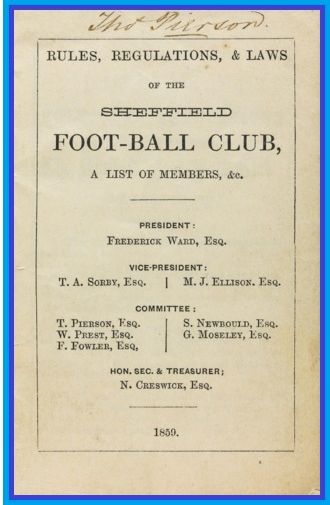
And finally from 1857 there is Sheffield, where a vibrant club culture developed, it is claimed from 1859 with the publication of its rules but in reality in the next decade with the foundation in 1860 of Hallam, Sheffield F.C.'s first external opponent.
But back to the pin head. "Foot-Ball" and even "Foot Ball" are not "football" as we understand it. They weren't in Edinburgh or Cambridge. And they did not become so In Sheffield either and to pretend otherwise is unhelpful. Not just are Sheffield's printed rules for a hyphenated game but the ITV piece's filming of the ledger of the founder of the first Sheffield club shows it clearly referring to "foot-ball".
So where does this leave us? After digitalisation much good work by many in many places has been done not just to uncover the real origins of modern football but also to sweep aside a number of myths. The fact is that the proto -game in Britain developed in largely parallel in a number of locations in these islands before coalescing. London produced an initial set of rules that stuck. Sheffield added and considerably improved them when it in 1877 it merged with the FA. Scotland, as its results show, provided tactics and technique. That it happened should be celebrated. However, instead there is parochialism and it is absurd. Where we have been allowed by technology the opportunity for clarity and agreement attempts are being made to create new but equally tenuous myths and resentments - North England of South England, Scotland of England and vice versa, even Scotland of Scotland - are not being eliminated but instead reformulated. A halt would be good.