The World Championships (1872-1904)
- ELO -
and then Proper Analysis
The Footycon conference was recently held at Fulham's Craven Cottage ground in London but with iimited Scottish presence because it was over the the weekend of Scotland-Haiti game in Boston. You could not make it up. And at said Footycon a paper on "‘Més que un club’: Identifying, Classifying and Chronologically Ordering Early Football Clubs" was presented by a group mainly from Sheffield, a by-product of which was an attempt to identify the best team in Britain in a period that covers both non-Association and Association football. And here we are going to be a little harsh.
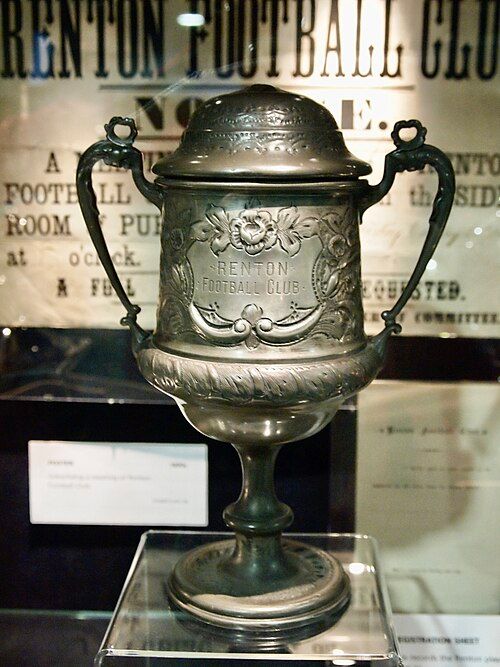
The paper itself is pseudo-academic, incorporating the false principles that annotation is justification and contextual interpretation is not required, perhaps even deliberately avoided for the purpose of gas-lighting. As to the team analysis, shown below, the timespan covered is interesting, starting in 1865, perhaps because of an understandable lack of data before that, and ending in 1887, coincidentally the year before Scotland's Renton swept all before it and the cup above was created in recognition.
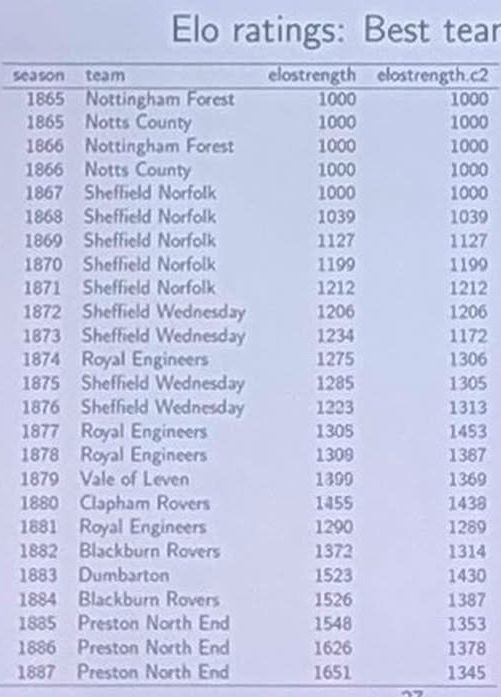
But back to the list itself, compiled by the adaption of the newly-advocated ELO mathematically-based methodology, developed originally for the ramking of chess-grandmasters. Just two Scottish teams appear in it - Vale of Leven in 1879, Dumbarton in 1883 but that is in part explicable. Whilst "football", "fitba" in Scotland had provably existed very long-term, until 1872 there were no known, cross-border games of any variety. In fact "Association football" arrivied to Scotland that same year with the first known, international club game only then taking place in the FA Cup in March; a 0-0 draw in London between Wanderers and Queen's Park. It is therefore also reasonable that until 1872 teams from Nottingham and Sheffield, each with their own sets of rules, dominate. But what is inexplicable its that said Queen's Park does not appear in the list at all. That alone should have rung methodological alarm-bells.
But that Nottingham/Sheffield hegemony was to change from 1974, the Royal Engineers coming into first place but again it is with no actual cross-border action. Indeed it would de facto only resume in 1875 and 1876 when Sheffield Wednesday apparently took over Britain-wide but with in the latter season a real curiosity. On the 1st April 1876 Wednesday travelled to Glasgow and lost 2-0 to Clydesdale, itself knocked out of the Scottish Cup as early as the 3rd Round, also 2-0, albeit to the eventual Scottish Cup winners, Queen's Park. So does that not mean there was a negative, four goal gap between the apparently best club in the World and not just the best in Scotland but that same year's notional "World Champion" (see: Football World Championship), an epithet won by The Spiders in thumping the FA Cup winner 6-0 and in London?
But hold on! Why should we be needing to use ELO anyway? Isn't there already something in the already mentioned "Football World Championship" (FWC) source that is, if anything, not just another but a better method of measuring all this? FWC is a listing too so not just the one match-up but more than several not just almost annually in the period between 1876 and 1904, when there were really only two countries from where that champion club could come, England and Scotland, and, moreover, a listing, from which unlike ELO a parallel version indeed versions of measurement emerge as a double-check.
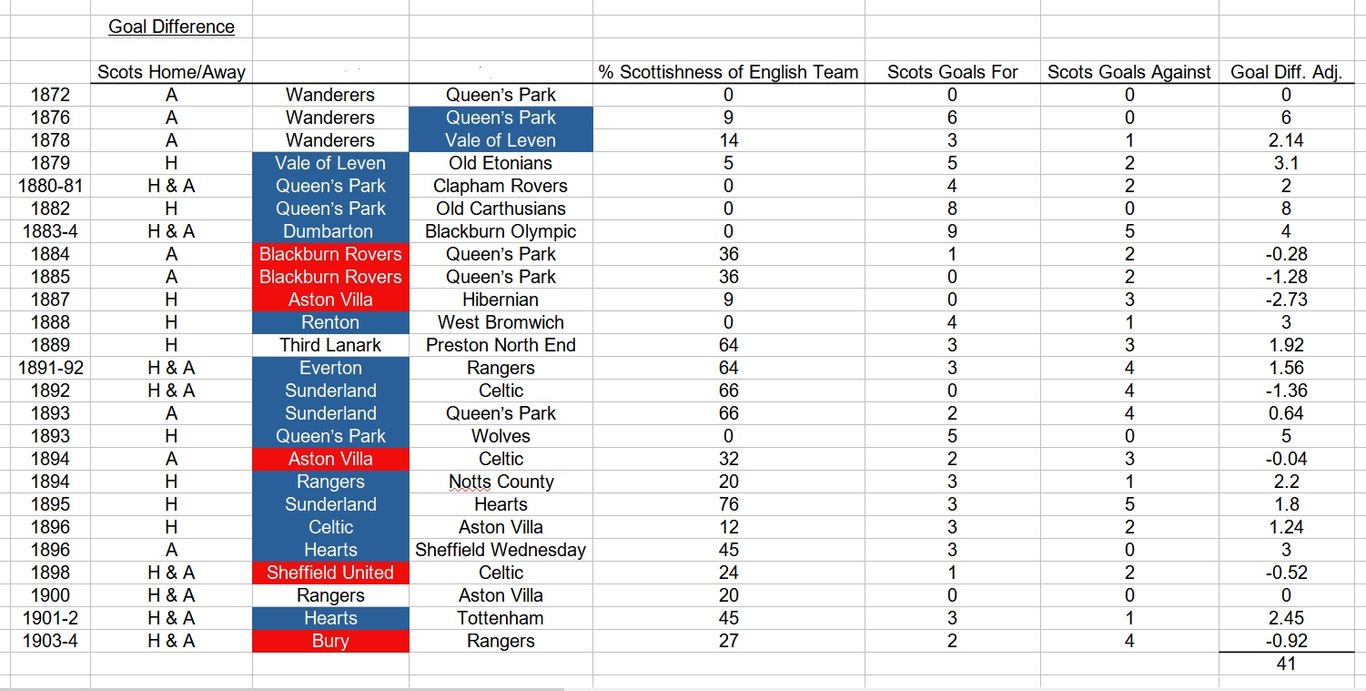
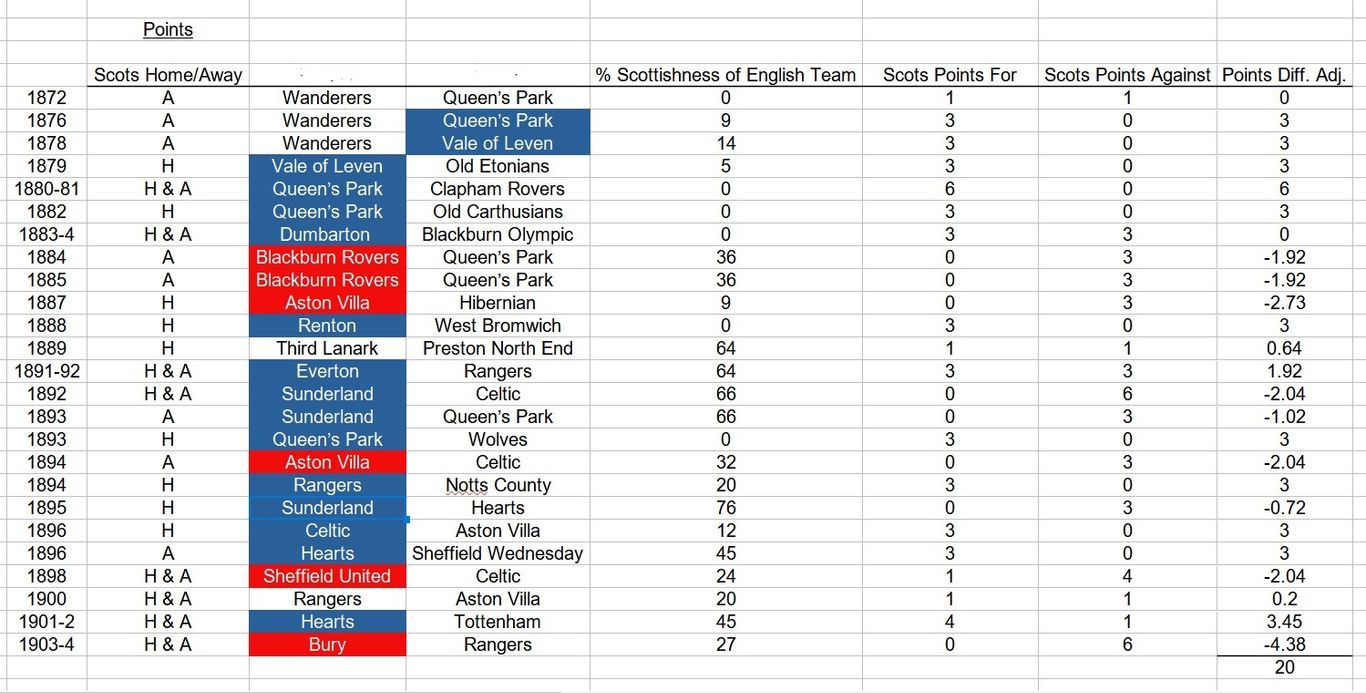
Of them the initial one, that of scoring for and against as in the table immediately below, clearly points to two things. The first is that over the piece there were thirteen Scottish champions to ten English, with Scotland dominating particularly in the early years. And the second, over the same period, is a healthy goal-difference for Scotland of +22. Yet, a further version of measurement, that of points - three for a win, one for a draw and zero for a loss as in the second table down - tells in fairness a slightly different story. There the gap is much narrower; just plus three points in favour of Scotttish clubs, in other words just a single win or more or less a single season.
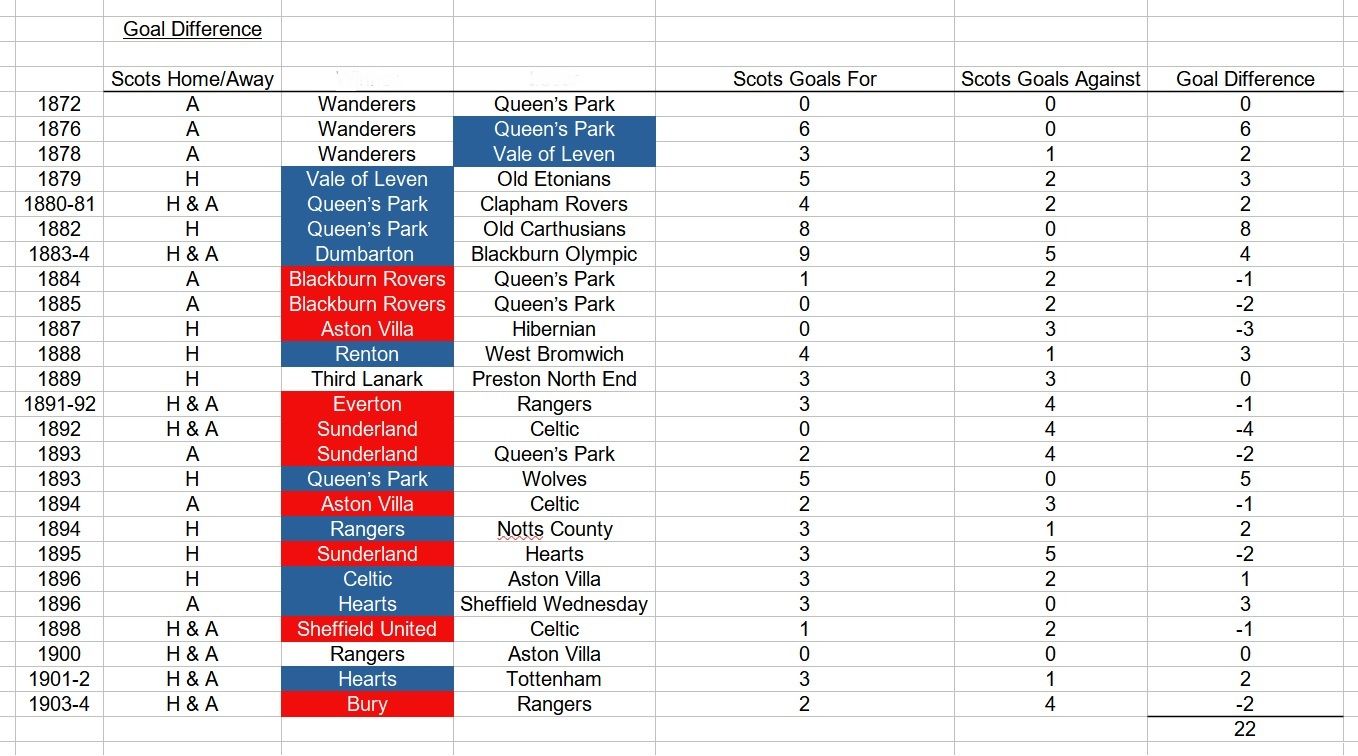
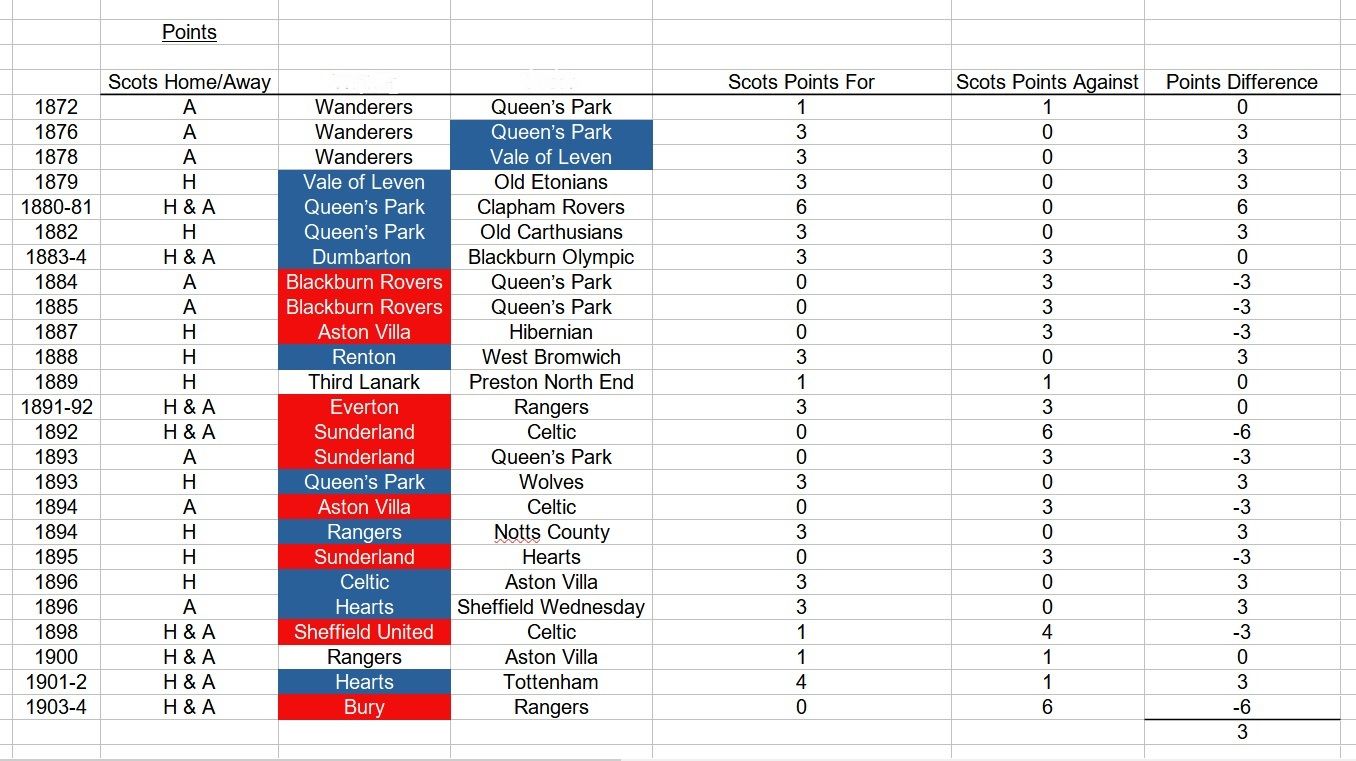
However, here a fundamental flaw of both these first measurements and more importantly the ELO methodology become apparent, albeit only if examination goes deeper that just eleven v. eleven. There was from as early 1869 a flow of Scottish players South. Queen's Park's adoption of Association i.e. London's Association rules was an almost immediate result as the Glasgow Southside club's founder and player, Robert Smith, soon folowed by his elder brother, James, took themselves to London for work and were soon acting as cross-border liaison. The outcome was the not yet even Hampdeners entering the first FA Cup competition, and, indeed, almost winning it. And throughout there had already been the presence of a still larger Scottish Diaspora, substantial enough from which to be able to draw five competitive elevens to face England in unofficial internationals between 1870 and 1872 and therefore also to figure at club level. Top English club,The Royal Engineers, would have up to five Diasporan-Scots and even Scots-born Anglos in its ranks. And that flow South would from the mid-1870s increase to the point that by the mid-1880s and into the 1890s many English clubs would have first eelevens, teams, squads that were up to three-quarters Scots. The result was that at times effectively a team from Scotland even in a supposedly partisan World Championship was playing another, albeit the latter was English-based. The peak was reached with Sunderland in 1895 and in terms of true comparion has to factored in, something that ELO does not accomodate. And the results are startling. Just as Blackburn Rovers and Preston under ELO seem to gaining the upper-hand it becomes increasingly clear that it is chimera. Adjust for Scottish players and overall a 22 goal difference, as can be seen below almost doubles, near points parity becomes in a moment an almost seven game or season disparity, winning teams by majority change not location but in effect nationality with the result that over thirty-two seasons a majority Scottish club became World Champion not twelve times out of twenty-two (55%) with three drawn and an English team eight but sixteen out of twenty-two (73%) and an English team just six but even then with caveats.
QED
Back to the SFHG Home page