QPNae-Pals
and how West Dunbarton Made Modern Football
Modern football is a working-class game, a game of the people; equally so in Scotland as globally. In fact modern, global football is the working-class game because of Scotland. That Association football began in it with Glasgow's Queen's Park is not in doubt. That for four years from foundation in 1867 the club was Billy-Nae Pals is just as clear. Eight games in the two years from 1868 and none really to the London Rules, then three more in 1871 and of them probably only one to the same.
That is until two events. Firstly QP was, it is said by a visit and an exhibition game, able in the Vale of Leven to convert one club, Alexandria's Vale of Leven itself ("The Vale"), from the oval-ball stramash, it then playing the Glasgow club three times in as many months, and cause the creation of two more, Dumbarton and Renton, probably in that order. And it was this last club, quite possibly because of the less than friendly attitude of Dumbarton to Vale of Leven, which reached the 1874 Scottish Cup Final. There, almost a decade before England, a barely nascent working-class team met the already doyen, middle-class one and lost. But that would not be the case for long.
However, whilst Glasgow had come to West Dunbarton there had also been significant movement the other way. Initially it had been with John Carson from Helensburgh to Queen's Park itself. That is before he headed South to Birmingham and founded that city's first major club, Calthorpe. And then there was Rangers. It is incontrovertible that without Rhu, in fact Shandon to Helensburgh once more, there would not have been the Ibrox club. Of the four founders three, the two McNeil brothers, whose elder sibling, Henry, had already ploughed the Clydeside furrow, and Peter Campbell hailed from there. And they would soon be followed to make up the new team by a further McNeil, more Campbells and, from the same source, two Vallances, first Alex and then Tom, the latter actually Renton-born.
Furthermore, when the first Scots went South with their home-honed skills the same Peter Campbell would be amongst the first half-dozen, the first to Blackburn, paving the way for that club's emergence as England's initial enduringly successful working-man's team. And there would be more. After Vale of Leven had eclipsed Queens Park in the Cup, in 1883 Dan Friel would be the first of its players to follow the same route, to Accrington so also North-West Lancashire, to be followed the following season by Sandy McLintock and in 1885 by Robert MacRae, both to Burnley, so that corner of Lancashire once more.
But it would be a trickle. That is until in 1888 a for a period dormant but now revived Renton exploded onto the national and then international scenes. Until that year from its team only Alick Barbour had taken the English shilling, in 1887, just one of just over a hundred to have done done that year, and to Bolton Wanderers, so Lancashire again, before moving on to Glossop and Nottingham Forest. Yet from the moment Renton won not just the Scottish Cup but in defeating both the English FA Cup holder, West Bromwich, and the next's season's, Preston North End became de facto World Champion over the next seven years about eighty players would join him from not just Renton but also The Vale and Dumbarton, more than a team a year from a valley population of perhaps 25,000. And on this occasion over the fifteen seasons from that same 1888 to the end of the century the penetration with the unique, local, Leven style of play would be far beyond that of their predcessor, indeed predecessors; onto Merseyside, deep into the English Midlands, into the burgeoning clubs of the Tyne, the Wear and the Tees and eventually even to London and the South.
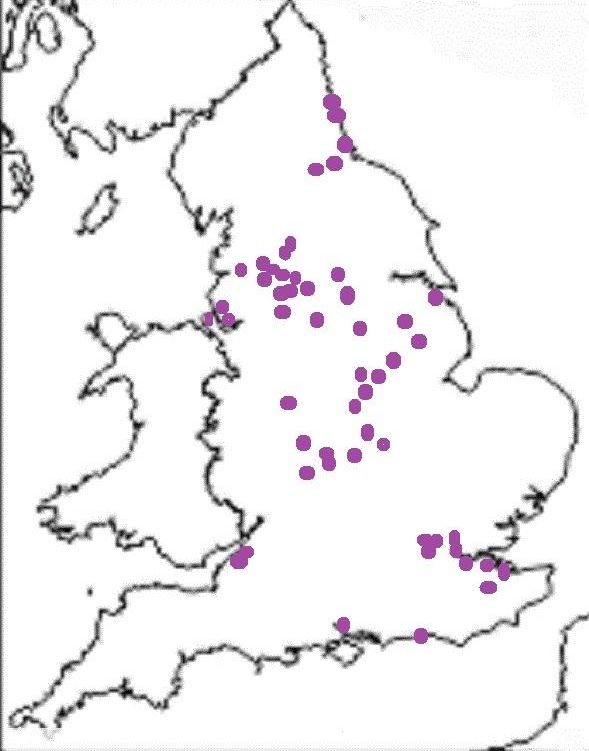
Proper research and the purple, the Scottish blue on English red, dots speak for themselves.
Back to the SFHG Home page