Plinths & Plaques, Statues and Graves
As with not just this but all our trails, local, national and country, we hold the view that merely recording or even putting on-line is a start but not enough. To do justice to the pioneers, as have a few clubs, even countries, to which they went, as in Scotland in the case of Tommy Donohoe and following the lead of Brazils's Bangu, Busby has too and as has SHFG again in Scotland, but also in England and Northern Ireland, there should be, both at home and elsewhere, place for more statues, golden or otherwise, restored, maintained graves, busts on plinths and if not them then plaques.
So, whilst we research and provide biographical and other details of as many of those Scots, native and Diasporan, who through deed and feet spread globally and uniquely the footballing word, we also look at where, in places from which they came or they rest, and as visual expression of our contemporary, national pride in them and those same localities, some form of physical, outdoor recognition would be both appropriate and feasible.
The Fife Coalfield Trail
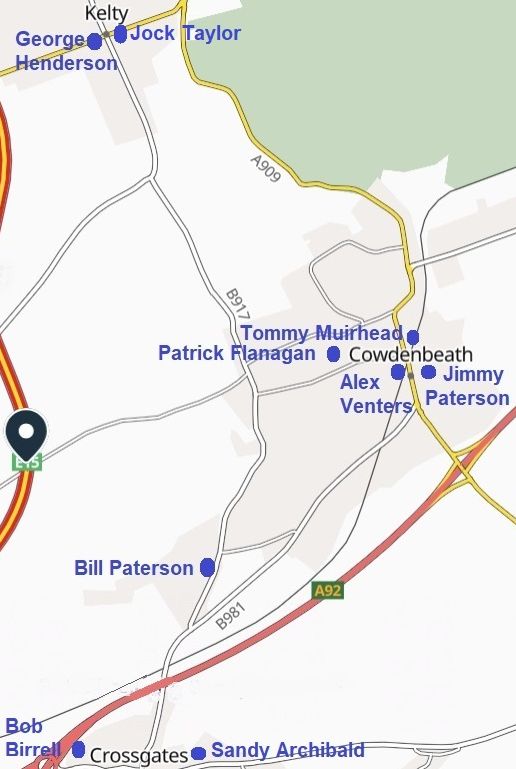
The last pit in the Fife Coalfield closed in 1988. The first had opened in the middle of the previous century and by the turn of the century what had been a large, rural area in the south-centre of the Kingdom had been changed into into three parallel concentrations, running north-west to south east of industry that required and imported manual labour from the rest of Scotland and Ireland. Westernmost was Cowdenbeath with Kelty to the north and Hill of Beath and Crossgates to the south-west. Eastermost there was Cardenden via Bowhill to Auchterderran. And in the middle lay Lochgelly to Lochore and, perched in the northern braes, Ballingry. All were difficult places to exist but were connected by a railway, still largely there today, that carried away the hard-won "black gold" towards Dunfermline or Kirkcaldy and for a good number was also the footballing route to a better life, be it in Scotland, Down South or elsewhere, a significant number taking the boat to North America, some to return, others not.
Cowdenbeath and Kelty
Lochgelly to Ballingry

Cardenden, Bowhill and Auchterderran

Of the Fife Coalfield locations Lochgelly and the valley above it was to be the most productive in terms of game and also be the source of two important footballing families. Ten boys would go on to the top-flight, five winning caps but only four Scottish ones. The first flurry would be at the turn of the century and include James Hendren. He would start in Scotland, move to America for a couple of seasons before returning and picking up with Hibernian. And was also the uncle of the Hibs great, Pat Stanton. And in the second flurry would be after The Great War and include John Duncan, who would be a pillar of Leicester as player and manager, representing Scotland once. And he would also be an uncle, this time of Alex wood, also born in Lochgelly, who emigrated as a child again to America and, before returning to a career in England, was in the US team in 1930 to reach the semi-final of the first World Cup.
The Players - Internationals
Cowdenbeath & Kelty
Lochgelly to Ballingry
Johnny (& Tom) Duncan
Geordie Wilson
Archie Devine
Michael Gilhool(e)y
Alex Wood
Other Players in Scotland, England and Beyond
Jock Rattray
James Hendren
Andy Clark
Jock Hamilton
David Pratt
Cardenden & Auchterderren
Back to the SFHG Homepage