John Connell
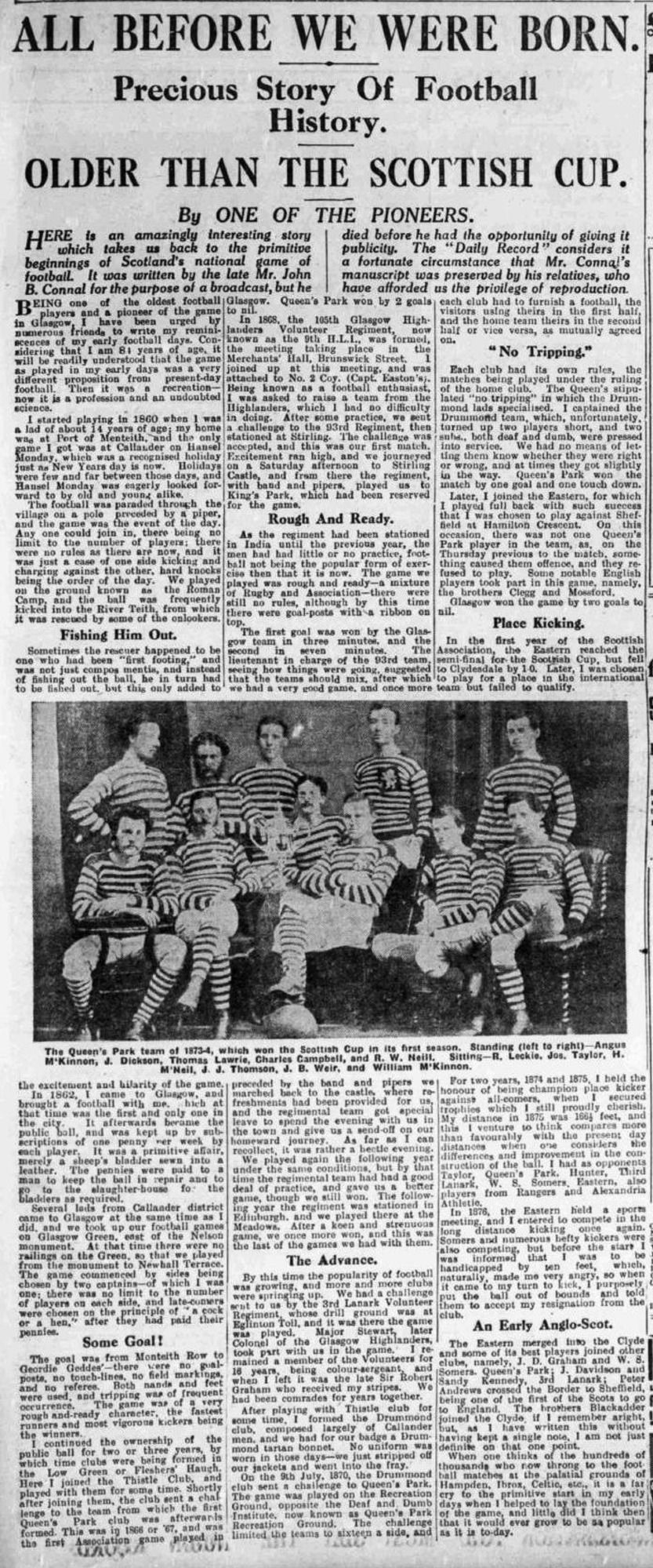
John Connell, John Burns Murdoch Connell or Connal, was the quiet man of the arrival of first football and then the Association game to Glasgow and therefore Scotland. He, himself, had been Perthshire-born, in 1846 in Doune but by 1851 the family was in Thornhill, his father an Inn Keeper and in 1861 back on the land by Port of Menteith, the father now a Ploughman.
Furthermore it was in that border area of Stirling- and Perth-shire that Connell had both come in contact with football, in his case folk-, mob-fitba' of the Callander ilk, and also from where he moved, seemingly alone, to Glasgow, in, by his own telling, 1862, so aged fifteen or sixteen. Further-more, he came with a Perthshire ball, a sheep's bladder in a leather cover, that he began to let out to groups for games, mainly on Glasgow Green and with him often as one of the organisers.
And it was within two or three years, so by about 1865, that the first "clubs" began to emerge, he joining the original Thistle club that would in 1868, Connell still only twenty-one, issue a first match-challenge. It would be to the equally newly-formed Queen's Park, played to something not too far from Association rules with The Spiders winning 2-0. Moreover, he would in 1869, on forming his next club, the short-lived Drummond F.C., largely made up of Perthshire boys, do the same. That game would take place on 9th July 1870, was at least sixteen-a-side and was once more won by Queen's Park by a goal and a touch so to some sort of composite rules.
However, meantime it seems as early as November 1867 Connell might have become a father, albeit perhaps, indeed probably, only by later adoption. A girl, Katherina, later known by her middle name, Margaret, had been born that year but in Mainz in Germany. Her mother, Louisa Barth was from there but had moved to Scotland either pre-pregnancy and returned or would make the move in the next few years. Certainly she and Connell would marry in Glasgow in 1877, she recorded as a Ladies' Maid and he a Warehouseman, the drapery-job he would keep, as he and Louisa had two more children, for the rest of his working life.
And the year of his married seems more or less to have coincided with the end of a football career that had seen him almost play for Scotland. As the Association game had found its way to Glasgow he joined Eastern, there playing at full-back and famed for his kicking. He was to win prizes for the distance he could power it, indeed that very ability would cause the end of his on-field career. And whilst at Eastern he would in 1875 be picked for Glasgow to play Sheffield, a 0-2 away win, this despite all the chosen Queen's Park players withdrawing at the last minute in a huff, with both goals from fellow Eastern player, Peter Andrews. Furthermore, that same year he trialled for the national team, failed to be selected outright but was one of two reserve backs.
But it would all come to a spectacular if unusual end, he by then aged thirty-four, when at the 1876 between-seasons,Eastern club sports-day he was in the long-kicking competition said to have had imposed a handicap of ten feet, to have taken offence, kicked the ball out of bounds and resigned from the club on the spot. It left him and Louisa to live out the rest of their lives in Glasgow, for the last thirty of them on Camperdown Road in Scotstoun. She was to die from there in 1927 at eighty-four, he three years later in 1930 at the same age but having left the above and priceless recollection of how he had been at, indeed, the epi-centre of the of the foundation of Scotland's game seventy years earlier.
Birth Locator:
1846 - Doune, Kilmadock, Perthshire
Residence Locations:
1851 - High St., Thornhill, Perthshire
1861 - Bigram, Blairhoyle, Port of Menteith, Stirlingshire
1871 - (Mainz, Germany?)
1877 - 89, Taylor Street, Glasgow
1881- 181, Stirling Road, Glasgow
1888 - 65, New City Road, Glasgow
1891 - 3, Mary's Place Glasgow
1901-1930 - 51, Camperdown Road (now: Earlbank Ave.), Scotstoun, Glasgow
Death Locator:
1930 - 51, Camperdown Road (now: Earlbank Ave.), Scotstoun, Glasgow
Grave Locator:
N/A