A New and Scottish Historiography of Association Football
(The Story and Analysis of How Scotland and Scots made the Game, the English Game and More)
Part 1: (1860-1900)
Prologue
There is but one programme in BBC Scotland's sports' broadcasting's output - aye, they let us have some of our own transmissions, you know, and sometimes even in the vernacular - that extends itself to be worth at least a pinch o' saut. It is "Off the Ball", said by its own miserable propaganda to take a "satirical and sideways view" at the game of football. Aye, reet! The alternative of 99% "petty and ill-informed" is more like it but when things go really pear-shaped the result can on the rarest of occasions and, of course, accidentally, passingly be that magical Scottish combination of self-depreciation and reality and even intelligence, knowledge and almost insightfulness.
And then there is the humongous, perennial error of the Terracing Teaser, the cretinous reverse-question, on which your entry into this specifically Scottish re-look at the history of the Scottish game is foolishly predicated. The OTB format is to ask what is the question based on the provision of the answer, or in this case answers in the form of these three numbers.
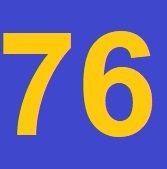
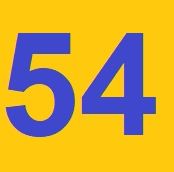
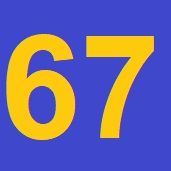
So if 76, 54, 67 and, indeed, a 70 and even more 67s are the responses what was the original enquiry and with that you will have, within the body of the text amd tables below, the reason why football was and, despite from elsewhere, shall we say "unequal generousity of kudos sharing", read "gas-lighting", remains the game of Scotland's soul and passion.
Introduction
So this piece, for it is neither article or paper, neither journalistic or academic, is a way of expressing through logic -based research, through empiricism, the frustrations of the sentient Scottish and wider, true football-fan, at the way and from whom the facts of Association football history were grabbed by those who had little participatory right, part-manipulated and part-repressed by the same, moulded into an artificial edifice - fake-news - but which, now with digitalisation, finds itself more than under threat, more than threadbare, but falling apart.
And to demonstrate that you are going to be provided with not necessarily the answers but certainly the conclusions first and it is up to you to read and and absorb the background, which is presented (in gold) in the form of threaded examination mostly of one Scottish area and mainly two clubs (and they are neither Glasgow or Queen's Park} and (in gray) more random articles and research done at various times as back-up, back-stop foot-notes, jottings and working-towards but up-dated and even corrected as necessary. It is a format that has been made possible by the Internet and effectively replaces, because of an ability to edit, enhance and change, the previous concept of the one-off academic thesis yet is equally open to review by peer, should those peers be bothered.
So here we go:
Conclusion Synopsis
1) Association football is a game founded in 1863 in Covent Garden, London, England.
2) Without the presence of Sheffield and its round-ball football for the first decade of the Association's existence there would be no modern Association-football.
3) Without Scotland and the Scottish-Game for the next three decades Association-football would again not exist in the present form and not as a global sport.
4) Not just professional, paid-to-play, individual- but also team-sport has existed in Scotland since who knows when.
5) Whilst Glasgow's Southern Suburbs were the source of Association-football in Scotland and they remain, although not necessarily to the greatest advantage, the administrative centre of the same, they were not that of the distinctively Scottish-Game.
6) The source of the Scottish-Game and therefore the Scottish passing-game was not Glasgow but Dunbartonshire's Vale of Leven.
7) Working-class round-ball football and the first working-class footballer originated in Sheffield.
8) Working-class Association football originated in Scotland, closely followed by Birmingham and North-East Lancashire.
8) Openly professional round-ball football originated in Sheffield.
9) But openly professional Association-football originated again in Birmingham and North-East Lancashire.
10) In England the basic driver of professional round-ball football was the administrative take-over from the game's provably, non-Public School, middle-class founders by the products of those Public Schools, the working-class reaction to it and the import of Scottish talent over the next two decades to fuel and render successful that reaction.
11) In Scotland, whilst much of the game was and remained local, the initial driver of wide-spread, professional football was from 1880 with Queen's Park active use of what we would today call tapping-up to recruit non-local and therefore at least "shamateur" talent.
12) By 1886 England's aggressive response to increasing professionalism had collapsed, leaving Scotland completely exposed yet through Queen's Park pressure failing to react with consequences for what had been by far and away the most successful national team in the British Isles and since then quite possibly globally.
13) Again in the Vale of Leven the fundamentals of the Scottish-Game having been honed in the 1870s were in 1888 then augmented at Renton by the introduction of the specifically Scottish centre-half, The Pivot, providing the essence of a fully functional mid-field, and its rapid transfer via personnel, mature "Scotch Professors", to wider Scotland, notably through the newly created Celtic, and into England.
14) By 1898 the process of Scottish, tactical transfer was within Britain largely complete. But, as the national team also recovered its position with professionalism in Scotland finally accepted, the principles of play developed at Scottish clubs at all levels were now not just being carried globally by enthusiasts but beginning also by recognised players and/or coaches.
15) And that world-wide transfer has become what is now the modern, World-game.
______________________________________________________________________________________________________________
But now to the detail:
Foreword
This piece, this "treatise" is an attempt to look at, to be momentarily highfalutin, in an Aristotelian argumentative way and write the early history of first what will here at times be referred to as "round-ball football", to distinguish it from the "oval" one, and then Association football, and from that distinctively Scottish Association football, not on the basis of the solely analogue input previously available but taking advantage of the data that has been digitalised over the last decade and continues to be. It had also been begun with the potential, just to carry on the theme of pomposity, for Hegelian synthesis but the conclusions seem finally to provide very little scope. The previous, as the academics like to call it, historiography has simply been wrong, indeed the continuation of an exercise, if we in Scotland were "North Britons", in South British gas-lighting.
And the impulse for the work has been in terms of our Scottish football that the wealth of new information and the ability more easily to join its parts together has created a new, different, revised and continually revisable picture, a novel historiography, of, just for the moment, mainly the thirty years from roughly 1870 to 1900 when Scots thinking on the game and the "Scottish-Game" were pre-eminent in Britain and therefore globally. With, if still interested, the main planks of the new un-gas-lit argument in chronological order being:
- Organised, inter-club, large-scale and therefore recognisably modern round-ball football was first developed from 1860 to local rules in Sheffield, England.
- Organised, non-mob football had existed in Scotland for several hundred years prior to point 1) but was regional, local, even parochial.
- As, from the mid-19th Century, modern Glasgow developed round-ball football came to Glasgow Green (After 1862 with John Connell) at much the same time as Sheffield but was semi-organised.
- In 1862 the Englishman John Thring published his pamphlet "The Rules of Foot-ball: The Winter Game. Revised for the use of schools" including his own rules for "The Simplest Game". Note the word "winter".
- London's Association football was founded in 1863 and throughout the late 1860s crucially nurtured by Sheffield to the point of "adulthood" and full independence from the oval-ball.
- In 1865 the first inter-city game, the pre-cursor to the International, was played between Nottingham and Sheffield, 18-a-side, to "Nottingham Rules".
- In the 1867 the Youdan Cup, the pre-cursor to the FA Cup, was played in Sheffield.
- In 1870 there was in Scotland the first known, written evidence of a team-sport (shinty) being explicitely played for money, i.e. professionalism.
- By mid-1871 Glasgow's Queen's Park accepted the London FA Rules and Association football as a winter not, as previously had been the case at that club, a summer game.
- In February 1872 there was the first record of team formation in a major game. It came in the fifth "unofficial" international. Both "England" and "Scotland" played 11-a-side and 1-1-8.
- In early 1872 the notion of fully Association football and first Glasgow thinking on it arrived through Queen's Park to the city. ("Association" rules had been employed in South Scotland prior to that date)
- In the 1872 FA Cup Final The Wanderers play 1-1-8 but The Royal Engineers 2-1-7.
- The Vale of Leven club from Alexandria in Dunbartonshire is officially founded in mid-August 1872. It is the World's first known, working-class, Association football club.
- In late August 1872 Queen's Park in playing Airdrie use an entirely novel 2-2-6 formation.
- In October 1872 Queen's Park in playing Granville revert to the English 1-2-7
- But in November 1872 in the first official international England form up as 1-2-7 but Queen's Park aka Scotland as 2-2-6 once more.
- In December 1872 in officially playing Vale of Leven, "The Vale", for the first time and in Glasgow, Queen's Park again employ 1-2-7 but the visitors 2-2-6.
- In Scotland by early 1873 impulse to and the control of round-ball football, the Association game now dominant, moves from Glasgow Green to Queen's Park in the city's Southern Suburbs,
- In the second half of the 1872-73 season in Scotland Queen's Park continue with 1-2-7 and 2-1-7 formations.
- In England in the second international in early 1873 Scotland retain 2-2-6 and England play 1-1-2-6
- In the English FA Cup Final in 1873 both teams play 1-1-8.
- But in Scotland in Glasgow Clydesdale in its first recorded game had adopted 2-2-6 and its opponent that day also newly-formed Granville was already experimenting with 2-2-1-5.
- By 1873 also the original middle-class, first generation founders of Sheffield football were fully replaced by a second.
- By again 1873 in England Association football outwith London took root first in Birmingham at Calthorpe and through Scots and then in 1874 in North-East Lancashire.
- At the start of the 1873-4 season both The Vale and Queen's Park are playing 2-2-6 and by November Renton is known to have taken that a stage further to 2-2-3-3; basically a shinty formation.
- In the course of the 1873-74 season Glasgow clubs continued to experiment formationally, seemingly employing in individual matches 2-1-1--6, 2-1-3-4, 4-0-6 and most notably already 2-3-5.
- By late 1873 the now tactical innovations reported by outside observers of position and passing, both short and long, in deliberate combination that would make for the first and distinctive iteration of the Scottish-Game would come certainly from a) outwith Glasgow, from Dunbartonshire's Vale of Leven and probably b) outwith football from shinty.
- In the 1874 international Scotland still played 2-2-6 but England now tried 3-7.
- In the 1874 English FA Cup Final both teams use 1-2-7, whilst in the Scottish Cup Final both employ 2-2-6, which is possibly actually 2-2-2-4 or 2-2-3-3.
- In 1874 the original middle-class founders of the English FA in London are fully replaced by alumni of the Public-School system.
- The World's first professional, round-ball footballer was probably Sheffield and Sheffield Rules' Jack Hunter, followed in 1876 by "hybrid professionals" from Scotland to Sheffield, J.J. Lang and Peter Andrews, then in 1878 by also Scottish, fully Association football players, Archie Hunter to Aston Villa and Jimmy Love and Fergus Suter to Darwen.
- In the 1875 FA Cup Final the Old Etonians play 3-7 and The Royal Engineers now 2-1-7.
- In 1875 Renton became the first working-class team to reach the final of the Scottish Cup and therefore of any major, Association football competition. In it both teams line-up as 2-2-6, Renton quite possibly 2-2-3-3.
- In the 1875 international England play 3-7 and Scotland 2-2-5-1, possibly 2-2-3-2-1.
- In three weeks in March 1876 in the Scotland-England international the former take the field as 2-2-6 once more and England as 2-2-4-2, adopting for the first time the Scottish defensive formation, in the Scottish Cup Final both teams are 2-2-6 and in the English FA Cup Final The Wanderers 2-2-6 but Old Etonians still 1-2-7.
- In 1876 Queen's Park are known definitively to be also playing 2-2-3-3
- In 1876 in its first international (against Scotland) Wales used 2-2-6, as did the Scots. Scots-born Dr. Daniel Gray (Grey) plays for The Principality.
- In October 1876 the previous winner of the English FA Cup Final, The Wanderers, and that of Scottish Cup, Queen's Park, played each other in London in what was effectively a first World Club Championship. Queen's Park won 0-6 away. (The 1877 match, which would have been between The Wanderers once more and Vale of Leven did not take place because of a dispute over expenses)
- By 1877 the centre of the on-field game in Scotland, the Scottish-game, had fully moved from Glasgow to the Vale of Leven, the working-class Vale of Leven club winning the Scottish Cup for the first of three consecutive times, and would effectively remain there for the next fifteen years as the centre of control of the game off-field North of the Border remained in Glasgow
- The 1877 Scottish Cup Final had both teams playing 2-2-6, the English FA Cup Final finally both also 2-2-6 but in the international England tried 3-1-6, even 3-1-3-3 and Scotland seemingly 1-3-4-2, perhaps 1-3-2-4, so with a sweeper behind three half-backs, in McDougall and Smith two big centre-forwards and Ferguson, the first working-class-Scots footballing star, seemingly solo on the left-wing.
- In the 1877 England-Scotland international the Scot, John Bain, born in Bothwell, plays for England, the first of several countrymen to decide or have no choice but to turn out for the Auld Enemy.
- The Sheffield Rules game was in 1877 absorbed by London, creating what might be called the "Unified Rules", but leading, because of dissent from within Sheffield itself, to schism and the partial collapse of the game there for the next decade.
- In the 1878 Scotland-England international both teams play 2-2-6, in the FA Cup Final it was the same as, of course, it was with the Scottish Cup Final.
- In 1878 The Wanderers hosted a second "World Championship" in London, this time against The Vale, the latter winning 1-3 again away, both team now playing 2-2-6.
- In 1878-9 in North Wales by Wrexham 2-3-5 , The Proto-Pyramid, began to be used regularly.
- In all three of the major games at the end of the 1878-9 season all teams use 2-2-6.
- In 1879 the first Renton club collapsed just as Vale of Leven, The Vale, won the Scottish Cup for the third year in a row.
- In December 1879 in Glasgow Old Etonians faced The Vale in the third "World Championships". Vale of Leven would win 5-2, both teams again playing 2-2-6.
- In the two Cup games at the end of the 1879-80 season all teams use 2-2-6 but in the Wales-England international both elevens are recorded as lining up not just as 2-2-3-3, the two centre-forwards playing one behind the other, but the wing-pairings with the front one tucked in-field in two up-turned Vs. The inside-forward and thus full The Pyramid is seen to be born.
- Queen's Park responded to the on-field challenge of The Vale by from 1880 initiating the recruitment of better players from outwith the club through a policy of "assembling" from i.e. "tapping-up" other teams mainly in the Glasgow area but thereby actually forcing the setting in train the change from "local" to "assembled" clubs and the process towards eventual not prize but wage-based professionalism in Scotland and almost its own demise.
- In May 1880 the fourth "World Championship" took place, this time a double-header. Queen's Park beat Clapham Rovers both home and away, 4-2 on aggregate.
- In March 1881 England are defeated at home in London by Scotland and 1-6. The highest margin ever.
- In January 1882 the fifth World Championship takes place in Glasgow. Suffice it to say Queen's Park won 8-0.
- In 1882 Ireland plays its first international and using 2-2-6.
- In 1882 Wales use both 2-3-5 certainly and perhaps The full Pyramid in beating England for the first time but will revert the following season.
- In 1882 Scotland inflicted the third heavy, international defeat in a row of England.
- In 1882 Lane Jackson in London starts the anti-Scottish, anti-working-class Corinthian project.
- In 1882 in England the first northern and also working-class team reached the FA Cup Final but it was not from Sheffield, where working-class football had first been played but was Blackburn Rovers and with three Scots in its eleven.
- In 1882 in Lancashire initial measures were taken against non-local professionals i.e. Scots and completely ignored
- The Renton club re-formed in 1882
- In 1883 Blackburn Olympic became the first northern and working-class team to win the FA Cup.
- In September 1883 and February 1884 a double header, now openly British Championship was held. Dumbarton won 6-1 at home and lost 3-4 away to Blackburn Olympic, aggregate 9-4, the former playing 2-2-6 and the latter now 2-3-5.
- From five in 1878-9 the number of Scots playing as effectively professionals In England had risen to about fifteen in 1881-2 and nearly forty in 1883-4
- In January 1884 in England objections for professionalism were with the English Football Association raised against a now "assembled" Preston North End by a "local" amateur London club. Unapologetic Preston was found guilty and disqualified from the FA Cup.
- "Assembled" Queen's Park do not agree to a postponement of the 1884 Scottish Cup Final against a Vale of Leven, "local" First Team decimated by illness. Vale of Leven withdraw
- In the 1884 Scotland-England international England line up as 2-3-5 with Indian-born, Gaelic-speaking Scotsman, Stuart MacCrae, as centre-half. He had first played for England the previous year.
- In 1885 new anti-professionalism measures formulated by Lane Jackson are introduced in England by London, objected to in England by Northern clubs, which threatened schism, with London more or less backing down, the exception being annual registration, with what otherwise remained of the policy in any case again ignored.
- In 1885 "local" Renton reach and win the Scottish Cup Final beating neighbouring and also "local" Vale of Leven.
- In the 1885 FA Cup Final 2-3-5 is used for the first time and by Blackburn Rovers with at centre-half the Scot, Hugh McIntyre, whilst England against Scotland use the same formation with Blackburn's outer half-back and McIntyre-protege, James Forrest, in the McIntyre role.
- In 1886 Blackburn Rovers win the FA Cup for the third time in a row, now with four Scots in its otherwise "local" eleven and a first recognised Secretary cum Manager, the Scot, Thomas Mitchell. He employs 2-3-5, McIntyre still at centre-half, as do opponents, West Bromwich.
- In 1886 England with nine Corinthian players, the maximum to be selected, was held, 1-1, by, from the 65th minute, a 10-man Scotland, Queen's Park's George Somerville scoring the equaliser in the 80th minute and with Lane Jackson an umpire
- In the Scottish Cup Final both teams still use 2-2-6.
- In 1886 all international teams except Scotland use 2-3-5.
- In 1886-7 the number of Scottish professionals in England passes the hundred mark
- In 1887 the Scottish FA at the behest essentially of Queen's Park bans all Scottish club participation in the FA Cup because of professional, English clubs taking part. Seven had participated the previous season.
- In 1887 "local" Dumbarton reach but lose the Scottish Cup Final to at least partially "assembled" Hibernian but with both teams now also using standard 2-3-5, i.e. with one of the centre-forwards dropping back into the middle of the half-back line, i.e. The Pyramid.
- In 1887 Aston Villa in the "World Championship" take on and beat the same Hibernian in Birmingham and 3-1. It is the first "English" victory in the unofficial competition but The Villa is managed by Scot-born George Ramsay and its captain is Joppa's and formerly Third Lanark's Archie Hunter.
- In 1888 John Goodall raised and learning his football in Kilmarnock but born in London, because his soldier father was serving there at the time, is first selected for England.
- In 1888 President of the English FA awards his match ball to winners of the FA Cup, West Bromwich, on the grounds that its team is all English (Defeated Preston North End having six Scots plus John Goodall in its eleven).
- In 1888 local Renton, playing its new 2-2-1-2-3 formation with what would become known at the Scottish-Centre-Half or -Pivot, differently an inside forward dropping back in front of the outer halves, win the Scottish Cup, against 2-3-5 Cambuslang, and then defeat West Bromwich, 4-1, to become World Champions and Preston North End, 4-2, to be de jure double "World Champions".
- In 1888 Scotland lose to England for the first time in almost a decade, at home and badly, 0-5, 0-4 down by half-time, with some kind of very unsuccessful mish-mash of 2-2-1-2-3 on 2-3-5 and serious problems on the right side of the defence.
- In 1888 the formation of Celtic is completed entirely by tapping-up, taking two Renton players, including, as captain, James Kelly to be part of its first eleven.
- In 1889 Preston North End win the English Cup and League Double with again six Scots players in its first team plus John Goodall.
- In 1889 in the de facto World Championship Preston and Third Lanark draw 3-3 in Glasgow, The Thirds having defeated in the Scottish Cup semi-final a Renton depleted by 10 departures, with twelve more the following season.
- In 1889 Scotland beat England by playing effectively a 2-2.5-0.5-5. It is an England now not only including John Goodall but also Bolton-player, Davie Weir, another from a Scottish military family, born in Aldershot but raised in Maybole.
- In terms of numbers moving South to play professionally in England, the total goes from just less than 100 for 1887-8 to over 200 by 1891-92, or seven per top-flight team, the Scottish national team because of the residency-rule therefore being severely weakened.
- In 1890 the Scottish League kicks off. Queen's Park, "assembled" Cup-winner over still "local" Vale of Leven, is invited to join but does not take up the offer.
- Renton is due to Queen's Park pressure expelled from the Scottish Cup for alleged involvement with professionalism and takes the SFA to court.
- At the end of its first season "local" Dumbarton is with an "assembled" Rangers the Scottish League Champion, Renton wins court case and is reinstated, still "local" Vale of Leven reaches the Cup semi-final and a "partially-assembled" Queen's Park takes the trophy.
- In the1890 FA Cup Final Blackburn Rovers defeat a finally resurgent Sheffield Wednesday with the former with now two Scot but the latter none.
- For the 1891-92 the number of Scottish professionals in England passes the two hundred and fifty mark.
- Over two legs in the 1891-92 season in the World Championship Everton take on Rangers, win one leg and overall with an aggregate of 4-3. Everton has eight Scots in its eleven.
- At the end of the 1891-2 season "local" Dumbarton is again League Champion but "local" Vale of Leven is not re-elected.
- In 1892 Sunderland face Celtic home and away for the World Championship and win on aggregate 4-0. But then the Wearsiders eleven would be Doig, Porteous, Smellie, Wilson, Auld, Gibson, D Hannah, J Hannah, J Campbell, Scott, Miller. Draw your own conclusions.
- In 1893 "assembled" Celtic win the League for the first time as again "partially-assembled" Queen's Park win the Cup for the last time.
- In 1893 professionalism is legitimised in Scottish football and the Second Division is formed.
- In 1893 two World Championships are competed for. One is English League versus Scottish Cup. Sunderland beat Queen's Park 4-2, Sunderland has seventeen Scots in its squad. But to the Cup-to-Cup game Queen's Park still beat Wolves 5-0.
- In 1894 still "local" Renton is relegated to the Second Division.
- In the 1894 World Championship in the league encounter Aston Villa just beat Celtic in Birmingham 3-2 but between the Cup-winners in Glasgow Rangers defeat Notts County, 3-1.
- In April 1895 Sunderland become World Champions again, this time beating Hearts 5-3 and in Edinburgh but The Black Cats are Doig, McNeill, Gow, Dunlop, Auld, Johnston, Gillespie, Harvie, Campbell, Miller and Hannah.
- In 1895 still "local" Renton from the Second Division reach but lose the Scottish Cup Final.
- In 1896 residence requirement for Scottish international is removed. Scotland beat England for the first time in six seasons. James Cowan of Villa ex. Renton as Pivot.
- Scot John Goodall after a record twelve goals in fourteen caps over a decade is in the England side for the last time. He had scored more England goals than any other player to that point and at 86% still holds England's goals per cap record. The next best is Jimmy Greaves with 77%.
- In 1896 still "local" Dumbarton is relegated to the Second Division.
- The FA Cup Final is finally won by a Sheffield club, Wednesday, but with five Scots in its eleven but only two in that of defeated Wolves.
- The 1896 World Championship goes to Celtic, defeating Aston Villa 1-0.
- In 1897 still "local" Dumbarton reach the Scottish Cup Final but resign from the Scottish League.
- In 1898 local Renton resign from the Scottish League as for the following season the number of Scottish professionals in England reaches its recorded maximum of almost 300.
- For the first time ever in a World Championship, in thirty seasons, a team made up entirely of English players finally beats its Scottish equivalent. The former was Sheffield United, the latter Celtic, the aggregate 2-1.
- In 1899 "fully-assembled" Rangers beat almost "fully-assembled" Celtic in the Scottish Cup Final.
- In 1900 Queen's Park join the Scottish League for the first time and into its First Division. Scotland beats England 4-1, Bob McColl scores a hat-trick. Alex Raisbeck is The Pivot. Assembled Celtic beat a now mainly "local" Queen's Park in the Scottish Cup Final, Queens' Park no longer able to compete in the transfer market?
- in 1900 Rangers and Villa share the World Championship, played in Glasgow and goalless.
Introduction
In 2023 it was suggested that the new thinking on early Scottish, foot-ball and football history to the beginning of the Second World War, and, indeed, football history in that same period more generally, emanating from the SFHG and others might be worthy of academic recognition through a PhD. And one over two to three years at Edinburgh University was applied for, but on the understanding 1) that it would be in the name of the whole group and not one person and 2) it would be a replacement for or at the very least the dominant part of a merging with the old thinking i.e. an antithesis to the current thesis leading at the least to synthesis, if not more.
The proposal was, however, without real explanation at the time but possibility hinterland, knocked back, which denied the academic route but saved £15,000 and, due to on-line technology, still left fully open the possibility of it being worked through, completed and simply posted. And what follows here is the result, not in a heavy but largely ignorable and ignored tome but in a series of articles, essays, if you like, sometimes loosely-linked, that state and allow, with more knowledge still becoming available, the amendment the current thesis yet without much need for compromise. The crux, in something of a repetition, of the offering on the one hand is that:
- Association, Association Rules (AR) football is provably not a product of the English Public School system.
- At its creation it probably would not have survived but for the Sheffield Rules (SR) game and the input specifically of Sheffield F.C..
- Much of the off- and on-field innovation in the early game also came from that same Yorkshire city before, for internal reasons, its football imploded.
- From the early 1870s when the game arrived North of the Border it was Scotland and Scots, our country and countrymen, and not England and the English, which and who for much of the next fifty years picked up the baton and successfully ran with it.
- And it was within Scotland but a) not at Glasgow's Queen's Park club as formally posited that b) major tactical innovation took place at two stages over the fifteen years from baton transfer, c) which was fundamentally to change the framework of our game on-field as d) Association football was in the same period consolidated in first Scotland and then wider Britain on-field and but also in-club as a universal and not a class-riven sport, e) it caused, both unofficially and officially, the professionalisation of the game and in doing so f) created through a Scot, William McGregor, the competitive league structures followed by most sports and by most of the World with g) Scotland then the driving force in taking that same game global.
But it begins with a little background and immediate thanks to Ged O'Brien, the founding Curator of the Scottish Football Museum, Europe's first, and to Andy Mitchell, the doyen of real historians of football in Scotland and wider Scottish sport. Thanks to O'Brien there has been the identification from 1627 at Anwoth in Dumfries & Galloway of what is just now considered to be the oldest football field in Scotland, Britain and therefore worldwide. But here a note: We have no indication of whether it was used in summer or winter or both, although knowing the Dumfriesshire winter, the former must be favourite. And from Mitchell we have his research into the Foot-Ball club John Hope founded in Edinburgh in 1824 and ran for the best part of twenty years. Gone into in depth in John Hutchinson and Andy's book, "1824 The World's First Football Club" we have a strong, and perhaps the earliest example of what could be called football's, i.e. the round-ball but not yet Association game's "modern" era of both written codification plus games, albeit then only intra-club, and continued organisation over an extended period of time; in this case seventeen years.
And this trend was further covered to the late 1850s in this, in retrospect, admittedly somewhat peevish, SSHG piece, "The Absurdity of the Parochial" (See next column). It was written in response to the claim by Sheffield, Home of Football (Our Brackets: Not Association football) that it was in 1857 and at Sheffield FC, the important nullifying proviso being that its rules were at that stage also only in-house. You will note here that the English Public Schools have not been mentioned because codification of their footballing iterations came mostly later, Rugby School in 1845 with its thirty-seven being the exception and with our SFHG Supplementary Timeline giving the more or less definitive chronology.
However, when it comes to organised, competitive, inter-club football, but still not the Association game, then it is the game played on Boxing Day 1860 again in Sheffield between Sheffield and Hallam F.C.s that is the marker. Indeed it is those two clubs and almost twenty more that followed in the same city over the next three years, which at that time represented the round-ball game's only real driver.
And the truth is that even with, in London, the formation in 1863 of the Football Association and therefore of embryonic "soccer" that role as driver did not really alter. It is questionable whether the FA would have survived birth had it not been for the support, even including travelling down to meetings, by a remarkably benign, philanthropic, almost paternal Sheffield and in 1866, even whether it, the London FA, might have dissolved itself but for the same. And through these three early years it was also Sheffield, which was the source, on-field, of a good number of sensible, practical rule-amendments as well as, off-field, competitive and even marketing innovation. It agreed to play, indeed suggested, inter-city, i.e. regional matches, conceptually the forerunner of the international, even agreeing that they take place to local rules. And in the Youdan Cup it produced the blueprint for the FA Cup.
But the question remains 'why', to which the answer might lie in origin and personality. Sheffield Rules football was very much the child of the city's legal profession. What it was not was founded by Public School boys. There was influence, particularly, it seems in the rules, from young men returning from school further south, noticeably Harrow, but the two men who were founders of Sheffield F.C. and therefore considered to be founders of Sheffield-Game, Nathaniel Crestwick and William Prest, were a locally-educated solicitor and a wine-merchant respectively and neither in footballing terms young. The former was twenty-five in 1857, the latter twenty-four. They were comfortably middle- but not upper-class and had come to the game sedately through cricket. And even when they stepped back, Crestwick in 1862, their successors were until 1866 William Chesterman, stepping down aged twenty-nine and a maker of measuring-instruments, and from 1866 to 1876 Harry Chambers, another lawyer, who at twenty-five/twenty-six also served for its first two years as President of the Sheffield Football Association when it was formed in 1867.
And this was a pattern that was fairly closely matched six years later in London. Of the four main, initial office bearers one was a solicitor, two were stockbrokers, and one a wine-importer. Moreover, only one, Robert Graham, had been to a public school, Cheltenham, but for just a year, three of them had come to the sport this time from rowing. Futhermore, Ebenezer Morley, regarded as The Father of the Football Association and therefore of Association football, had been born the same year as Crestwick, so in 1863 was already thirty-five, was also a solicitor, non-Public School and a Yorkshire-man to boot. He had been born and lived until twenty-two in Hull, and as the son and grandson of non-Conformist ministers so no more than middle middle-class.
It meant that one hundred and seventy miles apart there were two groups of round-ball football enthusiasts, who could talk to and interact with each other, not just on a sporting level but culturally and professionally. And talk and interact they certainly did. Sheffield's Chambers in his records states that he attended the first London meetings of the (English) Football Association in 1863, thus giving Northern encouragement as it struggled into life. In January 1864 he was played in the match in London to test the FA's new laws. He also took part in 1866 in the first inter-city match. It was played in Battersea Park between London and Sheffield teams and to London Rules. As to Chesterman he had been the one to propose the London versus Sheffield game, was Sheffield captain that day, represented Sheffield F.C. at the 1867 meeting of the FA, arguing against, giving it Northern backbone, as it almost dissolved itself, and that same day was elected to the FA, the London FA Committee and served on it until 1871. And in doing so he must have reported on developments in the Sheffield game, passing on its thoughts on adjustment of rules and competition, indeed competitions. The Youdan Cup of 1867 was followed a year later by the Cromwell Cup.
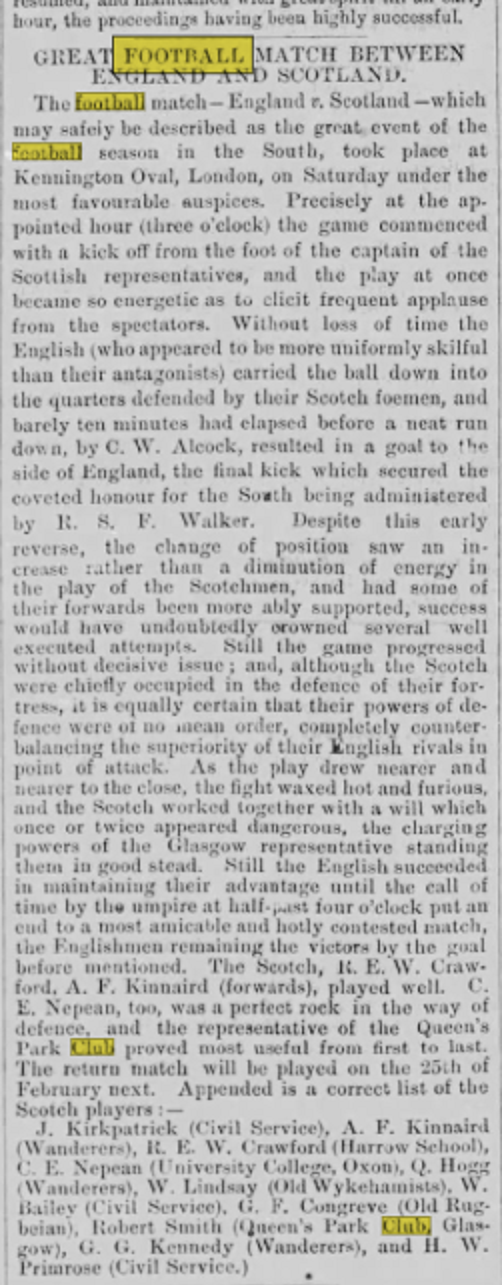
Thus by 1867 the characters, who were later specifically to come to dominate English football's off-field, some for just the next few years, two for extended periods, might have been beginning to fall into place but were not in charge. John Alcock had been an FA Committee member from its inception until replaced in 1866 by his 24-year-old and briefly Harrovian younger brother, Charles Alcock. Harry Chambers was his contemporary, when he arrived the next year. Then in 1868, the year the Association actually ran out of money with the officers covering the shortfall out of their own pockets, Arthur Kinnaird, just twenty-one at the time, would join and he would be followed in 1869 to 1872 by James Kirkpatrick, The Quiet Baron, just a year older than both Chambers and Alcock. He was the man who would go on to organise with Kinnaird the "Scottish" input into the series of five unofficial internationals from 1870, captaining the mainly Diasporan side for the first two matches. He also provides a link back to very first day's of the modern Scottish game in that his father had in Edinburgh been a member of John Hope's Foot-Ball Club. And in the background there was first Robert and then James Smith, who had both come South for work but were the liaison-men with their former club, Queen's Park in Glasgow. Robert Smith would play in the second, third and fourth of Kirkpatrick's and then Kinnaird's international sides as well as for South Norwood and in the first two official internationals before emigrating to America later in 1873. James, who would play in the first official international, would remain, still the link, in London until his death back in Scotland in 1876. Moreover, Robert would, following up match reports like the one below not just in Glasgow but both in Dumbarton and the Vale of Leven, advocate in writing for the unofficial games. As early as 1870 he had the following, essentially marketing, letter published,, not just in London but in the Glasgow Daily Mail.
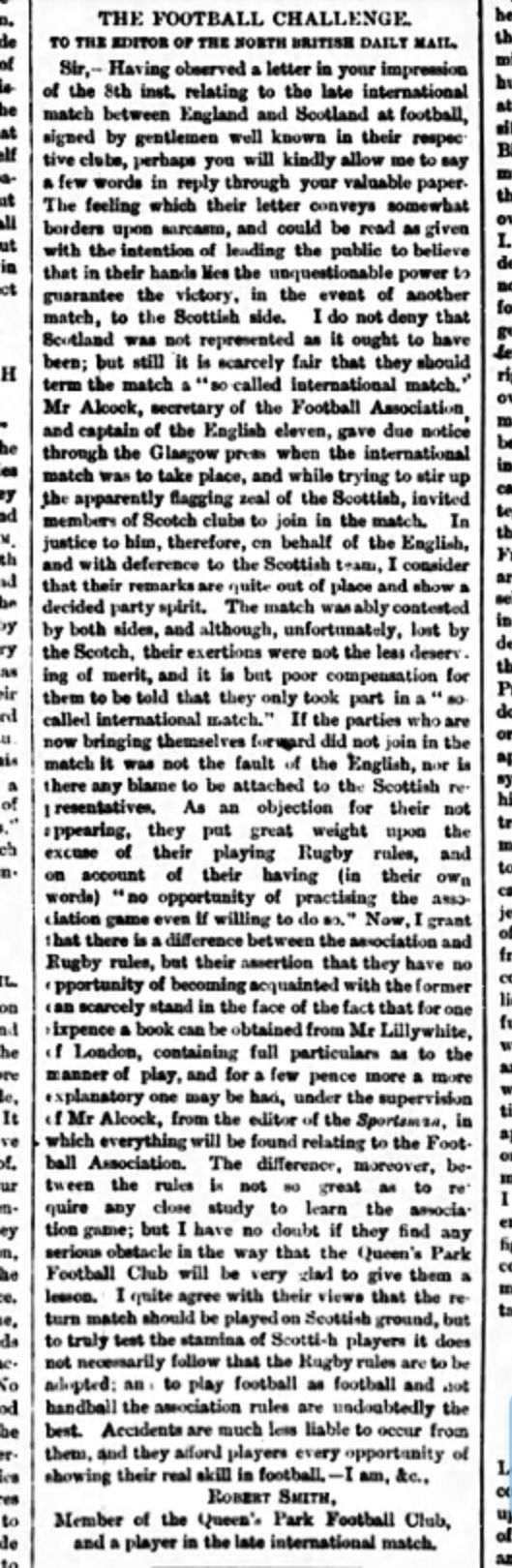
So given that Morley was still in overall control and Graham would remain Secretary and Treasurer until February 1870, only then to be replaced by the younger Alcock, there was in place from the turn of the decade an FA Committee, with Graham still on it until 1871, that was finally settled in terms of core personnel and influences. Moreover, from perhaps 10 member clubs in 1866, the number had grown to fifty or so, with Sheffield about the same, the organisation as a whole was finally also financially stable and could therefore move on. The internationals, the first in March 1870 with organisation clearly already commenced pre-Alcock, were one aspect. The Youdan-like FA Cup was another. A third was the agreement from Queen's Park to enter the FA Cup by its start in November 1871 but negotiated earlier in the year, the club having joined the "English" FA in 1870. And finally there was the first official international in 1872, quite possibly seen as necessary following the example, and challenge, of the first-ever rugby one of March 1871, firstly, taking place in Scotland in Edinburgh, secondly, with actual Scottish Scots in the team and, thirdly, won by Scotland. At that point it might have looked to Queen's Park as if round-ball football North of the Border was in danger of being chased South completely, about which it believed, to its eternal credit, something could and would be done. However, all the above throws some doubt upon the real role of Charles Alcock. To some he was football's first marketing genius, but perhaps not.
As it turned out Scotland's first participation in serious footballing competition, Queen's Park's entry into the FA Cup, could not have gone better. Twice the club was drawn at home to a school team from Lincolnshire, quite possibly even today one of the most difficult places in Britain in terms of transport from where to get to Glasgow, never mind the cost. Once the London FA was able to defer the problem with byes to the next round. On the second occasion there was no helping Donington. It had to scratch leaving the Glasgow a free run without touching a ball to the semi-final. If the draw had been, Heaven forbid, tampered with, it would turn out to be masterly, again quite possibly changing the course not just of Association football but football more generically forever. If not, and it was just happy serendipity, then fate was smiling broadly when the hardly-known, Scottish club travelled to the London Oval for the game against the assumed winners, The Wanderers, Alcock's team, and shut them out.
In fact the result was itself maybe nothing special or at least not too unexpected. The London team was perhaps the best the South had to offer but hardly a whirlwind. It had also had a walk-over and a bye to get to the round of four and had scored three goal to one in the two matches it had had to play, one being another 0-0 draw. However, with the game at The Kennington Oval, the fact that Queen's Park could not afford to travel South again for the replay and The Wanderers went on win the trophy, defeating The Royal Engineers in the final, did generate interest North of the Border. Indeed it was enough that other clubs playing other footballs, cricket and other sports, notably shinty, were now more prepared to listen more attentively to what Queen's Park had to say. And Queen's Park were also forward-thinking in this period and beyond, prepared to travel to demonstrate the sport, for which they were the first and only Scottish advocate or at least seemed so.
In fact it now appears that, thanks in large part to research from Andy Mitchell once more and Richard McBrearty, curator of the Scottish Football Museum, with his blog The Origins of Scottish Football, round-ball football, 11-a-side or otherwise, and even to Association Rules had been already played in Glasgow and along the Solway coast, specifically in and around Stranraer and also by Annan. In the first case it had and would centre around John Connell, who in 1861/2 in his mid-teens had arrived from Perthshire to the old town above Glasgow Green and with a ball that he would hire out for games; what he called a "public ball". His full story as initially a non-Association and later Association footballer, a player for Glasgow against Sheffield and almost an international (he was a reserve against England in 1875) is probably best told in Andy Mitchell's piece, The Man who owned the first football in Glasgow, in this SFHG biography and in his own words in an article, which can accessed in readable form and with greater detail by clicking on its image in the next column and above. The gist of it is that, once in the city, from where he stayed Connell could drop down High St. to Low Green or Fleshers' Haugh, to where ad-hoc games, using both feet and hands but surely with basic rules understood from week to week, seem to have been taking place from at least 1862.
It means therefore that the first centre of Glasgow football was actually north of the Clyde in the city itself not, as wrongly advocated elsewhere, south of the river in the newly developing then still Renfrewshire suburbs. Furthermore, it would also be from Glasgow Green that by 1866 or 1867 the first attempts at teams cum clubs would emerge. The Orkney Exiles was one such earliest on. Connell himself mentions that at about that time he joined the Thistle club. And it was that same Thistle, which, on the formation of Queens Park, the Southern Suburbs' initial specifically but note summer/autumn-only football entity, was, and not the other way round, first to issue a challenge; one accepted on 1st August 1868. Indeed it came from Connell himself, (See: Queen's Park History 1868-1870), indicating that it was he, who had the finger very much on the whole, local footballing pulse. It might even be no exaggeration that in fact he was that pulse and for the best part of a decade. It was again he, when Queen's Park was still getting virtually no interest in its adopted version of neo-Association rules and at least equally emergent rugby was getting much of the attention, who again would challenge it on joining, indeed, in 1869/70 forming, his next but short-lived club, Drummond. The challenge would be met in July 1870. The Drummond club was made up of fellow lads from Perthshire, playing, it seems, to non-Association, still hybrid rules but with the change and adaption about to come.
Meanwhile, however, it now seems that Association Rules, if not quite in their entirety, had been seen on Scottish soil, if only just. John Sholto Douglas, the 9th Marquis of Queensbury, born in in 1844 in Florence in Italy, compiler of boxing's Queensbury Rules, elder brother of Lady Florence Dixie, who in 1895 would become the first patron of the first women's football club, the London-based British Ladies' F.C., had, aged fourteen, inherited the title on the death of his father in 1858. He would then be educated in the Navy, serving until 1864, aged twenty, and before going up to Oxford for two years, not completing a degree, marrying in 1866 and probably for a while subsequently living in London. And it must have been there he, a consummate sportsman, came into contact with football. Even in terms of his known involvement in cricket he would have moved in the same circles as his almost contemporary, Scottish, footballing nobles, Lord Arthur Kinnaird and James Kirkpatrick.
So it seems that when he moved north in 1867/8 for a couple of years at least - his elder child was born in 1868 at Kinmount House, the family seat at Cummertrees by Annan, his second in 1870 in Worcestershire - Douglas took the essence of the London game with him, perhaps combining it with a local tradition of other, Anwoth-type football and setting up a small series of equally local matches to Association Rules but with larger teams, 15- a-side being mentioned, and he himself playing. But note, these were not "Yuletide Games". They were played not in mid-winter but from the middle of March 1868 so as Spring first arrived on the Solway, which may have been just chance but could equally have been a reflection, outwith alcohol-fuelled Hogmanay, again of an older, specifically summer, round-ball sport. Indeed, with, for example, the Anwoth ground it is hard to imagine anyone even then in far hardier times looking forward to a kick-about up there on the top of a hill in the freezing horizontal rain, sleet and snow of anytime between November and March/April.
It is these games and the pioneering work on early South Scottish football by Richard McBrearty, the present Curator of the Scottish Football Museum and PhD Researcher at Stirling University, and covered in his blog Scottish Football Origins that were gone into more detail in the article reshown here in the adjacent column and entitled "Stranraer - and the Coming of Football to Scotland. And it is it, which also takes us onto Stranraer and Newton Stewart and the third specifically Scots arrival of the early, not yet modern but modernish game.
The rise of wide-scale competitive sport was and continued for a good century to be made possible by the railways. It had arrived at Stranraer in 1862, connecting it with Castle Douglas via Newton Stewart. Castle Douglas had itself been connected to Dumfries in 1859 and Dumfries to to the Glasgow to Carlisle line in 1850. As to organised football, it arrived in Stranraer at least by 1865 by when there were four teams, three of which are still identifiable as areas of the town. Of the how and why it got there there is is no current idea. It could have come from north or south. It may even have been once more a long-standing tradition, again a summer one. The quote from John Boyd's 2002 paper "The First Thirty Years" is "they played intermittently on Wednesday afternoons and during the summer evenings on farm fields". However, clearly cooperation between the teams existed, suggesting even a local competition, because that same year, 1865, a Stranraer team, a "town" team, travelled the twenty-five miles to Newton Stewart. It was to take part in the first, over the next ten years, of three known, 11-a-side encounters, presumably again to agreed rules other than just number of players against specifically Cree Rovers, a team that according to other sources would not exist for another decade and more.
Furthermore we have the names of the Stranraer players taking part and there is (See again the article) in them remarkable continuity from 1865 to 1870, even some to 1875 and the move in the interim from non-Association to fully Association Rules. Moreover, those names, thanks to the historically game-changing Scotland's People web-site, can to a degree be pinpointed to the town itself, to surrounding villages and possibly to Ayr. Despite Ayr F.C., one of the two component clubs of present-day Ayr United, having its foundation as 1879, we know, again from Queen's Park's History, that the Cathcart/Crosshill club in 1868 put out feelers for a game to "newly-formed Ayr Football Club" suggesting, similarly to Glasgow Green, a form of ad-hoc football already being played in that town before that "official" date, perhaps even before 1865. Here more work is needed. - a deeper trawl through the local papers, perhaps.
However, let us at this point turn attention back to said Glasgow, initially to Queen's Park F.C. but then not the round- but the oval ball-game. The foundation story of Queen's Park is well-known. It is one of a form of presumably round-ball but ad-hoc football being in 1867 played on Queen's Park itself by local YMCA members and seen by a group of more northerly Scots, from Perthshire, Aberdeen and Aberdeenshire and Moray, forced from their former place of practice of field-athletics by Lorne Terrace in Strathbungo by encroaching development. The latter joined in with the former, took to what they saw and decided to and did form a football-club, but one with a difference, indeed, one that was in a sense elitist. This is all excellently covered in the chapter "The Beginning" of the modern Queen's Park's History and by Robinson's 1920 "
History of the Queen's Park Football Club 1867 - 1917
Renton & The Vale - The Making, Remaking, Unmaking, Breaking and the Who. (But the creation of the Scottish Game)".
"Episode 1: The Making
So this story begins not in mid- or late but early 1872. In March Queen's Park, having from November 1871 received byes to the semi-final of the first London FA Challenge Cup, the FA Cup, travelled to London to face The Wanderers. The result was a draw and, with the visitors unable to finance travel to the replay, they had to default and the home team went on to take the trophy.
Yet the one meeting that did take place tells us several things. The first is that, in order to take part Queen's Park had agreed a twofold acceptance; that Association football was a winter game and the London rules rather than its own would from now on apply. The second is thst two facts emerge, a) we know the Queen's Park team - Gardner, Edmiston, Hepburn, Ker, Leckie, J Smith, R. Smith, Taylor, Walker, Wotherspoon and Weir - and b) just now we do not know the formation. Moreover, we are also aware from contemporary sources that, whilst the internationals between England and Scotland, now designated as unofficial, all of which had taken place also in London, the first in March 1870 and last just a month earlier, had had not inconsiderable Press-attention, this club-match generated still more but also actually not much activity on-field or repliaction. A month later a single match - also a nil-nil draw - was played by Queen's Park against Granville, newly officially-formed just up a few hundred yards up the road at Myrtle Park. But that was it, apart from the previous February when The Spiders, as Queen's Park woud become known, had been reduced to publishing Press-challenges to "All-Comers".
In fact the first game after that was not to be until 28th August, a Wednesday, and the one after that on 19th October; initially against Airdrie, an emphatic 6-0 win, and then Granville once more, again a win, 4-0,. But there was a difference. In both cases we have the teams - Gardner, Wotherspoon, Taylor, Thomson, McKenzie, Leckie, Weir, Ker, McKinnon, Rae and then Thomson, Taylor, Gardner, Hepburn, Leckie, Weir, Wotherspoon, Grant, Rhind, McKinnon and Rae respectively with captain, Robert Gardiner, in the first playing in goal and in the second as a half-back. But crucially we also have the formations. In the second match, just as The Vale is reported in Alexandria to be holding its first practice, Queen's Park, according to The Glasgow Herald, seems in the latter to have played, as was the case with English teams of the era, 1-2-7. This was essentially rugby with feet, with rather than running with ball-in-hand dribbling seen as the replacement in terms of kudos, individual kudos, interrupted only by foot-only "scrimmages", i.e. the equivalent of hand-only mauls. But for the former, again from The Herald, it had been a completely innovative 2-2-6, so for the first time a defense with shape and purpose and, furthermore, perhaps already, the use of the pass simply to play around a potential scrimmage; in fact rendering it counter-productive. And it was these same shape and tactic that were to be employed, in the penultimate encounter of the year, played now in Glasgow and the World's first official international.
Now at this point we have to wind back slightly. At some point still in 1872, said to have been most likely in the Summer or perhaps Autumn but intimated as well before December, Queen's Park, as part of its programme of demonstrating specifically the Association game and creating opponents had travelled to the valley of the Dunbartonshire Leven, to the Park Neuk recreation-ground specifically, it on the riverside itself in Alexandria and probably from as early as 1852. That year the Dumbaton Herald & County Advertiser reported the opening of a "playing-ground" for cricket, quoiits, shinty, curling and notably also football, kind unknown.
Fifty years later Robinson in his History of Queen's Park Football Club reports,
"The Vale were at first disposed to adopt Rugby rules. They also played shinty to some purpose. A deputation from the Queen's Park went to Alexandria to lay before the neophytes the higher perfection of the Association code, with such good results, that the Vale abandoned the Rugby idea." (But note not the shinty one)
No-one knows exactly when "the deputation" was. There is no Press mention of it at all. But from a report actually in the local, Dumbarton-based paper, the Lennox Herald, we do know definitely that Vale of Leven Football Club was formed on 20th August, a Tuesday, suggesting, albeit as a longish shot, even though it began as Vale of Leven Rugby & Athletic Club, it may have been immediately before or after that date, even possibly the weekend of 24th/25th August. Which in turn opens up the possibility the new or even proto-Vale of Leven might have been the inspiration, even the reason for the Queen's Park i.e. captain Robert Gardener's apparent formational experimentation just three days later in his club's opening game of the 1872-3 season.
And the source of that formation may well be precisiely that Scottish ancient game of shinty, now finally starting to achieve rightful recognition as an origin of ice-hockey and even golf. In the upper valley of the Leven, where the Orr Ewing brothers, Alexander and John, had in the 1830s founded their calico printing-works, employing often near-Highland labour, it had become the winter game. The first recorded shinty match between the two establishments had been in 1852. In 1870, so just two years before the visit of Queen's Park and despite some seeing the game as "wearing somewhat out-of-date", 2,000 or so spectators are said to have come to the annual encounter, played at Tillichewan by Balloch. They and the young men on the field-of-play were thoroughly versed in the old sport and its stands to reason that they would have approached the new one with it doubly in mind. Firstly, it is said that when they were invited to take the field at Park Neuk/Cameron Park to play against the Glasgow men first they did so in shinty formation. Secondly, the major shinty challenge-matches involved prize-money. The 1871 game between the Orr-Ewing works was for £5; that in 1870 for £10. There was even a suggestion of £50 to £100 for a Vale of Leven challenge to Inverraray. Early 1870s shinty was clearly what today would be called semi-professional.
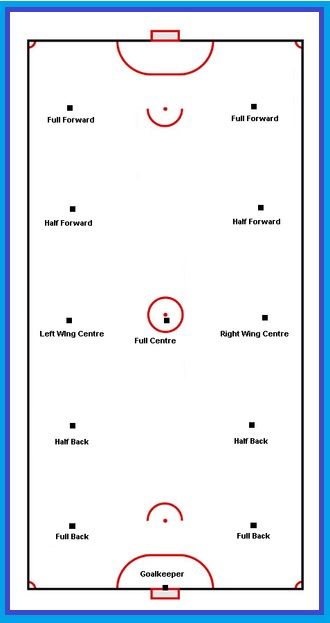
That said, even today with shinty formations differing between the north and south Highlands, the former regarded, in the slightly tongue-in-cheek words of Hugh-Dan MacLennan, as "hell for leather wing play", two things stand out from the Southern one (shown above) as being not just potentially transferable but one hundred and fifty years ago actually transferred to the football field. The first is the block-four defence; what turns out to have been Queen's Park captain Gardner's perhaps novelty but one he might already have been aware of, picked up from the shinty he must have seen or even played in Glasgow, his home-town, or Paisley, that of his parents, but with the possibility it had on Park Neuk been noted for its effectiveness and adopted. The second is the vertical forward pairings.
Here the use of the words "perhaps novelty" should be explained. Reason one is it is well-documented that in the World's first official football international, played in Glasgow on 30th November 1872 between an England team and a Scottish one, captained by Robert Gardner and drawn mainly from Queen's Park, the English played 1-1-1-7 and we 2-2-6, i.e. the block-four defense. Reason two is because on the 21st December 1872 The Vale travelled to Glasgow, note 'travelled to Glasgow', to Southside Park, aka Queen's Park, for the first of four encounters over the rest of the 1872-3 season. Again we know not just the team but the teams. Queen's Park's was William Ker, Joe Taylor, David Wotherspoon, James Thomson, Jimmy Weir, Bob Leckie, Alex Rhind, Willie Mackinnon, Andrew Spiers, William Keay, the referee of the first, official international, and Archie Rae, future SFA Secretary, but no Gardner - and would, noted for its "play together", win easily, 3-0. This was whilst the The Vale line-up was Parlane in goal, Michie and Jardine, Nicholson and Campbell, G. and J. McGregor, Lindsay, Glen, Cameron and Kinloch. And once and very importantly we have formations. The Vale would line up as 2-2-6, Queen's Park an also English 1-1-8.
And the same difference would also be the case for the remaining three encounters even with evolving teams, and here is the crux. Queen's Park, even with Gardner back in the elevens as twice goalkeeper and then a forward and contrary to myth, twice played 1-2-7 once more and then 2-1-7, i.e. Queen's Park was confirmed as going back, indeed backwards, to the English way. Yet their up-country, newly-come opponents took the field on all three occasions as a 2-2-6, the apparently new Scottish way, either because they were either very good and fast learners (as incidentally Clydesdale must have been also) or because, it has to be said once more, it was what they already knew from old, were comfortable with and, having passed it on once for it just now to be seemingly rejected, ensured, whether deliberately or not, it was nevertheless to be carried forward and ad infinitum. Even today it is the foundation, on which a back three, four or five plus matching mid-field is laid with the steps from then to now quite clearly disernable.
In fact Queen's Park, after the third Vale match, two draws and a Queen's Park win, was that season to play just one more fixture, a home win, 1-0, over Glasgow Wanderers from this time just down the road in Cathcart. Moreover, it seems also to have been the last one for The Spiders for Bob Gardner. There was to be an extensive falling out, a stoochie, whether generated within the club, possibly around future internationalist and scorer of Scotland's first ever away-goal, Fred Anderson, or perhaps by international defeat in early March 1873 in London, where England played 1-1-2-6 and Scotland 2-2-6 once more, is unknown. But by October 1873 Gardner's friend, Wotherspoon, had moved the mile or so across to equally near neighbours, Clydesdale, to be joined later by Gardner himself. A "J. Gardner" plays there at full- or half-back on 15th November behind Wotherspoon, as had a Gardner for almost equally nearby Dumbreck nine months earlier, but that may be, rather than a mistake in the initial, simply another with the same surname or even Robert's elder brother, James. An R. Gardner definitively first plays between the sticks and as captain on 13th December, by when the Titwood Park club, having previously again played English-style had adopted 2-2-6, as, whilst Vale continued with it, had Granville and another and still newer club was seen from the start to be using it too. It was Renton.
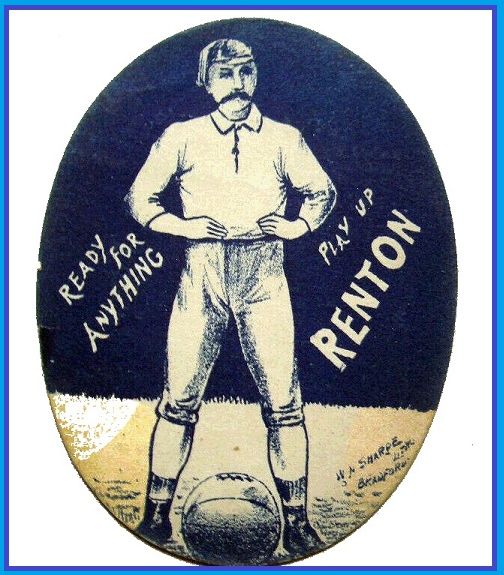
Renton F.C. was clearly not in the absolute first wave of Scotland's football clubs (it had not been a founder member of the SFA) and its actual foundation-date is un-known, although it may well have been in May 1873. On 31st May of the month the opening of the village's first Public Park took place, with it recorded that a football club had recently been formed. The opening was supported by the Smollett and Stirling families, the former the landowners, the latter the local indusrial entrepreneurs. Similarly a first, albeit mixed-rules game had already been recorded for Dumbarton F.C. earlier in the year on 12 April, suggesting formation shortly before.
However, Renton F.C. was to be one of the sixteen entries seven month's later into the first Scottish Cup. Moreover, at that initial attempt it would reach the Quarter-Final, losing only to Queen's Park, the eventual title winners, 2-0. Furthermore it would do it with a team that we know in detail (see below), one which included, for later reference, a Melville and remained largely unchanged when the club would the following year go all the way to the final, held at the first Hampden Park and won by the home team once more, this time 3-0.
But here again there is something else that is, if anything, more worthy of note. In that December 1873 encounter with Queen's Park both teams lined up as notionally 2-2-6 but in a contemporary report in The Scotsman no less more detail of Renton's positioning is given.
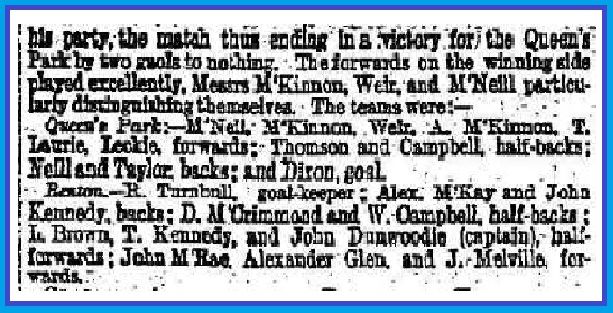
Alex McKay and John Kennedy were the full-backs, McCrimmond and Campbell the half-backs. But in front of them were three designated "half-forwards" and beyond them three "forwards". In other words they were firstly three pairs and secondly they were not horizontal across the pitch but vertical. The Renton formation was actually 2-2-3-3 and still more to the point, like the block-four defence, the term "half-forward" comes straight from Southern shinty with "full-forwards" in front of them. In other words Renton was observed as a first playing football using an almost fully Southern Camanachd formation that retained the full-centre (see again above), added another but was, in order to reduce to eleven players, less the two wing-centres. Moreover, the horizontal to vertical adjustment clearly worked, with more to come and the following implications. From these new tactics and not known passing, used in any case for two millennia in the ancient game, would rapidly emerge, perhaps via 2-2-2-4 with centre-forwards side-by-side at The Vale, a, in fact THE, distinctively Scottish style of play, which can and in both parts, defence and attack, be seen almost as quickly to be adopted by other teams; even if Queen's Park proved to be one of the more tardy.
The earliest reporting of it and vertical forwards would be on 9th October 1875. It was versus The Wanderers once more and this time with both a certain Arthur Kinnaird and also Charles Alcock in the Londoners' line-up. For Queen's Park Lawrie, in front, and Weir were on the right, McKinnon and Herriot in the middle, front and backup respectively, and similarly the McNeill brothers, Harry, a known shinty-player, and Moses, on the left. FYI Queen's at home at Hampden won 5-0.
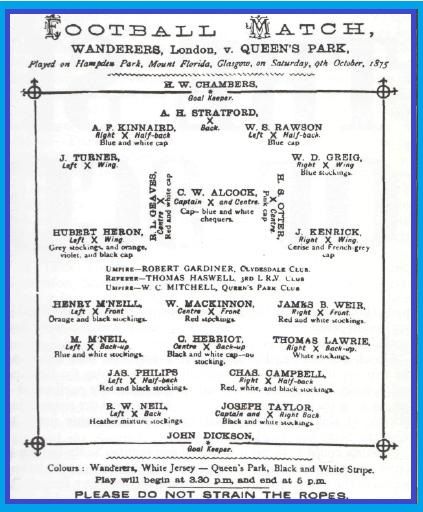
At this point Queen's Park had been and would remain undefeated. But that was to change and it was to be The Wanderers, which were first to make it happen. In the follow-up friendly to the above game and four months later in February 1876 they back in London would be victorious by 2-0 but then Queen's Park, playing essentially with ten men, had something of an off-day, rectified with a 6-0 win away against the same opposition in November that same year. However, that was to be just seven weeks before invincibility in Scotland also came to an end. It happened on 30th December in the Scottish Cup and at the hands of Vale of Leven. The Vale had, after the Ferguson affair essentially seen elimination from the first two Scottish Cups, but been building a head of steam. In its first year it had gathered a pool of twenty-four or so players that was then reduced over three seasons to a squad of sixteen to twenty, Ferguson included; one which essentially knew each other's game. They were drawn from the same calico works that had previously supplied the shinty players. In fact, a number of them were also accomplished at the game. And they would soon constitute the World's first consistently successful, working-class club. Renton, equally if not more working-class, had had its moment first but, having just eliminated Scotland's previously unvanquished doyen, The Vale would not only take that Scottish Cup that year and but the following one too, when for the first time Vale of Leven clubs in games against Queen's Park would actually outscore The Spiders (See: Queen's Park - The Rise and Demise or "When did The Spiders Cease to Dominate?"). Moreover, the Cup would then be taken for a third year in a row the next season (1878-9) too with The Vale, in also beating the English FA Cup holders, The Wanderers once more, becoming ipso facto the first, best club in the World.
(Here the work done at Stirling University, as shown in Scottish Football Origins, in examining the back-grounds of the players from the Vale of Leven, including Dumbarton, from the valley's three main teams, makes the point far better than we can.)
That is, however, not to say, meantime and a mile and a half down the road Renton had been just a one-off wonder. It too was prospering. Whilst in 1875-76 it had been knocked out of the Scottish Cup in just the second round and by The Vale it not only had an established group of players but one which it was able to re-build still from local talent. And, although it would in 1876-77 be eliminated in round one again locally by Dumbarton, in 1877-8 with the new squad it too would find a wave, one of its own, making it all the way to the penultimate round and only lose to Third Lanark on a replay, this as The Vale had been granted a semi-final bye. Who knows how it might have turned out had it been the other way round but it is not inconceivable, as Renton was about at last in Tontine Park to have, funded by the adjacent works, its own, proper ground, that first, the final, would have been all-Leven and, second even, that Renton might in winning have gone on instead to become both Scottish and Scotland's already second World Champions. Such are the fine margins of footballing fate."
"The Absurdity of the Parochial
At the beginning of the month (sic) an excellent report on some origins of the beautiful game was put out as a news item on television. It is neat, slick and informative and can be seen by cutting, pasting and clicking on (No Longer Available):
Birthplace-of-football-shares-its-history-in-bid-for-heritage-status
But it is also disingenuous because it seeks not just to connect but also deliberately to confuse "Foot-Ball" and "Foot Ball" with what we play today, the Association Rules game. The item was on ITV, English ITV. Its source was Sheffield, from where in recent years has come laudably deep and important research on the former locally-played, Sheffield Rules version of the game and now has emerged a campaign for UNESCO recognition of it, seemingly, as the sole place of origin for football in its modern form.
Now it might seem to be dancing on a pin-head but, as with the article above on the SFA not knowing where it started (NOT INCLUDED), accuracy matters. So let us try to impart some. There were four stages, all in Britain, to the initial creation of what is today's football.
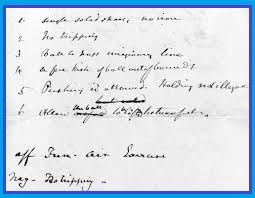
The first was the local, ad-hoc mass games what we in Scotland called "fitba" but existed through these islands. The second was the foundation of the first "Foot-Ball" clubs (note the hyphen) with codified and written rules. There is an argument that this first took place in Scotland in Edinburgh in 1824, lasted until 1841 with one copy of its hand-written rules shown above as an example.
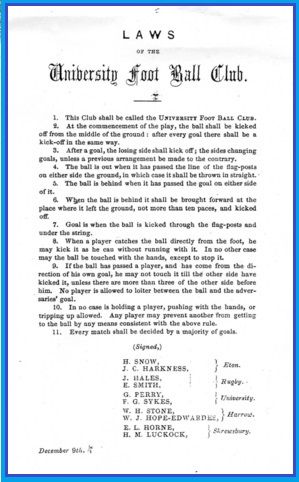
Then, third, there are the Cambridge Rules, of which there were several iterations, with the printed 1856 version illustrated above. But note two things. First, the iterations did not flow on one from another. They seem to have been separate codification attempts with differing drivers. Second, they were, as illustrated, for a "Foot Ball" club, no hyphen, and again subject to change and addition, not least in 1861 by the Forest Football Club, later to be known as The Wanderers and future five-time Football Association Challenge Cup winners, the FA Cup including its first playing.
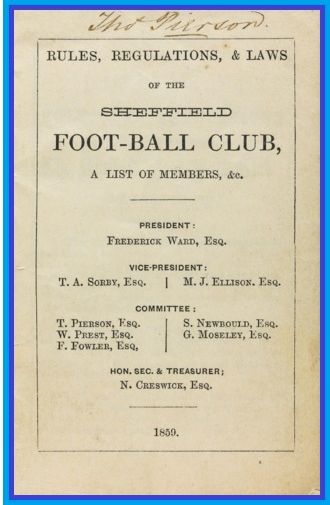
And finally from 1857 there is Sheffield, where a vibrant club culture developed, it is claimed from 1859 with the publication of its club rules but in reality in the next decade with the foundation in 1860 of Hallam, Sheffield F.C.'s first external opponent.
But back to the pin head. "Foot-Ball" and even "Foot Ball" are not "football" as we understand it. They weren't so in Edinburgh or Cambridge. And they did not become so In Sheffield either and to pretend otherwise is unhelpful. Not just are Sheffield's printed rules for a hyphenated game but the ITV piece's filming of the ledger of the founder of the first Sheffield club shows it clearly referring not to football but still "foot-ball", with a hyphen as in 1824. The transition had not yet been fully made.
So where does this leave us? After digitalisation much good work by many in many places has been done not just to uncover the real origins of modern football but also to sweep aside a number of myths. The fact is that the proto -game in Britain developed in largely parallel in a number of locations in these islands before coalescing. London produced an initial set of rules that stuck. Sheffield added to them and considerably improved what had been there when in 1877 it merged its FA with that in London. Scotland, as its results show, provided better tactics and technique. That it happened should be celebrated. However, instead there is parochialism and it is absurd. Where we have been allowed by technology the opportunity for clarity and agreement, attempts are being made by some to create new but equally tenuous myths and resentments - North England of South England, Scotland of England and vice versa, even Scotland of Scotland. Resentments are not being eliminated by new knowledge but instead reformulated and a halt would be good."
_______________________________
John Connell
(In his own words)
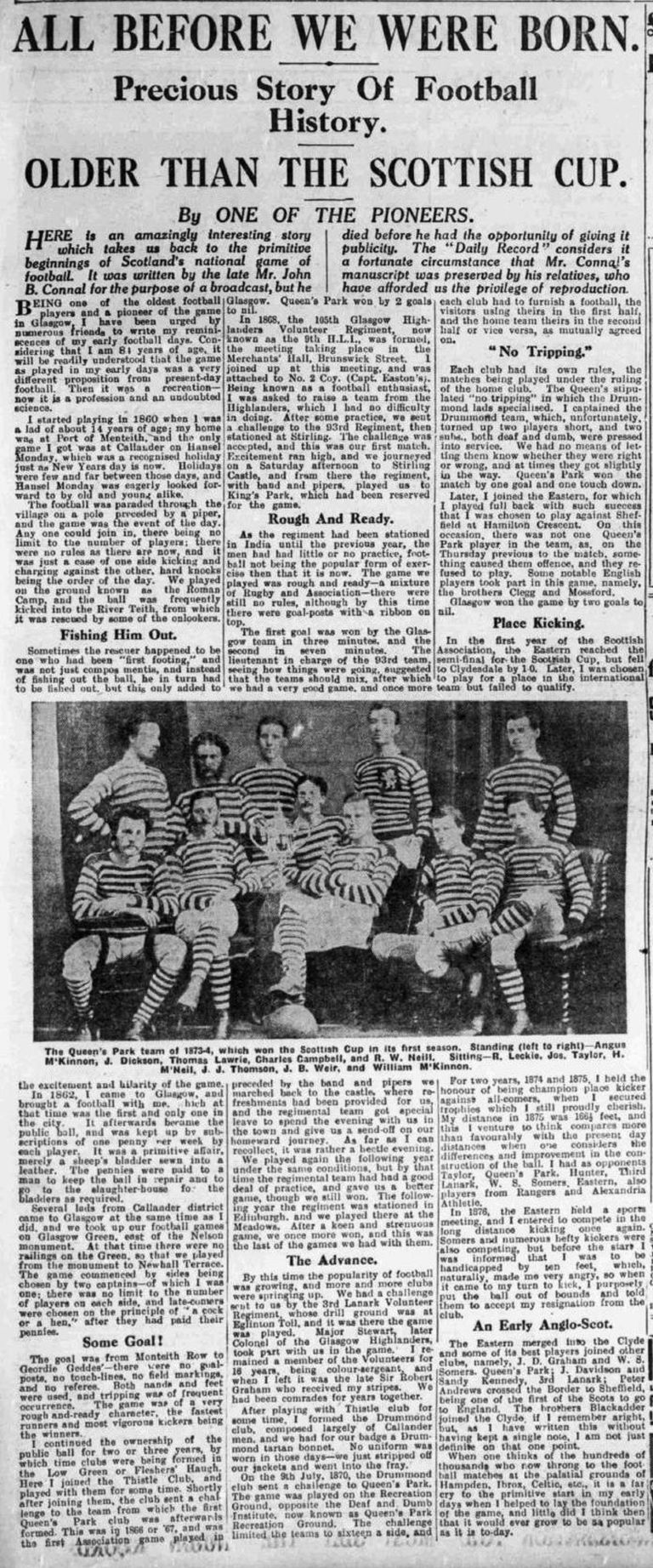
(Click on above)
____________________________
"Stranraer - and the Coming of Football to Scotland
Perhaps one of the most remarkable stories of the coming of football to Scotland, and one of the least known, is that of Stranraer. Founded officially in 1870 it is the third oldest club in the country. Only Queen's Park and Killy (Kilmarnock F.C) officially predate it and even then there are doubts, for which we have to thank not SFHG research but a unique piece of work, The First Thirty Years, preserved on the Internet from 2002 and by a John Boyd, of whom nothing more is known just yet.
In it he states that already by 1865, two years before Glasgow could even have heard of Queen's Park, Stranraer, The Toon, already had three clubs - Lodge, Sheuchan Swifts, Sheuchan, being a main street to this day, and Waverley, Waverley Lane being another - and perhaps even a fourth. Moreover, that same year a recorded game was played, 11-a-side, presumably to some form of agreed rules, away against Cree Rovers in Newton Stewart. It was made possible by the new-fangled railway and was not only with a clearly organised, representative "town" team but one for which we also have the on-field line-up. And that was a dozen years before Stranraer F.C. first entered the Scottish Cup in 1877, to be beaten in the First Round 6-0 by Queen of the South Wanderers, and a three-quarters of a century before it joined the League, with many a game played in between. They included a second early one, in about 1870, as also the three Toon clubs combined, this time versus the 3rd Kirkcudbright Volunteers at Palmerston in Dumfries, and 1875 against Cree once more, for both of which again we have knowledge of those taking part.
In 1865 in goal was Cluckie. Then there was Warren and Simpson, Bell and T. Alexander. The captain was McQuiston and he was said to be joined by R. and G. Porteous, Craig, Nish and a second Alexander, this time P. . Furthermore, with amazing continuity, Cluckie remained between the posts in 1870 as, in the wider team were also Warren and Simpson, Bell, now J.B. Bell, McQuiston, still captain, Nish, the Porteouses, one, Robert. And the eight remaining were joined by Mackie, Fraser and Mckinstrae. Moreover, even in 1875 both Warren and Bell were playing on still.
However, between 2002 and now something has changed and that is the explosion of the Internet itself and, more-to-the-point, the availability of resources on-line, notably ScotlandsPeople and similar. It has meant that we can look for and at the names of provided in the line-ups, specifically in the 1861, 1871 and 1881 censuses and for males aged between, say, fifteen and thirty. The results show almost all appear in Stranraer itself and surrounding nearby villages. And with some of the names we can even be more specific. A McQuiston was twice the captain and, whilst no-one of that name appears on the local record, there is one in Glasserton and it is an Ayrshire, most specifically an Ayr name. So where had he learned the game? Futhermore the Cluckies and Porteouses were Leswalt and Kirkholm people. And then there is J.B. Bell, a stalwart of the local game for at least a decade, and here we have perhaps a specific candidate - John Bell, recorded with a middle-name of both Broadfoot and Bradhurst. He was born in 1848 in Stranraer, so was seventeen in 1865. He became a joiner to trade. In 1871 still in the town he married Isabella Boan, who actually lived on Sheuchan St. at the time, although he gave an address in Glasgow. And it was there in Govan from 1872 that all their five children were born and from where by 1881 they all disappear from the records.
But the question remains, how and why was football, but not necessarily yet the Association variant, played so early in Stranraer and indeed Newton Stewart and Dumfries? Where did it come from? And answer there is as yet none. Unless, of course, it, as the Anwoth story (See above left) from two hundred earlier tells us, it was and remained indigenous.
In fact the nearest we come in South-West Scotland to any connection is the private work done by the laudable Richard McBrearty of the Scottish Football Museum and posted on his personal blog, The Origins of Football in Scotland. He states that John Douglas, the Marquis of Queensberry, and incidentally father of Lady Florence Dixie, later the first sponsor of the women's game, returned to his Kinmount estate by Annan from Cambridge in 1866. And that same year he set up under Association Rules, Kinmount F.C., which in itself is literally game-changing because Queen's Park by a year then ceases to be the first "soccer" club in Scotland. Furthermore, three more teams, Annan (formed 1867), again perhaps pre-dating Queen's Park, Springkell (before 1870) and, importantly for the purposes of Stranraer, Dumfries (1869/70) then by the end of the decade emerged to join Kinmount, with games played in 1868 between it and Annan, presumably to FA rules-ish but 15/16-a-side, the first at least with the Marquis in the team and scoring.
_______________________________
Cathcart - the Cradle of Scottish Football
(and a bit of English etc. too)
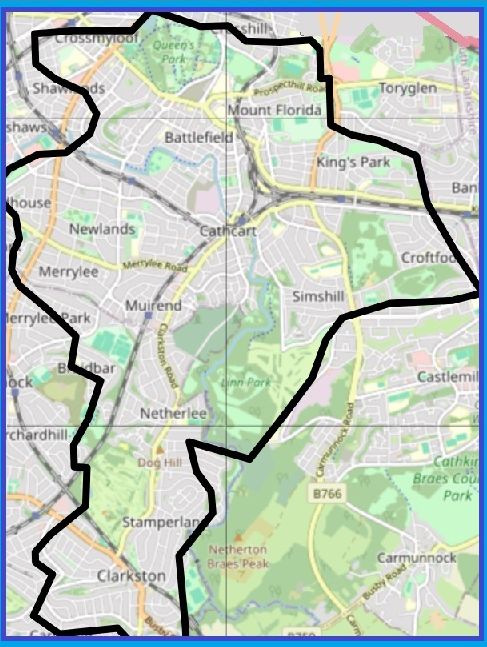
Cathcart, once in rural Renfrewshire, now in Glasgow, is both a village-suburb and a parish. This piece incorporates the former but is about the latter, from almost the Clyde in the north to nigh-on Busby in the south, Linn in the east and Crossmyloof or so to the west, and the role it has played not only in cradling football, our football, Association football in Scotland, but creating it elsewhere; the former so obviously continuing to be played today, the latter having been pivotal to the global game, notably in England, Uruguay, Brazil and, to a lesser degree, Argentina.
The birth of our football in Scotland, not the Scottish game itself, in reality took place on the last day of November 1872 and at Hamilton Crescent in Partick, also then not in Glasgow. That would require another forty years. And it was there for a reason, one quite possibly decided upon, indeed hatched at the Queen's Park Football Club in Cathcart but needing to be implemented elsewhere because the parish had no suitable venue; at least not quite yet. The first Hampden Park, in part now Hampden Bowling Club, would not be opened until the following year and become an international ground only in 1878. Although in 1876 it did host the replay of what might rightly be called the "Cathcart Cup Final" between its owners, Queen's, and its nearest neighbours, the now defunct Third Lanark; its ground, the first Cathkin Park in Crosshill and just half a mile away. Indeed, the second Hampden Park, in what we now call Cathkin Park after the original, would from 1903 to 1967 also become the new but second stadium of The Thirds, having been used by Queen's from 1884 until 1903. For it was then that the earliest version of what we now know as The National Stadium was completed on Mount Florida with beside it the fourth or Lesser Hampden, known previously as Clincart Farm, now as The City Stadium and from this, the 2025-6 season, the latest home of the club, the doyen club that had made it all possible.
For it is almost, stress almost, axiomatic that without Queen's Park, the club, there might well be no Scottish football. The club would be the fulcrum through its acceptance in 1871 of the rules of the Football Association in London and its willingness in the early days to apostolise and demonstrate the game wherever it could. Moreover, its participation in the semi-final, albeit in very advantageous circumstances, of the first (English) FA Cup and then provision officially of the entire Scotland eleven in 1872 for that first and drawn international were the sparks, which ignited what, North of Border at least, flamed into a special passion for the game that even today persists.
The facts are that within five years of Queen's Park's emergence as our game's doyen club the park itself became the home of sixteen further teams and within a stone's throw there were the grounds of nine others.
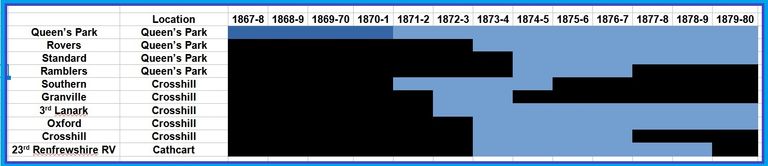
(Click on to enlarge. Lighter blue indicates playing Association rules, darker blue not Association, black means club not in operation)
Furthermore, within a radius of a mile and half or so there would teams in addition. And all were formed by and not just needing players but also producing many of them very locally with the concentration over the years of just the best or best-known of them there to be seen.
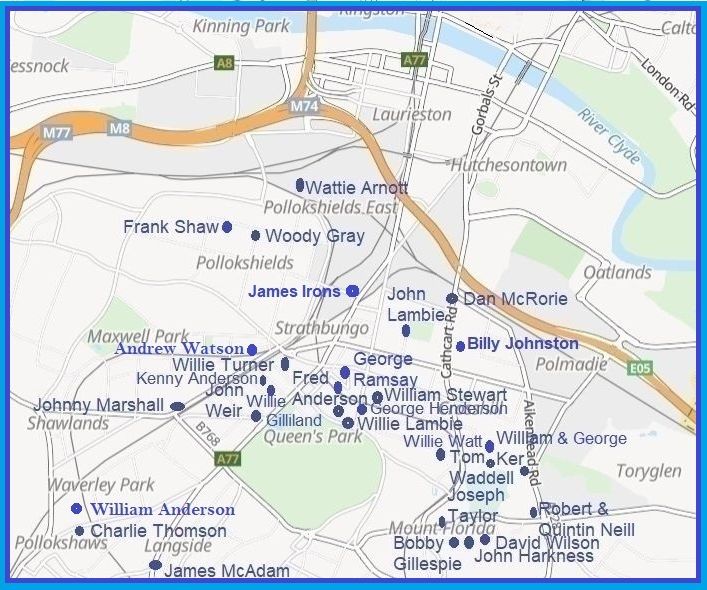
And already by the middle of the 1870s Cathcart players were having their effect elsewhere, as was passion also spreading out. In 1876 George Ramsay, having played for two of those local teams, Oxford and Rovers, had taken himself south to Birmingham, there almost immediately to be instrumental in the creation of Aston Villa.
And nor does Cathcart's influence on Britain's major clubs end there. In 1895 Sheffield Wednesday won the FA Cup. At inside-right was Alex Brady, considered to be one of the three or four most talented Scottish players never to have played for his country, but unlike the others not because, whilst being raised a Scot in Scottish football, he had been born in England. He had been raised in Renton, learning the game there, but he had been born at Burnbank by Cathcart station. His father was a cotton dyer, who had worked at the mill there before finding similar in the Vale of Leven. And the reason for Alex never pulling on the blue jersey - aged sixteen he was so good, an early Pele, and already at the start of, including one at Celtic but also Down South, a sixteen-year, professional career, for ten of which he was by the rules of the time ineligible.
And so to Celtic itself. It is said that on a December evening in 1887 a small group of men chapped on a door on the Clarkston Road in New Cathcart. One was a priest, Brother Walfrid, the founder of the club, another John Glass and they had come to try to sign the eldest son of a Drill Hall sergeant and already a Partick Thistle player. He was Tom Maley. But he was not home. He was out courting the girl he would later marry. And so the story is that instead of Tom his younger brother, Willie, was recruited, and from Third Lanark, not instead but in addition because both brothers would soon take the field for the Parkhead club. Tom would for several years successfully play as an amateur, whilst also teaching, before going on to manage Manchester to the FA Cup in 1904 and Bradford City into the top-flight. Willie would have a decade in Glasgow's East End as a player, win three Scottish caps he should not have (because he had been born in Ireland), from 1897 manage The Hoops for forty-three years but in death in 1958 remain true to his South Suburban roots. He is buried in Cathcart Cemetery.
And it is to Cathcart cemetery, that we lastly turn. It is beautiful, a place for a tranquil walk, but sadly far from immaculate, yet if there is world-wide a more important resting place for football’s early movers and shakers we have yet to hear of never mind see it. It is, including Willie Maley, the last resting-places of at least 19 of Scotland’s greatest players, pre-Second World War and others post, notably Tommy Burns. Nine more were cremated at neighbouring Linn Park. It contains lairs of footballing ambassadors, administrators and managers too. From the earliest days there is the grave, restored by his family, maintained by us, of Joe Taylor, Scotland’s first full-back. Wattie Arnott's has been restored also. Hugh MacColl, the captain of the winning team in the first, officially-recognised football match in Spain is there, Toffee McColl too, amongst others, as is Rangers first manager, William Wilton. George Pattullo has a memorial. He, when playing for Barcelona, had a better goals-to-games ratio than Lionel Messi. And there are others, all of whom lie in area of 500 by 300 yards on the southern edge of a concentration, the cradle of footballing pasts and presents two thirds of a mile by half and all within a larger catchment of over half a century of players to Scotland, Britain and the World little more than two miles by one.
______________________________
The Dunbarton Leven
- Source of the "Scottish-Game"
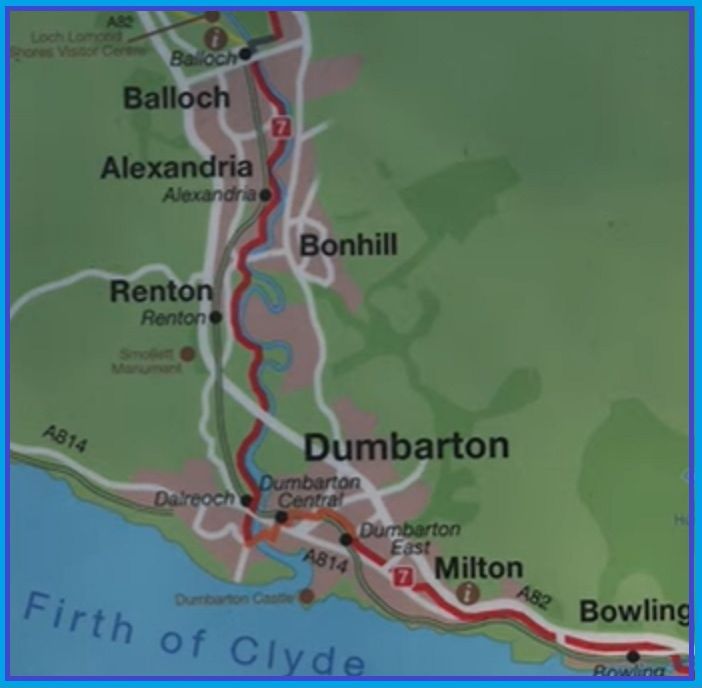
In November 1872 something happened. It was the World's first Association football international, in Glasgow and expected to be something of a walk-over for the away-team, England. It proved, thanks to intra-club familiarity, some with-ball talent and the nous and organisational, read tactical, ability of the Scottish captain on the day, Robert Gardner, a little different. It was also the catalyst for the creation of four specifically Association football teams in Dunbartonshire along the banks of the River Leven that flows the five miles from Loch Lomond to The Clyde and then more clubs elsewhere; by less than a year later at least sixteen in all.
In the meantime four more games had taken place, all important. The first, it is reported, had been on 21st December 1872, the second on 11th January 1873, the third on 15th February and the last on 1st March, two in Glasgow's southern suburbs, two not and all between the same two teams, Queen's Park, Scotland's doyen, and Vale of Leven F.C., The Vale. The first and last would be wins for the former, but the middle two, the younger club clearly learning fast, certainly in defence, were goalless draws.
More games followed after the summer-break, not least now with the instigation under the auspices of the almost equally new Scottish Football Association of the first Scottish Football Association Challenge Cup, the "Scottish Cup". But The Vale was not to be there. Its second nearest and neo-contemporary neighbour, Dumbarton, had accused one of its player of being that heinous thing, a professional. It was a try-on. The player in question, Johnny Ferguson, at twenty-four an old man in a young man's game but who nevertheless would become football's working-class star, had won prize-money only for running. But it was a stoochie, despite Ferguson nevertheless in the meantime being chosen for Scotland, that, at club level at least, would take two years properly to resolve. So Queen's Park found itself in December 1873 in the semi-final meeting Renton, the third of four brand new Vale of Leven's clubs. It had eliminated Dumbarton in the previous round and just now would be eliminated itself.
Thus there were by October 1873 already three obvious clubs in the Vale of Leven, five with second and third Dumbarton club, Alclutha, later Dunbritton, and Lennox also there in the back-ground. And that later in the year would become seven, three now in Alexandria with the addition of Star of Leven and Vale of Leven Rovers. The former would last a decade, the latter at least four seasons. Both would never get beyond the Cup's Second Round. But Renton, with The Vale effectively still excluded, had done so for a second time. In fact in April 1875 it was to go all the way to the final, there, having kept it scoreless for more than an hour, to be beaten and by Cup-holders, Queen's Park, once more.
It was all very encouraging and in 1875-76 enough for a further club, Renton Thistle, formed also in 1873, to become the eighth to join the fray and from Queen's Park Juniors receive a walk-over into the Second Round. Moreover, finally unhindered by accusation The Vale would get to that same next round after walking-over Vale of Leven Rovers. And it would be both The Vale, via Renton and Mauchline and Dumbarton via Renton Thistle and a bye that would make it to the semi-finals with, however, neither making it further. The Cathcart combination of Queen's Park and Third Lanark contested the final that season.
But there had been successes elsewhere and more to come. In March of 1875 in the Cup semi-final eventually won by Queen's Park The Spiders had conceded its first goals ever, to Clydesdale and a brace. Indeed it had had to come from behind not once but twice. Then in February 1876 it lost its first match, 2-0 in London to the Wanderers. Reasons given were that because of injury they essentially played with ten men and interestingly the pitch had been narrowed, the home team clearly wanting to constrict the visitors' breath of game. The question is why. Was it to restrict passing? And finally in December 1876 the Hampden team lost its first game to Scottish opposition. It was in the Quarter-Final of the Cup, it was at home and to The Vale, the last survivor of seven Leven teams that had in September entered the competition, Queen's Park having held the lead at half-time.
The game had and would not be without controversy, as would the Final also, one which The Vale would go on to win via two replays and a remarkable 35,000 being thought to have watched the three matches in total. But it marked a trio of things. The first was Queen's Park as a team was fading and would not be a driving-force in the Scottish game for another three seasons after it had actively recruited to rebuild its playing-strength. The second was that The Vale was the coming-team and would be that driver for those same three years. It would have a three-in-the-row of Scottish Cup wins in a row and do it with a combination perhaps of greater fitness due to its players' working-class lives but also because of positional innovation in attack and then team-linkage. The six forwards would become notated in pairs, first across the pitch, as a 2-2-6, and working in combination, and then vertically as 2-2-3-3 with the origin being quite possibly shinty, the winter game played along the Leven from its source to its mouth before the Association game and then still practiced. And, thirdly with eight teams in the 1877-8 Cup with the addition of newly-founded Alexandria, based around the town's cricket club, then Jamestown, formed in 1873, joining the following season to make ten vying for the trophy - fourteen clubs in all with the 5th Dumbarton RV, Jamestown Athletic, Bonhill Rovers and Vale of Leven Wanderers - the baton could and would be passed around and on locally.
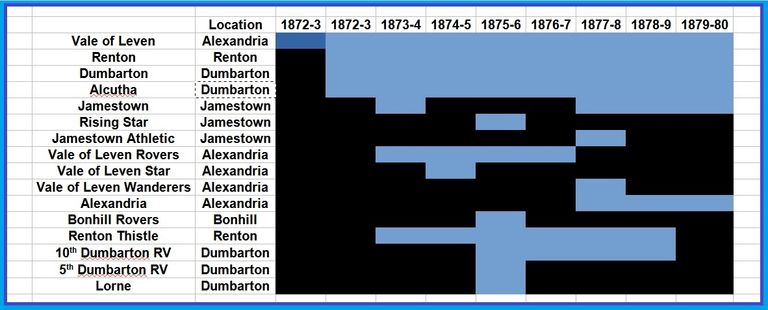
(Lighter blue indicates playing Association football, darker blue not Association or not all season, black means club not in operation)
In fact it was so local that today between Jamestown and Dumbarton it is just twelve minutes in a car. And with it In 1879-80 Dumbarton, having eliminated both The Vale, in a seven-goal, First-Round tussle, and Renton on the way, would reach the semi-final only to be beaten but a single goal in the second half by eventual champions, a re-emergent Queen's Park.
And thus it seems there is a more than adequate argument that a coherent, distinctive style of very successful Scottish play began to emerge not so much from Queen's Park to 1876 but to 1880 under The Vale, with it being adopted by the other Leven teams, also by the "new" Queen's Park, by West-Central Scotland at least, Edinburgh going something of its own way with its earlier adoption of the Welsh developed 2-3-5, and by the Scottish national team that would not lose a game in a decade. And that distinctive style is again reflected in the almost complete dominance of the Scottish Cup by the Hampden club and first two, Dumbarton and The Vale, and then three Leven clubs for the next seven campaigns. And this may have been longer still had that third, a re-emergent Renton, and Leven clubs more generally not been, as in the case of the former, "raided" by a nascent Celtic and then the collective "pillaged" by clubs Down South, Renton having from 1884 developed and in 1888 revealed, indeed unleashed, a final ingredient to the mix, the Scottish Centre-Half; the Pivot, it taking that distinctive and repeatedly successful football already played in Scotland from a "Style" to a "Game", arguably eventually the World Game.
It meant that in a rapidly changing football scene on both sides of the border as the source was effectively drained to dry only Dumbarton has survived long-term and then with a gap. Alcutha from that same town are long gone as major teams, as are Jamestown, Alexandria's Star of Leven and Vale of Leven Rovers, Renton Thistle too, and, of course, The Vale and Renton them-selves. But absence does not change the facts.
______________________________
"Modern Football" -
its Real Founders and Facilitators
If you have have been hooked by this article's title and read on, hopefully it has been with a snort or similar of derision. And, if that were the case, it was probably for at least three reasons. The first is the question of what is football; there have been and are so many variants, round-ball and other. Then there is the definition of "modern". And finally there is whole unknowable concept of founders for a game that goes back hundreds if not thousands of years.
So it is time for some precision. Here by football is meant the round-ball version that by some is called Soccer, the Association Game. Then by "modern" is the iteration of it not from 1863 but the one that is not only played today globally and, as this site is dedicated to de-gas- and spot-lighting, derived largely and specifically post-1872 from Scotland and the Scots-game. And so in terms of "founders" what results as a consquence is the men, for they were that, Scots-men, who formed the club in Dunbartonshire's Alexandria, which enabled our contemporary, competitive ball to roll.
That club was Vale of Leven Football Club, "The Vale", which the Lennox Herald reported as coming into being on 20th August, 1872 with its first practice of what was by then fully seen as a winter-sport then and there scheduled for the middle of October and reported by the same august organ as having taken place on the 19th of that very month.
So back to 20th August. On that day in Alexandria a first club meeting elected the following officers - President: Donald McFarlane, Vice-President: W. B. Thomson, Secretary: J. B. Wright, Treasurer: Joseph McEwan and Custodier (Groundsman): R. Cameron.
Now at this point there is inevitably a measure of guesswork but Donald McFarlane appears to have been a twenty-year-old Mercantile Clerk, living at home at "Myrtle Bank" on Main Street. He had been born in 1851 nearby on Bank St., the son of a locally-born father, a Druggist (Pharmacist) and a mother from Forres. But during the next decade he was to move away. As a Cotton and Yarn salesman he would in 1880 marry in Birmingham, the couple returning to stay back in Dunbartonshire but in the town of Cardross. And W.B. Thomson, William Thomson, who had been born in Alexandria, trained as a tailor in Glasgow, married there but at twenty returned to Bank St. and seems to have remained there for much of the rest of his life.
Then there was John B. Wright, John Barr Wright. He had been born in Balloch, so a mile and half to the north, was eighteen, also staying on Bank St. and working, as he would until retirement, as a Clerk. Moreover he would die in 1932 on Main St. to be buried again locally across the river, the River Leven, in Bonhill village. Which leaves McEwan and Cameron. Joseph McEwan was a little older, born in 1848 so twenty-three and a Calico Printer. But by 1881 he had moved to Glasgow, working as a Clerk in Bolt Manufacturer and eventually a Manufacturer himself. He would die in 1917, aged sixty-nine and is yet another of the important, early footballing figures to be buried in Cathcart cemetery.
But, whilst all of the above would be office-holders and also identfiable as players, no football club can exist without a ground. And this is where the Camerons came in. R. Cameron, custodier, seems to have been Robert, youngest son of John. The former was eighteen, a Printfield Worker and a player. The latter was born in Perthshire, in fitba' country, sixty, from age and the picture below clearly not a player, a "Cow-Keeper" and thereby the unknowing facilitator of finally home- opposition for Scotland's oldest club, Queen's Park. It and The Vale would play four matches in the four months from December 1872, using throughout the 2-2-6 formation it may even have created or at least inspired and which became Scotland's. In doing so it would not only catalyse the Scottish- but ultimately much of the British- and World-Games.
John Cameron
In fact, whilst both John and Robert lived in the family-home on Church St. on McLachlan's Land, the family itself owned a dairy on Main St., for which the former's cows supplied milk but needed pasture, part of which he was prepared to set aside, perhaps just temporarily, for his boy's new sporting passion. Cameron Park, as that field would become known, would be The Vale's ground for a couple of seasons, before the move to its second at North St.. John Cameron, himself, would see the transfer, indeed the club's most successful years. He would die in 1885 still in Alexandria at the age of seventy-five. By then The Vale had lost two Scottish Cup Finals but won three. And Robert would also remain locally. In 1880 he would marry Mary Fletcher, they having two children. But she would die in 1889 and Robert, now a Coal Merchant, would remarry the following year to Margaret Bulloch nee McNaught, with her have four more children and die in 1918. His grave is another of the major, early footballing figures also to be found in Bonhill Burial Ground.
______________________________
The Slow Rebellion - how Scots working-class realism made football proper pro -Part One
Legend, the Myth, has it that football was founded by posh-boys, mostly Southern, fresh out of the English Public Schools. But it wasn't, nothing like, as we hope this web-site has already shown. The truth is that the off-field construct, The Football Association, was begun in 1863 by a small group of middle-class, admittedly upper middle class men, dissidents from the handling-games, who hadn't been near a posh school, except in one case to Cheltenham for a short period. In fact for almost all of the first decade of the FA's, the "English" FA's existence it was headed up by a solicitor at the onset already in his thirties, a rower, who was the son and grandson of non-conformist ministers of the church and had been born and lived most of his life till then in Hull.
But the game that Ebenezer Morley, for he was your Humber-man, oversaw as the FA's Secretary and then, with a small gap, President for over a decade to 1874 was avowedly amateur so simultaneously from where did today's professional game come and what was the source of the posh-boy idea.
In the case of the latter it was because, after Morley's departure, a small of group of them attempted and succeeded with what amounts to a coup. Why is unclear. Perhaps they saw it, with the game growing in England and by then exploding in Scotland, as an opportunity for personal aggrandisement, socially and monetarily. But, although not before a decade and a half of embellishment, i.e. gas-lighting that persists to this day, was in place, it/they did not succeed. And the reason may ultimately and not for the first time have had its source some four hundred miles plus to the north.
Sport for money was, even in the 1870s, unlikely to have been a new concept. In Scotland middle-class athletes might on their sports days have run for fun but working-class ones at their meets openly competed for "siller" (See: The Fergoson Affair). And, whilst cash for team-sport beyond the tug-of-war might well have been rarer, it did exist and for substantial amounts. The evidence is there.
In 1870 a John Sinclair (see below) from Bridge of Allan by Stirling issued by newspaper seemingly on behalf of the players of the Vale of Leven in Dunbartonshire and to the men of Inveraray in Argyll a challenge to a shinty match with a prize of up to £100. That's £15,500 today.
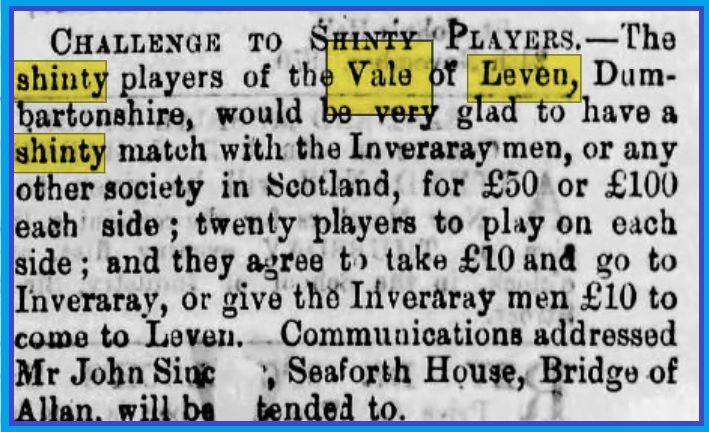
And even within the Vale there was clearly appetite for the same, admittedly less lucrative but still worth the equivalent of £70 per player, so not bad for an afternoon's work and, as the old game of the Gaels was from 1872 replaced by the new Association one, as shinty players became footballers, it is unlikely as a model to have been forgotten.
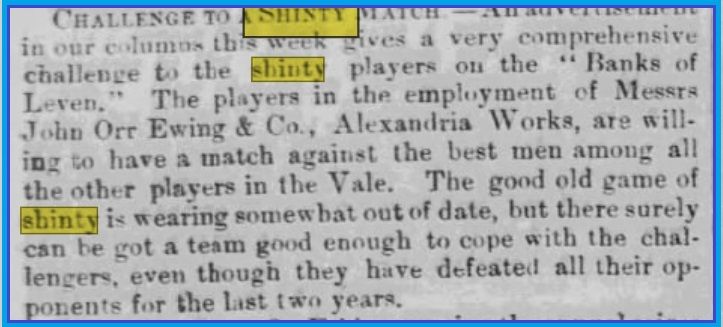
This is not to say that playing sport for money did not exist elsewhere in Scotland, indeed Britain. It is highly likely that it did but the point is the possibility that when the earliest of Scots football exponents, the first of the so-called Scotch Professors, went South the idea of the monetary incentive to play, rather than being a new thing, was there, already at the very least embedded in their psyches. It was an expectation not a novelty.
Known Renton, Renton Thistle, Vale of Leven and other Upper Vale Teams
- N/A
- N/A
- N/A
- N/A
- N/A
- N/A
- N/A
- N/A
- N/A
- N/A
- N/A
1872-3
_________________________________________
- Cunningham
- Wylie
- Fergus
- Ferguson
- MacDermid
- Moodie
- Graham
- McKechnie
- MacDonald
- Lang
- Edmunds
1872-3 - Jamestown
_________________________________________
- Robert Parlane
- Archie Michie
- J. M. Campbell
- James White
- John C. McGregor
- George McGregor
- Robert Lindsay
- Robert Jardine
- J. McNichol
- John Ferguson
- J. Campbell
McLay, Ewing, Bryan, Sandy McLintock, (Robert) Paton, Partington, Colquhoun, Duncan or Robert Cameron, D. MacFarlane, Matthew Nicholson, Charles Glen, William Kinloch, William Thomson, John Wright, Joseph McEwan
1872-3 Vale of Leven
_________________________________________
- Robert Turnbull
- John Kennedy
- Alex. Mackay
- W. Campbell
- Andrew Strachan
- (James) Brown
- John McCrae
- Lachlan Brown
- J. (G)Mel(ville)in
- Alexander Glen
- Findlay Kennedy
D. McCrimmon(d), T. Kennedy, John Dunwoodie, N (M). Campbell, D. Kennedy, J. McRain (McCrae?)
1873-4 Renton
_________________________________________
- James Cameron
- Robert Cameron
- George McKay
- William Ralston
- John Shankland
- John Watt
- N/A
- N/A
- N/A
- N/A
- N/A
_________________________________________
- Robert Parlane
- Archie Michie
- R. Paton
- D. McFarlane
- A. Mcintoal(McIntyre)
- W. MacDonald
- M. McGregor
- George McGregor
- Duncan Cameron
- J. McGowan
- Robert Lindsay
John Ferguson, J. M. Campbell, T. Wood, John McNichol, Sandy McLintock, John McGregor, Kinloch, Ewing, John McInlay, James Williamson, (A. or J.) McEwan, Matthew Nicholson
_________________________________________
- Robert Turnbull
- Mackay
- J. Kennedy
- (James) Sca(u)llion
- McGregor
- (Mc)Rae
- Melville
- J. Brown
- M. Kennedy
- Alexander Glen
- Lachlan Brown
_________________________________________
- William McLennan
- P. McKinlay
- P. Docherty
- J. M'Nichol
- A. M'Kinley
- R. Milne
- H. Irvine
- J.McAllister
- P. McAllister
- John McDougall
- George Smith
James Peters, James McDougall, George Neil [John Forbes, Robert Atherley, A. McEwan, J. McPherson, J. McNichol, playing for Star of Leven.]
_________________________________________
- Robert Parlane
- Archie Michie - to Dumbarton
- A(ndrew). McIntyre
- J. M. McIntyre
- James Baird
- (Charles) Glen
- Partington
- Robert Paton
- McDougall
- B. Russell
- John Baird
John Ferguson, Sandy McLintock, Robert Lindsay, (John or James) McDougall, James Williamson, McGregor
1874- 5 Vale of Leven
_________________________________________
- Turnbull
- McKay
- (J) Kennedy
- Scallion
- Jenkins
- L. Brown
- (M) Kennedy
- J. Brown
- Glen
- Melvin
- (James) McRae
(Peter) Joyce, Miller, Nelson, McCrimmon
_________________________________________
- McCrimmon
- Grant
- P. McGregor
- Davidson
- Cameron
- Burnholme
- (McIn)Tyre
- Grant
- J. McGregor
- McRae
- Ritchie
_________________________________________
- (William) Wood
- (Will) Jamieson
- A. McIntyre
- (James) McIntyre
- Sandy McLintock
- (John or James) McDougall
- John Campbell Baird
- James Baird
- McGregor
- (Robert) Paton
- (John) Ferguson
Alex Lamont, (Robert) Lindsay
1875-6 Vale of Leven
_________________________________________
- W. Kennedy
- Grant
- Turnbull
- McArthur
- M. Kennedy
- Miller
- McRae
- McCrimmon
- Burnham
- Grant
- (James)(John) McIntyre
1876-7 Renton
_________________________________________
- White
- McPherson
- McLeish
- Jones
- McEwan
- McFarlane
- McLean
- Strachan
- Russell
- Burns
- Lamont
_________________________________________
- William Wood
- Andrew McIntyre
- Archie Michie
- Will Jamieson
- Sandy McLintock
- John Ferguson
- John McGregor
- David Lindsay
- Robert Paton
- John McDougall
- John Baird
John McPherson, Robert Parlane, James McIntyre, John McFarlane, James Baird, Jones, May
1876-7 Vale of Leven
_________________________________________
- Kennedy
- Grant
- McKay
- N/A
- McArthur
- Miller
- McRae
- Burns
- N/A
- McCrimmon(d)
- McAllister
Colquhoun - from Dumbarton, McLearie, (Denton), Grant, Loy, Fagans, Davidson, Fraser, McIntyre
_________________________________________
- N/A
- N/A
- N/A
- N/A
- N/A
- N/A
- N/A
- N/A
- N/A
- N/A
- N/A
1877-8
_________________________________________
- Robert Parlane
- Andrew McIntyre
- James McIntyre
- John McPherson
- Will Jamieson
- John Ferguson
- Robert Paton
- John McDougall
- James Baird
- John Campbell Baird
- Johnny McFarlane
Sandy McLintock, John Baird, Strathearn, John McGregor, May, Jones, George McGregor
_________________________________________
- McIntyre
- W. Grant
- McArthur
- Colquhoun
- McLearie
- Burman
- McCrimmon
- Fagan(s)
- A. Grant
- McRae
- Loy
McKinnon, Kennedy, Cameron
_________________________________________
- Woodroe
- Moir
- Collins
- R. Sharp
- W. Sharp
- Brown
- More
- McIntyre
- McCulloch
- Lindsay
- Stewart
_________________________________________
- Robert Parlane
- Andrew McIntyre
- Sandy McLintock
- Will Jamieson
- John McPherson
- John Campbell Baird
- John McDougall
- James Baird
- John McGregor
- John McFarlane
- John Ferguson
Robert Paton, W. Strathearn, H. McLeish, J. McIntyre, Paton, P. Logan, T. Taylor, W. Taylor, J. Stewart, J. Murie (Murray), (Andrew Hunter)
_________________________________________
But returning to and staying with formations for the moment at this point it is back to that early 1872 Cup Final game at The Oval and not to the victors, The Wanderers, which would go on to have a fine run of similar Cup-wins, five in all to 1878, but to the losing opponents that day, The Royal Engineers. Reiterating, both teams would be play what would become seen as English formations, The Wanderers 1-1-8, the Engineers 2-1-7. But even in defeat the latter team was recognised for something else. Crassly it could be suggested that in it there were four Scots., and there were, but only one was Scots-born, in Glasgow, with one in Brighton and the birth of two, not for the last time, in The British Empire, one in India, the other in South Africa, which made them English by the "understanding" of the time and until 1887, when the Irish begged to demur. But it is, or rather they are, neatly contained within the following quote, albeit in reverse order.
"Contemporary match reports confirm that passing was a regular feature of the Engineers' style. An 1869 report says they "worked well together" and "had learned the secret of football success – "backing up" (being there when the ball popped out of the scrimmage, today's "maul"); whereas their defeated opponents had "a painful want of cooperation"."
What The Royal Engineers practiced, most likely as a product of military training and as also confirmed from other sources, was on-field cooperation, as against individualism; what was called at the time "combination", which together with an element of passing, albeit limited by the constraints of an inherently unstable formation, the footballing equivalent of a table with only one leg and just two feet, but at least marginally better than The Wanderers' one leg and one foot - made for football that was said even to be, the buzz-word of the era, "scientific".
But this where it becomes vexatious. There are already potentially at least two sources of both combination and passing. Others like a particular Public School, might also be dreamt up. But actually no evidence seems to exist from any of what seems to be the next stage in the evolution of round-ball football either of the Association or non-Association kind, i.e. a or the " passing game", and certainly not yet one that was successful. For all their perceived science the Royal Engineers would lose not just the 1872 FA Cup final but also the one in 1874 and so do now playing 1-2-7, the same as their opponents, non-scientific Oxford University, something that would only change in 1875 against previously 3-7 Old Etonians but now seemingly adopting a 1-1-1-7. And as to the other candidate, Sheffield once more, it did little better, certainly in terms of on-field success. Throughout the 1870s no Sheffield F.C. team got beyond the Third Round of the FA Cup except on a bye and in the same period and from the decade earlier we have no current idea of formations. It would be interesting for more Sheffield research to be done to see if more could be unearthed about shape and even tactics, with the suspicion given the current vacuum that at the time no-one cared; shape was non-existent or that it was so like that played by the Southern clubs that no-one bothered to discriminate and report; precisely the opposite to what would, from as early as the first months, be the case in what from 1872 became the new boy on the block, the third candidate for the passing-game, Scotland, with all this examined more fully below in the continuation of Renton & The Vale - The Making, Remaking, Unmaking, Breaking and the Who. (But the creation of the Scottish Game)".
"Episode 2: The Passing-Game
(More Facts over Myths)
The conventional argument, the accepted history of football, has been for as long as seems to be remembered that what had made Scottish Association football different, for that is effectively the only set of round-ball rules to which we have ever played, and for a long period by results demonstrably superior was its "passing-game". And at its core was the assertion that the source had been the Queen's Park club of Glasgow in the 1870s. However, it is seeming increasingly possible, indeed probable, that, as is the case with several elements of what is academically called the game's "historiography", it is not and never has been correct. And the reason is that the view until now has been largely based on the interpretation of events put forward in the "History of Queen's Park Football Club 1867-1917", dated 1920, published in 1921 and produced by Richard Robinson, a jobbing sports-writer, a pen for hire with QP connections; an interpretation that is presently, mainly because of what is now being uncovered through digitisation, under challenge.
Robinson's was a work designed to commemorate the fiftieth anniversary of the club's foundation but fell, perhaps unknowingly but quite possibly not, at an unfortunate time. In 1900 The Spiders had "agreed" to join the Scottish League a decade after its foundation. But to The Great War they had never finished in the upper part of the table, had actually found themselves bottom in 1906, 1910, 1913, 1914 and only recovering in the War years. But post-War, as the game re-grouped, the club almost immediately struggled once more and when the Second Division was revived would after just a year be relegated to it never to return.
And it is that which begs the question, whether the club was sensing what was already in the air and, with an, until then, position in the Scottish game beyond its performances on the field and with Hampden Park to be paid for, wanted to shore up its position? If so, what better way, if it could not justify by means of its contemporary position, than to inflate its historical one. It is rather like what was happening in the United States as in the 1920s "soccer" began to boom and sixty years after the fact the Oneida club of Boston tried to maintain that its games from the 1860s were the first manifestation. But it was a try-on, gas-lighting, the two major problems in Oneida's case being that, whilst it had certainly played football, the club itself had been founded in 1862 so before the Football Association and the ball they had used had not been round. And it is to a similar degree that the term gas-lighting applies on this side of the water in the case of Queen's Park. Passing existed, organisation too and there is now actually documentary evidence that the Hampden club was originator even in Scotland of neither.
So what is the evidence? It comes from two main sources, both of which predate not the arrival of Association rules but the full Association game North of the Border. The caveat is there because Association Rules were used in Scotland in the 1860s but not 11-a -side. And there is also a choice of arrival date. It is either in the middle of 1871 when Queen's Park agreed by entering the FA Cup fully to accept and play to the rules from London of the Football Association, 11-a side included, or on 5th March 1872, when the club kicked off, as it turned out, for its first, and only, match in that season's competition. However, neither date is crucial so we move on.
The first, main evidential source is Sheffield. There archival searching of newspaper reports has more than adequately shown that gradually in the decade from 1861 organisation and passing became part, albeit still a relatively small part, an element, of normal, Sheffield-Rules play. Confirmation, can be found, for example, in the bones of the paper:
The Evolution of Football Passing in Nineteenth-Century Britain
And the second of the sources is The Royal Engineers once more. Founded in 1863, so just a year after the Football Association, the "Sappers" had seen it all with time to think about the game and again gradually apply what else but military logic. In fact the Wikipedia page on the Royal Engineers Association Football Club, to the writer of which go very grateful thanks, produces a potentially succinct analysis, if one clearly with the aim of contradicting specifically Scottish claims, of the basics of the team's approach and thus contribution but badly jumbles points on "passing" with "organisation". However, by remedying that with some re-jigging a much clearer picture with timeline emerges as follows.
______________________________________________________________________________________________________________________________General
- "All of these developments occurred before and independent of the 1872 match between England and Scotland",
- "the early accounts all confirm that the Engineers were the first club to play a passing game of cooperation and organisation with both their forwards and their defence. Although they could also play rough – as would be expected for an army team –
- The Engineers are the first side to be considered to play the football "beautifully"" and
- "unlike the 1872 Glasgow international, the contemporary evidence above shows that the Engineers' team playing style benefited their team play by winning games".
Organisation
- 1867 - "The club was founded in 1863, under the leadership of Major Francis Marindin; the earliest game recorded for the Engineers against a non-military side is a 3–0 home win over No Names Club in March 1867.
- 1868 - "by early 1868, a contemporary match report states "For the R.E.s Lieuts Campbell, Johnson and Chambers attracted especial attention by their clever play""
- 1869 -"an 1869 report says they "worked well together" and "had learned the secret of football success – backing up"; whereas their defeated opponents had "a painful want of cooperation"
- 1871 - "in a match of March 1871 against Wanderers their victory was due to "irreproachable organisation" and in particular that both their attacks and their backing up were both "so well organised"
- Early 1870s -"in the early 1870s Wall (Sir Frederick Wall) states that the "Sappers moved in unison" and showed the "advantages of combination over the old style of individualism"
- Early 1872 - "that the engineers were the first side to break the trend of dribbling is shown in a contemporary account of their victory against Crystal Palace in early 1872. This said that: "very little dribbling was displayed"
- February - "there is evidence that opponents sometimes adjusted their playing style to counteract the organisation and passing of the Engineers. For example, in February 1872 against Westminster School, a brief contemporary match report states that: "The school captain took the precaution of strengthening his backs, deputizing HDS Vidal to cooperate with Rawson and Jackson and so well did these three play in concert... they succeeded in defying the... RE forwards"
- "what is most notable about this (1872 Westminster) report is that it confirms that the Royal Engineers "played beautifully together"
- November 1872 - "the evidence above contains detailed descriptions of passing that are lacking in reports of the 1872 Glasgow international. For example, in a lengthy account the Scotsman newspaper makes no mention of passing or combination by the Scottish team and specifically describes the Scottish attacks in terms of dribbling: "The Scotch now came away with a great rush, Leckie and others dribbling the ball so smartly that the English lines were closely besieged and the ball was soon behind" and "Weir now had a splendid run for Scotland into the heart of his opponents' territory""
- March 1872 - "similarly, the 5 March 1872 match between Wanderers and Queen's Park contains no evidence of ball passing, although the Scottish team are acknowledged to have worked better together during the (the 1872) first half, this contemporary account acknowledges that in the second half England played similarly: "During the first half of the game the English team did not work so well together, but in the second half they left nothing to be desired in this respect." The Scotsman concludes that the difference in styles in the first half is the advantage the Queen's Park players had "through knowing each others' play" as all came from the same club"
- 1873 - "the Royal Engineers were the first football team to go on a tour, to Nottingham, Derby and Sheffield in 1873.Wall's memoirs state that this tour introduced the combination game to Sheffield and Nottingham.", Wall being Sir Frederick Wall, Secretary of the Football Association from 1895 to 1934, who also "credited the Corinthians with bringing about the later developments in the passing game".
Passing
- "By 1870, ball passing was a feature of the Engineers style: "Lieut. Creswell, who having brought it up the side then kicked it into the middle to another of his side, who kicked it through the posts the minute before time was called",
- "In February 1871 against Crystal Palace it is noted that "Lieut. Mitchell made a fine run down the left, passing the ball to Lieut. Rich, who had run up the centre, and who pinched another [goal]"
- "In November 1871 similar passing tactics are described in a contemporary account of a game against the Wanderers in which two goals were scored through tactical passing: "Betts, however, soon seized his opportunity, and by a brilliant run down the left wing turned the ball judiciously to Currie, who as judiciously sent it flying through the strangers' goal in first rate style". Later in the match it is reported that "Lieut G Barker, turning the ball to Lieut Renny-Tailyour who planted it between the posts", (and) "turning" the ball clearly points to the short pass."
_______________________________________________________________________________________________________________________________
From the above there are two immediate observations to be drawn. The first is that organisation is mentioned far more frequently than passing, eleven times to three. The second is that the first mention of organisation predates that of passing by three years. Thus in both cases the suggestion is the latter is a consequence of the former and therefore the RE's was not firstly a "passing-game" per se, to which can be added that there is little evidence even that it ever really progressed to one. This is born out by their approach to formation. In the 1872 FA Cup Final in winning The Wanderers lined up as 1-1-8, whereas RE took the field as 2-1-7, a subtle difference perhaps but one that was, if at least considered, hardly radical. Then in 1874 it was 1-2-7, simply matching Oxford University, in 1875 then looks to have been 2-1-7 once more and by the 1878 final the Scottish 2-2-6 had been adopted, presumably because it had proven better.
So if it was not Sheffield, albeit that there passing was being employed but again with little evidence of a "passing-game", with no better reason really required beyond that it was not playing Association football at the time, and it was not The RE, because their prowess was organisation, there remains a space, one into which Queen's Park could and had been neatly fitted. But here once more there are problems.
The first is that Queen's Park's approach appears also to have been organisational. Robert Gardner as captain was recorded even before 1872 as giving out written instructions prior to matches. But instructions tell where generally to position and perhaps how to move but they cannot do the same for when to hold and when to release the ball. Those judgements can only be made in game. And in any case, whilst Queen's Park began in mid-1872, if not earlier, with mimicking the English 1-2-7 before in November 1872 for the international switching to the completely innovative 2-2-6, they, as contemporary match reports show, then immediately reverted. Indeed it may even have been the root of ructions within the club that caused Gardner and others to leave but revert they certainly did. Moreover, by the time, albeit just months later, they realised the error of their ways matters has already moved on. Vale of Leven, The Vale, continued through the first half of 1872 in it several encounters with Queen's Park to use only 2-2-6. And before the end of the year Renton was off its own bat already playing a development of the same, i.e. 2-2-3-3, which opens up a gamut of alternative possibility.
There is little doubt that Renton was utilising for football a formation it had taken from its other then winter game, shinty, The Vale, its nearest neighbours, having perhaps already done much the same thing, although not quite so explicitly. One sport had positionally been grafted onto another. But shinty is not just formational. The Ancient Game is one of movement of players into space and passing between individuals short, knocking-off, or long into that space to be run on to. It is par excellence a "passing-game", arguably the original one since its rules were even then two millennia old, and rugby, for example, had not yet been fully codified and seems to have been mostly ruck and scrimmage with American football, with its movement after throws or hand-ons being formalised as from one static scrimmage to the next, being the most similar, modern iteration. And it stands to reason, if shinty's game-shape were grafted, so, as a result, had been the in-game interconnectivity that would replace the lack of it, which individualism inevitably produces. It was that way round, "cooperation" displacing "vanity of the self". In other words the specifically Scottish passing-game that was universally noticed and rapidly became widely admired and mimicked because it worked, it literally produced results, did not emerge fully-formed but had come as the product, the natural product, of the layering of one, long-practiced sport on top of a still formationally-fluid, new one. And that layering came not from again literally bourgeois, indeed petty-bourgeois Queen's Park at all, despite the assertion, for example, of wholly Glasgow-centric and very factually-flawed FSM (Football's Square Mile) and seemingly even the SFA, but from the old on- and into the new people's, indeed proletarian, game of the valley of the Dunbartonshire Leven; from The Vale initially and seemingly more fully still from specifically Renton. Nor would it be the last time. No Leven, No Scots-Game. No Scots-Game, No Soccer."
____________________________________________________________________________________________________________________
Yet even as on-field first Renton followed closely by The Vale, or perhaps vice versa, emerged with a new style of, a new take on Association football so off-field problems started to raise their heads. Two were old as the hills, in Sheffield, personalities, in London, power, and one, professionalism, was newish to the game but already culturally embedded in Scottish sporting life. Indeed, like but less openly than shinty, there is an argument that it would be simply layered from existing sports onto the coming one.
So starting with the last, the rules of the London FA appear to have made no provision for being paid directly to play. They made no provision for not being paid either. Indeed pay-to-play was not mentioned. In Sheffield it seem to have been much the same. In fact this lack of attention to "professionalism" was not to be rectified until 1882 and then, after local difficulties via the Lancashire FA, to the parent London body possibly it was 1885. Otherwise there was in England until then simply an understanding that sport was something done as literally a "past-time", albeit one for which "legitimate expenses" might be claimed, but again without definition of "legitimate". However, in Scotland prowess at sport had long been openly rewarded by trophies and/or cash. Many communities, therefore working-class communities, with Renton and The Vale very much working-class teams, had their sport-days, some of which like Powderhall, with its formal stadium there from 1868, so in precisely this period, grew into major events.
Thus it was that in many places local athletes were able to supplement their incomes by running, jumping or throwing. And in the Leven Vale one such as a runner and to trade worker in the print-fields was John Ferguson. But he was clearly also a team-man, as already mentioned a noted shinty player, who even at the ripe old age of twenty-four in 1872 also took up and to the new Association game, as a left-winger. As such he was soon noticed. Amongst spectator's he soon became the Scottish game's first "working-class" hero, with Sheffield's Jack Hunter probably just pipping him South of the Border. But amongst the opposition he was someone to be feared but also who could be nobbled. And that is initially precisely what neighbouring rivals, Dumbarton, no doubt with local knowledge, did not hesitate to do by the very first round of the very first Scottish Cup in October 1873 and Glasgow's Clydesdale, already by then Cup runners-up, the following season after a first-round draw on its ground and the prospect of an away-replay. The outcome in both cases was twofold, first a refusal of The Vale to drop Ferguson and therefore forfeiture of the games and second a possible distortion of the Cup record. The Vale was obviously in 1873 already a very good team and would remain so. In 1875-6, by when "The Ferguson Affair" had been settled and he was already a winning internationalist, it reached at the first time of trying the Cup semi-final only to lose away to Queen's Park by the odd goal in three. In December 1876 it became the first Scottish team to beat the Hampden club. At the end of that same season it took the Scottish Cup for the first time and then held on to it for the next two. It also in 1878, following the example of Queen's Park two seasons earlier, became de jure British Champion by beating away, 3-1, the English Cup-winners, none other on both occasions than The Wanderers. And it would do it again the following year against Old Etonians, 5-2, in Glasgow at Hampden Park, so effectively still away with the question left hanging forever, might either of the Cups of 1874 and 1875 been The Vale's also.
And now to Sheffield where, if not a footballing death then a communal disaster was in its first throes. By the end of the 1860s the gradual withdrawal of the founders and immediate post-founders of Sheffield's until then exemplary and thriving football scene was complete. Chesterman had stepped back in 1865. Harry Chambers had in 1868 reverted to Secretary only of Sheffield F.C. Meantime the new wave was inveigling itself. In 1867 John (Charles) Shaw had come in as a Sheffield F.A. Vice-President, having been an early player with Sheffield F.C. once more and founder in 1860 at the age already of thirty of Hallam F.C.. In the beginning he had also been in the legal trade, a solicitor's clerk, and he became a Law Stationer but he clearly had ambition. The "Charles" was an affectation but it was to stick as in 1869 he stepped up to be Sheffield F.A's President, a position he was to hold for fourteen years. And in 1873 he was joined as the F.A's Secretary by William Dix, William Pierce-Dix (The name at the very least unfortunate but clearly then not seen as such, the hyphen also an affection), and who from 1876 would become Treasurer as well.
Thus from that date the Sheffield FA as an organisation was effectively in the hands of just two personae and two both conservative and Conservative personae at that. Each would go on to be Conservative Party political agents but elsewhere. Only one would return, Dix, but then his wife was the sister of the Liberal Clegg brothers, William and Charles, both one-off, ex. England internationals, although Charles was very clear on the experience. His pithy quote was that his international team-mates were 'snobs from the south who had no use for a lawyer from Sheffield'.
In retrospect the above probably makes what would happen next both inevitable and for Sheffield's game rather tragic three times over. The first consequence was that in 1877 the Shaw/Dix Sheffield Football Association would by their arrangement subsume itself into London's, albeit by 1878 with a number of Sheffield-sourced rule amendments, indeed improvements, simultaneously made to the London Rules, effectively producing what should perhaps in fairness have been called "Unified Rules" but, of course, were not. Sheffield's contribution was until now simply allowed to be passed over by London. The second, since glossed over by Sheffield itself, was that a good number of its clubs were unhappy, some because they had not been allowed by Shaw and Dix to join the Sheffield FA (Fifteen would form their own Sheffield New FA), some because they did not care to play to London Rules, so continued with the existing ones and some perhas just because. The fuller story is outlined in the article, "Sheffield - a Home of Football - from Cradle to Crash and Come-Back?" in the adjacent column but it was a situation that took several years to ameliorate with the easing out of the responsible pair, Shaw in 1882, Dix by 1885, and a decade to resolve, this by the old and new Sheffield FAs being in 1886/7 rolled into one new organisation, the Sheffield and Hallamshire FA and by Charles Clegg, who would then go on also to bring some regional sanity to and have a life-long connection with the FA in London. He would be become its Chairman in 1890 and President in 1923. And the third was that on-field, as results were by the mid-1870s already showing, not least against emergent, Scottish opposition, Sheffield football generally would struggle. In the early 1880s Lang and even Hunter would leave the city to play elsewhere, the latter to great success. He effectively coached Blackburn Olympic to its FA Cup win. Billy Mosforth, the other local star player of the era remained but was not selected for England after 1882. In fact, as frankly its clubs failed to adopt and adapt, only three other players from Sheffield sides would be selected during the remainder of the decade and each for just a single cap.
But Sheffield both in terms of results and politics, hence the "regional sanity" reference, would not be alone. The same had applied to the rest of England and the English national team itself, even with Sheffield players in it. In 1877 Scotland had defeated it 1-3 in London. Mosforth had been in that losing eleven, as was at centre-forward, and not for the last time, a Scot. He was John Bain, born in Bothwell. John Ferguson scored a brace, one the first free-kick goal ever in the international game. Moreover, in 1878, even with none other than Jack Hunter also in the English eleven, at the then Hampden Park Scotland would put six past the opposition without reply, be reduced to ten men by injury and finish up 7-2. And this was happening just as in the FA in London a quiet and not unrelated coup unfolded and organisational mayhem off- and on-field ensued.
Travel anywhere in the World, talk football and two things will at least to now be soonest said. The first is that England invented it off-field and on and the hope is that by now you as the reader will be being convinced that it is not true. The original, formalised conceptualisation of Association football was English. In fact we can be more precise. It was London. Of that there is now no doubt. Then on top the way it was played in the early days in theory, i.e. the rules, would rapidly become a combination of London and a lot of Sheffield. The second is that the game came out of the upper-class, Public School system. In fact, as has been already shown, very little of it did. It was a middle-class sport that very rapidly in Scotland percolated to the working-class but did so more more slowly in England, in fact more slowly even than it did to the English cum British upper-class, as the latter assimilated it, for reasons frankly still not fully understood. And it was that same England-based upper class that, on seeing the increasing popularity of "soccer" tried from about 1874 onwards to take possession of it institutionally and by gas-lighting then also falsely claim conception.
The possibility of the "coup" perhaps first raised its head in about 1870. The process probably really began with the standing down in 1874 of Ebenezer Morley, the FA's second but instrumental president, and his replacement by Francis Marindin. From this distance he seems something of a curious case - a military man but an Old Etonian; a man of engineering precision professionally but who literally took his eye off the ball or turned, deliberately or not, a blind eye in terms of football, at least in the second half of his presidency; an apparently staunch Englishman, although of Huguenot descent, who was nevertheless buried in a churchyard, an Episcopalian churchyard, by his family's Scottish estate. All this is discussed in more detail in the article below, "(Alcock) & Marindin", as is in greater the involvement of Arthur Kinnaird, another Old Etonian, and that of an increasing powerful Charles Alcock.
However, suffice it to say that the sixteen years of Marindin's stewardship saw an increasingly unpleasant attitude to English working-class football and, not unconnected, to Scots, a deeply unpleasant move against both, its complete failure, a double attempt to hold back playing-and player progress as embodied by professionalisation, so again the working-class game, with as a result this time double failure and short- and long-term weakening of the power of the Football Association and British Football Associations more generally. But, whilst he also seems to have held up some much needed reforms on-field, they coming in on his stepping-down, he did seemingly referee a good game from, as referees did then, the stands.
______________________________________________________________________
"(Alcock) & Marindin
In the period covered by SFHG - 1872 to 1939 - there were numerous presidents of the Scottish Football Association but only four of the London-based, English equivalent.
The first, for a decade, was the rowing-solicitor, Ebenezer Morley, with his seemingly light, cooperative touch and considerable help at the organisation's inception in 1863 and again in 1866-7, when it was in danger of death in infancy, from his fellow lawyers and founders of Sheffield football and its FA. And the last was a Sheffield-man himself, another lawyer, Charles Clegg. He, as a player, had been one of the four non-southerners in the England team in the first international in 1872. He also remained a staunch advocate of amateurish throughout his life and thus, whilst he was largely responsible for England joining FIFA in 1905, Scotland, Wales and Ireland (Northern Ireland) following in 1910, and, after the gesture exit in 1919, the re-joining in 1924, a year after he took the reins, it was also he who then managed to take all four nations out once more. That would be in 1928 over potential shamateurism at the Olympics, a problem resolved by FIFA by the invention the following year of the World Cup, first played in 1930 but a competition because of withdrawal the Home Nations could then not take part in and therefore not influence for a further eighteen years.
And then there are the two in between, who are by a curious seeming coincidence both buried Scotland. In the case of Lord Kinnaird, the all-embracing story of whom is to found in the book by Andy Mitchell, Arthur Kinnaird - First Lord of Football, there was a straight-forward reason. Although born and brought up in London he was from a Scottish noble family and is buried on its estate at Kinnaird, overlooking the Tay between Perth and Dundee. But in the case of Sir Francis Marindin it is a little more convoluted.
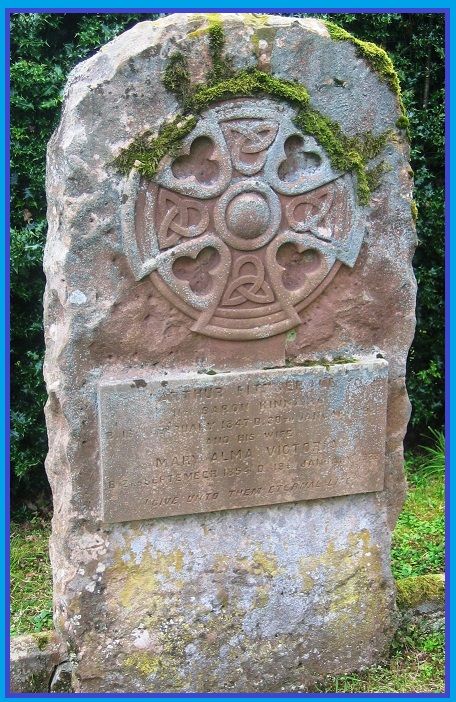
(Arthur Kinnaird Grave)
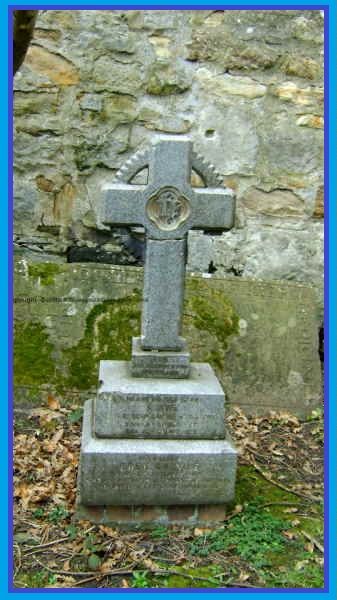
(Francis Marindin Grave)
Following his death at sixty-one in 1900 Sir Francis A. Marindin K.c.m.g. was buried, to be joined by Kathleen, his daughter, who survived him by thirty-nine years, and other family in the grounds of the ruins of Old Crombie Church, by Torryburn on the north bank of the Forth in Fife. But he had been born in Weymouth in 1838, his father a vicar and, given the surname, of probably French Huguenot origin, his mother born in Beckenham but with a complicated, wealthy and, shall we say, not very salubrious Scottish background. In 1851 her Edinburgh-born father was listed as a land-owner but had been a plantation and slave-owner in the West Indies and with John Gladstone had to compound the felony then imported indentured labour to the region.
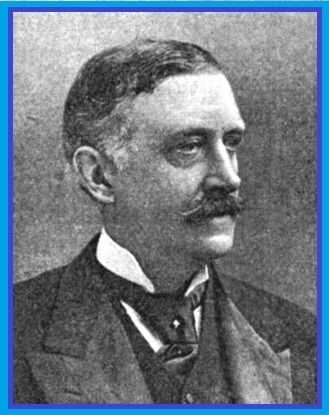
(Marindin)
Sir Francis himself had when very young moved with the family to another parish in Somerset, from where he was sent to Eton, then the Royal Military Academy and at sixteen joined the Royal Engineers. At seventeen he was serving in The Crimea and then from 1860 was A.D.C. and private secretary to the Governor of Mauritius, also serving in Madagascar. Indeed it would be also in Mauritius that he married the Governor's daughter, Elizabeth Stevenson, they themselves having, in 1865 and by then back in London after returning two years earlier, a single daughter, said Kathleen.
And by then a twenty-five year-old Marindin, having re-joined his regiment in about 1863, had been involved, if not in the actual foundation of its football club then its very early days. And that involvement would continue for a decade including appearances in the first FA Cup Final in 1872 and again in 1874, the same year he assumed the FA Presidency. But he must have filled this latter role initially from something of a distance. Again in 1874 he had been posted to Harwich, there founding and at thirty-six playing for Harwich and Parkstone F.C.. It meant that from then until 1877, when he was seconded to the Board of Trade as an Inspector of Railways, stepping back from the army in 1879, day-to-day London operations were inevitably left in the hands of Kinnaird and Charles Alcock.
However, as a Railways Inspector Marindin was known for his "plain-speaking, coupled with a complete mastery of his subject and great discriminating capacity" so it seems unlikely as FA President he would have been any different. Indeed those characteristics may well have been responsible for the smoothness, with which Sheffield's was in 1877-8 absorbed, albeit due to problems internal to the Steel City's own game, only initially partially subsumed, along with a number of its far more sensible rules, into London's, and the avoidance, twice over, in 1885 and 1888, of conflicts, which might well have resulted in schisms with Northern and Midland clubs over professionalism. But it does not explain the allowing of Lane Jackson's 1882 attempt with the formation of Corinthian F.C. at sporting eugenics, unless, of course, Marindin was in agreement or simply, and somewhat bizarrely given his burial place, just anti-Scots. But then a biographer is quoted as saying,
"Refereeing the [FA] final in 1888 he entered the winners dressing room, West Bromwich Albion's, and asked if it were true that they were all Englishmen (in fact they all came from Staffordshire) and being assured it was so gave them the match ball, which he was entitled to keep - political correctness then was unknown."
The judgement remains yours but West Brom had just beaten Preston North End with a Welshman and seven Scots in its team.
However, what he certainly did was to establish a high standard of game-officiation. He was in 1880 and from 1884 to 1890, the year he stepped down the FA Cup Final referee, so at that time still, with two umpires, one representing each team on the pitch, the arbiter in the stand. He was in his era considered to have a knowledge of the game's rules like no other but even then also perhaps conservative to a fault. Today's system of an on-pitch referee and two linesmen would only be introduced from 1891.
As Marindin had stepped up to the FA Presidency Charles Alcock had already been there as Secretary for four years. Furthermore he would be still there for five years after "the Major" would stand down. And in that period of twenty-five years he is initially credited with the introduction of both international football and competitive club football in the form of the FA Cup, neither accolade being completely deserved.
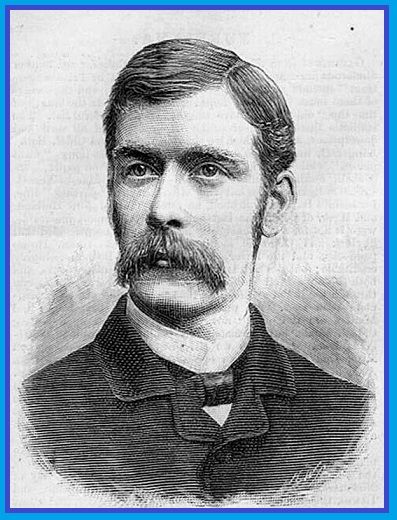
(Alcock)
It is true that Alcock was the signatory to the challenges issued in 1870 for the five unofficial international matched that followed and for first official one in 1872, but then he should have been. He was FA Secretary, having in the former case just taken over. And whilst he would, as again in the former case, be the England captain, both he and Secretary for the previous three seasons, Robert Graham, who remained on the FA Committee until 1871 were responsible for team selection.
Moreover, the selectors of the Scottish team were initially Kinnaird and James Fitzpatrick, the Quiet Baron, who was also captain in that first game and the one that followed. Kinnaird would captain in the third. And both Diasporan Scots would also be committee members with the impression thus being that it was very much a joint effort, the kudos for which was subsequently high-jacked.
And with regard to the FA Cup there is a very good argument that it was a borrowed initiative. Already in 1867 in Sheffield the knock-out Youdan Cup had been played with the concepts of both extra-time and the Golden Goal introduced. Twelve local clubs had taken part. Fifteen would start the first FA Cup, thirteen local to the South of England, plus one from the Midlands and Queen's Park from Scotland. Then the next season again in Sheffield the Cromwell Cup followed but with just four participants but then it had been restricted only to teams under two years old, perhaps a sign of rifts to come.
So where does that actually leave Alcock? On the one hand and conventionally he was a marketing genius, who took the game forward in leaps and bounds. But on the other perhaps he was not as innovative as some and perhaps he had liked us to believe. Indeed there is an argument that he, whilst he had seen off, on- and off-field, the first potential challenge from the English North in the shape of Sheffield, he, and indeed Marindin, failed to do the same on-field from Scotland. Moreover, he then would allow, still under his watch, the FA to be largely rendered permanently toothless off-field by the English Midlands and North-West in the form of the Football League. The choice is yours but whilst in Scots terms it makes little or no difference perhaps the following quote from Alcock himself and 1891, so as the second Renton-created, Scottish-Game was sweeping South, might help you. It is remarkable, noting the date cited, for its complete Anglo-centric myopia, indeed its pure gas-lighting:
"The perfection of the system which is in vogue at the present time however is in a very great measure the creation of the last few years. The Cambridge University eleven of 1883 were the first to illustrate the full possibilities of a systematic combination giving full scope to the defence as well as the attack"
Where was Sheffield. Where were the Royal Engineers? Where were Renton and The Vale? Where indeed was Queen's Park?"
____________________________________________________________________________________
However, before the further tendrils of the Mandirin/Alcock era are unravelled let us shift attention North of the Border once more. With its first defeat and the rise from 1877 of The Vale as the replacement of Queen's Park at the peak of the Association game, the Glasgow club must have realised it needed to refresh an ageing team. And this it tried to do at least in part internally. The 1878 team had six new faces and just two and half had been recruited from outwith, the experienced Davie Davidson from four years with neighbouring Third Lanark and the youngsters, twenty-year-old Jamie Richmond, who had already been capped from also nearby Clydesdale, and nineteen year-old George Ker, from Alexandra Athletic, north of the river in Dennistoun but whose elder brother, William, had already been a Spiders' player. However, it made little difference. In fact Queen's Park struggled, not the only city one to do so, that is until the three were by 1880 joined by two more players who were brought-in, or perhaps bought-in with better expenses. They were the full-back, William Somers, and the forward, John Kay, again both from Thirds. And it was with all five new arrivals that the Hampden club, for that was what it was by then, was able in 1880 not just to reach but regain the top trophy once more.
However, for another notable Scottish club decline, perhaps also because of ageing or simply lack of players, would appear to have been more rapid and recovery to take a great deal longer. That club was Renton, the demise and gradual rebirth of which is set out, with the third episode, an in-depth look at the men involved in the first Renton iteration, available here, in the fourth episode of Renton & The Vale - The Making, Remaking, Unmaking, Breaking and the Who. (But the creation of the Scottish Game)".
Episode 4 - The Unmaking
So it was that at the end of the 1877-8 season the valley of the Dunbartonshire Leven would have the Cup-Winner, The Vale itself, and a semi-finalist, Renton, which had failed to make the final only on a second replay. And it was to be superficially much the same the following season, except that, whilst the Alexandria club would go on to take the trophy for a third time in a row, having meantime also defeated the English Cup-Winners, The Wanderers, to become ipso facto World Champions, and Renton's slot would be filled by Dumbarton. To do so, with Renton having gained from a first-round walk-over, it had in October 1878 in the second round and watched by fully 4,000 crushed the Tontine Park club away 1-6. As it turned out It was not a good omen. Whilst a new, third village club, Renton Wanderers, played its first recorded game in January 1879 Renton itself was perhaps already struggling and with worse to come. The next year's Cup would see them get through Rounds One and Two on replays, one against the Dumbarton club, Lennox, before in the third Dumbarton itself overwhelmed them once more, this time away but still 5-0. And after that there is for the loser of that encounter not a single game recorded for the rest of the season.
Moreover, Renton's premier team would not be alone. In October 1878 Renton Thistle, until then the village's second of two clubs, had lost in the Cup's first round, in fact to Lennox, then played a single last fixture and was dissolved. There would be no obvious explanation and, furthermore, turned out to be a precursor of what was to come.
In September 1879 The Vale had lost its Cup crown, going down in the First Round and to the growing power of Dumbarton once more in what much have been a great match, 4-3, away. But it continued to play on with a programme of friendlies, a full squad and, in 1880-81, would reach the Cup quarter finals with Renton, firstly, be one of its victims on the way, again in October in just the Second Round, 0-1 at home, and, secondly, the Tontine club once more having not a single further, recorded game. Then in September 1881, whilst Renton had entered that season's Cup, it allowed itself in the first round to be walked over by another local club, Jamestown, and in addition did not obviously feature anywhere again. Indeed, by the end of the season, so the summer of 1882, it had even resigned from the Scottish Football Association. The club had seemingly collapsed, its players stepping away from the game with the exception of M(a)cRae, or even the brothers M(a)cRae, who would transfer their allegiences to The Vale, Robert in time into the first team and a career in England.
There is, as previously with Thistle, to this point no obvious explanation for this turn of events. And, whilst initially several theories have been suggested, none seems enough on its own, although together they might have been sufficient. The first is that through the 1870s, on-field, whilst The Vale had regularly drawn from a pool of at least twenty players, climbing to thirty in 1880-81 as its rival just down the road seems by 1878-9 to have had just fourteen at its disposal, and from that point perhaps simply struggled to put together an eleven. The second is off-field. By that time its Secretary, the man who organised it and the fixtures, was James Thomson, who in 1878 married a girl from Dumbarton, moved there with no replacement found. The third, somewhat tortuously, is that there was almost an edict had been handed down in the village that specifically football should cease, although not all sport. Shinty was still acceptable. It seems unlikely. And the fourth is that repeated early exits from the Cup had redirected the village's sporting talent, and in 1879-80 that of Alexandria also, back to the ancient game.
In fact the fourth has been for sometime the preferred thesis as in 1880 "Vale of Leven" won the premier, Glasgow shinty trophy, the Glasgow Celtic Society Cup, and in 1881 and 1882 "Renton" was twice runners-up. However, we now have uncovered the GCSC teams and, whilst there is some cross-over of personnel from both football clubs, notably David Lindsay, W(illiam) Campbell and A(lex) McCrimmond, and therefore a continuing intermixing of tactical thinking, it was simply not enough numerically to have weakened either club fatally. In the case of The Vale in fact there was quite the opposite, which suggests the shinty "Vale of Leven" may have been geographical rather than club. Indeed, the Alexandria team, with half-a-dozen new recruits, can be seen to have rebuilt its specifically footballing side starting after the 1879 set-back ,and to immediate success. In season 1880-81 it was to be a Cup semi-finalist, losing to Dumbarton, and in 1881-2, whilst exit would be in the second round it would be to the same opposition, again 0-2 and at home, with The Sons of the Rock once more going on to the last hurdle and a second loss to an also rebuilt and importation-rejuvenated Queen's Park.
But there is a fifth theory, one based on a disruption in patronage and thus finances, not in the form of sinecure jobs, as the academic, sports-historian, Matthew McDowell, has suggested but with seemingly little indication beyond later normal practice everywhere, and certainly no evidence from and for these early years, but in terms of facilities and sponsorship. Tontine Park, rudimentary as it was with, for example, no grandstand until 1886, had to paid for in terms of both land and infrastructure, never mind running-costs. And in 1878 the Stirling family had sold its local business interests to a consortium, one including and from 1873 an already Stirling-employee; a certain Alex Wylie.
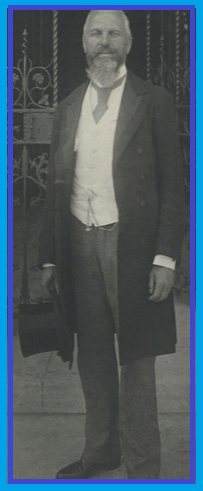
(Alex Wylie)
From the formation of Renton Football Club it seems Alexander Wylie had been its President, Honorary or otherwise. A Wylie, perhaps Alex himself or one of his younger brothers, George or Hugh, had even played right full-back for Jamestown in its earliest, known team, as had, for future reference, a McKechnie. And interest in the club was retained. In 1886 at the Renton F.C. sports-days, as they might have been in other years, all three brothers were there, even acting as judges.
As background Alex, George and Hugh's father, John, had been the one to bring Turkey-Red dyeing to the valley. He had come in from Balfron, Perthshire fitba' country. But Alex's mother was local, Bonhill parish born. In fact she was a Kinloch (See Vale of Leven's first ever squad) with Alexander himself born in 1839 in Alexandria itself and working initially for the Orr Ewings. But indeed in 1873, so at the age of thirty-four, he joined William Stirling and Sons in Renton at the Cordale and Dalquhurn works, being part, note part, of the consortium that acquired the business in 1878 but becoming its manager in 1880. And that was the same year he wed Ann Mylrea and might simply have turned his attention to newly-married life with the previous interest in football relegated to the back-burner.
However and sadly it was not to last. In 1883 Ann Wylie died in the village aged just twenty-seven and is buried in the graveyard of Cardross i.e. Renton's Old Parish Church, with her husband never remarrying.
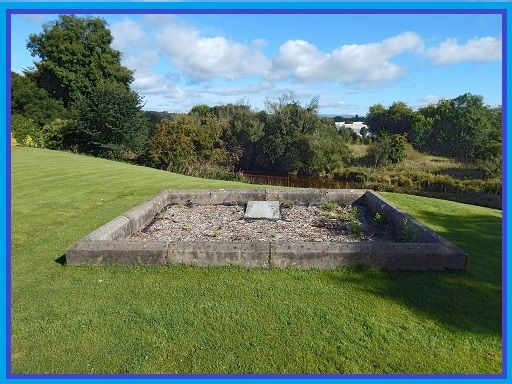
(Alex Wylie Grave)
In fact he would outlive her by almost forty years, dying in February 1921, aged eighty-one, to be buried with his brother and sisters in the family plot still in Renton but at its Trinity Church. The timings are significant. He had been involved with the first iteration of Renton F.C.. He held all the main, local, industrial purse-strings and he in November 1883 he would be widowed, needing diversion from his grief. It is therefore unlikely to have been coincidence that at about that same time not just a new but a well-run and -funded Renton football club emerged, of which he would be President and also almost four decades what remained of the same, by then long outwith the top-flight, indeed, the League, was wound up within months of his passing.
And so to Alex Wylie himself. He is, perhaps best described, as, for example, Alexander Watson Hutton is of the Argentine game, as the "Father", and twice over, of Renton football and therefore much more. He would see his remarkable village-club in five years from rebirth rise right to the top in Scotland, then in Britain and therefore the Football World of the time. But it would in that same time also develop what would become not just its tactics and therefore style but Scotland's as a whole, thus should he not also be considered the "Father" of our game? Furthermore, with the Scottish Game provably the one that was taken round the World, should he not then be lauded too as at least one of the "Fathers of the Global Game"? Yet where is the recognition, where are the laurels? Unlike the arguably less significant Watson Hutton, Alex Kinloch Wylie's last resting-place is adorned neither by stane nor bloom.
"Sheffield - a Home of Football - from Cradle to Crash and Come-Back?
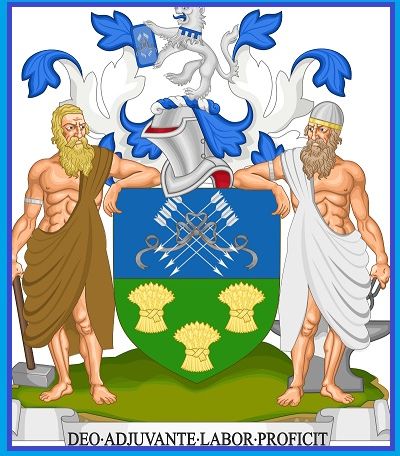
It is beyond doubt with current research both from the city itself and elsewhere that Sheffield, in the form of the doyen of British round-ball clubs, Sheffield F.C., was crucial and even pivotal to the creation, indeed preservation of the earliest Association and thus the game as a whole. No Sheffield, No Soccer might be a mantra in just the same way as is No Scotland, No Modern Soccer. And this was despite the fact that for the best part of two decades and half from genesis it seems to have continued to prefer, at least in part, and practice not the London but its own Sheffield Rules.
Yet it, the club and by default the city, was there if not at the very first step towards the London-based Football Association in 1863 then within a few months, perhaps weeks, urging by letter and even in person the minority who had chosen the game practised largely with just the feet, rather than the majority for hands plus feet, to remain steadfast. And whether it was actually a full member of the nascent Football Association or not it would from then be, a) at meeting after meeting in the form, it is said, initially of future Secretary, twenty-one year old Harry Chambers, significantly a trainee solicitor, as were both London's FA and Sheffield F.C.'s founders, b) in 1865 suggesting itself as the organisation's first, representative opposition, travelling in 1866 from Yorkshire to London to make it happen, c) in 1867 in the form of former Secretary, William Chesterman, be there to provide that same organisation back-bone as London teetered on dissolution and then even d) arguably providing, in the Youdan Cup and pre-Alcock, the model for the FA Cup.
All this was largely off-field but also in its match-reporting there is evidence that not just Sheffield F.C. but the Sheffield game more generally provides early examples of passing, heading and position and a number of its rules and and innovations in equipment were incorporated into those of the Association game. Indeed it would still after 1870 continue to contribute similarly even as on--field success went missing and that local game would drive itself into a cul-de-sac; one from which it would not emerge for the best part of two decades, its leading place meantime taken certainly on the playing-front initially by Glasgow, then by the West of Scotland and eventually by the Scottish game more generally.
And here is the evidence of the cul-de-sac. From 1872-3, the years of the successful planting of the Association game North of the Border, and for the next fifteen seasons Sheffield would produce, with the Clegg brothers, only seven England internationalists and really only two stars, both in the 1870s and early 1880s. It would take a decade from 1883 before another would be produced, and even he, Fred Spiksley, was actually a Lincolnshire-man. And of the two one, the fine winger, Billy Mosforth, would achieve only a single win over Scotland and even then in controversial circumstances, whilst the other, the defender cum half-back, Jack Hunter, would never have even that success in four attempts, in fact, be in the team in 1881 to suffer the worst ever defeat in an international by the Auld Enemy and in eight city-representative starts for Sheffield against Glasgow see again just the one victory.
In part this situation was probably due to the Sheffield FA, formed in 1868, splitting after less than a decade and remaining thus for the next ten years, two thirds of its members accepting London rules and the remainder staying with the local ones, albeit differences were by then small. And that split may well have been a product of two factors. The first was in 1874-7 and onwards a change of guard at the top in the English capital from essentially middle- to upper middle-class and public school in 1874-7. And the second was before that in 1869 a stepping-back of the first President of the Sheffield FA, none other than Chambers, with from 1868 a year as Vice-President and then fourteen to 1883 as President for John Charles Shaw followed perhaps as early as 1873 and certainly from 1876 by William Dix as Secretary and then also Treasurer. And both seem, whilst clearly alienating emergent, local football teams, hence the split, to have developed locally a less apparently collegiate, more widely an absorbent and in the end vis-a-vis London a more subservient, indeed totally acquiescent relationship than had been the case. One Sheffield commentator goes as far as to say re. the mid -1870s, "It was quite clear by now that the Sheffield Association was tacitly in feudal submission to London". And the results were that, whilst in 1876 the Birmingham FA is said to have affiliated not to London but Sheffield FA, making it in theory more powerful, in 1877 Sheffield deferred to London, like it or not, with then some Sheffield teams under the banner of the New Sheffield FA just carrying on for the best part of a decade as if it hadn't happened, i.e schism.
And behind all this there was something else, only heightened by dispute. There seems to have been even from the early 1870s a gradual loss of general impulsion. It saw Sheffield teams be first beaten by Glasgow teams and second adopt the Scottish 2-2-6 formation, even importing prominent Scottish players, Andrew(s) and Lang, on a shamateur basis. And even then it, in parallel with much of the rest of England over much the same period, with worse results still and clearly failing to match us Jocks tactically and therefore technically previous self-evident self-confidence just ebbed away to zero. In the 1880s the city as a whole hardly produced a player and won little of note.
In fact organisationally it would not be until 1889-90, after reconciliation of the rift between the Sheffield FA and the Sheffield New FA under what would become the enduring figure of the city's game, Charles Clegg, that there would be a partial re-emergence. And it was also that year Wednesday, from outwith the then new Football League and with a largely local team, reached the FA Cup Final albeit being badly beaten. The club would not join the League until 1892 and really not be fully back until 1896, when the Cup was actually won, but fielding a team that contained five Scots, Spiksley and just one Sheffielder, with for the city as whole the come-back arguably only truly completed as non-Scots but even then still mainly non-local Sheffield Utd. would win that same competition three seasons later in 1899, be runner-up in 1901 and champion once more in 1902."
____________________________
"Sheffield Football 1870-88
- Cups, Confusion and Cleggs
The city of Sheffield has and is mounting an extremely competent campaign for UNESCO heritage status as The Home of Football. And home of a football it is, but not the Association game. Whilst Steel City was instrumental in, even pivotal to the genesis of the round-ball game we play and should have been at the forefront of its on-field advancement, it never happened, its erstwhile place taken, and with considerable aplomb, not by Southern England, as historically claimed, but by Scotland and then the Scottish Game, now essentially the World Game.
So the question is why did it, or rather why didn't it happen, the answer, one carefully avoided, even somewhat obscured by the Sheffield-ers themselves, being that when it mattered, having had a unified face, they descended to arguing amongst themselves for the best part of a decade and half and with an explanation as follows.
In 1876 the Sheffield Football Association announced "following the example of London (note London not English) and Scottish Associations" the inauguration of its Challenge Cup. The Birmingham Association did much the same thing at the same time. Its competition, the Birmingham Senior Cup, still played for annually to this day, would have in that first season all sixteen of its members taking part. In Sheffield there would be twenty-five of twenty-six, Endcliffe seemingly the exception. The games would be to local rules and in each case not the eleven per side of London and Scotland but twelve and on the same day, 10th March 1877. The Wednesday would win Sheffield's first version, the final refereed by its association President, John Charles Shaw, and serendipitously Wednesbury Old Athletic Brum's.
All seemed well but in Yorkshire it would not stay so for long. In-fighting would erupt. By the following season there were two associations and three cups, the existing Sheffield FA Challenge Cup (ShFACC) now joined by the rival Sheffield New Football Association Challenge Cup (ShNFACC) competed for fifteen other clubs and a Non-Association Cup competed for by six more, so forty-seven teams in all. Moreover, whilst the last of the three seems to have existed for just the year, the half-dozen clubs involved joining the New Association taking it to twenty-one members, the ShNFACC continued to be played for until 1882 and the ShFACC until that same year when it morphed into the Hallamshire Challenge Cup to 1887 and then from 1888 to 1900 to The Sheffield and Hallamshire Senior Cup. Echoes of Life of Brian are audible even here in the Scottish Highlands.
And behind all these iterations and changes is a tale essentially of almost collapse and, if not then full, at least significant recovery. And it starts in 1872. That year the England team in the first ever international included as a forward just one Sheffield man, John Charles Clegg, aka simply Charles Clegg, soon to be a qualified solicitor, like two of the three football pioneers in the city. However, it was to be his only cap and not a happy experience. As he would be later quoted, having hardly had a pass or therefore a kick,
"Some members of the England eleven were awful snobs and not much troubled about a 'man fra' Sheffield."
Yet the following year in the same fixture, more or less filling his shoes but in retrospect perhaps an exercise in (further) window-dressing, would be his younger brother, William, also a future solicitor, winning the first of his two caps. The second would be in 1879 against Wales and a year before at the age of twenty-seven he retired through injury. Charles had retired at much the same age in 1878. But both would remain in the game. Charles would initially become a noted referee, William President of Sheffield Wednesday and a Vice-President of the Sheffield Football Association, where all was clearly not well. The three Cups of 1877-8 and the continuing duo of Cups and two associations demonstrated that. And there might have been personality-clashes and even political rivalries. After a first few years from foundation in 1867 of apparent calmness at the Sheffield Football Association under pioneer William Chambers, Shaw of Hallam F.C. had taken on the Presidency in 1869, Chambers reverting to solely Secretary of Sheffield F.C. Then, as we understand it in probably 1873, Shaw was joined by William Pierce Dix as Secretary and then in 1876 Secretary/Treasurer. Dix was an accountant. Both were politically Conservative with a big C. and appear to have been social-climbers. Shaw was a man, who had inserted a Charles into his name when originally it was not there. Dix later personally hyphenated his surnames. And given those possible stand-points and attitudes it can be seen how the pair might well have thought they could get on well with the London FA hierarchy from 1877 of Marindin, Alcock and Kinnaird but might have appealed considerably less to those from across the whole social spectrum playing the game at their hometown clubs.
The result was breakdown and it is unlikely to have been coincidence that first in 1878 the non-association clubs joined the Sheffield New Football Association and not their Sheffield Football Association and the two rivals Cups, if not yet the associations, merged in 1882 but only as Shaw stepped down, eventually to leave the city for Birmingham for good. And at this point it appears Dix may have held the fort for another year before he too by 1885 was replaced, in time left the city also for Birmingham but did in the end return. After-all he had in 1878 married the Cleggs' sister. And his direct replacement was the politically Liberal Charles Clegg himself.
It may have been that the replacement was just expediency with Shaw and Dix seen personally as the problem. It may even have been something of a political coup. But whatever the truth with the older Clegg in place by 1887 resolution was to be achieved. The two associations were re-merged as the Sheffield and Hallamshire FA, the cup from 1888 to 1900 was renamed The Sheffield and Hallamshire Senior Cup and tranquillity was restored such that Sheffield United was founded in 1889 with Charles Clegg as its first President. Furthermore, The Wednesday, after the waste of the best part of two decades when Sheffield , clubs and players, had moved from prominence to near invisibility on the British footballing map, reached the 1890 FA Cup Final, although the game was lost, returned to win the 1896 Final with United doing the same in 1899, tasting defeat in 1900 but achieving victory once more in 1902. And, as for the Cleggs, William would go on to be Lord Mayor, be knighted in 1903 and be called the "uncrowned king of Sheffield" and Charles would follow with a knighthood in 1927, having been Chairman of the Football Association, the "London" Football Association, from 1890 and its President from the death of Arthur Kinnaird in 1923."
____________________________
The Slow Rebellion - how Scots working-class realism made football proper pro -Part Two
Movimg on with "The Slow Rebellion" from Part One, where the evidence is there that specifically in Scotland it was regular practice for money to change hands for ostensibly amateur team sport, to "Part Two" the stage is reached where the first Scottish players actually moved South for payment. However, the point has to be made that the first of them to go - J.J. Lang and Peter Andrews - went to Sheffield so in 1876 to Sheffield Rules outwith the London ones, our game. Thus the impact on the latter was felt first only in 1878 when Jimmy Love and Fergus Suter joined Darwen on the other side of The Pennines and in Birmingham Archie Hunter arrived at Aston Villsa. However, again there were caveats. First Love lasted only a few months, seeing, given his personal circumstances, the army as a better offer, and, second, both he and Suter, and, indeed Hunter as well, were very young - just turning twenty-one Moreover, in home-town Glasgow neither of of the Darwen recruits were playing for one of the better clubs. Neither had been capped. Both were talented but raw, Suter in Lancashire essentially applying the Scottish game, as far as he knew it, but also, given the eventual length of his playing-career able very successfully to learn on the job. And whilst Hunter had been playing at a higher level, at Third Lanark reaching the Scottish Cup Final, learning on the job was also a key to continued success.
(J.J.Lang)
(Fergus Suter)
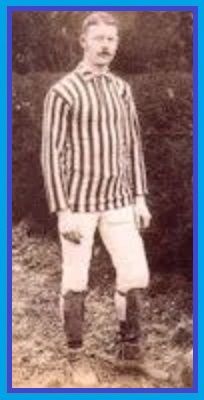
(Archie Hunter)
______________________________
"Villa"
"But for the moment another, wee step-back, some expansion of history i.e. minor de-gas-lighting, and preparation.
Meantime still in England but elsewhere, specifically in Birmingham and Lancashire's North-East, changes were slowly not just taking place but quietly bedding in. As also previously mentioned In 1876 a certain George Ramsay had made his way to the West Midlands, probably legitimately for work. But he had come from Glasgow, where he had been born in The Gorbals but was raised in the Southern Suburbs and there is said to have turned out for Oxford and Rovers, two teams from Crosshill, i.e.just north -east of Queen's Park. And that was clearly sufficient for him, when Down South he came across a group of footballing locals in a park, so greatly to impress them with his ability as to be invited to be the first captain of what is today's Aston Villa, remain so for four years, play on for two more, have a wee break and then return for another forty as Secretary, i.e. manager. But he did not do it alone. At the beginning he had the critical help on- and off-field of the two Lindsay brother's, Billy and Jimmy, Scots temporarily down from Golspie in Sutherland, from 1877 off-field the support of William McGregor, locally-installed draper and sometime umpire/referee but a native of Braco in Perthshire and from August 1878 on-field the ability of Ayrshire's Archie Hunter. He was one of three footballing brothers with, John, a Scottish international, and Andy, who would join Archie at Villa the following year. Archie himself had come directly from the Third Lanark team that had just been defeated by The Vale in the Scottish Cup Final and included brother John, William Somers, who himself via Rangers and Vale of Leven would end up at Bolton Wanderers, Johnny Kay, J.J. Lang and William Peden, likely the elder brother of Queen's Park player, Andrew. And he would stay at Villa until 1890, when he suffered an on-field heart-attack, never really recovering and dying four years later, his source of income whilst at the club never really explained, certainly shamateur but perhaps in part as player-coach. If so it makes him the World's first, and, with his initial recruitment also seemingly just pre-dating by a couple of months those of Love and Suter at Darwen, also making him the World's first ever Association football professional.
__________________________________________
__________________________________________
__________________________________________
__________________________________________
__________________________________________
__________________________________________
__________________________________________
__________________________________________
__________________________________________
__________________________________________
__________________________________________
__________________________________________
__________________________________________
__________________________________________
__________________________________________
Known Renton, Renton Thistle, Vale of Leven and other Upper Vale Teams (cont.)
- James Smith
- R. Kilpatrick
- D. Lindsay
- J. McLean
- W. Campbell
- John Smith
- John Docherty
- James Williamson
- Thomas Kinroy
- James McComish
- A. McClaren
_________________________________________
- Cunningham
- Collins
- Sharp
- Cranmer
- McCulloch
- Brown
- Stewart
- McIntyre
- Hendry
- Coubrough
- Graham
_________________________________________
- Robert Parlane(28)
- Andrew McIntyre (23)
- W. Strathearn(18-20)
- John McPherson(23)
- James McIntyre
- John Ferguson
- John McFarlane
- James Baird
- William Taylor
- John McDougall(23)
- M. Gilles
Will Jamieson, Paton, McGregor, John Baird (23), Sandy McLintock (26), John Forbes, G. Cranmer/Cranbury, (Mc)Rae, D. F(L)indlay, D. McLean, J. Brown, A. McLeish, Cunningham
_________________________________________
- James Towie
- D. Gordon
- W. McKay
- H. McKinney
- A. MacCrimmond
- M. Kennedy
- Joseph McIntyre
- J. Munro
- James McIntyre
- T. Watson
- James Watt
- Alex. McKinney
1880-81 Renton Shinty
_________________________________________
- Lindsay
- McIntyre
- N/A
- N/A
- N/A
- N/A
- N/A
- N/A
- N/A
- N/A
- N/A
- N/A
_________________________________________
- Robert Parlane
- W. Strathearn
- Sandy McLintock
- James McIntyre
- Andrew McIntyre
- John McPherson
- Peter Logan
- John Campbell Baird
- James Baird
- Robert Paton
- John McFarlane
M. Gillies, John or James McRae, C. McRae, John Ferguson, John Forbes, R. Murie, H. McLeish, D. Lindsay, D. McLean, John McGregor, W. Taylor, J. Cranmer, Cunningham/Cumming, Kerr, Wilson, McLaren, Chapman, Walker
_________________________________________
- M. Kennedy
- J. McKimie
- A. McLaren
- D. Gordon
- J. Towie
- John Smith
- James Smith
- T. Watson
- A. McKimie
- J. Baxter
- Joseph McIntyre
- James Munro
1881-82 Renton Shinty
_________________________________________
- A. Sharp
- J. Millar
- W. Collins
- T. Hendry
- D. McLean
- J. Brown
- H. McCulloch
- A. McCrimmond
- D. McIntyre
- J. MacFadyean
- William Mann
_________________________________________
- Sandy McLintock
- John Forbes
- John McFarlane
- John McPherson
- (Robert) McRae
- Peter Logan
- J. Abraham
- William Struthers - from Rangers to Bolton Wanderers
- Dan Friel
- James Brown
- D. Kennedy
Andrew McIntyre, M. Gillies, Kerr, W. Strathern (Strachan), J/G.Cranmer, Cumming, Gillies, C. McRae, J. McCrae, McLeish, John Miller, J. Wilson, W. B. Johnstone, Kennedy, McNee
_________________________________________
But back to Marindin and Alcock and the actual extent of the "Scottish" problem that seems even from the mid-1870s to have so engaged the now "unified", English FA. The answer is that it was frankly huge and can be best expressed by first a table, then the story of for the England national team and therefore its Association a cataclysmic and catalytic series of games and finally a few simple tables more.
Firstly, over the decade of the 1870s there was the startling differential in simple club-creation and therefore annual total club numbers in England, the sub-division that is Sheffield and Scotland. Those from 1870 to 1880 are shown below with the Scottish proportion of known clubs to be in existence in Britain rising from 10% to 69%. The figures, which are not completely carved in stone but will not be too far off the mark, speak for themselves.

Moreover, in 1870 one in ten football clubs in Britain, but, of course, yet not Association football clubs, was Scottish and a decade later that had become seven in ten and all Association.
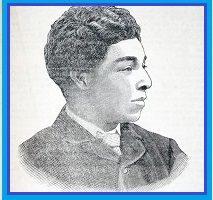
(Andrew Watson)
Then there is the story of Andrew Watson, not the the World's first Black player - that was near-contemporary Robert Walker with an African mother and a Scottish father and who made it is as far the national team trials but there was up against John Ferguson - but the World's first Black internationalist, and his impact or rather that of the Scotland teams, in which in his he was involved. His first re-recognition when Ged O'Brien was curating the Scottish Football Museum followed by the re-discovery of his grave in London by Andy Mitchell and the fund-raising for restoration of it by SFHG's Ali Firth are all well documented, if not fully appreciated.
Nor is there full recognition of the impact of the three matches, in which Watson took part and which he might even have in part subsidised. The first, the annual Scotland-England encounter, took place at The Oval in London on 12th March 1881, a Saturday. Depending on source Watson was captain. Francis Marindin was undoubtedly the referee. Sheffield's Jack Hunter was one of the English half-backs. Scotland, as previously mentioned, would win 1-6, John Smith and George Ker both scoring braces. Morever, three Scottish other goals would be disallowed for off-side. But there would be more. The Scots then travelled north to Wrexham and on the Tuesday evening Wales were beaten but showed up better. The score was only 1-5 with the home-side even having scored the opening goal but at the end of time England, having already suffered humiliation once, now might have felt subject to a second dose by proxy. Even Wales was better than it? Moreover it would suffer a third measure the following season, 1882, against Scotland once more again with Watson involvement at full-back, away from home but still 5-1. The aggregate goal-count against England would be Scotland eleven, the "Saxons" two with the response soon to be attempted from London, from the English FA itself, in the form of Corinthian F.C., club and philosophy.
And thirdly there are the comparitive figures once more in four instances over the period of the 1870s and in a fourth from 1874 to 1887. Table One is of the Scottish-English inter-club record, when each team would consist with only one or two exception players from the respective country, even locality. Some seventy games were played over eight season, the goal count for the teams from Scotland was two hundred and thirty-one and for those from England sixty-seven. For every English goal there were 3.4 Scottish ones.
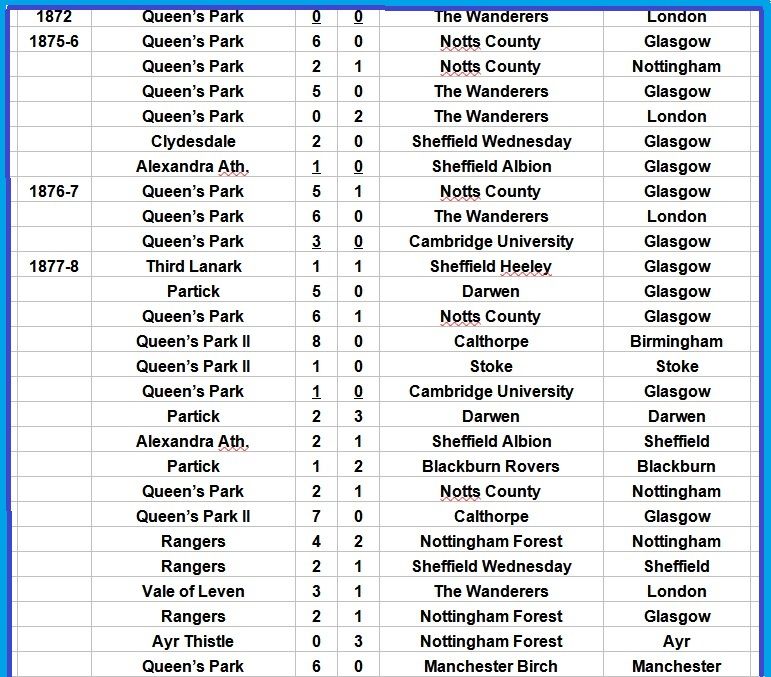
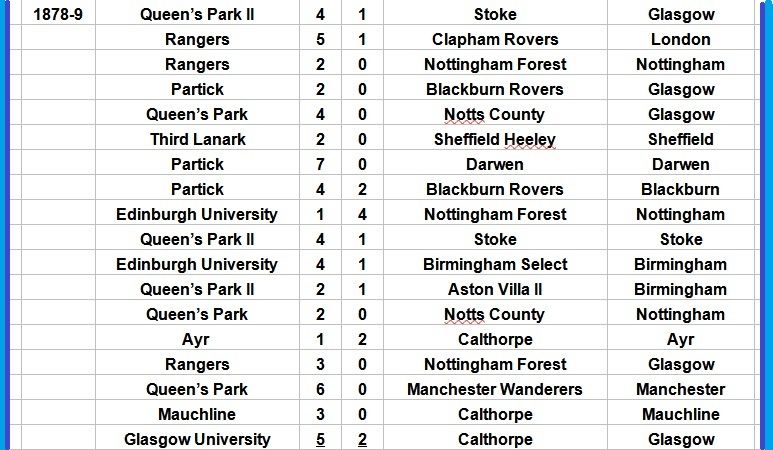
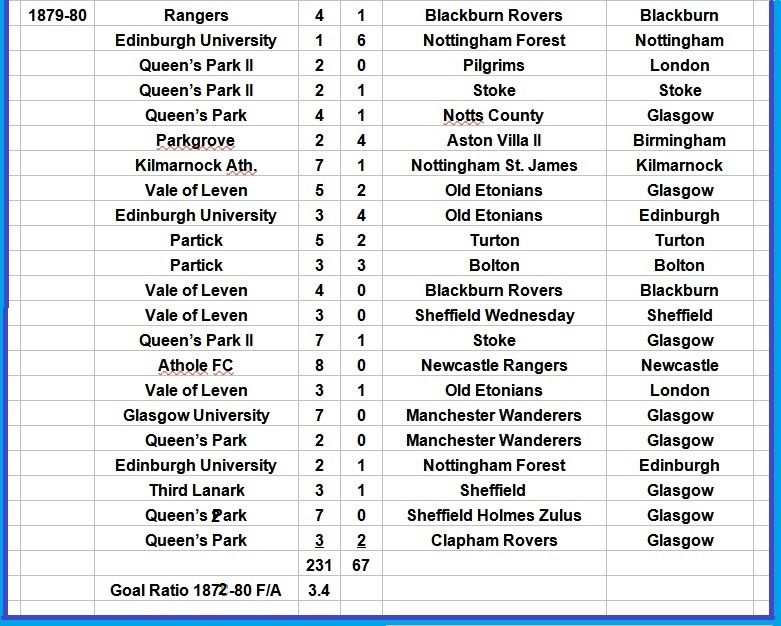
(Cross-border, inter-club games)
Then In international games the win ratios, using both two and three points for a victory, one for a draw and zero for a defeat, were over thirteen years from 1874 by modern standards quite phenomenal, 82% and 76% respectively.
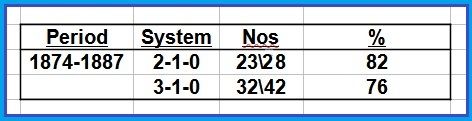
(Internationals Points)
For comparison, as this is written Steve Clark's Scotland has just qualified for the World Cup in America, Canada and Mexico with a final ten-game run that on 3-1-0 has seen a win-percentage of 63%.
And, when it came to Sheffield-Glasgow encounters Glasgow did not lose a game, winning six out of seven with goals for sixteen and goals against five, over three for the Clydesiders to every one from Steel City.
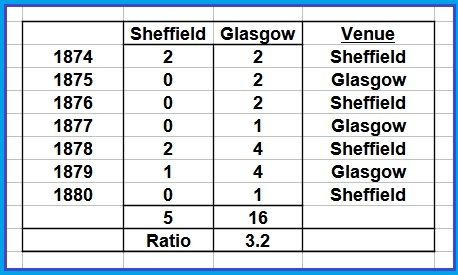
And the same degre of differential was also reflected in comparative crowds that were drawn to Cup Finals South and North of the Border with the latter at the very least 11% greater than the former and on average over the first seven seasons almost 100% more.
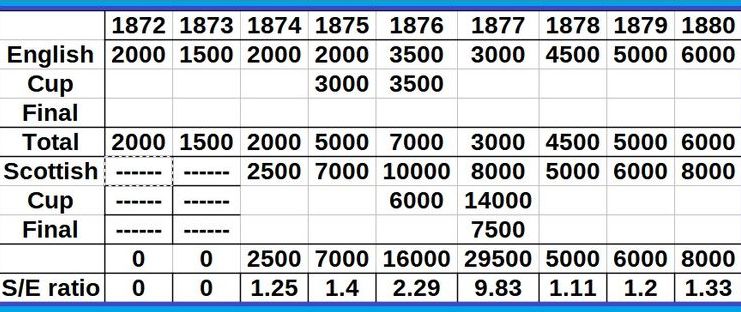
(Cup Final Crowds)
Indeed, it is also apparent in the difference in the crowds at internationals between Scotland and England, as they alternated between Glasgow and London. Glasgow crowds, once the first of the games had been played, were greater by a factor of between two and eight on every occasion.
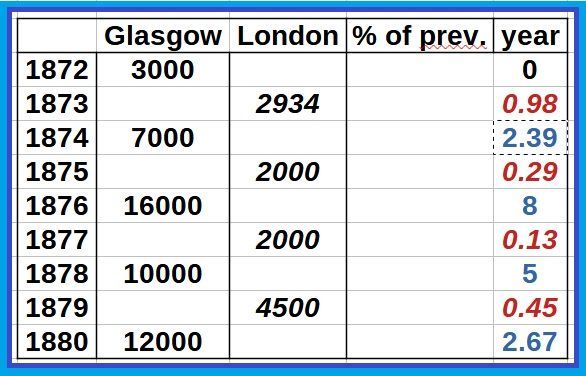
(Scotland-England Internationals Crowds)
In fact all five tables, results and crowds, drawn to the match-up by national passion but also the regular prospect of victory, from their different perspectives pose the same question, one that by Sheffield historians is always the subject of attempted diversionary tactics, by historiographies that have until now been almost entirely Anglo-centric been simply glossed over, ignored from the begining, yet is the very one that forms the crux of this treatise, this challenge. It is, if football were English why were its teams at every level, club, city and national for the decade and a half from 1874 gubbed and gubbed again? It was for Scotland a Golden Era, the first and best of three based simply on results and the reason could not have been because, for example, we ate our porridge.
And there is still more in terms of evidence. With every what can be loosely called "World Championship" (See below), between largely Cup-winning but towards the end Cup and/or League winning clubs north and south of the border the same outcome was almost universally repeated. It was exactly the same pattern but now over a full twenty-five seasons, a generation. Moreover, where there were exceptions the winning English clubs had in them a strong, somtimes even 100% Scottish presence. And even then when the first team to break the sequence was League-winning Sheffied United in defeating also League-winning Celtic by the odd goal in three in 1898, the two FA so English Cup finalists that season, Derby and Nottingham Forest, featured - another pattern in itself - nine Scots between them with the team with five the victor.
________________________________________________________________________________________
World Championships (1876-1900)
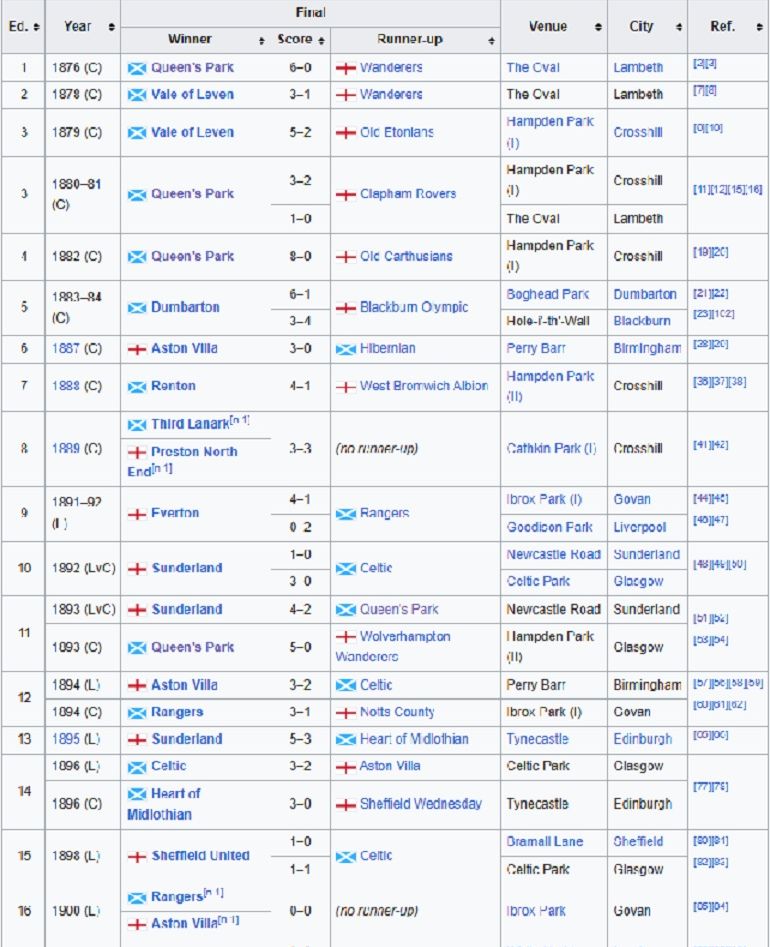
Click on image for access to Wiki-page
More than half a century before the first World Cup in 1930 the idea of what was the best national team globally already existed and would de facto be competed for the first time in 1872 when Scotland met England in Glasgow. But, whilst that Scotland was effectively a club team, Queen's Park, the first attempt to answer, which was the best of club-to-club would take just a wee bit more time to come to fruition.
The year was 1876, with then the concept much more simple than today to test, since, whilst three countries played the game, only two, England and Scotland had competitions, both Cups, that produced a winner. Wales had clubs and good ones but it would play its first international match just that same year, against Scotland in Glasgow, and the inaugural Welsh Cup, won by Wrexham, would not take place until seaon 1877-78.
That "World Championship" match itself took place at The Oval in London and was to be the first of eighteen over the next quarter of a century. In it The Wanderers hosted Queen's Park and the home team was frankly played off that park and the next, conceding six goals to none in return. Scottish club football had triumphed over English and by some margin. Moreover it was a pattern that was to be repeated for the next four similar meetings. In 1878 Vale of Leven would defeat The Wanderers once more and again away 3:1, then the following year simply roll over the Old Etonians 5:2, this time at the first Hampden Park,. Whilst in 1880/81 a re-invigorated Queen's Park would vanquish Clapham Rovers both home and away and then the following year Old Carthusians at home. Thus far the goal-count was twenty-six to five.
However, perhaps at that point there was a slight drop-off in enthusiasm for the fixture. Certainly the 1882 Cup-candidates, Queen's Park and Old Etonians failed to pick up the gauntlet. But the next season battle was recommenced and with finally an English victory. Blackburn Olympic would defeat Dumbarton at home 4-3. The only problem was that the fixture was played over two legs and Dumbarton was already 6:1 up from Boghead and cruising; the aggregate to the Scottish club, 9:5.
And now there was a something of an actual hiatus. Perhaps the shock for the English had been too much!! No direct match-ups took place for three seasons. Yet the truth is that it was not quite as schismatic as might appear. In 1884 and 1885 the FA Cup Finals, then not confined to English clubs, were both between Blackburn Rovers and Queen's Park, the former victorious on both occasions, the first effectively a World Championship in itself. And in 1886 it would have been the same match-up but various other factors were involved. Blackburn Rovers were by then a team that was openly paid to play and Queen's Park had decided it on principle would not take the field against professional opposition. Which means the only match that might have taken place was Rovers versus Renton in 1885. But it did not, at least that calendar-year, although the two did happen to encounter each other the following season, the Scottish club drawing at home but then winning away.
And, of course, there was another factor. Even in 1884 Blackburn Rovers was a team that wasn't strictly English anyway. That year there were four Scots in its eleven, five the following season and again four the one after that.
Thus it was that the next strictly World Championship meeting would not be until 1887 and finally after a decade the English team, Aston Villa, could walk away with its head high. At the Birmingham club's then ground of Perry Barr Hibernian was beaten well, 3-0, but with two caveats. First, that day the Villa was lead by Ayrshire's Archie Hunter and, of course, managed by Glasgow's George Ramsay. Moreover, the following season normal service seemed to have been resumed by Renton in beating Villa's neighbour and actually Scot-free West Bromwich, 4:1.
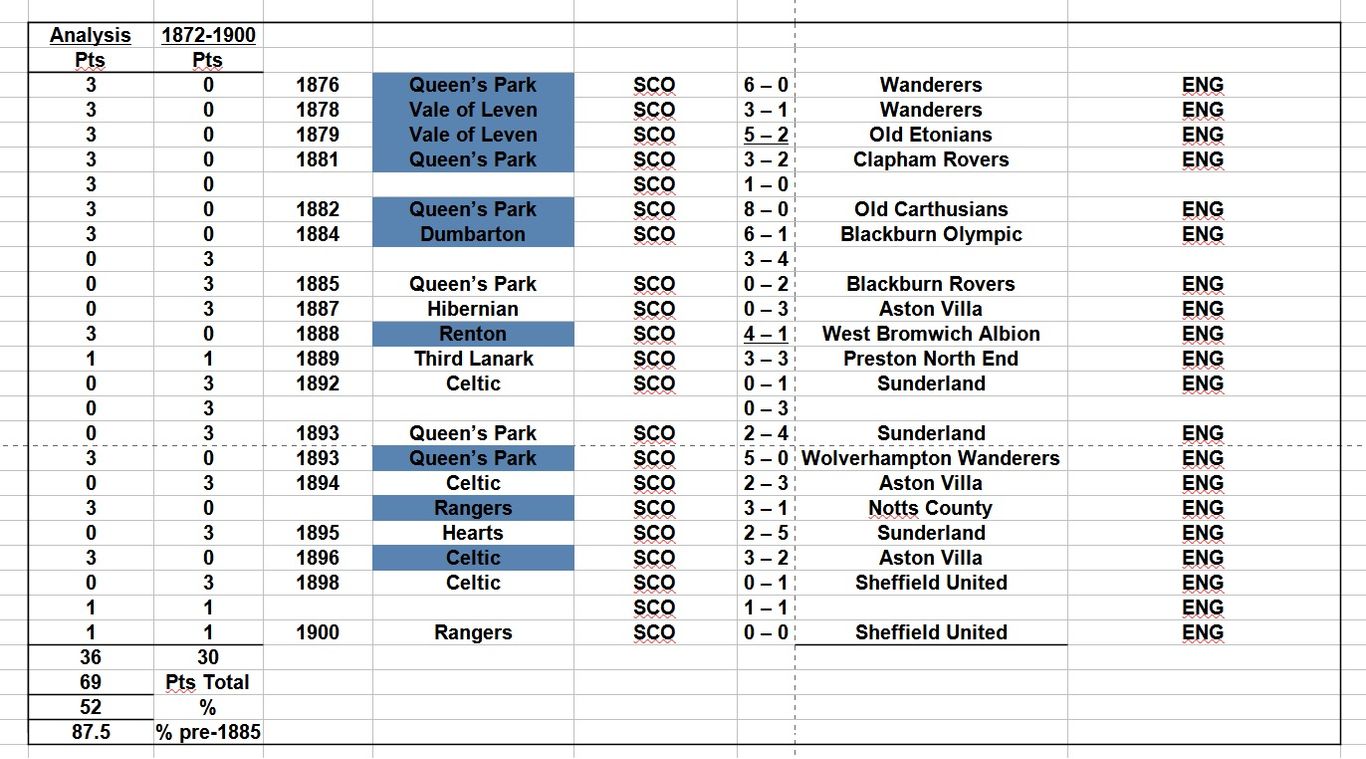
Yet, there was at this point genuine change afoot, not only in terms of results but in English football itself. In 1889 the Scottish Cup winner was Third Lanark, whilst in England Preston North End would take both the FA Cup but eventually The Double, with the first ever League as well. And when they met, albeit in Glasgow, the outcome was a 3:3 draw but with now eighteen Scots on the pitch. In addition to the all-Scots Third's eleven Preston Cup-winners had fielded a further seven from north of the border. Moreover, there would have been probably still fourteen had the equivalent fixture taken place in 1890, there were certainly nineteen in the 1891 match-up, although it was won by Everton, twenty-one (and a half) in 1892 and probably at least the same again as Queen's Park was once again involved in 1893, defeated by Sunderland on Wearside.
In fact the 1893 Sunderland-Queen's Park encounter was between League and Cup winners respectively. With the formation of the Scottish League 1891 had seen winners of each square up, 1892 had been as the following season, a mix, whilst 1893 would also pit Cup-winners against each other with all-English Wolves shipping five without response. Moreover, 1894 allowed a further variation. Cup-winner played Cup winner. Rangers defeated Notts County 3:1 at Ibrox. League-winner faced League-winner, Aston Villa beating Celtic 3:2 at Perry Barr but this time with a twist. There were now, with the same George Ramsay as manager, not one but five Scots in the English team, eleven in the Scots, sixteen in all.
It seemed now that what might be described as a Double World-Championship, League and Cup could become the norm. Certainly in 1896 that was the case, resulting in Scottish victories in both, revenge for Celtic over Villa in the former, Hearts over Sheffield Wednesday in the latter. And it had followed a Sunderland victory over Hearts in Edinburgh the previous year but with every single one of each of the teams a "Jock". Indeed, it was only to be in 1898 that this hegemony was not yet broken but finally interrupted for the first time in a decade and only the second time in two. League-champion met League-champion, Sheffield United met Celtic, the former winning at home at Bramall Lane, drawing at Celtic Park.
However, perhaps the format cum formats were now losing their sheen. Maybe the crowds for whatever reason were not coming, perhaps not helped by a 0-0 draw between Rangers and Aston Villa at Ibrox in 1900 with no reciprocation from by then Villa Park. In any case there were to be just two more throws of the die. 1901 Cup-winners would face each other over two legs. Hearts would draw against Tottenham in London, win easily in Edinburgh, even with the Spurs having five and then six Scots in its elevens. And in 1903 Bury would have the last word. It would twice defeat Rangers 2:1, home and away, with a Cup-team that contained officially two Scots but actually with captain, George Ross, three but both clubs undermining for the moment the concept of best versus best by seeming to field a number of reserves.
That is until 1960. From then the Intercontinental Cup, later the Toyota Cup, pitted the best now of Europe against South America, and from 1980 also Japan, until from 2000 it was to a degree superseded and then replaced by the FIFA Club World Cup, a competition largely without purpose except revenue because today it is played for no longer annually but only every four years.
_____________________________________________________________________________________________________________________
But back to Scottish football internally. What was from the mid-1870s without question an unmatched explosion in both off-field interest in Association football at all levels of Scottish society except to a degree in the mainly oval-ball, Edinburgh upper classes and in on-field success both within and then from Scotland was not to be without other consequences, three in all certainly directly:
1) The re-emergence of Queen's Park for most of the 1880s as an on-field force, the club having not created what was the Renton/Vale Scottish Game, but accepting, adopting it and crediting itself for it, yet formulating the route used for that re-emergence without either heed or understanding of the longer term implications - the change from the "local" team to the "assembled" one.
2) The reaction to Scottish on-field success from the Southern English game - i.e. from the FA in London.
3) The response to that reaction from the the English Midlands and North-West - its model of pay-to-play -
and a further two more indirectly with:
4) The full emergence of Dumbarton
5) The re-formation of Renton
It might have been thought that, with the 1878-9 demise of Renton, football in the Vale of Leven could have remained with its one club that had been at the pinnacle of the British game - The Vale. But not so as the seemingly defunct club's nearest neighbour, Dumbarton, emerged seamlessly as its proven replacement. Like Renton Dumbarton F.C. was formed in 1873, perhaps even as early as 23rd December 1872. Certainly that is the date claimed by the club just now with the reason given that a group of young men from the town had attended a match between the Vale of Leven and Queen's Park. It is possible. As previously mentioned such a match had taken place two days earlier but it had been in South Glasgow not locally. More likely the foundation was as the result of the game between the two same clubs played three weeks later into the New Year and a short train-ride away in Alexandria or even, and probably more likely still in terms of interlude, of the one on 1st March at the same venue so only two weeks before the creation of the Scottish Football Association on 13th March, of which The Sons of the Rock, as they would become known, were noticeably not one of the seven plus one original members.
However, all that in the great scheme of things matters little. By October 1873 Dumbarton had joined the SFA, was responsible for the previously-mentioned objection lodged against The Vale's John Ferguson, and was therefore handed a First Round bye only to lose in the next to Renton. What style of football, or rather what formation it began with we do not know but it was soon to adopt 2-2-6, even 2-2-3-3 as the following year it, then with an obviously still developing team, was able to reach the Cup semi-final to be defeated by Renton once more but having already beaten both Glasgow's Rangers and Third Lanark on the way, perhaps another indicator of the Leven not Glasgow as the source of the better game. Moreover, the following season, 1875-6, it was again to reach the semi-final stage, this time losing to Third Lanark. That was before a Third Round loss to Lennox in 1876-7, a Second Round one on a replay in 1877-8, but to eventual trophy-winners, The Vale, then defeat in the 1878-9 Quarter-Final to The Vale once more and the semi-final in 1879-80; this time having bested both The Vale, which, as already observed, successfully reverted to shinty, and a now almost moribund Renton in the process.
And all this seems to have been done to start with a mixture of young men, aged 18 to 22, and a couple of older heads like William McIntosh, aged twenty-six, who were local, i.e. from Dumbarton itself and further up the valley, and others who had arrived from all corners of Scotland to work in the port-town's booming industries. McIntosh himself seems to have been a Ship Joiner from Braemar in Aberdeenshire. However, over those first seasons this mix was to change as the club drew more and more on locally produced talent, something that was in sharpening contrast to the re-emergence back in Glasgow of Queen's Park, which itself had been on a journey.
Having like Dumbarton seemingly also fully adopted the Renton/Vale style of play, albeit perhaps not immediately, yet suffering the setbacks of 1877 to 1879 and losing its position of on-field pre-eminence, the Hampden club had sought to strengthen with some new players from within and others from outwith. George Ker had already in 1877 been recruited from Alexandra Athletic north of the river, as was James Richmond from nearby Clydesdale. Davie Davidson, Johnny Kay and William Somers were all brought in from literally closest rivals Third Lanark in 1879. But for the next season, 1880-81 The Spiders had gone a step further. The goalkeeper and both full-backs, including Somers, were replaced. And whilst the experienced half-backs, Charles Campbell and Davidson, were still in place, in the forward-line Richmond was temporarily demoted, Ker and Kay retained, Dr. John Smith legitimately recruited, as he switched studies from Edinburgh to Glasgow, and twenty-year old Eadie Fraser brought through the ranks. But that still left Willie Anderson and the three defensive newcomers, all of whom were essentially tapped-up from other clubs. Anderson himself came from up the road at Shawlands Athletic, new 'keeper Archie Rowan again from across the river from Caledonian of Kelvinbridge. Left full-back, Andrew Hair Holm, a fine, actually Glasgow-born player had come up from Ayr, but did not stay too long because he was tempted away by business. He became in our terms a whisky-millionaire. And then at right-back there was Andrew Watson, Diasporan Scot, Demerara- so South American-born, schooled in England, on reaching twenty-one in 1877 independently wealthy through inheritance and a Black man. With probably three Scots grandparents, his fourth, a grand-mother, had been a manumitted African slave. In fact the 1880-81 eleven would retain only two old-stagers, Harry McNeil and Campbell, and with Eadie Fraser only three that were, if you like, home-grown.
Yet this is not to say that Queen's Park as, of course, a paragon of amateurism was directly paying better. But it must have been doing something and the truth is that it was probably able to offer improved T & Cs in terms of better, spectator-funded expenses and therefore also, first, attract and retain but, second, be, albeit unknowingly, setting a serious precedent that other players and clubs, and not just those North of the Border, would see and have to seek ways, alternative ways to try to match.
Indeed we know from a series of articles from James McGhee, Scottish international from Ayrshire and published in 1908, just how it was done, still in Scotland, by far poorer Hibernian, which he joined in 1883; i.e. by finding the player a job, topping up, as in the case of Willie Groves, and then essentially win-bonuses.
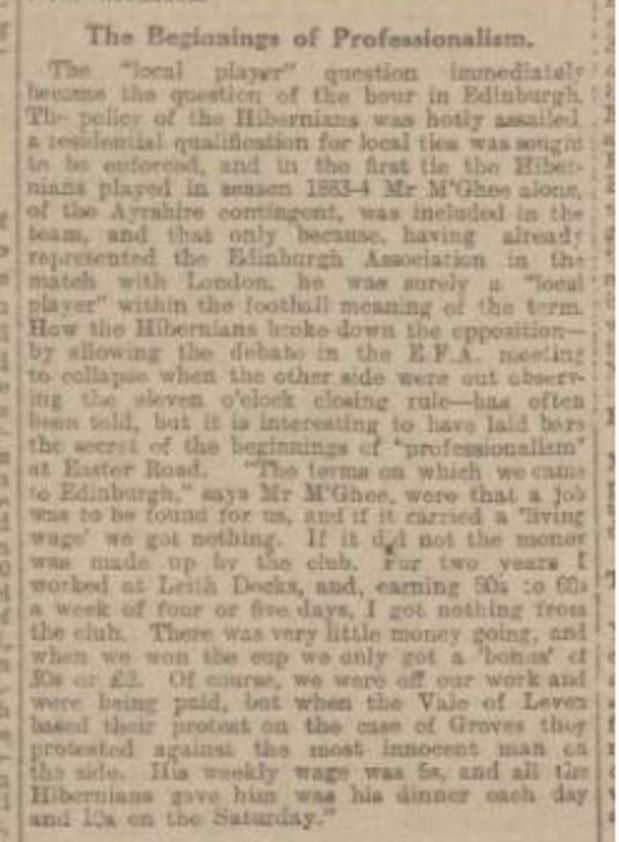
(With thanks to Hibernian Biographies Project)
Now, it may have been that same, Hibernian methods of payment were the ones that had from 1876 been adopted in England. Certainly J.J. Lang on arrival in Sheffield is said to have given a paid but task-less job in the factory, the owner of which was a Wednesday director. However, in Birmingham there would little such clarity, when it came to Archie Hunter. The nearest is that he is said to have been paid with a combination of legitimate work, "boot money" and even product endorsement. And in North-East Lancashire Fergus Suter would be given the tenancy of a pub but it is also known he would as required also simply go to the clubs for cash. Round-ball football had reached this last part of the country in 1870; at Darwen and initially at Turton, north of Bolton. They were the first of eighteen larger clubs that in the first eight years of the following decade would be formed in the quadrilateral formed by Blackburn, Padiham, Bacup and Bolton itself. Indeed the last of those formations, Irwell Springs by Bacup, was by two Scottish brothers, the Rankines, from Rutherglen via the Vale of Leven but they had come, and would stay, genuinely for work. So, following the example in 1878 of Darwen with Jimmy Love and said Fergus Suter, the latter moving on to neighbouring Blackburn Rovers in 1880, the next to take the football's underhand shilling, and in 1879, was a certain Peter Campbell, significantly also just turned twenty-one, one of the Rangers' founders and a Scottish internationalist, to be joined for a few games at the end of the season by his two years older team-mate in Glasgow and also future Scotland player, Hugh McIntyre.
Campbell was to remain just a season but McIntyre would return to Scotland, win his cap in March 1880, then be back in England for the start of the following campaign, also given a pub to run, and stay for the next half dozen years, only in the last of which, he aged by then thirty, was professionalism legitimised. It meant that by the end of the 1880-81 season there were with the arrival of Jimmy Douglas also at Rovers, McDade at Preston North End, Lomax at Great Lever and William Struthers also of Rangers to Bolton plus several on Merseyside perhaps twenty Scots playing their football South of the Border, fifteen of them shamateur but with only three with enough proven quality and experience to be even close to being hailed as a "Scotch Professor", the term that has since then widely bandied about.
Its source is a Scottish cartoon (See below, right) from about 1882 and probably laced with heavy irony given the accompanying wording and actual numbers. Indeed it has proved unhelpful by its inflation. At best a dozen of the Southern incomers, although a few would learn on the job, were at a time in life and in football university terms to be considered in Scottish terms "profs" or even "fellows", certainly no more than very young "lecturers" and probably nothing more than "lab-technicians", albeit ones au fait with the latest and best of knowledge and practice. (See the article to the right and below)
Nor would the position, that of the arrival of Scots with in Scottish terms real proven ability, alter much in the short term, even as numbers gradually increased. In 1881-82 and in 1882-83 the totals in place North-East Lancs. were low and stable at around sixteen with the newcomers confined to Accrington and Darwen and aged, from what little we have, no more than twenty-two, so no "Profs".
But in 1883-4 it would change and and counter-intuitively. Until 1882, we repeat, there had been in English FA regulations no real recognition of even the prospect of professionalism but that year a few clubs in the county's north-east had complained to the Lancashire FA essentially about the Scots at Blackburn Rovers; the complaint perhaps, but only perhaps, going all the way up to London as Rovers reached but lost the FA Cup Final to Old Etonians, the first by then working-class team (it had started seven years earlier very middle-class) to get so far in the competition but with McIntyre, Suter and now Renfrew's Jimmy Douglas all in the eleven.
The outcome of the complaint was a now official ban in Lancashire at least on being paid to play, which was promptly ignored by cross-town rivals Blackburn Olympic, when it recruited not a Scot but from a full a decade earlier the first football professional of them all, Sheffield's Jack Hunter, as captain and coach. And so successful was he from half-back with his "wing-to-wing" style that Olympic in 1883 went the next step, winning the FA Cup, the first northern club to do so and at which the other, local clubs decided they had no choice but to ignore the new rule as well. Thus, for the 1883-4 season the number of Scots in North-East Lancashire jumped by two thirds, with Preston Zingari and Burnley leading the way, with player-recruitment from North of the Border, even if many were still young, inexperienced and from lesser teams, becoming an industry with agents actively seeking out talent. In fact such were the concerns that the Scottish FA was in 1884 persuaded to compile a list (it had fifty-four names, although the real number would be nearer a hundred) and send a warning letter to those on it about registration and eligibility to play for Scotland. In 1882 the SFA had changed its rules for qualification for the national team from residence to birth. It had probably been persuaded to do so to exclude Andrew Watson because he was Black but it also caught the very White Eadie Fraser, albeit after a year's havering, on the grounds that he had been born in Canada and until 1887 Empire was still English. For Fraser the consequences would prove literally fatal. He would die aged just twenty-five. Now the rules were being changed once more, to both birth and residence.
However, the Scottish FA letter was completely ignored for an obvious reason - few of those coming South had had due to age and experience any real prospect of international recognition anyway - hence for the 1884-5 season an effective doubling of their numbers England as a whole and a tripling in North West Lancs. Preston North End, from 1881 under the stewardship of the local and very determined Major William Sudell, had ten Scots on its books, up from six the previous season and two the one before that. Burnley had a dozen, several others half a dozen. And there were, as a consequence, already complaints, but notably not local ones.
In fact the complaints arose because in 1883-84 Preston had stormed through to the fourth round of the FA Cup with a bye and then two very good wins locally over Great Lever by Bolton and Eagley by Turton. But it then faced London amateurs, Upton Park, drew 1-1 at home, was subject to a protest from them for fielding professionals, basically a whole team of them including Scots, and disqualified. (It is worth noting here that in the next round also complicit, albeit to a lesser degree, Blackburn Rovers then beat Upton Park away 0-3 without so much as a word.)
But the problem had not gone away. With Preston still excluded the same Rovers would make it all the way to the 1884 Cup Final, where with four known and paid Scots in its line-up it faced all amateur opposition; none other that Glasgow's Queen's Park. Moreover, Blackburn would win 2-1 against expectations, although the referee that day, FA President Francis Marindin, said post-match he thought The Spiders had scored but had not claimed it. In his defence he was, as was the convention at that time, in the stand as a sort of human VAR and neither umpire had called on him to adjudicate. However, no objection to professionalism seems to have been raised that day but it became more of problem the next year when in 1885, Preston still excluded, the same two clubs met, again in the final, with the same result, 2-0 but this time Queen's, weakened by withdrawals from injury, less happy about what they had faced.
In fact there had over the previous five seasons been not one but two pressures building up. One was amateurism versus professionalism, which was not necessarily about money per se but actually the way it was distributed, with basically two routes. As already intimated Queen's Park had gone down the one of good expenses, for playing and for time off work to play. Sudell, and in his wake others, on the other hand had first gone down more or less the Sheffield-, Hunter, Lang and Andrews-inspired route of sinecure jobs before moving to effectively straight-payment. In truth from the present-day perspective there was in the top flight of the game and amongst the wealthier clubs little difference in on-field outcome. Those that spent won. But with some like Upton Park, Queen's Park and others still wanted to make a fuss it combined with the second pressure would nearly bring down the whole house particularly of English FA cards.
But before an explanation of how that almost happened a look at the source of the of the second pressure is needed. With a narrow and, from the Scottish point-of-view, controversial win in the international match of 1879 giving some English relief to being bested at all levels by Scottish teams it had been followed in 1880 by an equally narrow Scotland-England victory and in 1881 by the Watson-gubbing with in 1882 another. And it was at this point the English FA, now fully in the control of the Public and neo-Public School fraternity, or rather the Assistant Secretary of the association, Nicholas Lane Jackson, decided on enough-is-enough, indeed on a reverse-ferret. And to implement it the plan was to create a club, Corinthian F.C., where all the best mainly English players of class and/or wealth would be gathered and from which an all-English and England but expenses-based amateur, super-team would emerge. And, despite the irony that Lane Jackson himself was the son of a Somerset-born cattle-dealer and was brought up in London's East End, it almost worked. See:
"Jackson, N.L. and Sommerville, G.
- the "Gent", who almost stole the Game from the working-man and the Draper, who snatched it back?
It looked bad. It was 1886 and for the first time in a decade Scotland, against England at home, was in real trouble. The game was at the second Hampden, now Cathkin Park, in front of some eleven thousand on-lookers and in the 37th minute Tinsley Lindley of Nottingham Forest but also Cambridge University and Corinthians had scored for the visitors. Moreover, the home-team was down to ten, one of its centre-forwards pairing, Joe Lindsay of Dumbarton, had been forced by an injury he was carrying to go off in the 65th minute, leaving the full burden of the central attack with the other, George Sommerville, ex. of Rangers and now of Queen's Park. But in 80th minute, Scotland actually said to be playing the better, the ball emerged from "scrimmage" and Sommerville struck with one of the "daisy-cutters", for which he had become known. The referee that day, in the stand as would be the way at that time, was Alexander Hunter from Tiverton in Devon but Secretary of the Welsh FA, with a mother born in Scotland and father, born in Liverpool but a Presbyterian Minister. And the on-field umpires were probably Alexander Stuart, the SFA Vice-President and a certain Nicholas Lane Jackson of Corinthian F.C., Assistant Secretary to the Football Association and no doubt raging. And the reason was that afternoon the England team had included four players, who were former pupils (FPs) of major English public-schools, five from Cambridge University and nine from his own, "elite" club, Corinthians. It should have been the culmination of a project that N.L. Jackson, "Pa" Jackson, had begun in 1882 but of which, because of a Scots draper, of whom we have no known photograph or grave, he would have in person to witness the ultimate failure.
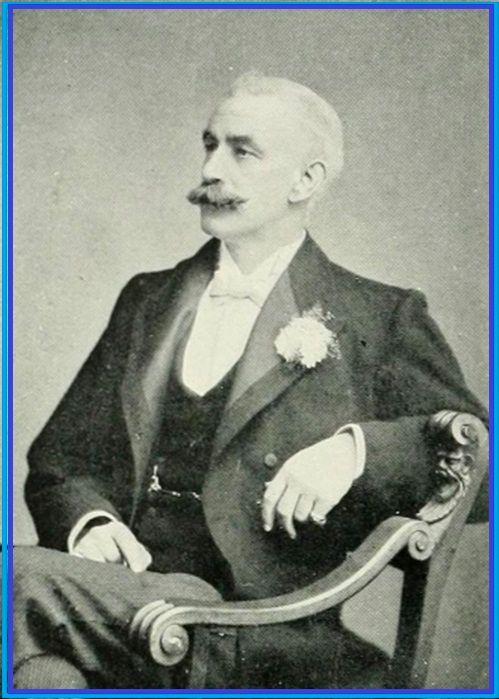
Nicholas Lane Jackson
"Pa" Jackson (above) was, shall we say, an interesting man, much lauded, even mythologised in Southern English, football history and, therefore by some in World football. However, the Northern English view of him is considerably less complimentary. The late and esteemed Sheffield historian of the game, Martin Westby, was scathing and not without reason, whereas the Scottish view can afford to be dismissive and should be just that. The unfolding of the Scottish game never quite allowed for classist and almost racist gas-lighting to take hold, although some did try.
Jackson was said to have been born in 1849 in Hackney in London, read Hoxton, and grew up in Shoreditch, the son of a mother from Enfield and a father, also N.L., from Devon, who having moved to London was a Cattle Dealer and later a "widowed" publican in Lambeth, although his wife is elsewhere to have survived him. But no matter.
Moreover, Jackson Jnr. would marry young, at nineteen, he recorded too as a publican, his bride, Mary Ann or Marianne, also nineteen already five months pregnant. Thus he at under twenty already had a family, had certainly never been to any form of public-school or university but was clearly ambitious and very capable. At twenty in 1871 he was a Land Steward just west of London in Isleworth. At thirty in 1881 he was recorded as an Editor, living now in Finchley and then progressively be a Newspaper Proprietor and Journalist, an Author and Journalist and by sixty was living in Buckinghamshire on private means. And in the meantime he had involved himself in football, tennis, golf and curling and in the process transformed himself very much into a "gentleman".
However, as regards the football there are doubts about the truthfulness of his account of his involvement, at least in early part. Westby found little to back up claims of involvement in the pioneer club, Upton Park, which played in West Ham, so East London. He did find them with regard to North London's Finchley F.C. from 1879, aged already thirty, as captain and acting Secretary, possibly also having founded it in 1877. Then in early 1879 he served as an umpire with Charles Alcock in a match involving Old Etonians, so presumably also Arthur Kinnaird. Thus he now had connections and that would lead to him being elected to the committee of the FA plus being between 1881 and 1883, under Alcock, its Assistant Secretary. And it was at that same time in 1882 that the London Football Association was formed and, by him, albeit by his own account and with others known to have been involved, Corinthian F.C., the Corinthians.
His reason for it would later be clearly stated.
"I founded the Corinthians because I did not like the way Scotland kept beating England in the late 1870s and early 1880s."
although it is not obvious whether it was because he did not like getting beaten, did not like Scots or a combination of both and would later be followed by other interesting asides. For example:.
"Amateurs usually supply better backs than professional. They learn to kick cleanly and well at school, and generally show better judgement in placing the ball to their forwards than the professors (Scotch Professors?), who do a lot of vigorous charging and hard wild kicking, but are not a rule finished players."
and the following,
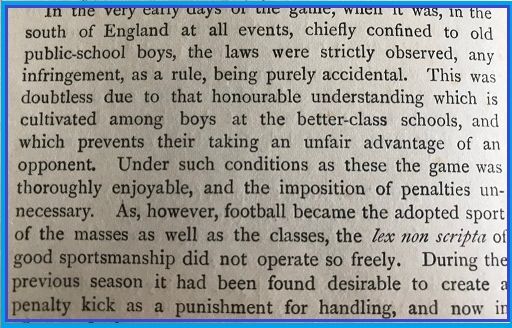
And there were clearly tensions, north-south and others that would soon emerge. He would also write,
"There was a great desire on the part of some individuals in Lancashire to get the headquarters of the Association transferred to Manchester. They (who they, exactly?) knew that Mr Alcock could not act as secretary if this was done, and therefore hoped to acquire the coveted position for one of their leaders. Fortunately, the Midland clubs and those in the far north held aloof from these intrigues, and thus prevented them from being effective."
And in 1884 he would be placed in charge of investigations into Preston North End, as it was accused (by Upton Park) of "offering financial inducements to attract Scottish players". It was that Scottish thing again with the club, of course, doing exactly as accused, as had been and were many of the clubs from the North and the Midlands. Indeed it and paying to play had not officially been outlawed until 1882 so until then it had been legitimate. However, Preston was as a result disqualified from that and susequent years' FA Cups, hard-line anti-professional recommendations were adopted for 1884-5, at which point the Northern clubs rebelled, threatened schism and by March, now with the support of Jackson, ever, it seems, the pragmatist, professionalism was accepted.
However, by that time he had and would have other problems, both concerning the Corinthians. Eventually it would again be about money. In 1893 questions were being raised about the expenses the club was paying (See also Queen's Park), which were hefty, and what difference there was between them and payment for working-days missed or even straight wages with the answer being little or nothing apart from a large measure of entitled hypocrisy. But first there had been the question of the effectiveness over what had been a five-year, Lane Jackson-inspired attempt at what was at the very least, as quoted, a class-based, elitist philosophy of competence, even innate ability. In other words an upper-class footballer would by genes and nature always be superior.
In 1882, his first opportunity, against Scotland, the game that mattered, two Corinthians played, one former Public-school pupil and no Oxbridge. In 1883 it was four, three and two, in 1884 three, one and one. And in 1885 the numbers were two, four and four with a net no change as measured by wins even in the home ties. And the result of it all? It was by 1888, by the look of it, the abandonment of the try-on entirely.
That year England beat actually Scotland for the first time for a decade but there were special circumstances of Scotland's own making. And it was done with admittedly five Corinthians, but two were Northern invitees, two FPs, no Oxbridge and crucially eight players from outwith the South, including the Scot, John Goodall. Moreover, the following year, 1889, it seemed the old pattern might be resumed, Scotland winning in London against an England that now had two "Scots" in its team, five Corinthians, but notably four in what was obviously a very leaky defence, four FP, all in that same defence and one from Oxbridge, also in the defence. It clearly wasn't working, despite from 1883 to 1890 fifty-two of the eighty-eight caps awarded against Scotland being to the "elite". In fact the next England win would not be until 1891 and with one Corinthian and FP, the goalkeeper, and all the outfield players, including Goodall once more, seasoned professionals from Midland and Northern club. The experiment in neo-applied-eugenics was over, even as the process of highly-effective gas-lighting began, continued by Jackson from 1895 from his eventual position of Vice-President of the FA.
So who was this man, who unknowingly was to sink the Jackson-ship. George So(m)merville was born in the Lanarkshire village of Forth in 1863. His father was a thirty-five year old draper, who had been a merchant, a cloth merchant and would become a clothier. In fact George would train as a tailor and become a draper himself but by then the family had move to Uddingston, working and living close to the village-centre and its football ground.
And it was probably with Uddingston F.C., which had in 1882 dropped from senior to junior status, that he, as a teenager and a centre-forward seemingly of the robust variety, began. That was before, according to the inestimable Andy Mitchell in his The Men Who Made Scotland (MWMS), turning out for neighbouring Hamilton Academicals for two seasons from 1883 and then in January 1885, not long after turning twenty-one, being recruited by Rangers. It was in a phase when players were both arriving and leaving that club in steady streams, the better ones going largely to Queen's Park, presumably for better "expenses". Indeed, Sommerville was to prove no different. After a successful ten months at the then Kinning Park, soon noted for both his dribbling and shooting and scoring regularly including against The Spiders, he made exactly that move.
And once at Hampden he was straight into the first team in a Cup-win over Partick Thistle in October 1885, he aged just twenty-two, in the season where Queen's Park would retake the trophy. In that final he opened the scoring in ten minutes and sealed the game with a third in eighty-fifth minute. That was in February 1886 and just six weeks before he was briefly to swap the hoops for the blue.
Sommerville was to spend three seasons at what is now Cathkin Park, interspersed, according to Mitchell with a period back at Uddingston. In fact it was a new team that in 1887 had re-formed as a senior one once more. It is therefore understandable that he chipped in to help. But he returned to Hampden this time to a team, which was beginning to struggle and to comments that in 1886 in the establishment 'Scottish Referee' had remarked on "his superior shooting power" but by 1888 changed to saying the "he was a good man until the laudation spoiled him". It was harsh, quite possibly unjustified, and there were quite probably reasons.
In 1888 the club neighbouring to Queen's Park, the very, very middle-call Battlefield, was on the brink of collapse and its foremost player, William Sellar, who also had QP membership, moved across. He had been the Scotland centre-forward before Sommerville in 1885 and the one after him in 1887 and 1888, would eventually win nine caps, seven against England with appearances also in 1891 and 1892, as captain. But he would never score a goal or, apart from 1887, be on the winning side. Then there was also the emergence of Jamie Hamilton. In 1888 he was nineteen and would eventually win three Scotland caps. Moreover, Sellars was a club-able man. On retirement in 1894 he was immediately elected President of Queen's Park and sat on the SFA Council. It would be hardly surprising that Sommerville could have felt both pressured and slighted, with what he may have considered an inferior player or players, certainly at centre-forward, being preferred to him. Perhaps he spoke out-of-turn and, in any case, he had other things going on. His father about to turn sixty-five and there was a business back in Uddingston to take over and the local football club valued him. Thus he returned home, played for his hometown club until 1891, bringing it up once more to a good standard, retired at twenty-eight also in 1891, in 1893 in Aberdeen married a girl, Annie Smith, from the city and settled down to the rest of his otherwise un-lauded life.
George Sommerville would remain in Uddingston for the rest of his days. By 1901 he was a Traveller, a traveling salesman, with two children, both born locally, in 1911 a Commercial Traveller in Colour Printing, in 1921 a Manufacturer's Agent and on his passing in 1929, aged sixty-five, be an Advertising Agent, staying at "Cranley", Brooklands Avenue in the town. He would be survived by Annie and by "Pa" Jackson. The latter's death would be in 1937, by which time the era of the footballing amateur and Corinthian in the England team had literally just come to an end, the last being one-cap Bernard Joy just a year earlier in 1936."
___________________________________________________________________________________
The North English Game -
Two Rises and a Fall
On this site the increasingly obvious, pivotal role Sheffield (population 1870: 260,000) played from 1857 and in the decade of 1860s and early 1870s in the development of round-ball football, both through its own Sheffield Rules and of the Association game, has already been explored and will continue to be so. And so has and will be the former's, if not quite collapse from within, then fall that caused it to spend the last half of the same 1870s and most of the 1880s in first at very least a major stutter and then only gradual recovery.
And now we turn our attention to the other area of England that would have a similar role, but a decade later and without the cliff, i.e. North-West Lancashire with in 1880 a population of 300,000, similar to what Sheffield's has been a decade earlier. The Lancashire Football Association would be formed in 1878, by clubs mainly from that specific corner of the county. But football there, outwith the folk-game and not yet the Association variant, had been around since at least 1865. That was when a quartet of mill-owner sons, aged eighteen to twenty-two, came together to create what might be called "Blackburn-Rules", said to be a mix of those from Harrow and the Eton Field Game.
And the arrival of Harrow's rules was to replicated in 1870 in Darwen with the formation there of its cricket and football club and also in 1871 at Turton, north-east of Bolton. There John Kay, sixteen years old and fresh from the school, literally teamed up with twenty-six year old Blackburn-born, local national teacher, William Dixon, to form a club that inevitably require working men from the village to give the numbers. And it seems to have been the first to have in 1874 turned to the Association game, although there is a hint of an encounter in November1873 to its rules, more or less, and between Blackburn Ramblers and Blackburn Brookhouse. Church by Accrington would do the same and that year too, as would Bolton Wanderers. Darwen would not do so until 1875 as also in Blackburn there were the foundations of Rovers and Witton. Eagley F.C., in a village just a short distance from Turton, also came into being at that time too.
In fact 1874 in the quadrilateral formed by Blackburn, Padiham, Bacup and Bolton no fewer than eighteen had been formed by 1876 and twenty-six clubs existed in 1879 with Bacup and Oswaldtwistle being the last. And as confirmation in 1878 at the foundation-meeting of the Lancashire Football Assocaiation in a pub at Bromley Cross ,just south of Turton, of the twenty-eight or twenty-nine clubs present twenty-four had come from the area.
So where does the much discussed Scottish influence in Lancashire's North-East fit in? The answer, to repeat more or less verbatim from a previous article of ours, is that, "whilst Bacup was formed by two Scottish brothers, the Rankines, said to have played for Vale of Leven but more likely to have done so for Renton, the story of its arrival had probably been got back-to-front.
In 1875 at the age of just twenty-one Darwen-boy William Kirkham, a textile colour-mixer to trade, seems to have taken himself north to Glasgow for work. It was also the year Partick F.C. had been formed, one of half-a-dozen or so clubs that had sprung up that year and Kirkham, with no known indication of previous involvement in Lancashire, joined. In fact in that summer he had been a founding member, was in the team and with Darwen/Partick already playing their initial cross-border fixture on 1st January 1876 was the obvious link.
It would be the first of seven such trips South with Partick only losing for the first time in 1880 by when at least two of its players has been recruited to the English club and one, Fergus Suter, to the English game more permanently. Both had made their moves in the winter of 1877, James Love first as he turned twenty-one himself and faced business bankruptcy at home, with Suter following on having lost his work in Glasgow as a stonemason and also about to reach the then age of maturity. The personal stories of both men have now been uncovered and told in detail. (See: Andy Mitchell's Scottish Sports History),. Their place in football is said to be that as two of three, with Archie Hunter of Aston Villa, of the first professionals in the Association form, although even that is in doubt. It appears that being paid to play was not an offence under Lancashire Rules until 1882 ad may not have been against London and Birmingham Rules ever.
And at this point it might have been expected that there would have been something or a flood or at least a strong flow of Scots player being attracted to the Lancashire game. In fact if anything the numbers dropped until starting to climb once more and counter-intuitively in 1882 as Preston started to recruit, its clubs being formed from 1880, and the Bolton area, with a flurry of clubs founded in 1878, followed suit just as the other teams in the quadrangle also stepped up their demand. In 1884 the town o Preston had fourteen Scots recruits on its clubs' books, fifteen in Bolton and the Colne valley from Blackburn to Burnley, founded in 1882, had thirty-one.
So the question is why and there are perhaps tthree reasons. The first two were numbers and success. Between 1876 and 1884 club numbers had increased two-fold and a half. In 1876 there had been no North-West teams in the FA Cup, in 1877-8 only Darwen, it in 1878-9 reaching the quarter-final only to be beaten by the eventual winners, Old Etonians, away in a second replay. But by 1884-5 there were twenty-four and Blackburn Olympic had already taken the trophy. And then there was the proselytising of James Gledhill. In the Darwen team on January 1st 1879 he was, aged twenty-four, there as a centre-forward. And he was there again in 1880 as Darwen won the Lancashire Senior Cup with Suter at full-back. Born in 1854 in Manchester with an English father, a coach-builder, and a Scottish mother Gledhill had been brought up by Preston, was a Student Teacher, had gone to London to study medicine, there playing football, before in 1878 it was back north, joining Darwen, where also newly-arrived Suter and Love were team-mates.
However, his next professional move took him to Glasgow to train as a Surgeon and there he turned out for Partick, after which on returning to Lancashire in 1883, now aged almost thirty and perhaps his playing days over, he is said to have begun to tour Lancashire lecturing on how he thought the game should be played. Given his time in Scotland in the first golden era of football North of the Border it is unlikely to have been any other way than ours."
How much Gledhill's work had effect is difficult to ascertain. No club cites him as its inspiration. Nor was a surge of formations (see table left) in or around Darwen when he was there as a player or when he returned in 1883 from graduating as a Surgeon on the Clyde. Nor even was there were surges of note in the wider North-East Lancashire area.
But there was between 1883-4 and 1884-5 a notable increase in the number in the county of Scots, so specifically Scottish players, i.e. players with the specifically Scottish game. In the former season the number was twenty seven and the latter seventy-four. The number had almost tripled indicating possibly that Gledhill's advice had been taken on board, not so much in Preston, where by 1880 and certainly 1882 Sudell had perhaps already been convinced but around Bolton and in the valleys of the Colne and now the Calder; so in Clitheroe.
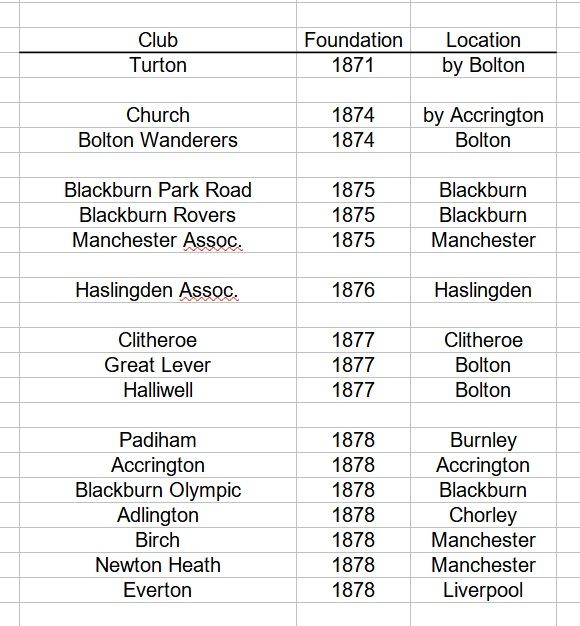
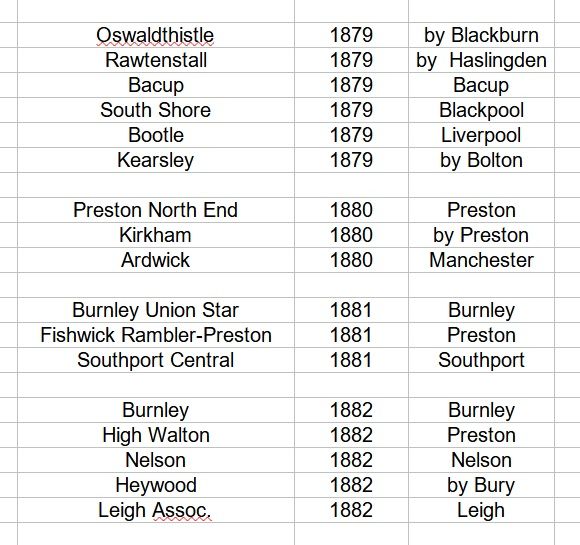
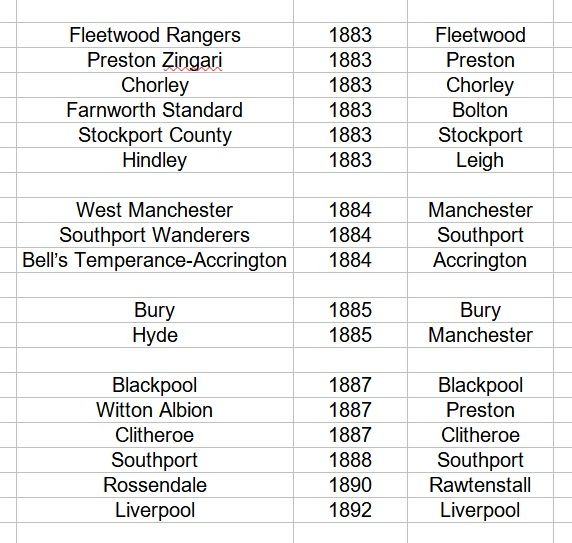
And all this has to be compared with the Sheffield of a decade earlier. Thanks to brilliant work done in the Yorkshire city we know, in comparison to the six North Lancastrian clubs in 1875 and forty-six in 1885, there were across The Pennines some twenty-two clubs in 1865 and fifty-four in 1875.
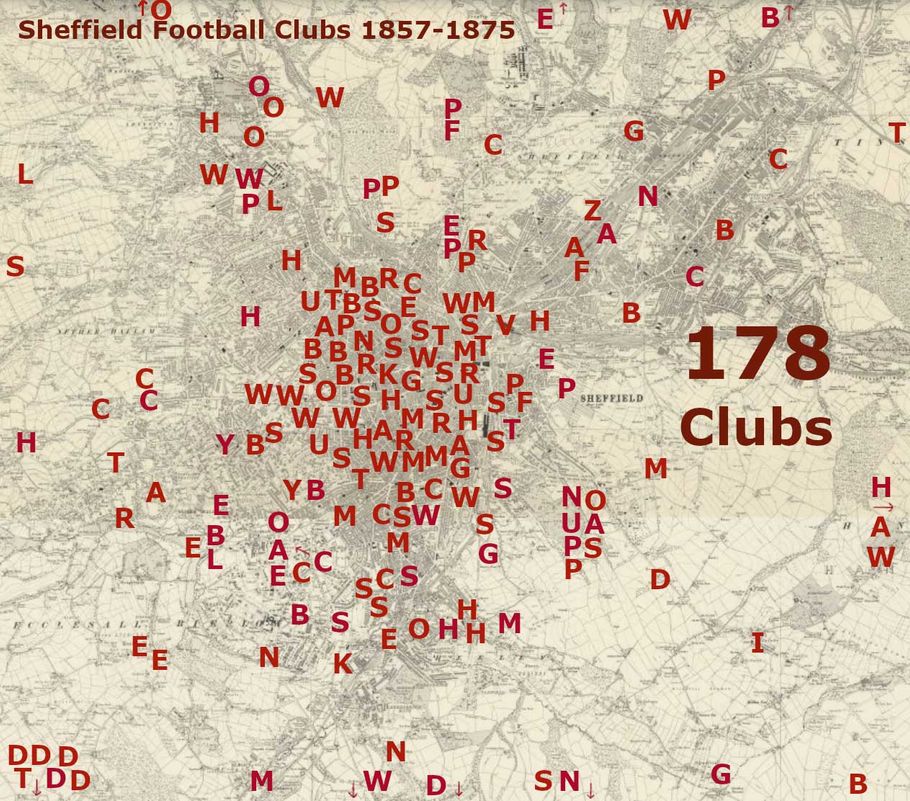
(Total Sheffield area clubs formed but without dissolutions deducted.)
However, here, whilst the similarities between the two similarly industrial areas seemed to continue, in fact there was divergence. Sheffield would in the 1870s produce just four players, who went on to feature at international level for England; first the two Clegg brothers and then Jack Hunter and Billy Mosforth. Yet in the 1880s from North-West Lancashire in would come twenty-five (including two Scots, John Goodall and Davie Weir)), admittedly from three times plus as many fixtures so adjustment required but nevertheless a significant multiple, in terms of men and, still more, caps.
Moreover, whilst the 1880s proved for Sheffield a decade of disaster, with only two of its clubs surviving to the top-flight and success, and only in the 1890s, first achieved in terms of national trophies with the importation of Scottish talents, in North Lancashire it was more definately not the case. Whilst some club- consolidation would occur, at least a half-a-dozen of the original clubs remain to this day and Scots-aided success continued in terms of on-field personnel to the Second War particularly with Preston and beyond in terms of style with Burnley.
________________________________________________________________________
________________________________________________________________________
________________________________________________________________________
________________________________________________________________________
________________________________________________________________________
________________________________________________________________________
________________________________________________________________________
________________________________________________________________________
________________________________________________________________________
________________________________________________________________________
________________________________________________________________________
________________________________________________________________________
"The North-East English Game -
The Start and Rise
On this site the increasingly obvious, pivotal role Sheffield played from 1857 and in the decade of 1860s and early 1870s in the development of football, both through its own Sheffield Rules and of the Association game, has already been explored and will continue to be so. And so has and will be the, if not quite collapse from within and fall, that cause it to spend the last half of the same 1870s and most of the 1880s in first a considerable stutter at least and then only gradual recovery.
But now we turn attention to the other area of England that would have a similar role but by fifteen years later, i.e. North-East Lancashire. The Lancashire Football Association was formed in 1878, by clubs mainly from that smallish, specific north-eastern part of the county. But football there, outwith the folk-game and not yet the Association variant, had been around since at least 1865. That was the year when a quartet of mill-owners sons aged from eighteen to twenty-two came together to create what might be called the "Blackburn-Rules", said to be a mixture of those from Harrow and the Eton Field Game.
And the arrival particularly of Harrow rules was to replicated in 1870 in Darwen with the formation there of its cricket and football club and also in 1871 at Turton, north-east of Bolton. There John Kay, sixteen years old and fresh from the school, literally teamed up with twenty-six year old Blackburn-born, local national teacher, William Dixon, to form a club that inevitably required working men from the village to give the numbers. And it seems to have been the first to have in 1874 turned to the Association game, although there is a hint of a slightly earlier playing game in November1873 between Blackburn Ramblers and Blackburn Brookhouse. And Church by Accrington would do the same that year too, as would Bolton Wanderers. Darwen would not do so until 1875 as also in Blackburn there were the foundations of Rovers and Witton. Eagley F.C., in a village just a short distance from Turton also came into being that same year.
In fact 1874 in the quadrilateral formed by Blackburn, Padiham, Bacup and Bolton no fewer than eighteen clubs had been formed by 1876 and twenty-six existed in 1879, with Bacup and Oswaldtwistle being the last. And as confirmation in 1878 at a meeting in a pub at Bromley Cross just south of Turton twenty-eight or twenty-nine clubs had been founder-members of the Lancashire Football Association with twenty-four coming from the local area.
So where does the much discussed Scottish influence in Lancashire's North-East fit in? The answer is that, whilst Bacup was formed by two Scottish brothers, the Rankines, said to have played for Vale of Leven but more likely to have done so in Renton, the story of its arrival had probably been got back-to-front.
Already in 1875 at the age of just twenty-one Darwen-boy William Kirkham, a textile colour-mixer to trade, seems to have taken himself north to Glasgow for work. It was also the time Partick F.C. had been formed, one of half-a-dozen or so clubs that had sprung up that year, and Kirkham, with no known indication of previous involvement in the game in Lancashire, joined. In fact in that summer of 1875 he had in Scotland been a founding-member, was in the Scots team with Darwen/Partick already playing their first cross-border fixture on 1st January 1876 and with him as the obvious link.
It would be the first of seven such trips South with Partick only losing for the first time in 1880 by when at least two of its players has been recruited to the English club and one, Fergus Suter, to the English game more permanently. Both had made their moves in the winter of 1878, James Love first as he turned twenty-one himself and faced business bankruptcy at home, with Suter following on having lost his work in Glasgow as a stonemason and also about to reach the then age of maturity. The stories of both men have now been uncovered and told in detail. (See: Andy Mitchell's Scottish Sports History). Both were paid to play. That, one way or another, is certain, although curiously it was not, seemingly by omission, actually against the rules. The FA in Lancashire but not necessarily in London would not make it so until 1882.
And at this point it might have been expected that there would be perhaps not a flood but a steady flow of Scots player being attracted to the Lancashire game. In fact, if anything, the numbers were to drop off before climbing once more in 1882 as Preston began to recruit, its clubs being formed from 1880, the Bolton area, with a flurry of clubs founded in 1878, following suit and as other teams in the quadrangle also stepped up their demand. In 1884 the Preston area had fourteen Scots recruits on the books, fifteen in Bolton and the Calder Valley from Blackburn to Burnley, founded in 1882, thirty-one.
So the question is why and there are perhaps three reasons. First, between 1876 and 1884 club numbers had increased two-fold and a half. Second, in 1876 there had been no North-West teams in the FA Cup and in 1877-8 only Darwen, it in 1878-9 reaching the quarter-final only to be beaten by the eventual winners, Old Etonians, away in a second replay. But by 1884-5 there were twenty-four and Blackburn Olympic with a professional trainer from Sheffield, Jack Hunter, had already taken the trophy. And then, third, there was the proselytising of James Gledhill. In the Darwen team on January 1st 1879 he was, aged twenty-four, there as a centre-forward. And he was there again in 1880 as Darwen won the Lancashire Senior Cup with Suter at full-back.
Born in 1854 in Manchester of an English father, a coach-builder, and a Scottish mother Gledhill had been brought up by Preston, began as a Student Teacher, had gone to London to study medicine, there known to be playing, and in 1878 returned north, joining Darwen, where also newly-arrived Suter and Love were team-mates. However, his next move took him to Glasgow to train as a Surgeon and there he turned out again for Partick, after which on returning to Lancashire in 1883, now aged almost thirty and perhaps his on-field days over, he is said to have begun touring Lancashire lecturing on how he thought the game should be played. And with that the die was cast. Given his time in Scotland, in the first golden era of the game North of the Border, it is unlikely to have been any other way than ours."
_________________________________
Scotch Professors
Within the SFHG group there is deal of discussion of and, indeed, disagreement about the much-bandied term "Scotch Professor", whether he/they really existed at all and, if they did, what was their actual role and impact in early English, indeed, in British football and when.
The term seems to have come from a cartoon (See below) published in about 1882. For non-Scots the translation is:
Mrs. McKirdy (McHardy) "So, and how's your son, Johnny, getting on? Is he being more serious about work?".
Mrs. Thomson: "Goodness, have you not heard about the great job he has managed to find. He's gone to England to be a Professor of football."
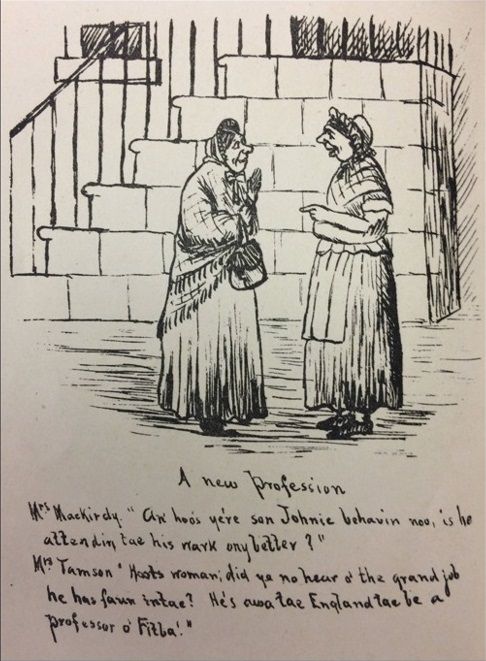
The first thing to bear in mind is that early football was a young man's game. The earliest clubs were often founded by teenagers and Scotland was no exception. Eighteen or nineteen year-olds were first-term players. And it is also important to note that the age of consent was then twenty-one so young men were often tied to home legally and financially, whether they liked it or not, until that age. Moreover, despite belief to the contrary, the first "football" professional was very probably not a Scot. And the reason is that when the first of our countrymen, Jimmy Lang and Peter Andrews, went South for the English shilling in 1876, already by then it looks as if Jack Hunter, twenty-one by 1872, was being paid to play.
But there is a caveat. He was in home-town Sheffield, where the game there already had a ten-year start on Scotland's, and it was to that city's rules, so not the Association game, that he plied his trade. Professional footballer he might have been but professional, Association footballer he was not until a move to Lancashire, to Blackburn Olympic, in 1882. Moreover, this same caveat would apply to Lang and Andrews, which then raises the further question of who actually was the first to be paid play the Association game. And to that the answer is probably nobody knows but that it might well have been delayed until Archie Hunter, aged nineteen, signed for Aston Villa in the summer of 1878 and Jimmy Love, not quite twenty-one but with no family constraints, and then Fergus Suter, who was about to turn twenty-one, so both like Hunter with perhaps no more than two and a maximum of three seasons of experience, took themselves with presumabably already ingrained the Scottish concept of payment for sport (see shinty in the Vale of Leven cica 1870) from Glasgow to Lancashire in the autumn of that same year.
However, there is a further complication. Peter Andrews had been born in 1845, J.J. Lang in 1851 so in 1876 the former was already thirty and the latter twenty-five. Neither was young, Andrew in footballing terms positively ancient. Both are known to have four years playing behind them and therefore might to said to have been approaching, if not professorship, then certainly the status of lecturer. Indeed, with both remaining in Sheffield until their mid-thirties, they could even be said to have achieved at least professorship by their returns to Scotland, Andrews to Paisley, Lang to Glasgow, but in what? Sheffield's own non-Association football would more or less implode by the beginning of the 1880s and not really recover for the best part of a decade and half. And during that same period Association in football north of the border and even elsewhere in England and Wales had moved on without any suggestion of them keeping up.
So when was it that the first Association football professors actually would find work in an Association-football-playing area? In fact this is the area of greatest discussion with one view it was early-on and the other not accepting that it happened until certainly 1885 or perhaps later still, in and around 1888. And the turning-point was probably 1882, the year of the cartoon with the implication that it was perhaps to a large degree ironic.
That year the Lancashire FA attempted to do something about the number of Scots descending on their clubs. In fact it was a non-problem. They numbered perhaps eight with the real bones of contention, concentration and inter-club rivalry. There were by then some twenty clubs but of the Scots three were at ambitious Blackburn, two each at Preston and Accrington, one at Darwen and it was that which provoked moves by essentially the others to try to introduce constraints in the form of artificial, residential requirements. But all that resulted was a spot-light being shone on already existing shamateurism and more Scots being attracted. By season 1883-4 the number in the South had doubled to forty with sixteen in the catchment in question. In 1884-5 it would be ninety-odd and sixty-odd respectively.
However, those that came south now had in the main three characteristics. Firstly, very few of them were from the major Scottish teams in Glasgow and the Vale of Leven. In fact they came largely from Ayrshire and Edinburgh. Secondly, they were mostly twenty-one or very much thereabouts. In other words they were far from the best players that Caledonia could produce either in terms of source or experience. In fact what they had was a basic understanding of the Scottish Game and its advantages and in a good number of cases, thirdly, an ability to learn on the job with the Rosses and the Goodalls later the perhaps most observable examples. Indeed it was them and players like them, who might be said to have become by the time of the next, the second English professionalism crisis in 1885 in limited numbers professorial and at the time of the third in 1888 to be, if you like, head of faculty. By then both John Goodall and Nick Ross were twenty-five with seven top-flight years behind.
However, that year with the all-conquering achievements of Renton both north and south of the border that was to change. At the start of the 1887-88 season some hundred Scots were now plying their trade South of the Border. In 1888-9 it was one hundred and fifty and two season later still it was well passed two hundred. And for the moment they were of a different ilk. The Vale of Leven, Renton, "The Vale" and Dumbarton had largely been stripped of its talent, its mature talent of much the same vintage as Ross and Goodall or older still. These were players who not only knew what they were doing but brought with them a novel way to play the game. And they were gradually joined by others from a much wider, Scottish catchment into a widening English pool but who had also adopted the new Scottish Game, two hundred and sixty in 1893-4, and they too were older, lecturers at least, and as, for example, with James Cowan, a professor of the near future."
____________________________________
The Slow Rebellion -
how Scots working-class realism made football proper pro. - Part Three
But, as outlined in Part Two, confinement of Scottish professional footballers to just Sheffield did not last long, changing specifically with the arrival albeit in stages but by 1880 permanently at Blackburn Rovers of Hugh McIntyre. And he was a different animal, by then already twenty-five, having played at half-back for Rangers including in a Cup Final and been capped, again in the Scottish, standard pair, at left-half. He was both talented and experienced and also about to enter his prime. And his effect was rapid. In the 1880-81 FA Cup the Rovers were eliminated badly at home in the Second Round. A season later they were in the Final, McIntyre now joined by Suter as the full-back pairing and up-front another young Scot, from Renfrew and also capped, Jimmy Douglas.
Hugh McIntyre
Rovers lost the 1882 Final to Old Etonians, but only by an early, single goal and next year would stutter again in the Second Round as town rivals, Blackburn Olympic, became the first northern and working-class to take the English trophy. Yet Rovers would re-emerge in 1884, reach the Final once more and this time be successful. However, it would be done by Suter remaining at full-back, Douglas being joined in the forward-line by also ex-Rangers and twice-capped, John Inglis, the opposition that day being Glasgow's Queen's Park, and now twenty-nine year-old McIntyre, as captain, at Scots-2-2-6 right-half, with at left-half local boy, James Forrest.
James Forrest
James Forrest was nineteen; twenty the following year when the scenario was repeated, with Blackburn once more triumphing over The Spiders. In 1884 it had been 2:1. Now it was 2:0 but there were other differences. The first is that whilst Queen's Park continued with 2-2-6. Blackburn had changed to 2-3-5 with McIntyre at centre- and Forrest at left-half. Moreover, in addition there was England, for which against Scotland two weeks earlier and having learned from the master Forrest had been at centre-half. It was the first obvious manifestation in the top-flight of the younger Englishman in full receipt of knowledge from an older Scottish team-mate, indeed from his Scotch Professor. But consequences there would be, and against a backdrop of tension elsewhere.
In 1880 in Preston William Sudell, a player in a previously uncompetitive team, had taken over the running of the North End football club. It at that time also came under the influence of James McDade, said to have come down from Renfrewshire's Neilston, quite probably genuinely looking for tinsmith work since the following year he is recorded as such, aged twenty-six, with a wife and four children, three born in Scotland, the youngest aged two, and new-, Lancashire-born one month old girl. But he clearly had Scots footballing knowledge, joined what is now the town's club, began "to educate the locals", played a couple of seasons and then coached and probably scouted, seemingly initially in his what had been his home patch. He would be joined in 1882 by John Belger and Jack Gordon, the former by fate actually Hull-born, but Stewarton-raised, a player for Govan's South-Eastern, and the latter originally from Bridge of Weir, so also in Renfrewshire.
William Sudell
And it was at that point that Dade's boss, Sudell himself, went all out, aided by additional scouting contacts found in Preston but notably with links to Edinburgh. For the 1883 season four more Scots arrived, all from the Caledonian capital, including the Ross brothers, Nick and a seventeen-year-old Jimmy, plus Gordon and Robertson. Then for 1884 it was four more, two more again from Auld Reekie and now a first two from Ayrshire, to which in 1885 would be added a further brace of Ayrshire-men, John Goodall and Sandy Thomson, plus in 1886 Archie Goodall.
It meant that by 1883-4 the North-End team that took the field in the Fourth Round of the FA Cup on January 19th 1884 might have been half-Scots and whilst near-neighbouring Bolton clubs, Great Lever and Padiham, that had been beaten in the earlier rounds had said nothing, because they were going down the same path, Upton Park, the London-amateurs opposition that day was not so reticent.
After a 1-1 draw at Deepdale a formal objection to professionals having been played by the home-team was made by the Londoners, upheld by the FA, even openly admitted by Sudell on the grounds correctly that everyone (in the North) was doing it and perhaps less correctly that it was not against regulations anyway. It was true that until 1882, so after Sudell had begun to recruit, there was in all the FAs' rules, naively, not even recognition of the concept of non-amateurism. Yet that year it had been changed, moreover, by Sudell's native Lanacashire. Nevertheless the 1884 bottom-line was that all hell broke loose.
____________________________
The Slow Rebellion -
how Scots working-class realism made football proper pro. - Part Four
So at this point the question has to be asked how it had come to this. There three figures were of most import - Francis Marindin, the Eton-educated soldier-President of the FA, the briefly Harrow-educated Charles Alcock, the Secretary and Treasurer, and his social-climber, secretarial assistant, Nicholas Lane Jackson, (See above left) the three of them united by a trio of hatreds, one, of the repeated defeats Glasgow meted out to English cities, two, those that Scottish clubs inflicted on English ones and three, the again repeated gubbings by Scotland's national team of England's. About the first of the trio of 'shame' the three gentlemen could do little but by 1882 for the second and third they had come up with a plan. It was to create a club of amateur players of the right ilk, i.e. the best of the English, upper-class best, that would then feed into their country's team, making it, of course, nothing less than invincible. And to be frank but for two events it might even have worked.
Francis Marindin
Charles Alcock
The two events were an injury plus broken leg and a late goal. With regard to the former England had in 1883 found a good, experienced half-back, who not only slotted in on the left of the 2-2-6 pair the team was then employing but was able to move to centre-half when a switch to 2-3-5 was made the following season. Never mind that he, Stuart MacRae, the half-back in question, was a Scot, a Gaelic-speaking, Highland clan-chieftain, educated largely in Edinburgh but born in India. That he was Empire made him English especially when, with him in the team, results improved against both Wales and Ireland, even if with his home-nation as the opposition there were still only defeats.
And it was in 1884 in the second of these Scottish defeats that MacRae took a knock so against Wales two days later an alternative had to be found, with the assumption that for 1885 the proven regular would be back. But a subsequent broken leg in a club game saw to that. In fact it brought a complete end to his playing career and as a result the alternative would remain in place. It was James Forrest, apparently out of position but well able to play the role that he had observed, that his almost personal Scotch Professor, Hugh McIntyre, had schooled him in so often.
____________________________________
So where does all this place Lane Jackson? In 1882, it has to be stressed with the obviously tacit approval of Marindin, he had come up with the socially and perhaps ethnically questionable Corinthian master-plan, mostly generated by a vehement dislike of repeatedly being beaten and by Scots. And for a while it seemed to have had enough impact to be said to have at least begun to work. Then in 1884, as a result of the Upton Park objection he had been put in charge of an FA investigation, one into encroaching English professionalism in a part of his country far-flung from London but industrialising at pace and therefore increasingly financially powerful and thus independent. And this was at a time when the Glasgow power-base in Scotland, i.e. Queen's Park and a client SFA (ex. President, originally Queen's Park but now Clydesdale Robert Gardner, was not given the job of Secretary), would have been largely on-side because it had its own worries, first, about numbers going South and, second, the impact of the way the North-English clubs were paying them. And the result of the investigation was to be the banning England-wide not of being paid-to-play, the Corinthians were well compensated, but the Lancastrian, the Northern way of doing it.
However, there was one problem. The Lancastrians, William Sudell of Preston in particular, were not having it. A take-over and even move of the FA to Manchester was threatened, a full schism also, thirty-one clubs in a rival British Football Association, and faced with a potential, complete loss of power over what was an increasingly lucrative and commercialising Northern game there was, with some help from clubs from The Midlands and Lane Jackson's apparent approval, a reaching of what was on-the-face of it a compromise. In fact it was nothing of the sort. The reality would be a more or less total FA climb down with from 1885 direct payment permitted but subject to an effectively anti-Scots residence requirement and player registration. In terms of the latter until then the relationship between clubs had been effectively game-by-game, amateur or shamateur, but now for bona fide professionals it would be season-by-season, with clear advantages for both parties. However, the residence requirement was immediately ignored by the Northern clubs with London unable to do anything about it, the number of round-ball "North Britons" in England promptly surpassing one hundred, and to top it off there was an eventual further and perhaps somewhat desperate response. And it came from the SFA. With, in 1886, seven Scottish clubs, including a certain Renton, entering the FA Cup, up from five the previous year, from the start of the 1887-8 season all Scottish participation in the English competition was banned. And the grounds were that "amateur " clubs i.e. Queen's Park, FA Cup finalists in both 1884 and 1885, should not have to compete and lose against "professional" ones, which translates as "expenses-paid" OK, "direct-paid" not.
And there was to be one more irony. In the internationals against Scotland of 1885 and 1886, both 1-1 draws, England had played Blackburn Rovers with 20 and then 21-yar-old James Forrest at centre-half. But in the FA Cup Finals of those two same years the victors, also Blackburn Rovers, had in that position none other than 30- and then 31-year-old Hugh McIntyre, with in the first Forrest at left-half and in the second right-half. The significance is twofold. First, England was playing Blackburn's back-up in one of the most crucial positions, a compliment to Forrest but an even greater one to McIntyre. Imagine how good England might have been if he had been eligible. It's a surprise they did not try to find a way. After all a certain Stuart MacRae had preceded Forrest. But second, Forrest, an Englishman, had at least been taught, a "Scotch Pupil", by someone with by then almost a decade's experience of the game at the highest level, who was therefore a proper "Scotch Professor", perhaps the first genuine one. Nick Ross was seven years his junior.
Thus it was that in a single year Lane Jackson was to see both of his areas of direct involvement effectively disintegrate and it was to get worse. If professionalism was able to be placed on the back-burner, commercialisation was not, and it would within two short years raise its head and this time with clubs from The Midlands having changed sides. In fact it would be The Midlands, notably Aston Villa, that would be the main driver. Professionalism meant large squads of players had to be supported. Support meant money and Cup-games and friendlies subject to cancellation at short-notice did not cut it. And that is when, remember Diasporan Scot, William McGregor appeared once more on the national stage. With his money-hat on at the beginning of March 1888 he wrote to his own Aston Villa board and to a number of other geographically-close and financially similar clubs with a proposal for guaranteed, weekly games, the important word being "guaranteed". Interest was shown. A first meeting was held in London on 23rd March, with eight clubs there but since none were from the South a second get-together was arranged for 17th April but this time in Manchester with now twelve in attendance and what would become known as "The Football League" was founded, kicking off that very autumn.
And it was an immediate success, against which the London FA was once more powerless, won in its first season by Sudell's Preston North End completing the Double, but, perhaps most galling of all for the FA's powers-that-were, with an almost all-Scots team. In fact in retrospect Saturday, 8th September 1888 can be seen as the day the real power of the English FA was broken and for good with the SFA as constituted then completely exposed. Football Leagues may well have now been usurped by Premier Leagues but it is a change of name but not the principal of the big clubs of the era pulling the strings with, when it might all have been so different, the British Football Associations, starting with the English, finding themselves firstly emaciated and eventually subsumed into a foreign-based FIFA that has at least until recent times always found a way to tread the line between power and practicality. But that is another story.
So we now turn back to that "certain Renton". It had clearly re-emerged and with the remaking, with a flame perhaps sustained by the remarkable, Watson-era success of the early 1880s. And this, again taken from Renton & The Vale - The Making, Remaking, Unmaking, Breaking and the Who" is the suggested 'how' and 'with what result':
Episode 5 - The Re-Making
So first a resume, a rapid recapitulation. In 1878, having made it to the second round of the Cup only to be thrashed 11-0 by Vale of Leven, Renton Thistle, the village's second but still senior club, allowed a first round walk-over in the September of the following season and was then, having played one further game in October, seemingly dissolved. And in 1881 the pattern of early walk-over and dissolution was repeated by Renton F.C. itself, this as The Vale stuttered in 1879 but regrouped, rebuilt and came again to reach successive Cup finals in 1883 and 1884.
But this is not, as newly identified, to say that football ceased in Renton. The fire was still smouldering and through a third club, exploits of which are monitorable only in the local papers of the time. It was Renton Wanderers, the name of which implies a somewhat ad hoc nature and, albeit Tontine Park must have been under-employed, perhaps no fixed ground. In 1879 it had had one known game, in January, a 1-0 loss in Alexandria to Heatherbell (perhaps Bluebell), a junior team from the town. Then in 1880 it again had at least one match, in October, two more at the end of the 1880-81 season, one in January 1882, another in February and a third in December, so the following season. And two names for the future, Andrew Hannah and John McNee are said by 1882, then aged 18 and 16 and living on Renton Main St. and at Succoth Farm respectively, to have emerged from it, plus David Hannah, aged fifteen and in Park Buildings, from non-existent Renton Thistle, so perhaps a third. Moreover, we know from the 1880 fixture two of the players to have shown up the best, Lindsay and McIntyre, the former perhaps in David Lindsay a link to the past via shinty and The Vale and the latter highly likely a link to the near future.
The emergence itself would be from early September 1882. Having re-joined the SFA that summer Renton - version two - was once more eligible to enter the Cup. And that it did, going from nowhere on a mini-run, albeit with a team, of which just now we have not one detail. In the first round it defeated Dumbarton's Alcutha 1-3 away. In the second on the last day of the month it was Southfield from Slamannan, away once more and very impressively, 1-14. Then at the end of October Falkirk was accounted for 4-1 at home, after a 2-2 draw away. Only in fourth round did the opposition prove too much. Lugar Boswell, quite possibly with James McGhee still in its eleven came to Tontine and won; but it must still have been an epic encounter, the final score being 3-5.
However, despite the successes the second thing, after team-sheets, that did not re-emerge was Press interest. But it would when on 8th September 1883, with the initial Cup rounds played regionally, the holder, Dumbarton, travelled the ten minutes on the railway to Tontine and was defeated, 2-1. It was to prove seismic, albeit initially sedately so. The Glasgow Herald would quietly reflect:
"It may be remembered that the Renton club succeeded some years ago in running into the final tie (i.e 1875), and played with the Queen's Park but on that occasion they were unsuccessful, since then the club has been little heard of, Saturday's team being an entirely new one."
And, whilst this time the run only went as far as the Third Round, a win 6-1 win at home over Kings Park from Stirling following on 20th October but then a loss up the road away to The Vale, 4-1, there are known team-sheets, further reports of other, friendly games and also interestingly a brief re-emergence of Renton Wanderers. (In November and December two encounters took place against lesser but still senior club, Dumbarton Rock.) Moreover, of the Renton F.C. friendlies in a 6-1 victory over Paisley Athletic its "brilliant passing had been very much admired". And at the end of the season in April, it would again lose a friendly to Vale of Leven, 4-2, but do so in a match that was "well-contested", The Vale having just been runner-up in the Cup-final and then only on a walk-over caused by it defaulting because of team-illness.
And from these Renton matches three things become clear. The first is that its players, or at least some of them, were by the footballing standards of the times not in the first flush of youth. Whilst Bob Kelso and James McCall might have been just eighteen and Andrew Hanna by now nineteen, Archie McCall and Donald McKechnie were already twenty-two, the younger of the two (shinty-playing) McIntyres, along with several others, twenty-one and his probable, older brother appears to have been an ancient of twenty-three.
The second is that they, a pool of about eighteen in total, were a very local, close village-group, although one which remarkably was within five years to prove of national, indeed, international, importance. Of the main eleven Archie McCall, half-brother, James, plus Donald McKechnie, John Lindsay and Andrew Hannah were all living on Main St.. Alick Barbour was on Back St., as was Joseph Thomson, Hannah's future brother-in-law. Meanwhile Bob Kelso stayed on Thimble St.. Then throw into the mix the McIntyres, probably Alexander and John, both from Stirling St., whose elder sister, Christina, had a decade earlier married John Kelso, Bob Kelso's elder brother. And that leaves just John Mall, perhaps McColl, not easily identifiable but possibly an Irishman, who emigrated to America, or maybe hailed from Jamestown.
And third is that, having been aged between fourteen and nineteen or twenty when the first Renton folded, they must somewhere have learned and, under the radar, had considerable practice, perhaps mostly in-house, at what they were obviously able to do so well, with really only one candidate known, the shadowy but clearly very effective Renton Wanderers.
But the Dumbarton Cup-tie would not be the first game Renton had played that season of 1883/4. A week earlier on 30th August there had been an odd one on-the-face-of-it, again at home, a first against non-Scottish opposition, won substantially 10-1 but perhaps the result of former more glorious times. The away-team was Irwell Springs, the club from the Irwell Springs Dyeing Works, the Irwell being Manchester's river. The team still exists today, now as Bacup Borough, Bacup being the adjacent town. The club had been formed in 1879, one of the last in that East Lancashire footballing hot-spot and by two brothers, John and Robert Rankine, said both to have been "former Vale of Leven players", the assumption being that they had played for The Vale. It is unlikely. They were not Vale-men. Both had been born in Rutherglen, where its football club had been founded in 1875, but there is a link and it is not to Alexandria.
Both John and Robert were in the textile trade and it was that, which had in 1878 taken them, the former aged twenty-two and the latter twenty, from Scotland to Bacup in the first place. John was a Turkey-Red Dyer, Robert, a cotton yarn dyer, who would eventually become the works manager but a clear, Scottish passion for football was in the meantime and in what would become their permanent home a driving force outwith their professional lives. And in settling John would marry a local, Bacup girl, whilst Robert would shortly after arrival return to Rutherglen for his bride, Annie, with whom he would have seven children. However in 1891 she died and a year later Robert at thirty-four would remarry. His new wife would be twenty-four. Her name was Magdaline Gillespie. She had been born in 1868 in Dumbarton and as a girl in 1881 had been living there on on the east side of the river in Levenbank St., so in the parish of Cardross, the same parish as Renton. And was still there in 1891, and presumbly 1892, by then a Printfield Worker, presumably at Renton's Dalquhurn.
It suggests that certainly Robert knew the valley of the Leven, had had and maintained contacts there, might even have briefly worked and lived there in the mid-1870s, could even with his brother there have played football and still be held in high enough esteem in the wider Leven area not just for the 1883 visit, but another exactly a year later and then a third game, on 2nd April 1885 this time in Bacup. It would be the first but far from the last time Renton would demonstrate its emerging abilities outwith Scotland. Indeed, that third game would be part of a Lancashire tour, but one which still suggested frailties. Irwell would be beaten, yet this time only 1-3 , but the game the following day against Blackburn Olympic was lost 3-1 and the one the day after, that against Bolton Wanderers, was also a defeat, 2-1.
In the meantime the 1883-4 season in Scotland had seen, as already mentioned, the Tontine team after the knocking out of The Sons of Rock progress to a third round defeat to The Vale, which itself would go to the defaulted final. Then Renton's 1884-5 campaign would start with a narrow first round win over Alexandria's other team, Vale of Leven Wanderers, be followed by a far easier 2-10 victory over East Stirlingshire in the second and another, 9-2, over Northern from Glasgow in the third, this as notional Cup-winner, Queen's Park, was knocked out. Then November's fourth round would produce a narrow home win over St. Mirren and a stroke of luck. The club was granted a bye into the quarter finals and there defeated Rangers, did the same to Hibernian in Edinburgh in the semi-final and thus had only to face Vale of Leven in the Final match and this time emerge with a replay-victory. Renton were 1885 Cup-winners.
And over the same period there had been other developments. More generally the first local player from the whole valley of the Leven to have gone South professionally had been Dan Friel. It had been in the summer of 1883, he had played for The Vale, been twenty-two, had left for Accrington, perhaps encouraged by the arrival in Alexandria the previous season of, as a first, William Struthers from Rangers and his departure at the end of it to Bolton Wanderers, but was uncapped. But the next to go the following season and from the same club was more immediately notable. It was Sandy McLintock, capped three times, aged thirty and Burnley-bound. This was as his home-club, albeit that Johnny Ferguson was still playing at thirty-four, was rebuilding for a second time. As to Renton by the end of the 1884-5 season and the final, whilst the defence remained settled, Alex Grant had had come in for the younger McIntyre and in the wing-pairing with Alick Barbour the replacement of the mysterious Mall was a certain, nineteen year-old James Kelly.
And the 1885-6 campaign was for that same club in terms of personnel to start much the same. John Lindsay was in goal. Hannah and Archie McCall were the full-backs, McKechnie and Kelso the preferred half-backs in a still 2-2-6. That is until December against Cowlairs. There for apparently the first time three half-backs was tried with a player called Watt between the otherwise two incumbents.
It, the 2-3-5 system, was, however, on the face of it not new. A formation, with a centre-forward dropping back, to have come out of Wales in 1878, Midland and now Northern teams in England were already using one version of it as were Ayrshire clubs, or at least, Lugar Boswell, another; actually a form of 2-2-1-5, as again reported (See below) by said James McGhee and using the interesting term, "drag centre" for what was a role, where one of centre-forwards was fully supportive of the other but also seems to be tasked with marking the opposition's equivalent.
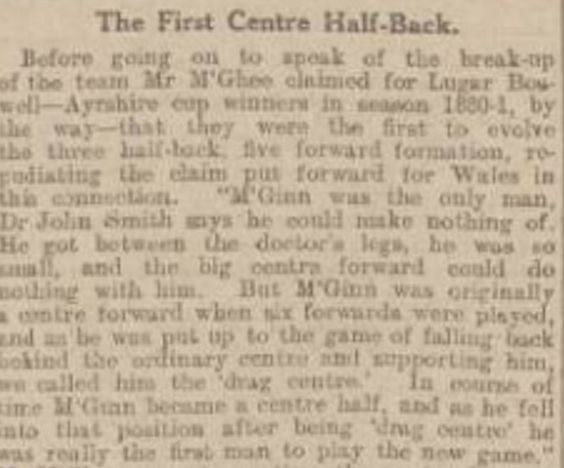
(With thanks to Hibernian Biographies Project)
And in Edinburgh football, Hibernian (See above), had also turned to it early with also Nick Ross, even when from captaining Hearts he had joined Preston, also already a notable exponent. Indeed from Auld Reekie it had been creeping westward, in addition to which all the international teams except Scotland now employed it too. Nor did it even at Tontine go away but went change-about. For the following game 2-2-6 was reverted to but notably against Edinburgh's Hibernian in the one after that, matching up man-on-man, it appeared to be back with now erstwhile half-cum inside- not centre-forward, Alex Grant, in the middle of the three, whilst for the Cup Final against Queen's Park on 13th February the line-up was back to Renton-conventional.
But then came the PNE debacle. It was to be the clubs' first meeting. It took place on 27th March 1886 and in Preston at Deepdale. There were nineteen Scots on the pitch on the day. North End, as they had for much of a season that had seen them undefeated with only handful of draws, fielded eight as Renton was massacred 7-0 but with no possibility clearly that it was anything to do with difference of national style. It was personnel or tactics, this as Dewhurst scored after fifteen minutes, then young Jimmy Ross hit two, his brother Nick one, from full-back, as did John Goodall, Jack Gordon and even known hard-tackler, Davie Russell, from defensive, repeat defensive centre-half one also. And it led after the match to Renton's then captain, a soul-searching Alick Barbour, sitting down with his opposite number, Nick Ross, and getting him to explain in detail what Preston was doing and Renton was not. It proved to be a revolutionary conversation although not quite yet. The club had first to return to a home-match against Hibernian once more, a 3-5 defeat.
With Preston and now Hibs obviously re-thinking was needed and change necessary. And both might first have begun to show their faces in a good 6-2 defeat in a friendly at home of Aston Villa on about 20th August 1886. But with no team and therefore formation known that remains surmise. However, we do know on the 25th September 1886 at the start of the new home season Renton faced Rangers and played three half-backs, Kelso, Kelly and a new name from the second team, Allison, with Barbour and another new-comer, seventeen-year-old John Campbell, as the right-wing pairing. Yet still there was tinkering. Subsequently it was back to the more conventional 2-2-6 but with Kelly then being moved about still more. He and Barbour were at right-wing for the next game and three weeks later with Campbell back he and and McIntyre, presumably the more advanced of the two, were the central pairing but perhaps in still captain Barbour's mind now a more consistent shape beginning to form. Throughout November, December and into January 1887 the formation remained the same against home-grown clubs and in defeat of English visitors alike; Accrington in October, a home draw with Blackburn Rovers in November and an away win in Blackburn in December. But then, if something were gelling, it needed to, not least because in January Preston would be back, coming north not for one but two games a week apart, a friendly and an FA Cup tie.
The friendly was on 15th and ended as a 2-2 draw. But on 22nd Preston got down to business. The result for Renton was a 0-2 home defeat, the response to which and the fact that the Dunbartonshire team had never yet beaten the Lancashire one was that first Barbour dropped himself, bringing in a further new name, Neil McCallum from Bonhill, himself replaced Kelly for the game after that, then brought him back and played himself on the wing with either Campbell or McCallum for the remainder of the season, which was going more or less to end with an April tour to, you have guessed it, Lancashire once more.
It would not go well. The first game was yet again against North End. It was a 2-1 defeat. Then came draws at both Burnley and Bolton Wanderers, at which point but aged just twenty-five Barbour clearly decided at his home-town club at least he had done what he could. That summer he joined that same Bolton club and, whilst he returned to Renton or more specifically to Bonhill village to live out his life after football, he would spend the rest of his footballing dats on-field and then coaching across The Border.
As such he would be the first Renton player to make the Southern move, although there had been more leakage from The Vale. In the summer of 1886 Robert McRae had gone effectively from its second team. Without him having played a first-team game of note again Burnley acquired his services. Then the summer after it would be Will McColl to Morton with George Davie at twenty-three and a centre-forward moving briefly to Renton and eighteen year-old James Cowan going the other way, both probably feeling their paths blocked by talent ahead. And this was as, meanwhile, the captain's armband at Renton would between the end of season 1886-7 and start of 1887-8 be passed to Archie McCall.
And at that point quite simply something extra happened. Perhaps it was generally maturity and timing, perhaps it was that McCall's by then twenty-six year-old head had in it ideas for fine-tuning or that he just had different leadership qualities. The suspicion is that it was a little of all three, i) a combination of more experience throughout the team, ii) an adjustment of Kelly as the not always but normally central one in the half-back trio from an emphasis on defensive duties a la Preston or support to the centre-forward a la Lugar to more attacking ones, as might befit a player, who had begun not as centre-forward but a proto-inside-forward, and iii) an ability to cajole a still relatively inexperienced Kelly, perhaps by McColl himself with a better overview from full-back, to hold a position behind the five forwards but not between but in front of the Scottish tradition of just two half-backs. And the results were to be spectacular. With a fairly steady first-team and a total pool of about twenty-five players by the turn of the year Renton was in the Cup semi-final with a tally of thirty-nine goals for and six against and here is the run of games from then, the 1st January, to the denouement at the season's end.
2nd January 1888 Dundee Harp - Renton 0 - 5
3rd January 1888 Forfar Athletic - Renton 0 - 4
14th January 1888 Renton - Queen's Park 3 - 1
in the Scottish Cup semi-final
21st January 1888 Dumbarton Athletic - Renton 0 - 2
in the Dunbartonshire Cup
4th February 1888 Renton - Cambuslang 6 - 1
for the Scottish Cup Final
11th February 1888 Renton - Vale of Leven 1 - 2
for the Dunbartonshire Cup Final
25th February 1888 Hearts - Renton 0 - 3
3rd March 1888 Rangers - Renton 3 - 7
(10th March 1888 Scotland - Wales)
and Queen's Park - Renton 1 - 1
(17th March 1888 Scotland - England) 4 players in Scotland team
(24th March 1888 Ireland - Scotland)
and Partick Thistle - Renton 2 - 4
31st March 1888 Renton - St Mirren 3 - 2
7th April 1888 Kilmarnock - Renton 1 - 1
14th April 1888 Renton - Morton 2 - 2
19th April 1888 Queen's Park - Renton 2 - 2
for the Glasgow Charity Cup
21st April 1888 Sunderland - Renton 2 - 4
28th April 1888 Vale of Leven - Renton 0 - 5
2nd May 1888 Queen's Park - Renton 0 - 2
for the Glasgow Charity Cup replay
8th May 1888 Rangers - Renton 1 - 5
12th May 1888 Renton - Cambuslang 4 - 1
for the Glasgow Merchants Charity Cup
19th May 1888 Renton - West Bromwich Albion 4 - 1
for the "World Championship"
26th May 1888 Scoto-English played Scoto-Welsh
(The Scotland players against England v the Scotland players against Wales)
28th May 1888 Celtic's first game
2nd June 1888 Renton - Preston NE 4 - 2
for the "World Championship" II
In the twenty-six games over five months four finals (and they say modern, professional footballers play too much) were reached and three won. There was just the one defeat, to The Vale in the Dunbartonshire Cup. There were three draws, two when resources were stretched by internationals, one to Queen's Park. Seventy-two goals were scored for and twenty-four conceded, exactly 3:1 and, as well as taking the Scottish Cup then playing and roundly defeating the English Cup winners, West Bromwich, to become de jure World Champions, they finally beat Preston, which the following year would be the World's first Double-winners.
Oh to have seen a rematch of that fixture the following season but it would never be because at that moment the Renton World as was would fall apart, a combination of rapaciousness from each side of the border. First came the departure to newly-formed Celtic of both James Kelly himself, there to be captain, and Neilly McCallum, but it should be remembered that also Andrew Hannah went initially to West Bromwich, Frank Dyer to Bolton, George Davie to Everton and William Brady to Burnley, a ration of 2 to 1, South of the Border to North. And Vale of Leven almost by proximity was not immune either. It lost James Coyne also to Everton and from its first eleven John Forbes to Blackburn and Tom McLean to Notts Co., so two North and seven South so far.
And the drain would continue at the end of the following campaign with from Renton John Lindsay going and once more to Accrington, Andrew Hannah, another to Everton, Harry Campbell also to Blackburn, John McNee to Bolton Wanderers and even Frank Dyer brought back from Bolton to replace Kelly taking himself to Vale of Leven. And to that, never mind Dumbarton was now being similarly impacted, must be added The Vale's further losses of John Baird to Aston Villa, Frank Dyer off again, this time to Warwick County and James Cowan again to Warwick County before Aston Villa, so from the two upper-Leven clubs one North and seven South from that season alone and totalling three and fourteen overall thus far.
But even then it, what was becoming a pillage, did not stop. In the summer of 1890 Renton was virtually cleaned out. John Harvey and John Middleton Campbell went to Sunderland, David Hannah to again Sunderland and then Liverpool, Patrick Gordon to Everton, Billy Fraser to Stoke and Robert McDermid to Accrington. Whilst the exodus from The Vale comprised John Murray to Sunderland, Alex Paton to West Manchester, Archie Osborne to Notts County, James McLachlan to Derby Co., John Walker to Grimsby Town and Daniel Paton to Aston Villa. That is twelve, all heading South, so now three still North and twenty-six South.
And by the middle of 1891 it was even worse. From Renton Duncan McLean had moved to Everton, George Campbell and James Brown to Aston Villa, Harry Gardiner to Bolton, Duncan McNair to Middlesbrough Ironopolis, John McNee back to Bolton, John Cameron to Stoke, John Duncan to Notts Forest, Willie McArthur to Sunderland Albion and George Davie to Arsenal. Whilst from The Vale they were accompanied by Andrew Whitelaw to Notts Co., James Sharp to Preston, John Baird to Aston Villa, James McMillan to Everton, the returned McCallum to Nottingham Forest and Malcolm McVean to Liverpool.
Moreover, even as it slowed still there was no end. 1892 would see the departures or re-departures from Renton of Andrew Hannah, James McBride and James Kelso, all to Liverpool, and Thomas Towie briefly to Celtic and then Derby County. In 1893 its was Gilbert Rankin(e) across to Vale of Leven, Robert Glen to The Wednesday, John Cowan to Preston North End and Aston Villa and Andrew Hannah back to Liverpool, whilst in 1894 it would Jack McNee, now to Newcastle Utd. and Jock Bell to Wolverhampton Wanderers. This as The Vale saw the departures in 1892 of Daniel Bruce to Rangers and Johnny Darroch also to The Wednesday, in 1893 amazingly none and finally in 1894 Duncan (Mc)Nichol to Darwen.
It meant in the seven season from 1888 there were something like seventy-eight net out-flows to English clubs and and ten to Scottish ones, eighty-eight in all or eight teams, one plus a season. It was, of course, unsustainable. Indeed, the clubs would begin a wither-on-the-vine, this whilst ex-players and the few originals who remained in Scotland taught and/or demonstrated to the rest of the nation the distinctive Renton cum Leven way of play and those who went as a new wave of this time more properly qualified "Scotch Professors" to England did the same there before also beginning to carryng it to the wider World. It would be a still distinctive but now renewed Scottish style of play, the new Scottish Game with a mobile, attacking, passing rather than defensive, non-Preston, pivotal centre-half, essentially the first, dedicated mid-field and, dare it be said, not unlike shinty's "full-centre". He would be positioned in front of still narrow half-backs with full-backs now able naturally to widen and all behind a forward-line, already operating in vertical pairings that had or would soon consolidate from the back-up- or half-forwards of the old system inside-forwards, right and left. And from those adjustments would soon emerge the concept of those same inside-forwards fetching and carrying, the one-man mid-field becoming at times three, and almost organically until really the Hungarians the again Scottish adaption of the half-backs marking inside-forwards and full-backs the wingers. The long-term superiority of this final concept was nowhere better expressed than by Jimmy Mullen, the experienced Scotland captain a full forty years later on the victory of the Wembley Wizards of 1928. He said:
"I want to emphasise that all our forwards are inherently clever......But I wish to say that the English tactics were wrong. The Saxon wing-halves paid more attention to the wingers than the inside forwards – therefore the latter were given a lot of space. It is a common thing in England to let wing halves, and not fullbacks, mark the wingers. It doesn’t pay and I don’t know why they pursue it."
To which he might have added. "I feel sure that the wider, global, footballing World will not make the same mistake."
Known Renton, Renton Thistle, Vale of Leven and other Upper Vale Teams (cont.)
- Re-joined SFA
- Andrew Hannah - aged 18 -from Renton Wanderers
- David Hannah - aged 15 - from Renton Thistle (Wanderers)
- ((John) McNee aged 16 - from Renton Wanderers)
- N/A
- N/A
- N/A
- N/A
- N/A
- N/A
- N/A
_________________________________________
- Cunningham
- Collins
- Miller
- Wilson
- Hendry
- Sharp
- McIntyre
- McGregor
- McCulloch
- Weir
- Muir
1882-83 Jamestown
_________________________________________
- Dan Friel - to Accrington
- Sandy McLintock
- Andrew McIntyre
- John Forbes
- John McPherson
- A. McLeish
- John McFarlane
- (D.) Kennedy
- M. Gilles
- Robert MacRae
- W. B. Johnstone
Peter Logan, W. Strathearn, James Brown, A. Kennedy, James Wilson, A. McLellan, (D.) Lind(say), McCulloch, D. McIntyre
_________________________________________
- John Lindsay (21)
- Archie McCall (22)
- Bob Kelso (18)
- Donald McKechnie (22)
- James McCall (18)
- Alick Barbour (21)
- John M(H)all(McColl) (21)
- Joseph Thomson (20)
- John McIntyre (21)
- Alex McIntyre (23)
- Andrew Hannah (19)
_________________________________________
- Sandy McLintock - to Burnley
- James Wilson
- John Forbes
- Andrew McIntyre
- John McPherson
- Peter Logan
- Robert MacRae - to Burnley
- D. Kennedy
- D. McIntyre
- W. B. Johnston(e)
- M. D. Gillies
John McFarlane, A. McLeish, Cramner, W. Strathearn, James Brown, Abraham, Gilles, McCulloch, McLean, Cumming, McLellan, Kerr, Sinclair, McBrayne, J. Galloway, Campbell, Graham, Roxburgh, Tait
_________________________________________
- John Lindsay
- Archie McCall
- Andrew Hannah
- Bob Kelso
- Donald McKechnie
- James McCall
- Alick Barbour
- James Kelly
- Joseph Thomson
- Alex McIntyre
- Alex Grant
(Robert) Allison,John McNee, David Hannah, Burton, Baxter
_________________________________________
- W. Collins
- T. Sharp
- A. Roxbrough
- R. Sharp
- T. Hendry
- William Wilson
- William McColl
- J. McCallum
- A. Whitelaw
- C. McLaren
- A. McLaren
_________________________________________
- James Wilson
- Andrew McIntyre
- John Forbes
- J. Abraham
- J. Galloway
- David McIntyre
- John Ferguson
- W. H(B). Johnston(e)
- M. D. Gillies
- D. Kennedy
- R. Wilson
John McPherson, John McFarlane, J. McLeish, A. Kerr, James Brown, Sinclair, Coleman, J. Davie, Reid, McNaught, Murray, Whitelaw
_________________________________________
- John Lindsay
- Archie McCall
- Andrew Hannah
- Bob Kelso
- Donald McKechnie
- James McCall
- Alick Barbour
- James Kelly
- Alex Grant
- John McIntyre
- Joseph Thomson
Alex McIntyre, David Hannah, John McNee, Watt, John Campbell, Neill McCallum, McLaren, Ralston, Daniel Grant
_________________________________________
- McCallum
- McLean
- Buchanan
- McLeod
- Tom McLean
- T. McLeod
- Brodie
- Robb
- Reid
- Reid
- Neil
_________________________________________
- James Wilson
- Andrew Whitelaw
- John Forbes
- W(R). Wilson
- John Murray
- D. McIntyre
- Coleman
- M. D. Gilles
- Robert McRae - to Burnley
- McLeod
- William McColl
(Mc)Nichol, Brown, Abraham, Davie, Sinclair, Reid, Lewis Brodie, G. Willis, McNeill, Robb, Campbell, Watt, Muir, T. Nicholl, A. Nicholl
_________________________________________
- John Lindsay
- Archie McCall
- Andrew Hannah
- Bob Kelso
- Donald McKechnie
- Alick Barbour - to Bolton
- Neill McCallum
- John Campbell
- James McCall
- John McNee
- Harry Campbell
James Cowan - to Vale of Leven, George Davie, James Kelly, David Hannah, Alex McIntyre, (Robert) Allison, J. McIntyre, J.C. Nicholson, A. McDermid, Robert McDermid, H. Campbell
1886-7 Renton 2nd XI: W.Jardine, F. Shaw, J. McAdam, T.Allison, A.P. Mackay, J.B. Brodie, P. McCallum, R.A. McCall, D. or P.(eter) Campbell, J.C. Nicholson
_________________________________________
- White
- Busby
- Kemp
- Harrison
- Cormick
- Bruce
- Campbell
- McGregor
- McMillan
- Warnock
- Muir
1886-7 - Bonhill
-----------------------------------------------------
- Cranmer
- Roxburgh
- McLaren
- Hendry
- McCulloch
- McLaren
- Munro
- Lavel
- Stevenson
- Curran
- Paul
_________________________________________
- William McColl - to Morton
- James Wilson
- Andrew Whitelaw
- John Forbes
- (William) Wilson
- (John) McNichol
- John Murray
- McLeod
- M. D. Gilles
- Coleman
- George. Davie - to Renton
James McLaren, Nichol, Brodie, D. Kennedy, T. McNichol, Merry (Murray), Tom McLean, (T.) Sharp, James Coyne, D. McNee, Graham, McLeod (2)
_________________________________________
- Andrew Hannah - to West Bromwich
- James Kelly - to Celtic
- Neill McCallum - to Celtic
- Archie McCall
- Bob Kelso
- Donald McKechnie
- Harry Campbell
- John Campbell
- James McCall
- John McNee
- Frank Dyer - to Bolton
George Davie - to Everton, William Brady - to Burnley, David Hannah, A. McDermid, Nicholson Duncan, McRae, George Campbell, , (James) Brown, , P. Jardine, (James) Brown,, Patrick Gordon, John Lindsay
_________________________________________
- T. McLeod
- L. Glass
- J. Davie
- R. McLeod
- J. Ferguson
- R. Crawford
- T. McLeod
- A. McLeod
- N. Blair
- D. Kennedy
- L. Brodie
J. Reid, J.Buchanan, M. McLean, Nichol, McGregor, F. McLeod
_________________________________________
- John Forbes - to Blackburn
- Tom McLean - to Notts Co.
- James Wilson
- Andrew Whitelaw
- John Murray
- D. McIntyre
- Graham
- James McLaren
- James Cowan
- Gilbert Rankin
- James McLachlan
James Coyne - to Everton, Graham, Gilles, McGregor, John Baird, Paterson, Gow, Currie, McMillan, McCallum, Osborne, McLaughlan, Bruce, Coleman, McIntyre, Daniel (Patten) Paton
_________________________________________
- John Lindsay - to Accrington
- Harry Campbell - to Blackburn
- Andrew Hannah - to Everton
- John McNee to Bolton Wanderers
- Archie McCall
- George Campbell
- Harry Gardiner
- James Brown
- John Harvey
- John Campbell
- James McCall
Frank Dyer - from Bolton to replace Kelly, to Vale of Leven, A. McKay, (H) Duncan, Willocks, D McLean, McIntyre, Mathieson, James Kelso, McNee, David Hannah, McDiarmid, A. O'Neill, Patrick Gordon, Davie
_________________________________________
- John Baird - to Aston Villa
- James Cowan - to Warwick County & Aston Villa
- John Gow
- Andrew Whitelaw
- John Murray
- Collins
- James McLachlan
- Campbell - from Bonhill
- (Daniel)(J) Paton
- James McMillan
- McIntyre
Frank Dyer - to Warwick County, John Walker, Gilbert Rankin, Daniel Bruce, Latta - to Everton, Archie Osborne, John Forbes, William Murray, John McNichol, McLeod, James Cowan, (Lewis) Brodie, James Wilson, A. Paton
_________________________________________
- Johnny Darroch - to Vale of Leven
- John Harvey - to Sunderland
- David Hannah - to Sunderland and Liverpool
- Patrick Gordon - to Everton
- Harry Gardiner - to Bolton Wanderers
- John Campbell - to Sunderland
- George Campbell - to Aston Villa
- Billy Fraser - to Stoke
- Duncan McLean - from Renton Union
- James Kelso
- James Brown
Robert McDermid - to Accrington, John Gow, Duncan McNair, (James or John) Brady, James McCall, John Cameron, Currie, Willie McArthur, McLean, O'Neill, McKenzie, Belger, MacAdam, Mathieson, John McNee, John Duncan, Archie McCall, George Davie, Harrison, Mackay, J. Burleigh
_________________________________________
- Graham
- Wilson
- Crawford
- McLellan
- Ferguson
- Harrison
- McVean
- A McLeod
- R. Mcleod
- Hillfordy
- McFarlane
1889-90 Vale of Leven Wanderers
- Caldwell
- Kelsken
- Howell
- (G ., D. or J.)Sharp
- (W or A) Graham
- Balfour
- McKay
- Courtney
- Stevenson
- Mansland
- Stevenson
1889-90 Jamestown
_________________________________________
- John Murray - to Sunderland
- Alex Paton - to West Manchester
- Archie Osborne - to Notts County
- James McLachlan - to Derby Co
- James Wilson
- Andrew Whitelaw
- James Sharp
- James Paton
- Daniel Bruce
- Gilbert Rankin
- James McMillan
John Walker - to Grimsby Town, Daniel Paton - to Aston Villa, William Murray, John (Mc)Nichol, Newton, John Baird - back from Aston Villa, Paterson, (W. or A) Graham, Gilles, McLaren, Allan, Cormack (Carnock), McLeod (Dumbarton), Mckenzie & Pollock (Clyde), John Cowan
_________________________________________
- John Gow - to Blackburn Rovers
- Duncan McLean - to Everton
- George Campbell - to Aston Villa
- James Brown - to Aston Villa
- Harry Gardiner - to Bolton
- Duncan McNair - Middlesbrough Ir.
- John McNee - to Bolton
- John Cameron - to Stoke
- John Duncan - to Notts Forest
- Willie McArthur - to Sunderland Albion
- George Davie - to Arsenal
- James McCall
- (Alex) Currie - Iron Moulder, who moved to Greenock
Carlyle, MacAdam, Hendry, Mathieson, John McIntyre, J. Burleigh, James McBride - from Renton Wanderers, Joe Lindsay - from Dumbarton, Daniel Devine, Murray, Mackay, Harvie, (James, John or Joe) Brady, Abraham, James Kelso, Archie McCall
_________________________________________
- Caldwell
- Ken(l)ski(e)n
- Darroch
- McKenzie
- Balfour
- Graham
- (Mc)Courtney
- Rice
- McAusland
- Gillies
- Mills
_________________________________________
- Andrew Whitelaw - to Notts Co.
- James Sharp - to PNE
- John Baird - to Aston Villa
- James Wilson
- William Murray
- (John) Corma(i)ck (Cornoch(k))
- McLeod
- Gilbert Rankin
- John Cowan
- Buchanan
- Daniel Bruce
James McMillan - to Everton, (Neill) McCallum - to Notts. F., (Jack) Bell - from Dumbarton?, Rice, W(alter) Bruce, Turnbull, McGregor, Mackenzie, Raeside, W. Graham, A. Graham, McIntyre, Paterson, (John) Gallagher (Gallacher), (John) Docherty, W. Smith, G (J.) Sharp, (D). Sharp, McAdam, James M(a)cAdam, Reid, John McNichol, Thomas Graham to Arsenal, Mills, Malcolm McVean to Liverpool, Johnny Darroch
_________________________________________
- Joe Lindsay
- Andrew Hannah - to Liverpool
- Archie McCall
- Devine
- (Robert) Allison
- James McBride - to Liverpool
- Mathieson
- Murray
- John Cowan
- James McCall
- (James , John or Joe) Brady
Thomas Towie, Archie McQuilkie, Robert Glen, Billy Fraser, Brodie (Bradley), Fairlie (Fairley), McNeil, McKechnie, Abr(ah)am, Duncan, McBride, Gillard, Johnstone, James Kelso to Liverpool, John Lindsay, Carlyle, (John) Cameron
_________________________________________
- James Wilson
- Busby
- (Thomas) Connoch (Cormack)(Cornock)
- A. Paterson
- David Tait
- McAdam
- John Cowan - to Renton
- James Logan - from Ayr
- Daniel Bruce - to Rangers
- Paterson
- McFarlane
Gilbert Rankin(e) - out of retirement?, (James) Henderson, Walter Bruce, John Galla(g)cher, Barr, Bob Robertson, J. Bain, Joe Hutchi(n)son, (Duncan), Kerr, (Murphy), George Fowler, Park, McFarlane, McNichol, Murray, James Fleming, Robertson, Mathieson, Clark, McLafferty, (T. Wilson), W. Smith, D. Sharp, John McNichol, Dan Friel, Johnny Darroch - to The Wednesday, W. Graham, D. Paton, Buchanan
_________________________________________
- Joe Lindsay
- Haig
- Archie McCall
- Gilbert Rankin - to VofL
- (Robert) Allison
- Robert Glen - to The Wednesday
- Mathieson
- John Cowan - to Vale of Leven
- McGregor
- James McCall
- Bell
Andrew Hannah - back to Liverpool, Murray, McKechnie, Archie McQuilkie (McQuigley) - to Arsenal, Dan Devine - to Arsenal, John Lindsay, Thomas Towie - to Arsenal, Celtic, Derby County, George Davie, Robert McDermid - from Lincoln, McLeod, David Tait, John Fleming, John McNee, Bell, Joe Brady - from Sheffield United, James Wilson?, Robert Duncan, Alick Barbour - back from Nottingham Forest, William White, (McGregor - from Methlan Park), Wilson, Henderson, Robert Glen, Taylor, Beattie, Mills/Milne, T. Wilson - from Levendale, Baird
_________________________________________
- T. Wilson
- Busby
- Henderson
- Gallocher
- Tait
- Hastie
- McFarlane
- Logan
- Mills
- Ritchie
- Muir
_________________________________________
- Archie Graham
- T. Graham
- Daniel Paton
- Cross
- D. (Duncan) (Mc)Nichol
- (Patrick Gallocher - from Accrington)
- Walter Bruce
- Crawford
- Keir
- W. McFarlane
- John (Mc)Nichol
Mills, Cowan - to PNE & AV, McLintock - out of retirement?, Haggerty, Row, T. Wilson, (William) McColl - from ???, Millar, T. (Mc)Nichol, McAslan, Duncan, P. McFarlane, (R.) Allison, A. Paterson, W. Graham, P. Graham, W. Gallacher, J. Nieal, Busbie, J. Wilson, McCallum, Logan
_________________________________________
________________________________________________________________________________________________________________
So, with initially very basic, official but still contractually individualistic professionalism in place from 1885 at least a part of the 1882 Manadarin/Alcock/Lane Jackson project of (entitled) English footballing dominance off- and also on-field had been rendered on the face of it if not dead then seriously wounded. The caution is became it would not be entirely killed off until with McGregor's Football League a structured, communal improvement was introduced in 1888. Only then would the aspiration of fully amateur football in England be rendered impossible, as effectively it would in short time despite resistance also become in Scotland and in the longer term by example globally too. But the other part, that of the on-field transfer and implementation of the off-field notion, the "ideal" of Corinthian eugenics, still lived on. But it would not be for long. By the end of 1886 the game that would mark not the collapse but the turning-point for its eventual eradication through overwhelming evidence in play had already taken place. Then in five years it was peripheral, in ten minimal with the actually hugely talented G.O. Smith the only one left standing, and he was half-Scots anyway.
The Slow Rebellion -
how Scots working-class realism made football proper pro. - Final Part Five
And with regard to the latter (the game [and the goal} that might have changed football for good) it took place a little later, on 27th March 1886. Scotland was playing England at Hampden Park. But it was a special England. The elite, invitation-only club Marindin, Alcock and Jackson had founded in 1882 had been Corinthian F.C.. By March 1882 it had already provided three players to the England team. It made little difference. It had been a 5-1 away-loss. Then in 1883 that had become five, the goalie, a half-back, Stuart MacCrae himself, and three of the six forwards, including both centre-forwards. England lost again, this time at home. In 1884 the number fell to three. England lost away, but only by a single goal. And by 1885, the year James Forrest was in the middle of the pitch by now for the fourth time but the first against Scotland and had been joined by four similar others from Midland and Northern clubs, it was down to two. England, at home, improved and drew.
There might have been a pattern emerging, yet in 1886 the number of Corinthians shot up to nine. Forrest was still there with the 'keeper, also from Blackburn, and the the explanation perhaps that Lane Jackson was attempting, backed up the SFA/Queen's Park with a petty demand about Forrest's shirt but curiously not Herbert Arthur's, to make a point, even to regain some control. And it almost worked. England would draw away yet it might have been so different. And the difference proved to be George Somerville, one of the two 2-2-6 centre-forwards but from the sixty-fifth minute working alone as his pairing, Joe Lindsay, had had to leave the field injured.
England had scored in the game's thirty-fifth minute. Scotland pressed to half-time but to no effect. And the game continued much the same into the second half, even after the home team had gone down to ten. But in the eightieth minute Scotland won a corner, the ball was put into front of goal, there was a melee, Sommerville stuck out a toe and the ball trickled through. It wasn't pretty but it was a turning-point.
In the same fixture the following season Somerville was not there. He never won a second cap, abruptly replaced even at club level at Queen's Park; another story. But there were now not nine but just seven Corinthians. England lost at home. Then in 1888 it was five and England finally won but in somewhat special circumstances, in 1889 it was five once more but with Scotland winning and away and in 1890 it was six, the last time there was a majority, yet with just a draw resulting and the decision taken for changee. And how!
The next year, 1891, not only was there no majority the number of Corinthians was actually zero, with the obvious but side-observation being that Marindin was gone, replaced meantime by Arthur Kinnaird. Moreover, victory was England's once more and this time without caveat, with an even bigger win in 1892, 1-4 away, two in a row for the first ever time, with John Goodall, John Goodall from Kilmarnock, scoring an English brace (Another, another story) and but a single Corinthian in the eleven. And that would be the pattern for the rest of the 1890s; none, one or two Corinthians, notably G. O. Smith, albeit that his father was a Scot, and the rest working-class professionals essentially until 1906 and a change then of circumstances.
But let us at this point wind back to that Preston-Upton Park episode. There were other, this time off-field, repercussions, which very quickly had come home to roost. The first was that the FA in London had sided with Upton Park, not least because Sudell openly admitted the charge of paying players on the grounds correctly that, one, everyone around him was doing it as well and, two, probably correctly, it was in any case not against the regulations. On both counts he had points. In terms of the former Preston North End would be expelled from the FA Cup, the irony being that in the next round Upton Park found itself facing and now without complaint well beaten by an almost equally professional and nearby Blackburn Rovers (Preston had 6 Scots, Blackburn 4); the same Blackburn that would reach but lose the final. In terms of the latter it is correct that until 1882 the FAs' rules did not cover professionalism, the very idea being infra dig. But that year it had changed when specifically the Lancashire FA had within the county introduced rules effectively to combat Scottish arrivals, the question being whether they had also been incorporated in the "English" FA's regulations in London or not. The suspicion is not and, if not, Preston's expulsion was invalid.
The second repercussion was that the SFA wrote, or was persuaded to write, a threatening letter to all the Scots footballers believed to be plying their trade South of the Border. It failed, one, because the SFA thought there were for 1884-5 some fifty odd, whereas the real number was about one hundred and it was in any case ignored; after all the largely proletarian miscreants were only continuing to do what had been endemic in their team sport in Scotland before the Scottish Association football even existed.
The third was the setting up of an FA enquiry into professionalism under the chairmanship of Lane Jackson, so no bias there.
And the fourth was to stir Queen's Park and thus the SFA into joining in with the complaint, the same Queen's Park that itself had been able to rebuild and then maintain its position over the previous half dozen seasons by somehow tapping up players from other Scottish clubs. Better half-time oranges perhaps.
Unsurprisingly Lane Jackson's enquiry came down on the side of "amateurism" with compliance demanded from all the teams in the FA Cup including Scottish ones, to which the response from Sudell and Preston, despite an extension of their ban, was a point-blank refusal. But there was more. Preston had all along been talking to other Northern-western and Midland clubs and the result was the tacit approval of the idea for effectively an FA alternative but a professional one, the British Football Association. (Note the word British, which must have scared the SFA rigid).
It was a pivotal moment, made more so by events elsewhere. Sudell was able to threaten the FA in London with schism and therefore loss of control of, by then, more than half of the English game. Moreover, in places where organised club football had not existed previously it was developing, often with Scottish impulsion, ideas, attitudes and players. In the North-East Middlesbrough had been already founded in 1876, Sunderland in 1879 by Ayr's James Allen, West Hartlepool in 1881, Newcastle East End in 1881, Newcastle West End a year later and Darlington St. Augustine that same year and by Edinburgh's James Nolli. Then in London Spurs had been formed in 1882 with one of the three boy-founders, John Anderson, the son once removed of Lochwinnoch, Millwall was formed in 1885 with its first President, William Murray Leslie from the Black Isle and its captain Dundee's Duncan Hean and Arsenal in 1886 by Fifer, David Danskin. Moreover, in Southampton 1885 would see the foundation of what would become today's league club but the start to the game in the city had been by Scottish shipyard workers, their club Southampton Rangers and already in 1878.
Quite simply the result of the British Football Association (BFA) threat was that the FA in London called a Special Conference, where a certain William McGregor of Aston Villa advocated for professionalism, even admitting that Villa paid it players, and the FA backed down. The findings of the Lane Jackson enquiry were overturned, Jackson himself doing a complete "reverse ferret", with now just a residence qualification left in place; and it was ignored. Jackson himself was in 1886 voted off the FA committee, although he was back the following season as the representative of the London Association, which he himself had formed. It meant that Southern England/London's power was broken and, whilst the number of Scots in English football did not increase greatly, the concentration did. Preston would continue to have ten in its squad, Great Lever now nine, Bolton eight, Burnley six, Accrington and Halliwell five, Blackburn and Bury four, each, the Newcastles also four, Sunderland three and on Merseyside Bootle and Everton six each; two thirds of the total in thirteen clubs, all now with wage bills to match.
But the effects were not confined to South of the Border. Whereas there amateurism was in retreat with more to come, North of it the SFA in fact doubled down. Queen's Park, having lost those consecutive FA Cup Finals to Blackburn Rovers led the way and after five Scottish clubs had played in the 1885-6 Britain-wide competition and seven in 1886-7 for the following season a total ban was imposed on the grounds that Scotland's "amateurs" should not be playing England's professionals. It was total cant but might be seen as a backstop against a future BFA and did permanently render the FA Cup English, Welsh and Irish and ultimately English and Welsh only.
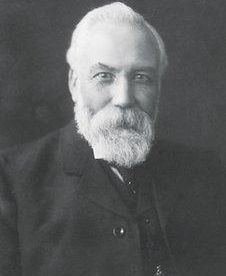
William McGregor
However change brings its own problems. Football throughout Britain had been relying on Cup-games, be they national, county or local, and friendlies with the former subject to early defeat and/or walk-over and the latter cancellation at short notice. It meant potentially large gaps in club schedules, therefore no income but now with not just player's expenses but expenses and permanent wages to cover. As a result many of the same clubs that had forced through and/or accepted pay-to-play now found themselves looking into a financial black-hole.
And at this point Aston Villa's William McGregor stepped forward once more, with his confession that everything he knew he learned in childhood and youth in his rural, Perthshire home-village of Braco with how to run a football club presumably no exception.
Sudell's BFA might have been successfully coercive but also a rather blunt instrument. It was a substitute not a progression and the almost three seasons from 1885 had convinced the afore-mentioned McGregor of the necessity of and given him the time to consider a better solution. It was that which he in March 1888 proposed in a letter to his own club and four others and to which he gave the working title of the Association Football Union.
And by those five clubs and others in the North and Midlands MvGregor had his hand bitten off, with a meeting for all FA clubs then organised in London. Ten clubs attended but none was from the South so a second meeting was arranged for Manchester and by the following September his "Union" had become the twelve-team Football League.
It meant that in three years not just the Corinthian experiment had effectively failed but the "posh-boy" trio of Marandin, Alcock and Lane Jackson and been by-passed both in terms of class-attitude and playing ethos not once but twice over. Indeed the League itself soon became paramount, expanding exponentially over the next decade. Furthermore within a few seasons its concept would with the Southern League be adopted by new clubs in the South, which swept aside the old ones, taken up abroad, already in 1891 in Argentina, and everywhere by other sports.
It additionally meant that by 1898 there were not one hundred Scots playing football for money in England but three hundred. And it also caused the whole "posh-boy "trio to be gone, Alcock by 1895, Lane Jackson in 1897 with Marindin already replaced in 1890 by Lord Arthur Kinnaird, still "posh" Public School and certainly rich but a Scottish peer.
_________________________________________________________________________
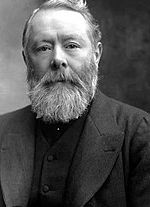
Arthur Kinnaird
__________________________
And meantime football back in Scotland itself, as earlier intimated, was working itself into a major even legal fankle. It was clear the top-flight clubs, Queen's Park included, were finding creative ways to "recompense" their players. It would all come out with the formation of the supposedly still "amateur" Scottish League in 1890, not least due to Queen's Park choosing not to take part because, as had been the case with the FA Cup three seasons earlier, it would have to play shamateur i.e. "professional" opposition. Meanwhile the accusations against other clubs flew. Renton, an early advocate of open professionalism, was expelled from that first Scottish League for one such and had to win in court against the SFA to be reinstated. Indeed the amateur against professional would prove a bitter pill that Queen's Park would take a full decade to swallow. Moreover, it was a problem that even then had and did not go away, and on both sides of the border. With the boot, the football boot, now well and truly on the professional and not the amateur foot, the latter, quite correctly felt neglected, even resentful. In England it would all come to a head in 1906, as, with the formation of the English Amateur Football Alliance, there was a further schism that was replicated and compounded three years later with, North of the Border, the foundation of the Scottish Amateur Football Association resulting in both juristictions in loss of control of the unpaid game now being added, and permanently, to that of the paid one.
But that is another story outwith the scope here so let us get back to 1887-8. Celtic Football Club was on foundation to a degree a unique institution, and twice over. Everyone knows it came about out of charitable intent, the first obviously to do so. And, whilst that as sole motivation did not last long at all, charity remains a part of its DNA. What is wasn't was the first to come out of religion. A decade earlier Aston Villa had emerged from a Wesleyan Chapel. More than a decade before that Sheffield football had given birth to the Congregational Cemetery Road Church club. But Celtic did on the face of it also come out of more or less nothing. There was no obvious group of local enthusiastic youngsters or friends like Villa, Rangers or Down-South, Tottenham, from the home-town, -village or -suburb with a dream. There was not even a break-away from an already existing team. Instead there was an idea, a blank canvas, and a Scotland-wide population, from which as of necessity to make up, for the first time fully to "assemble" repeated, successive elevens. If you like Celtic was the World's first fully tapped-up team.
Yet as we know assembling, tapping-up was far from new. The best part of a decade before 1888 Queen's Park had set the precedent. In 1881 and 1882 half its first eleven were by then conventional practice to a degree "ringers". Nor was the example to be lost on others. The 1885-6 Rangers team contained just two perhaps three locals. The others had been brought in from Kilmarnock, Cowlairs, Partick Thistle and Alexandra Athletic. Queen's Park's 1886 Cup-winning team had five locals in it and six imports. The ratio in the 1889 Third Lanark Cup-winners was exactly the same. So the reality of the Scottish situation prior to Celtic was that there were already two approaches in parallel. The first was recruit from everywhere, a policy notably adopted by the city-clubs, a duplication of what had happened from Scotland in England and led first to professionalism and then the Football League. The other was to bring through entirely local talent, lose some of it inevitably to England, and even elsewhere in Scotland, but in theory always retain a core to provide sustainment even in some sort of acceptably professional, league -like structure.
This latter would, of course, never happen. What had been done with Celtic was to take the first option to its ultimate conclusion and so rapidly that the possibility of option two was simply swept aside and with the widest-reaching ramifications. That story is told in "The Early Beginnings" on The Scottish League History's site, reprinted immediately below. It would, despite them preparing for and Renton even openly encouraging professionalism, destroy in remarkably short order it and the clubs based on locality and almost as quickly, a case of two-decade-old chickens coming home to roost, isolate Queen's Park in its amateur cul-de-sac and finally also reduce it to a shell. But in the former case it would not be without some Dunbartonshire resistance with the story continued column right in episode 6 of Renton & The Vale - The Making, Remaking, Unmaking, Breaking and the Who. (But the creation of the Scottish Game)".
_____________________________________________________
_____________________________________________________
"The Early Beginnings
In the 1860s, so the story goes, a group of young men, mainly from Argyllshire and beyond, regularly gathered on Saturday afternoons in a corner of Queen’s Park in Glasgow for sport and recreation amongst themselves. These men were said to have been well educated and had migrated from the Highlands to Glasgow in search of work away from toiling on the land or the burden of heavy industry. It was in the white-collar field of administration these men were employed. Given that they had all come from similar areas it was only natural that they banded together in friendship and through recreation.
Looking for something different to occupy their free Saturday afternoons, they came across an evolving game called association football. This was a version of rugby football but with the major difference that the game was played with a round ball instead of an oval one. Association football was mainly played in English public schools and universities and the rules varied from school to school. In 1863 the Football Association was formed and adopted the “Cambridge Rules”, which became the “London Rules”; thereafter all member clubs played under a uniform set of rules. In the north of England, however, clubs played under a slightly different set of rules known as the “Sheffield Rules”. It was not until 1877 that a completely uniform set of rules was formally adopted across the whole of the United Kingdom. The friends therefore decided to try out this “new” game and in 1867 formed themselves into a club called Queen’s Park Football Club.
Whilst much enjoyment was experienced and, indeed, people started to watch the men play this “new” sport, it soon became apparent that playing amongst themselves was not enough so they started to look for other opponents. Initially, this took the form of public challenges against other sporting clubs to play against Queen’s Park under the rules they had drawn up and then a series of exhibition games took place in an effort to spread the game. Gradually, over the next 5 years, other clubs were formed. These varied from participants of other sporting activities such as athletics and cricket clubs looking for a sport to occupy the winter months, villagers banding together to form a team, through to factory workers’ teams and even army volunteer groups. Swimming clubs, rowing clubs and YMCA clubs had all dabbled in association football.
By the early 1870s things were looking rather bleak for Queen’s Park and for the establishment of association football in Scotland. The difficulty in persuading teams not to handle the ball made finding opponents hard. However, the publicity of several events suddenly changed the overall outlook. In 1870 Queen’s Park joined the Football Association and in 1871 contributed one guinea towards the cost of purchasing a cup. The F. A. Challenge Cup was launched for the 1871/72 season. Queen’s Park entered the inaugural competition and were exempted from playing until the semi-finals where they were drawn against the Wanderers. The tie, played in London, ended goalless but a lack of funds meant they could not remain for the replay and had to scratch i.e. forfeit the match. This sparked interest, particularly in Dunbartonshire, with 6 new clubs including: Dumbarton, Renton and Vale of Leven; and Glasgow with 7 new clubs including: Clydesdale, Rangers and Third Lanark Rifle Volunteers.
In November 1872 the first International football match between Scotland and England took place at Hamilton Crescent, Glasgow. Scotland was entirely represented by players from Queen’s Park and, although England were clear favourites, they played out a creditable goalless draw. This sparked another surge of interest and more teams were formed during 1873, including over 20 in Glasgow alone. March 1873 saw representatives of Queen’s Park, Clydesdale, Dumbreck, Eastern, Granville, Third Lanark and Vale of Leven attend a meeting and form the Scottish Football Association. Kilmarnock did not attend but sent a message of support. At the end of the meeting a statement was issued: “The clubs here represented form themselves into an association for the promotion of football according to the rules of The Football Association and that the clubs connected with this association subscribe for a challenge cup to be played annually, the committee to propose the laws of the competition.” Other clubs soon became members and a subscription for a trophy raised £56 12s 11d. That trophy is still used today and is the oldest trophy still competed for in the world of football. 16 teams entered the competition that began in October 1873 with Queen’s Park becoming the first winners after defeating Clydesdale 2-0 in the final, held on March 1874.
After a five-year struggle to establish the new game, suddenly the concept grew legs and by the end of the decade 140 teams competed for the 1879/80 Scottish Cup. During this period local associations began to form and with it then launch their own competitions. First off the mark was the Edinburgh Football Association, formed in 1875 and with it the Edinburgh Cup. The Ayrshire Football Association (Ayrshire Cup) followed in 1877 with the Renfrewshire Football Association (Renfrewhire Cup) next, a year later. The Lanarkshire Football Association and Cup was formed in 1879.
Unsurprisingly Queen’s Park were the dominant team in Scotland and won the first three Scottish Cups – Clydesdale, Renton and Third Lanark, respectively, the beaten finalists. This dominance was about to be challenged though it would not come from Glasgow but from the Dunbartonshire villages of Alexandria (Vale of Leven), Dumbarton and Renton. Vale of Leven knocked out Queen’s Park in the quarter-finals of the fourth edition and carried on to win that seasons competition, as well as the next two, thereby emulating Queen’s Park. Rangers, Third Lanark and Rangers, respectively, the beaten finalists. Stung by their lack of success in the Scottish Cup (although they did win the first two editions of the newly launched Glasgow Merchants’ Charity Cup), Queen’s Park reasserted their authority by winning the next three Scottish Cups, Thornliebank, Dumbarton and Dumbarton again being the beaten finalists. They also won the Charity Cup twice in that period.
The early 1880s saw football across Scotland continue to grow. This can be demonstrated that by 1881 the north-eastern area of Glasgow had enough interest and support to form the Glasgow North Eastern Football Association and with it its own cup competition. 1882 saw the Fifeshire Football Association formed and in 1883 Forfarshire and Stirlingshire followed suit. Until this point Glasgow’s football interests were effectively administered by the SFA but this had now become too onerous for them and the Glasgow Football Association was formed in 1883. Surprisingly, however, for one reason or another, they did not launch their own cup competition until 1887. In 1884 another three association and cup competitions were launched – Dunbartonshire, Linlithgowshire and Perthshire.
During the mid 1880s Queen’s Park once more entered the FA Cup in England and in 1884 went all the way to the final where they lost out narrowly, 2-1, to Blackburn Rovers. They repeated the feat the following year, again losing out to Blackburn Rovers, this time by 2-0. In the 1885/86 season Queen’s Park were joined by Heart of Midlothian, Partick Thistle, Rangers and Third Lanark but none progressed further than the Second Round. The next season saw Cowlairs and Renton also participate. Hearts and Queen’s Park fell in the first round and Third Lanark in the second. In the third round Cowlairs lost out to Rangers, and Renton, who defeated holders Blackburn Rovers in the previous round, lost to Preston North End. Partick Thistle defeated Cliftonville of Ireland 11-0 in the third round and eventually lost out in the fifth round but Rangers reached the semi-finals, losing out to Aston Villa by 3-0. This was the last time Scottish clubs played in the FA Cup as the SFA, perceiving a threat to their own competition, banned Scottish clubs from participating in the FA Cup from season 1887/88 onwards.
Background
Football in Scotland in the 1880s grew year on year, not only by participants but also by those willing to pay to watch. Although there was a lot of fluidity at this time as clubs folded for one reason or another, these were replaced by other clubs that were formed. The only real competitive matches were Scottish Cup ties and local cup games, “ordinary” matches – games that nowadays are classed as friendlies; filled the rest of the season’s calendar. Interest in these ordinary games fluctuated depending on the level of the opposition and an early exit from a cup competitions could often lead to “blank” Saturdays i.e. a Saturday without a game because a fixture could not be arranged. Scotland also started to lose players to England and this “poaching” of players was starting to cause serious concerns amongst most Scottish clubs.
At this time football clubs in both Scotland and England was amateur. Players were not paid for playing football but expenses for loss of earnings was permitted. Mostly players stayed with a particular club because it was local and close to their place of work. However, if a player moved area in order to secure a better-paid job it often led to a change of club particularly if he was of a certain standard. Clubs in the towns and cities, although not immune, had a better chance of holding on to their better players than those in the counties due to the higher availability of employment. Movement of players between Scottish clubs was frequent but at least they stayed in Scotland, the loss of players to England was not welcome. Scotland had become a nursery for the clubs in the industrial north of England – the prospect of better-paid employment being the incentive.
If the prospects of better-paid employment alone was really the case then things might have stabilised, but for "amateurism" read “shamateurism”; as the more ambitious clubs in both countries were increasingly coming up with more ingenious ways to effectively pay players. To the clubs who could afford to pay players, amateurism was just a veneer and unless it was blatant the authorities were largely impotent. The not so urban myth was that clubs had two sets of account books, one for the SFA and one containing the real accounts. Furthermore, the clubs themselves rarely called each other out for fear of being exposed for doing the same thing. The game changer came in 1885, when the FA in England could no longer hide the hypocrisy and accepted the inevitable and legalised professional football.
Attempts for Scottish football to follow suit failed repeatedly. The SFA, driven by Queen’s Park, refused to endorse professionalism and were ably supported by the press. They held the view that “professionalism" was a dirty word, that football was an amateur sport that should remain pure in Scotland, and they backed the SFA’s stance with an almost evangelic attitude. In some ways, this attitude bordered on bigotry given the majority of players came from a working class background employed in menial through to heavy industrial and dangerous mining tasks, they should not have the opportunity to better themselves. The middle class administered football, the press was middle class and the working man should know his place and do as he was told. And yet the irony of the situation was lost on the administrators and the press – they complained about the loss of talent yet refused to accept the solution.
English football at this time was the same as Scotland – the season comprised of national and local cup competitions “filled-out” by ordinary fixtures and the randomness this entailed with clubs having to arrange fixtures amongst themselves. From a professional aspect a more formal structure was needed if clubs were to survive and, more importantly, make a profit. In early 1888, William McGregor, an exiled Scot and director of Aston Villa FC based in Birmingham, formulated a plan that would guarantee clubs a set number of fixtures throughout the season. It would take the form of a league and each member club would play each other twice, home and away, with the winners of this competition becoming champions. McGregor wrote to other clubs, mainly based in the northwest and midlands of England and invited them to discuss his plan. In April 1888 the Football League was formally adopted with 12 member clubs and the first season kicked off in September of that year.
The Football League was such a success that the following season saw three regional leagues being formed in England, the Alliance League, the Midland League and the Northern League. This, in effect, exacerbated the problem of Scottish players leaving for England. Such was their reputation for being skilful footballers, that this made the demand for Scottish players even higher and reached a point where there was a high disproportionate amount of Scots playing football in England. This reputation was not unfounded. Between the first recognised international in 1872 and 1890, 19 annual matches had been played between the two countries. Scotland had won 11 of them losing only three times.
Despite the loss of players, Scottish football was still flourishing. By 1890 another 4 regional associations had been established – Aberdeenshire (1887), Clackmannanshire (1887), Wigtownshire (1889) and Banffshire (1890). This meant there were now 17 regional associations covering just about the whole of the country and this had an impact on the Scottish Cup. The first competition in 1873 saw just 16 clubs enter, by the 1888/89 season a record 162 clubs entered. In season 1876/77, the draw for the early rounds became regionalised, thus clubs in local associations were drawn against each other. The upside to this was local clubs faced each other, thereby cutting down on travel time and expenses; the downside was that two top regional teams could meet in the first round with one inevitably knocked out. This left the loser, relying on a decent cup run for fixtures, with empty fixture dates in their calendar – and a potential reduction to their finances.
It is often reported in the press today that the SFA is a collection of self interested parties with those who shout loudly and often enough getting their way mostly to the detriment of the game as a whole. It was no different 130 years ago as it is today. In the late 1880s and early 1890s there was a clear demarcation between the successful and ambitious clubs (supported by those clubs who had pretensions of joining them) and those who were content to survive and trundle along as social clubs. Presiding over all this was Queen’s Park who believed that as the founders and introducers of association football into Scotland, they were the sole arbiters of all that was good for the game. The battle lines were now drawn.
In early 1890, Renton, one of Scotland’s top clubs, made it known that they would push for qualifying rounds in the Scottish Cup. The top clubs in each region would be exempt from the early rounds. Renton had previous with this proposal. Two years earlier they demanded that a qualifying round be introduced for the Dunbartonshire Cup. On that occasion they did not get the required support and the proposal was defeated. Renton withdrew from the competition as a result and did not play in it again until 1894. When this plan became publicly known, the sporting press were fully supportive as they saw it as a way to spike any attempt to form a league. They urged the SFA to get behind any such proposal. Anything that would halt a league and by extension, professionalism was a good thing in their eyes. How dare the working class aspire to better themselves!
Going Forward
Renton was the driving force behind Scottish Cup reform and they were also the prime movers for the creation of a Scottish League. In February 1890 they issued invitations to Dunbartonshire, Paisley and Edinburgh clubs to an informal meeting to discuss forming a league. Third Lanark were tasked with drumming up support in Glasgow with St.Bernard’s tasked with the same in Edinburgh. The outcome of this meeting would decide the viability of moving forward. From this point it did not take long for outrage to hit the pages of newspapers. Typical was a letter published in the Glasgow Evening News on Monday, 3rd March 1890:
“Football League for Scotland
Sir – Allow me, through the medium of your paper, to enter a protest against the formation of the above. Why should a league be formed in Scotland? Is there a need for it? The English Football League was formed by professional clubs, so that those who composed the league might draw large ‘gates’ and thus manage to keep themselves afloat. But we have no professional clubs in Scotland – at least I hope not. Again what about the time which would require to be devoted to this competition? Cup ties take up so many of our Saturdays that most of the matches would require to be played on other days. But few could find the time to play on these days, and it is therefore clear that if a league was formed professionalism would immediately follow. Would true Scotchmen, then, like to see professionalism rampant in Scotland? I think not – trusting that by a general outcry this proposed league will be crushed. I am, etc,
J. Fergus Stirling
Glasgow, 1st March, 1890."
Professionalism, with its subsequent drain of Scottish players to England, was the hot topic discussed at a meeting in Derby between the SFA and the FA on the 7th March 1890. The SFA raised real concerns regarding the exportation of Scottish players to professional English clubs. Unfortunately, as was becoming more usual, the conference was held in private so we have no way of knowing how strong a case the SFA put forward. The only information available is a press statement issued by the FA:
“That the President (Major Marindin) of the English Association be requested to convey to the representatives of the Scottish Association the assurance that the members of the conference belonging to the Football Association appreciate the evils complained of by the SFA with reference to the importation of players from Scotland, and will be glad to give any suggestions which may be conveyed to them with a view to the same being reminded their most careful consideration.”
I am sure the SFA took comfort in that two-fingered gesture from the FA. The only real action offered by the SFA was to hammer players who went to England only to return fairly soon after because they could not settle, with long bans from the game. A classic cutting your nose off to spite your face.
Following the informal meeting in February, a more formal meeting was held in Holton’s Hotel, Glasgow on 20th March 1890 for all clubs interested in forming a league. The meeting was chaired by Mr Lawrance of Dumbarton FC and the clubs represented were: Dumbarton, Renton and Vale of Leven from Dunbartonshire, Celtic, Cowlairs, Rangers and Third Lanark from Glasgow, Heart of Midlothian and St.Bernard’s from Edinburgh, Abercorn and St.Mirren from Paisley and Cambuslang from Lanarkshire.
The delegates spoke strongly advocating the formation of the league, as being beneficial to the best interests of the game and the clubs financially. Great stress was put on the fact that the league was to be conducted on purely amateur lines and in harmony, if possible, with the SFA. They agreed that the formation of a league meant a qualifying competition for the Scottish Cup would be necessary. A motion by J.H. McLaughlin (Celtic) and seconded by Mr Richardson (Heart of Midlothian) was put to the delegates:
“That a committee be appointed from this meeting to draft the rules and constitution of this proposed league, and submit them to the various clubs deterring upon at this meeting; and that those clubs be requested to send representatives with full powers to a meeting to be afterwards convened."
The motion was passed unanimously. The appointed committee was Messrs Henderson (Cowlairs), Lawrance (Dumbarton), Graham (Renton), Towns (St.Mirren), Thomson (Third Lanark), McLaughlin (Celtic) and Wilton (Rangers). Lawrance acting as interim Secretary and McLaughlin as Convener. A Scottish league was now becoming a reality and it did not take long for the press to come out strongly against it.
An editorial by the Glasgow Herald on the 24th March 1890 pointed out that proposals for a Scottish league modelled on the lines of the English one was met favourably in some quarters but unfavourably in many others. The opinion expressed was that a league would be a clear threat to the Association despite claiming it would not run counter to the SFA. It went on to claim there was need for a league as the game was amateur. If professionalism existed and clubs were crippled with want of funds then a league would revive them. According to the Herald, as Scottish football was amateur it therefore has little expense, it would be a disastrous for the game and the SFA should strongly oppose its formation. Queen’s Park would have to stand against this.
Any thoughts that qualifying rounds for the Scottish Cup would halt the formation of a league were soon dashed at a meeting of the League Committee held on 26th March 1890. They drew up a petition requesting the SFA to grant a cup qualifying round exempting leading clubs. In doing so they emphasised that a refusal by the SFA would not halt the League’s programme. The committee also drew up a code of rules for the league competition itself. So the battle lines for the coming SFA AGM in May were set. This prompted another editorial from the Glasgow Herald. On 31st March 1890 it voiced that the proposed league attracted little public favour and urged the SFA to use every legitimate means in its power to crush it. League clubs rebelling against the SFA could have international complications. It still held the belief that a qualifying cup competition would placate the clubs saying leading clubs want a “qualifying clause” by which they are precluded from the first and second rounds. The SFA should therefore take the initiative to remove the grievance. Such a move would take from under the feet of the league, a primary reason for which it is called into existence. Clearly the opinion of the Glasgow Herald and other newspapers ran contrary to that of the clubs pushing for a league.
At the Scottish Football Association Annual General Meeting held on Tuesday, 6th May 1890, the first order of business was professionalism. It reported that 46 players had been suspended the previous season for periods of between 1 and 18 months for professionalism. 21 players, after satisfying the committee, were granted reinstatement and permission to play under SFA jurisdiction. It was becoming a losing battle and the only solution they saw was to harden their attitude against those players who sought payment for playing football. The SFA adopted a rule to the effect that “any registered professional who has played under the jurisdiction of another association shall be suspended for a period of not less than one year.” Players now knew exactly what the penalty was. In their hatred of professionalism it seemed to pass over the SFA and their vocal supporters in the media that punitive consequences against the individuals was also hurting the game itself.
The other contentious item on the agenda was that of qualifying rounds in the Scottish Cup. A motion proposed by Mr Graham (Renton) and seconded by Mr Lawrance (Dumbarton) was as follows:
“The competition for the cup shall be divided into two parts – a preliminary and a final competition. The committee shall select 16 clubs, composed of the semi-finalists of the preceding season, and the 12 others they consider as next in merit; and those 16 shall be exempted from the preliminary competition should they so desire. The committee shall then proceed with the preliminary competition until 16 clubs are left. These 16, with the 16 selected, shall then be placed in one lot, and drawn in the final competition. Should any of the 16 selected clubs elect to play in the preliminary competition the number of clubs left from the preliminary competition shall be increased, so that the number of clubs in the final shall always be 32.”
This was a sensible proposal for the improvement of a competition that had become bloated by the increasing number of clubs participating. Furthermore, it gave a selected club the choice of still entering the preliminary rounds if it chose to do so. However the following amendment to the motion was proposed by Mr Campbell (Greenock Abstainers) and seconded by Mr Charles Campbell (SFA Chairman):
“There was no reason for departing from the old rules regarding the cup competition. There should be absolute equality among clubs regarding the national competition.”
This was a classic example of the tail wagging the dog. The reality for these clubs was that they had little chance of winning the competition and what they saw in the main motion was a reduction in the chance of securing a financial windfall. It was ironic the voices that shouted against professionalism were the same voices that shouted for money for their clubs. The clubs wanted as much “gate" money as possible but they were adamant they would not pay players without whom there would be no "gate" money. Not surprisingly the above amendment was carried by 105 votes to 31 and it was reported that this result was greeted with loud cheers. As a footnote the number of entrants for the 1890/91 Scottish Cup competition rose to a record 172.
Following the AGM, the press, who had urged the SFA to accept the qualifying rounds as a means to halt the formation of a league, now changed tact and gave the opinion that a league would now be unworkable due to fixture congestion. However, the interested clubs moved on regardless. There was nothing in the SFA rules preventing the formation of a league. Providing they remained members of the SFA, abided by its existing rules, and Scottish Cup fixtures had precedence over league fixtures, there was nothing to stop league football taking place.
On the 13th May 1890 the committee of the Scottish Football League held a meeting in Glasgow. They unanimously decided to go ahead with a league despite the fact that there would be no qualifying competition in the Scottish Cup. They also unanimously agreed that to avoid any friction league fixtures would be arranged on dates not required by Scottish and other Association cup dates. The league would therefore last throughout the season. The league aspirants did receive one blow, however, as one of the original interested clubs, St.Bernard's, had decided to drop out. This now left an odd number of 11 committed clubs and the committee decided to carry on with that imbalance. The fact was many who were involved in the project still felt privately that Queen’s Park would join them, even at this late stage, and their addition would even up the numbers. As it stood, therefore, the league would comprise of Abercorn, Cambuslang, Celtic, Cowlairs, Dumbarton, Heart of Midlothian, Renton, Rangers, St.Mirren, Third Lanark and Vale of Leven. A futher meeting would be held to elect office bearers and arrange fixtures. A Scottish Football League was now a reality despite all obstacles.
Interestingly, a report of Rangers FC AGM held on Wednesday, 31st March 1890, caused a few eyebrows to be raised. A motion was proposed that a paragraph in the secretary’s report affiliating the club to the Scottish Football League be deleted. It seems that there was some dissent within the ranks of the membership in at least one club. In the end, however, the motion was roundly defeated and Rangers remained committed to the new competition. A few days later, on the 3rd June 1890, at a meeting of the league clubs the fixtures for the coming season were arranged. Also, the following office bearers were elected:
Chairman Mr A. Lawrance – Dumbarton FC
Vice Chairman Mr George Henderson – Cowlairs FC
Secretary Mr J. H. McLaughlin – Celtic FC
Treasurer Mr W. Wilton – Rangers FC
On the 10th June 1890 the full fixture list for season 1890/91 was issued.
The League Clubs and Queen’s Park
On the 30th June 1890, the Scottish Referee, a weekly (later bi-weekly) newspaper dedicated to football and other major sports in Scotland, led with an article on the relationship between the league clubs and Queen’s Park. For the first time a newspaper gave some support to the league formation, albeit lukewarm as the main target for criticism was Queen’s Park. Back in February 1890, when the league issue was first raised, Third Lanark were tasked with gaining support of the Glasgow clubs and, of course, Queen’s Park received a written request to send a representative to a forthcoming meeting. The reply to Third Lanark was that the question of a league had been put to the Queen’s Park committee but they would not see their way to appointing a representative to attend a meeting.
According to the Scottish Referee that was the first and last communication that had so far passed between the league and Queen’s Park. This silence, they maintained, was taken for granted as implying that Queen’s Park would have nothing to do with the league. As a result the clubs that formed the league organisation went ahead forming their fixtures. The position Queen’s Park now found themselves in was if they wanted to accommodate a league club in their fixture list, they would find that their opponents were unable to comply due to a full fixture list. Furthermore, the league clubs had agreed that no match could be played (outside cup ties) against any other team not in the league without the permission of the other league members.
It was the attitude of Queen’s Park FC that the Scottish Referee was really aiming towards. Queen's Park had long held the mantle of the establishment club, the guardians of Scottish football and that they "mothered" newly established clubs. In the past years this position had been strongly questioned, not only in terms of on field success, but also the teams they played. It had become the habit of Queen’s Park to arrange matches with only those clubs they deemed worthy enough. Indeed, it had become a common grumble that a “minnow" club, lucky enough to secure a fixture, would find the match cancelled because Queen’s Park had secured a more lucrative game to play. Of the league teams it is extremely unlikely that they would have condescend to play at least half of them unless drawn in a cup-tie.
The principle of the league was to have guaranteed set fixtures. It was a principle that potentially killed off the purpose for which Queen’s Park now existed - that of selecting certain clubs for their favours and taking on or putting off fixtures as they choose."
_____________________________________________________
_____________________________________________________
_____________________________________________________
_____________________________________________________
_____________________________________________________
_____________________________________________________
_____________________________________________________
_____________________________________________________
_____________________________________________________
_____________________________________________________
_____________________________________________________
_____________________________________________________
_____________________________________________________
_____________________________________________________
_____________________________________________________
_____________________________________________________
_____________________________________________________
_____________________________________________________
_____________________________________________________
_____________________________________________________
_____________________________________________________
_____________________________________________________
_____________________________________________________
_____________________________________________________
_____________________________________________________
_____________________________________________________
_____________________________________________________
_____________________________________________________
_____________________________________________________
_____________________________________________________
_____________________________________________________
_____________________________________________________
_____________________________________________________
_____________________________________________________
_____________________________________________________
_____________________________________________________
_____________________________________________________
_____________________________________________________
_____________________________________________________
_____________________________________________________
_____________________________________________________
_____________________________________________________
_____________________________________________________
_____________________________________________________
_____________________________________________________
_____________________________________________________
_____________________________________________________
_____________________________________________________
Episode 6 - The Breaking
With what post-1888 can only be described as the pillaging of initially the first and then second elevens of the Vale of Leven clubs, in particular Renton, it might have been expected that they would have simply collapsed through lack of players, with the Tontine Park team the first to go. And to begin with that was exactly what looked to be happening. With a half of the "World Champion" squad remaining, in 1889 Renton still had managed to reach the semi-final of the Cup, losing to eventual winners, Third Lanark. But in 1889-90, with another four having moved on by the season's start but a further ten by and at the end, second round defeat by powerful Dumbarton was the limit. Meantime The Vale with two thirds the departures had managed in the same two campaigns only second round and that on a bye but then the final, only lost to Queen's Park on a replay with in both matches taking the lead and holding it until the last gasps. In the first match The Spiders had equalised in the 89th minute, in the second in the 80th with the winner scored two minutes later.
And then the Scottish Football League was formed, with all three main, Leven clubs in the eleven starters but very different outcomes during and by the end of that first iteration. (The Scottish League History article in the column to the left is here a very enlightening read). Dumbarton would on points be joint-champions with Rangers but with the former having the far better goal-difference. Moreover, The Sons of the Rock had almost managed The Double, defeated only in the Cup final by a single goal by Hearts as, meanwhile, The Vale would finish eighth but be re-elected and Renton would find itself in September 1890, so after hardly a game, having been expelled with then its "record expunged".
And the reason for Renton's league, in fact general situation was said to have been professionalism but might well have been simple spite. The younger McCall, James, although still only twenty-five, had been with Renton from its resurrection. He had played numerous times and on the way accrued five caps, three against England. Quite simply, as an amateur, and quite probably shamateur, he had given club and country sterling service, yet when a benefit match was arranged for him there were complaints, compounded by a friendly that followed.
The testimonial had been on 31st May 1890 at Celtic Park, between a Celtic eleven and Old Renton and was conciliatory, the latter winning 2-0 with both James Kelly and Neilly McCallum playing alongside their former team-mates and against their then current ones. Yet the SFA, very probably at the behest of staunchly amateur Queen's Park, did not like it, not least because Renton in the form of Alex Wylie had been for some time been advocating for payment to play, not least because it was happening anyway. McCall, like his team-mates, was "earning" money from football. Then the friendly would be on 27th September against Edinburgh Saints, a poorly disguised St. Bernard's team, that club from Edinburgh having already been by the SFA suspended for "professionalism", as if all the teams in the top flight of the Scottish game were not at it in one way or another. Was James Kelly living on thin air?
The result from the on-going argument was from the beginning of October the suspension of all the Renton players, who had taken part in the "Saints" encounter and of the Renton committee seemingly sine die. In truth it did not matter that year in the Cup. The club had already been knocked out at the start of September in the first round. But the league was a different matter and no doubt with the financial backing again of Alex Wylie, Renton did not roll over. In fact the club took the SFA to court and on 2nd December there stated its case. It makes interesting reading as a barometer of the power-struggle going on between the Glasgow-based, footballing authorities and the clubs elsewhere outwith.
"Renton claim they are not professional and that their expulsion was illegal that they are still members of the Association and are entitled to all rights, privileges and benefits of membership. Payment of £5,000 (around £650,000 today) is due in compensation. The SFA contend that their proceedings complained of are valid and regular.
On conclusion of their presentations, the record was closed and the case sent to the Procedure Roll. This is a procedure where the legal issues in a civil action are considered before proof of facts.
(Renton) Court statement(s) in full
Renton FC was among the earliest to join the association, and, with the exception of the Queen’s Park Club, Glasgow, there was no other club in Scotland whose career had been more distinguished, or whose name had been more favourably associated with football throughout the world (NOTE: WORLD). The club are lessees of a field at Renton and they expended hundreds of pounds in improvements of the ground and building a grand stand and pavilion, with a view to permanent occupation in connection with the association. The association is managed by a committee of 17 members, including a president, vice-president and treasurer. On or about 1st October a letter was addressed by John K. McDowall, secretary of the association, to Robert Cameron, Match Secretary of the Renton club, conveying the resolution which is complained of, and stating also that the Renton players who played against the “Edinburgh Saints” were suspended until 30th April 1891, and that the individual members of the Renton committee were prohibited from taking further part in football affairs in Scotland. Pursuers understand this decision was come to on account of a match which, on the 27th September, Renton played with an Edinburgh club known as the “Edinburgh Saints”. Defenders, it is said, maintain that this club was composed of the same persons who composed the Saint Bernard’s club, which had been dealt with for professionalism. Pursuers say they received no intimation in terms of sub-section of rule 11, which provides that names of clubs and players declared professional shall be posted in the association rooms, and intimated to various clubs and affiliated associations, nor was the same St. Bernard’s club posted in the association rooms. Pursuers believed, and assert, that it is a fact that the “Saints” were distinct from the St. Bernard’s. In token of the bona-fides of the Renton club, the fact of the intended match was communicated to the secretary of the association, and he, on 25th September, replied that the committee of the association had come to the decision that, in their opinion, the “Edinburgh Saints” was the same club as the St. Bernard’s, and therefore they decided that clubs could not play them during their term of suspension. The Renton club, finding these clubs were not the same on the 26th September, wired Mr McDowell to that effect, and in replay received a telegram that the committee had decided that they could not play the Edinburgh Saints. In the meantime all arrangements had been completed for the match, and it was accordingly played. Pursuers were not aware and did not admit that the St. Bernard’s were legally declared professional or suspended, and they call for production of the books and correspondence on the subject.
The action of the defenders is declaring the Renton club professional and expelling them was, they maintain, wrongful and oppressive in the circumstances, and was not legally carried out. No notice, it is said, was given to the pursuers of the course defenders intended to take, no enquiry was made by the defenders and no opportunity was afforded to pursuers of stating defences, although they tried good defences to state. Further, it is believed by pursuers that no meeting of the committee was summoned to deal with the matter, nor was notice given either of the meeting or its object to members of the committee; the expulsion was not conceived or carried out in good faith; pursuers were entitled to notice of the charge to be brought against them, and to have an opportunity of being heard in their own defence, but this privilege was not afforded, and they were condemned unheard. They requested the secretary to call a general meeting of the association to consider the case, but their request has been refused. Defenders, it is maintained, have no power to expel clubs or declare clubs professional; there is nothing in the rules or constitution conferring such powers; the association is a partnership in which all the members, or at least all the clubs, are partners. The consequences of the expulsion are very serious; pursuers cease to have use and benefit of the funds and property of the association to which they have materially contributed; other clubs which are, members of the association and affiliated associations are debarred from playing them. They had a large number of fixtures for the season, which would have yielded considerable revenue, and could not now be played. They are excluded from contending for valuable prizes offered by the association out of its funds, and they have thrown on their hands the burden of maintaining their grounds without corresponding benefit of having association matches played on them."
And on that basis, after a legal battle that lasted for the rest of the season, Renton, against the considered odds, won. In April 1891 it was reinstated and, despite losing all its first team bar, two, none other than the McCalls, re-recruited, and with in its belly renewed fire. In the second season of the league, won this time outright by Dumbarton, it finished a creditable sixth of twelve and in the Cup made it to the semi-final to lose after a replay and ironically to still non-League Queen's Park.
But for The Vale it was a different story. After having fielded some thirty-four players the previous season in reaching the fourth round of the Cup, then seeing seven of the better ones move on and, obviously scraping the barrel, using over forty in this campaign, Cup-exit had come in the first round and not a single league game was won. The club finished bottom and with no Second Division yet in place was not re-elected. In fact, although in 1892-3 it continued with a season in the briefly competing Football Alliance, finishing eighth with again over thirty players tried, it did not get beyond the Preliminary Rounds of the Cup and, when for 1893-4 season the second tier of the League did come into being and it was not included, the following season even ceased to be professional, returning to amateur status. Indeed in terms of the League it would only join Division Two in 1906, to be a team that then would oscillate between the foot and the middle of the table; that is until 1924 dropping to Division Three, as it existed for a single season, joining the Alliance once more in 1926 for again a single campaign before in 1929 ceasing to exist altogether until resurrection in 1939.
Meanwhile Dumbarton, having topped the Scottish League in its first two years had slipped down the First Division table. By 1895 it was second to last, in 1896 last, relegated to Division Two, and by the summer of 1897, despite just reaching but badly losing the Cup Final, had resigned even from that, not returning until 1906-7. It meant that in 1897-8 only one Vale of Leven club remained in even the second flight, yet that would not be the case for many months more. The following season even Renton was gone but not without a fight.
From 1893 the Tontine club had gradually dipped. In 1892-3 it had not survived the first round of the Cup and finished eighth of ten in the League. Three of its players had gone by the start of the season and still there was demand. Whilst two, including briefly Alick Barbour, were back from Down South, seven others were on their way. It meant for 1893-4 there were step-ups required, some too young and some aging, and it showed. The team only made the second round of the Cup and finished bottom of the First Division to be relegated to the Second.
Yet, whilst three more players would take the English shilling this time they proved replaceable, even improved on. In fact so astonishingly good was the new crop, because it was tantamount to an annual harvest and replant, that the team, noted and remarked on elsewhere for its youth, led its new division in December 1894, would finish third, take the Dunbartonshire Cup and reach the 1895 Scottish Cup Final to face St. Bernard's. Indeed, there were in the main eleven just two senior players, Archie McCall, captain, and, dropping back from the forward-line, at centre-half, Scottish centre-half, thirty-years old and much-travelled Will McColl; grandfather of Ian (John) McColl, future Rangers and Scotland player and manager of, by results, since pre-Second World War and to this day the numerically most successful national team.
However, the youth claim is something of a chimera. It is true that apart from McCall and McColl all the others in that team were aged between twenty and twenty-two. But then football was in that era still a young man's game. Indeed, whilst this one actually also averaged twenty-two, the Renton team to have won the 1885 final had across the board been a year younger still.
And so to the final itself. It was played out on 26th April at Ibrox. About 13,500 watched on, with James Cleland on the the Edinburgh club's left flank giving the right of Renton's defence all sorts of trouble. He scored a brace to just one in reply and it looked as if the moment had been lost with the pattern of previous seasons to be repeated. Indeed, there would be exits.
Yet, they were superficially limited. Only two were to move on. And they were both squad players so there was seemingly potential for a repeat the following season. And it almost happened. As the league position was more or less held, fourth instead of third, the Cup semi-final was reached, albeit with narrow wins, only this time to be lost, to Hibernian away in Edinburgh but by just the odd goal in three. However, between the two campaigns - 1894-5 and 1895-6 - and beneath the surface there actually had been three other changes, two subtle and one more obvious.
The first was that Alex Wylie probably had, albeit briefly, other priorities. In the General Election of July 1895 he had been chosen as Conservative MP for Dunbartonshire and, whilst his tenure lasted barely six months, perhaps it had been enough for him literally to take his eye off the ball and the purse-strings; enough, indeed, for in the summer of 1896 now the departure of eight of the younger players, but notably this time, as reflection of a changing market, only two South. Six simply moved across to, were tapped up by rival, Scottish teams.
The second was that Will McColl, early in the 1896-7 season and as something of a metaphor for the future of the club as a whole, broke his leg so badly that it might even have contributed, with other football-related damage, first to prolonged hospitalisation and then his premature death; at his passing he would be just thirty-eight.
And the third was the older McCall; James having already stepped back except in extremis. In the autumn of 1895 Archie had been there at left-back and captain. By the same stage in 1896, aged thirty-five, it appears he was no longer. After twelve years of peerless service time had simply caught up.
Renton would in April 1897 finish joint sixth of ten in the Second Division, then in 1897-8 be eleventh of eleven and resign, never to return. It would then spend the rest of its existence mostly in the Western League before in 1922 being wound-up with meantime a final glory season and a sweet and sour moment of pathos for Tontine Park. The latter was that Archie McCall, ever constructive, was said to be one of the brickies, who built the housing-estate that now stands on it. The former is that its 1906-7 team reached the quarter-final of the Cup only to lose and at Hampden to a Queen's Park that had just joined the top division of the League for the first time, there itself to struggle and eventually fail. And this time wee Renton had managed it not only by in the previous round beating a Dundee, which only months later would finish second to Celtic in the League, but also St. Bernard's in the one before, the Edinburgh team that same season destined to win the second division, with The Vale just below in joint-second, Dumbarton fourth and Renton otherwise nowhere. Such are the miniscule margins and the manifold ironies of our game."
Known Renton, Renton Thistle, Vale of Leven and other Upper Vale Teams (Cont.)
- John Lindsay - to Accrington
- Harry Campbell - to Blackburn
- Andrew Hannah - to Everton
- John McNee to Bolton Wanderers
- Archie McCall
- George Campbell
- Harry Gardiner
- James Brown
- John Harvey
- John Campbell
- James McCall
Frank Dyer - from Bolton to replace Kelly, to Vale of Leven, A. McKay, (H) Duncan, Willocks, D McLean, McIntyre, Mathieson, James Kelso, McNee, David Hannah, McDiarmid, A. O'Neill, Patrick Gordon, Davie
_________________________________________
- John Baird - to Aston Villa
- James Cowan - to Warwick County & Aston Villa
- John Gow
- Andrew Whitelaw
- John Murray
- Collins
- James McLachlan
- Campbell - from Bonhill
- (Daniel)(J) Paton
- James McMillan
- McIntyre
Frank Dyer - to Warwick County, John Walker, Gilbert Rankin, Daniel Bruce, Latta - to Everton, Archie Osborne, John Forbes, William Murray, John McNichol, McLeod, James Cowan, (Lewis) Brodie, James Wilson, A. Paton
_________________________________________
- Johnny Darroch - to Vale of Leven
- John Harvey - to Sunderland
- David Hannah - to Sunderland and Liverpool
- Patrick Gordon - to Everton
- Harry Gardiner - to Bolton Wanderers
- John Campbell - to Sunderland
- George Campbell - to Aston Villa
- Billy Fraser - to Stoke
- Duncan McLean - from Renton Union
- James Kelso
- James Brown
- Robert McDermid - to Accrington
John Gow, Duncan McNair, (James or John) Brady, James McCall, John Cameron, Currie, Willie McArthur, McLean, O'Neill, McKenzie, Belger, MacAdam, Mathieson, John McNee, John Duncan, Archie McCall, George Davie, Harrison, Mackay, J. Burleigh
_________________________________________
- Graham
- Wilson
- Crawford
- McLellan
- Ferguson
- Harrison
- McVean
- A McLeod
- R. Mcleod
- Hillfordy
- McFarlane
1889-90 Vale of Leven Wanderers
- Caldwell
- Kelsken
- Howell
- (G ., D. or J.)Sharp
- (W or A) Graham
- Balfour
- McKay
- Courtney
- Stevenson
- Mansland
- Stevenson
1889-90 Jamestown
_________________________________________
- John Murray - to Sunderland
- Alex Paton - to West Manchester
- Archie Osborne - to Notts County
- James McLachlan - to Derby Co
- James Wilson
- Andrew Whitelaw
- James Sharp
- James Paton
- Daniel Bruce
- Gilbert Rankin
- James McMillan
- John Walker - to Grimsby Town, Daniel Paton - to Aston Villa
- William Murray, John (Mc)Nichol, Newton, John Baird - back from Aston Villa, Paterson, (W. or A) Graham, Gilles, McLaren, Allan, Cormack (Carnock), McLeod (Dumbarton), Mckenzie & Pollock (Clyde), John Cowan
_________________________________________
- John Gow - to Blackburn Rovers
- Duncan McLean - to Everton
- George Campbell - to Aston Villa
- James Brown - to Aston Villa
- Harry Gardiner - to Bolton
- Duncan McNair - Middlesbrough Ir.
- John McNee - to Bolton
- John Cameron - to Stoke
- John Duncan - to Notts Forest
- Willie McArthur - to Sunderland Albion
- George Davie - to Arsenal
James McCall, (Alex) Currie - Iron Moulder, who moved to Greenock, Carlyle, MacAdam, Hendry, Mathieson, John McIntyre, J. Burleigh, James McBride - from Renton Wanderers, Joe Lindsay - from Dumbarton, Daniel Devine, Murray, Mackay, Harvie, (James, John or Joe) Brady, Abraham, James Kelso, Archie McCall
_________________________________________
- Caldwell
- Ken(l)ski(e)n
- Darroch
- McKenzie
- Balfour
- Graham
- (Mc)Courtney
- Rice
- McAusland
- Gillies
- Mills
_________________________________________
- Andrew Whitelaw - to Notts Co.
- James Sharp - to PNE
- John Baird - to Aston Villa
- James Wilson
- William Murray
- (John) Corma(i)ck (Cornoch(k))
- McLeod
- Gilbert Rankin
- John Cowan
- Buchanan
- Daniel Bruce
James McMillan - to Everton, (Neill) McCallum - to Notts. F., (Jack) Bell - from Dumbarton?, Rice, W(alter) Bruce, Turnbull, McGregor, Mackenzie, Raeside, W. Graham, A. Graham, McIntyre, Paterson, (John) Gallagher (Gallacher), (John) Docherty, W. Smith, G & J. Sharp, (D). Sharp, McAdam, James M(a)cAdam, Reid, John McNichol, Thomas Graham, Mills, Malcolm McVean to Liverpool, Johnny Darroch
_________________________________________
- Joe Lindsay
- Andrew Hannah - to Liverpool
- Archie McCall
- Devine
- (Robert) Allison
- James McBride - to Liverpool
- Mathieson
- Murray
- John Cowan
- James McCall
- (James , John or Joe) Brady
Thomas Towie, Archie McQuilkie, Robert Glen, Billy Fraser, Brodie (Bradley), Fairlie (Fairley), McNeil, McKechnie, Abr(ah)am, Duncan, McBride, Gillard, Johnstone, James Kelso to Liverpool, John Lindsay, Carlyle, (John) Cameron
_________________________________________
- James Wilson
- Busby
- (Thomas) Connoch (Cormack)(Cornock)
- A. Paterson
- David Tait
- McAdam
- John Cowan - to Renton
- James Logan - from Ayr
- Daniel Bruce - to Rangers
- Paterson
Gilbert Rankin(e) - out of retirement?, (James) Henderson, McFarlane, Walter Bruce, John Galla(g)cher, Barr, Bob Robertson, J. Bain, Joe Hutchi(n)son, (Duncan), Kerr, (Murphy), George Fowler, Park, McFarlane, McNichol, Murray, James Fleming, Robertson, Mathieson, Clark, McLafferty, (T. Wilson), W. Smith, D. Sharp, John McNichol, Dan Friel, Johnny Darroch - to The Wednesday, W. Graham, D. Paton, Buchanan
_________________________________________
- Joe Lindsay
- Haig
- Archie McCall
- Gilbert Rankin - to VofL
- (Robert) Allison
- Robert Glen - to The Wednesday
- Mathieson
- John Cowan - to Vale of Leven
- McGregor
- James McCall
- Bell
Andrew Hannah - back to Liverpool, Murray, McKechnie, Archie McQuilkie (McQuigley) - to Arsenal, Dan Devine - to Arsenal, John Lindsay, Thomas Towie - to Arsenal, Celtic, Derby County, George Davie, Robert McDermid - from Lincoln, McLeod, David Tait, John Fleming, John McNee, Bell, Joe Brady - from Sheffield United, James Wilson?, Robert Duncan, Alick Barbour - back from Nottingham Forest, William White, (McGregor - from Methlan Park), Wilson, Henderson, Robert Glen, Taylor, Beattie, Mills/Milne, T. Wilson - from Levendale, Baird
_________________________________________
- T. Wilson
- Busby
- Henderson
- Gallocher
- Tait
- Hastie
- McFarlane
- Logan
- Mills
- Ritchie
- Muir
_________________________________________
- Archie Graham
- T. Graham
- Daniel Paton
- Cross
- D. (Duncan) (Mc)Nichol
- (Patrick Gallocher - from Accrington)
- Walter Bruce
- Crawford
- Keir
- W. McFarlane
- John (Mc)Nichol
Mills, Cowan - to PNE & AV, McLintock - out of retirement?, Haggerty, Row, T. Wilson, (William) McColl - from ???, Millar, T. (Mc)Nichol, McAslan, Duncan, P. McFarlane, (R.) Allison, A. Paterson, W. Graham, P. Graham, W. Gallacher, J. Nieal, Busbie, J. Wilson, McCallum, Logan
_________________________________________
- Jack Pry(i)ce
- John Murray
- Jack McNee - to Newcastle Utd
- Robert McDermid - from Lincoln, to Dundee Wanderers
- James Kelso - from Liverpool
- Jock Bell - to Wolves
- Robert Allison
- Archie McCall
- Archie McQuilkie
- Tom Wilson
David Tait, John Fleming, John Murray, James McCall, Robert Duncan, (George) Davie, Mathi(e)son, (Alick) Barbe(ou)r, Robert Glen, (William) White, Beattie, John McLean, David Gilfinnan, Ritchie
1893-94 Renton
_________________________________________
- James Wilson
- Duncan (Mc)Nichol - to Darwen
- Busby
- John (G) Gallagher
- William McColl - to Renton
- William Wilson
- Logan
- Gilbert Rankin(e)
- Gillies
- Paton
- Walter Bruce
A. Paterson, Cross, W. Gallocher, Hastings, Docherty, Cust, Bruce, Bryan, McFarlane, McCallum, Smith,
_________________________________________
- Matthew Dickie
- John Ritchie
- Archie McCall
- David Tait
- William McColl
- Robert Glen
- John McLean
- John Murray
- Jack Pryce
- David Gilfillan
- Robert Duncan
George Davie - from Arsenal, William White - to Hearts, Robert Allison, Irving, Fairlie, Duncan Johnstone, Hart, Hollaran, James McCall
_________________________________________
- Gilbert Rankin
- Walter Bruce
- Tom Wilson
- Graham
- Wicks
- W. Gallocher
- Paterson
- Logan
- J. Rankin
- Alexander
- McFarlane
John Ritchie - from Leicester Fosse, Newlands, Lindsay, Littlejohn, Docherty, Henderson, McKay, Paterson, A. Graham, G. Ritchie, J. Rankine, G. Rankin, Glashan, Littlejohn, J. Graham, Gilles
_________________________________________
- John Lindsay - from St. Bernard's
- Beattie
- Robert Glen - to Rangers
- Hastings
- Walter Bruce
- Robert Duncan
- John McLean
- John Murray - to Dundee
- Kinloch
- Robert Johnstone - from Dumbarton, to Sunderland
- William McColl - broke leg
Matthew Dickie - to Rangers, John Ritchie - to Queen's Park, (James) John Fleming - Larkhall, Archie McCall - rtd., William White - to Hearts, (William Campbell - from Everton) or Peter Campbell, McKirdie, David Gilfillan - to Part. Th., Darwen, Duncan Johnston(e), John Pryce - to Hibernian, David Tait, Paterson, Ritchie Henderson, Dunning, McAllan, Forsyth, Thomas Towie - from Rossendale, James McCall
_________________________________________
- N/A
- N/A
- N/A
- N/A
- N/A
- N/A
- N/A
- N/A
- N/A
- N/A
- N/A
John Baird - from Leicester Fosse, John Ritchie - to Queen's Park
_________________________________________
___________________________________________________________________________
But whilst, given the facts outlined thus far, and they are verifiable facts, if you, as the reader choose to believe that the work above, the sequencing extracted from it and the interpretations could still be seen as hyperbole, figures cannot be cast in the same way. And here they are:
The Scots Making (most) of the English Game
Clubs
So whatever in the drift South from the very beginning of football in Scotland was the country's and between 1888 and 1895 in particular Balloch to Dumbarton's loss there was a gainer. And it was England and to the extent that "No Scots, no English football" might in many places, although not all, even be appropriate. And it began with teams and clubs, the first Calthorpe in Birmingham through to at least Chelsea in London. The list is here to see.
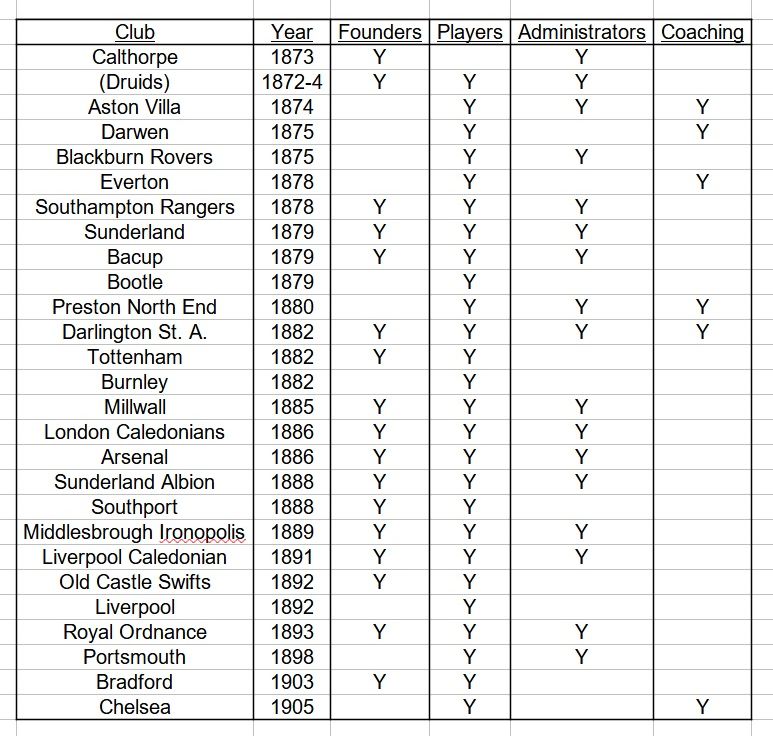
But clubs and teams neither form themselves nor are perpetuated ethereally. They need members and on-field participants, who are prepared, be it for love or money, to pull on the boots each week come rain and shine for as long as their legs and time will allow. The best, or the best-financed clubs will look for the best players but ageing requires not just a one-off assemblage but a flow. And that for the best part of one hundred and fifty years was Scottish football's continuous top-flight gift, corporal, attitudinal and pedagogic; short-hand "Scotch Professorial"; through Lang, Andrews, Hunter, Suter and McIntyre, the literally thousands in between, lauded and unlauded, to the Laws and Mackays, Bakers, Bremners, Gemmills and Dalglishes to the English game, indeed to the whole of global football as we know it.
Scotch Professors I
The Numbers - Limb and Sinew
Outflows of players, both South and even within Scotland, of the scale experienced in the five seasons from 1889 by the two clubs, indeed three plus clubs in the Vale of Leven, because Dumbarton and others were not unaffected, are hardly imaginable today, although some African teams might beg to differ. The numbers speak for themselves, particularly in 1890-91 and 1891-92.

But they can, indeed, should be seen to a degree in terms of the overall totals and in the context of an overall pattern, one, as already pointed to, over the best part of that same century and a half. But concentrating on the period in that flow that here is maintained to have changed the game for good and consolidated it for the better in 1888--89, the first year of the English Football League, with in a sense Renton's all-encompassing successes coming too late in the season, the increase of forty-three in the total numbers of Scots South of the Border was still almost a half of the previous overall total. And, whilst the following year it slowed, the percentage was still well into double figures and the next year it was not too far off a third. Moreover, now, of that third more then a quarter had come just from the two Vale of Leven clubs. And the next season, 1891-2, the picture was starker still. The total number with English clubs hardly rose at all. The increase was perhaps just four. But from Renton and Vale of Leven more than four times that number, seventeen in all, had made the move. In other words thirteen Scots in England from non-specific Scottish clubs had been replaced by equally Scottish players but from specific ones because the English destination- clubs believed that the replacements could offer something the incumbents could not. And it was true. Those whose services were dispensed with knew the old, and previously very serviceable Scottish game, whilst the incomers had the new.
And this was all happening as the Scottish League had commenced, would presumably have wanted to attract these new-best players but clearly could not. In its first two seasons, 1890-1 and 1891-2, not one member of the Renton and Vale of Leven teams seems have gone to a Scottish rival. In fact not only, as the two now League teams were hollowed out over the campaigns and The Vale and equally "local" Cambuslang actually were forced from the top-flight on results, the English clubs simply stuck with or turned to those that remained. In 1892-3 some sixty players, and mostly good ones too, took the shilling, including six, a tenth of the total from Renton alone.

The consequence for the village team would be a slip from a safe sixth to eighth and forced re-election. For "local" Abercorn from Paisley and Clyde it would be the newly-formed Second Division and even for Dumbarton a tumble from top to joint sixth/seventh. And it was at this point, too late for The Vale and in reality also too late for Renton and The Sons, the SFA finally woke up. For the 1893-4 season professionalism was officially sanctioned but at club level all it really did was increase the powers of those from the cities. By the start of the 1894-5 season they numbered eight of ten in the First Division. By 1897 it was nine and in between there had been a lot going on politically with more to come.
As already stated professional football arrived officially in 1885 in England but not in Scotland. And with it had come annual registration. Then in 1888 England's professional Football League kicked off, first with one division and from 1892 a second.

And the effect can be seen immediately. In 1887-88 there were ninety-seven Scots players in England and thirty-four or 35% in the twelve clubs that the following season would be the founders of the League. But of the thirty-four eleven were at Everton, which was skewing the total badly. Taking them out that percentage falls to 24% and the average per club from three to two.
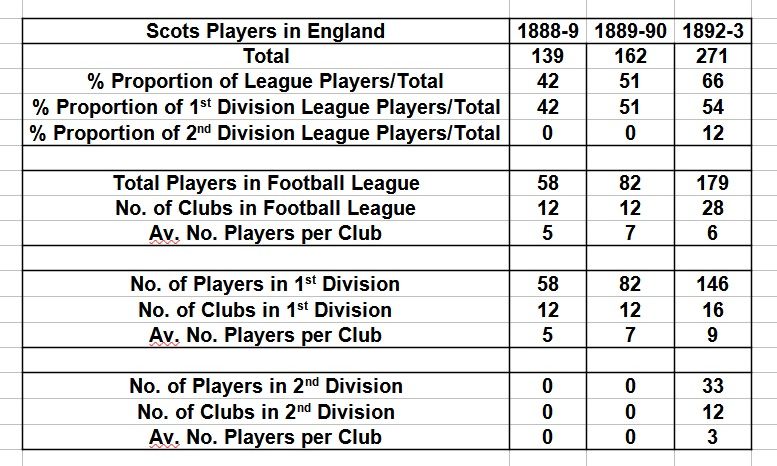
But over the summer and autumn of 1888 the overall total rose by 45 or almost 50% to one hundred and thirty-nine, with fifty-eight or 42% of those in the League, the English Football League itself. And that would rise by the next campaign to 162, 82 and 51% respectively. And even when in 1892 the English Second Division was introduced, with the second tier teams, probably because of financial constraints not hiring Scots in the same proportion, there now were two hundred and seventy-one in the country, one hundred and seventy-nine of them in what had become twenty-eight clubs in the top flights, and the ratio had climbed to 66%. It meant that in those same seasons the average number of Scots players per League squad had increased from 5 in 1888-9 to 7 then seemingly falling back to 6 but actually in the first division by 1892-3 reaching 9, almost a whole team.
And amidst all this there had been the introduction of the Scottish but still amateur League and with frankly little or no effect. In fact change would only come North of the Border as by 1893 Queen's Park resistance was finally overcome with the official sanctioning of direct payment to play. Professionalism, open, non-expenses professionalism in Scotland had arrived.


And the result was almost immediate. For the next two seasons the number of Scottish players that chose to go or to stay South actually for the first time fell. And why not. Now they could stay at home and be rewarded for their talent, perhaps not so well as across the border but more culturally comfortably.
And there were other factors at play. In 1893 Down South the suggestion was made by Derby County of a wage-cap. It was for the moment not agreed to by the other clubs but "Retain and Transfer" was. And R & T was a fundamental change to the player/club contractual relationship, one notably imposed by the clubs and not agreed on, as had also been the case in 1885, through a now impotent, indeed, emasculated, FA. Basically the annual agreement between the partners, player and club, was swept aside and replaced by the same minimum annual contract but with permanent retention. In other words a player could be contracted to play (or not to play) for only one club at a time with its construct of wages, bonuses and perhaps closed season payment as well. So take-home pay depended on whether an individual was in the team or not. Yet if he were not, he could not move without agreement from the club, be it on a "free" or subject to transfer-fee. And, if no-one wanted to pay the transfer-fee, that was it.
However, Scottish players had for the moment a way out. Retain and Transfer was only agreed in England. Scots players could walk out and simply return home. And not a few did just that. But by 1897, noting again that this discussion was no longer a matter for the respective football associations, the Football League and the Scottish League came to an agreement that the latter would respect the former's arrangements. It, the former's arrangements, had already annoyed many top players because they limited their movement and therefore their ability to maximise income. Now it enraged Scots players in particular, almost 300 now employed outwith their homeland, the best of them having just achieved the major breakthrough of playing for their country. The consequence was the formation in both Scotland and England of players' unions. In the latter it was the AFU, the Association Football Union. Its main office-holders were Scots as were many of its most prominent figures and the clubs hated it. In fact they very rapidly suspended the activists, who promptly took their talents elsewhere, some back to Scotland and others into the fortuitously newly-formed Southern League, where there were no similar constraints.
The Southern League had been founded in 1894. It began with a nine-team First Division and a seven-team Second and hardly a Scot in sight; perhaps ten in all and seventeen the following season. But in 1896-7 that had doubled and by 1899, after the first salvo of the AFU, it would double once more. And the influence would be felt. After Millwall Athletic, a team prominent in the "Scots clubs in England" list, had topped the table in the first two seasons Southampton replaced them for three before Portsmouth and Tottenham Hotspur, another on the list, eclipsed it. Portsmouth was captained by Glenbuck's Bob Blyth, uncle of Bill Shankly. Spurs were player-managed, a new concept, by Ayr's John Cameron ex. of Queen's Park and Everton and former Secretary of the AFU. And so strong were these teams that Southampton, with three Scots in its eleven, reached but lost the 1900 FA Cup Final to Bury, incidentally with Johnny Darroch at right back, formerly of Dumbarton, Renton and The Vale. And then the South Coast team was to do it all again in 1902 by when Tottenham, with, including Cameron himself, five Scots in its line-up had in 1901 actually taken the ultimate prize, the only non-League team ever to do so.
And now finally for this exploration in figures and not feelings of the the start of football, the initial four decades of the round-ball and Association-games more generally and the first thirty years of our Scottish version of it, it is back a little to 1896 and North of the Border once more. From the specifically Scottish view-point there were over those three decades perhaps five not just major but very major dates. 1873 had seen the appearance and first demonstration specifically not in Glasgow but the Vale of Leven of the first "Scottish-Game". Then the second had been in 1880-81 with the initial use by Queen's Park, perhaps observing the examples set by Sheffield, Darwen and even, most immediately, Blackburn Rovers, of "assembling" perceived talent from sources other than "local". Down South it had been and was with jobs and Scotsmen to English teams. In Glasgow's Southern Suburbs it was expenses and Scots to Scots. But the principle was basically much the same and in both locations it would lead to full professionalisation, albeit in Scotland it would take a little longer and be accompanied by a deal of Hampden "not me pal". Third had been 1888 with the arrival of a second, a new "Scottish-game" from Renton, so once more specifically not Glasgow but the Vale of Leven, with fourth the creation in 1890-3 of the Scottish League with its initial pretence of amateurism but rapid professionalisation. And the fifth would be 1896 with the beginning of the last throes at club level of "local" teams and at the international level the completion of the same progression to "assembly", to assemblage of Scotland- and England-based players.
In 1891 North Glasgow's Cowlairs had, as a result of this sequence, been the first "local" team to have to drop out. In 1892 Cambuslang and Vale of Leven would follow, then successively Abercorn, Renton, Leith and even Dumbarton into the new Second Division. Only Clyde would rebound. Then out of the League altogether in 1895 it would be once more Cowlairs, in 1897 Dumbarton and in 1898 Renton. And meantime in March 1896 and, given the run of results, notably against England over the previous six seasons but now also against Ireland, not before time, Anglos, Scottish-born Scots playing and therefore living Down South, of whom there were by then approaching three hundred, were finally made eligible for international selection.
So it was that at a stroke what had been since 1882 effectively a "local", almost parochial national-team was, mirroring the club scene, finally opened up, changing in sourcing and also success. The April 1896 encounter with England was won, as was the next. The well-defeated 1895 team, which had had in it nine Glasgow-born or -based players and two Edinburgh ones, for that following, pivotal season retained the Edinburgh brace and the only one from Queen's Park, which in "transfers" could not longer compete financially, but dropped six others from Clyde-side, replacing them with an eclectic "ensemble" drawn from Letham via Alva to Auchinleck. Two players of Leven origin were also included, John Bell of Everton, before he became AFU President and previously capped in 1891, the last Dumbarton player so to be . Gilbert Rankine and James Wilson had been the final ones from The Vale that same year. John Lindsay in goal would be the last Renton one in 1893.
And perhaps it was that double recovery, which prompted a pause and slight reversal of player-flow, at least to the Football League. After a year's hiatus the number plying Down South actually increased by almost forty to in 1898-9 about three hundred. However, the Southern League, where Retain and Transfer was not introduced until 1910, was largely the cause. Whilst the Football League was to peak in 1898-9, Scots numbers in its expanding, expansive and innovative, Southern rival first rose from 33 to 55 and in 1899-1900 itself peaked at 63, with effects on-field previously spotlighted and a certain overall balance achieved.
And then in 1901 it all changed. For the Football League only in came the much-discussed wage-cap and with it a new era, one of player semi-indenture, which would only end in 1953 with a legal judgement that it was exactly what it was, a restraint of trade. But that is another story and one not for here.
___________________________________________________________________________
The "Scotch Professor" II
Penetration
Numbers are fine but always only half the tale. The other half is impact. Already it has been stated that the total number of Scots in the squads of the teams that made up the 1892-3 English Football League First Division averaged out at nine rounded down, ten rounded up. Of course, some teams had more than others but two things. First a Scot would be a unlikely to be hired unless he was seen as a first eleven player and nine in a first team pool of perhaps fourteen is an astounding level of penetration that is clearer still when, as just below, 'Scots per English Top-Flight Club' is looked at. Note the slow start, then the differential between the top- and bottom-halves of the Football League over the first dozen years of its existence and the couple of years of exception, which might be put down to the necessity of rebuilding. Notwithstanding, whilst Scots at the club obviously didn't guarantee top- half it can surely be recognised to have gone some way towards it.
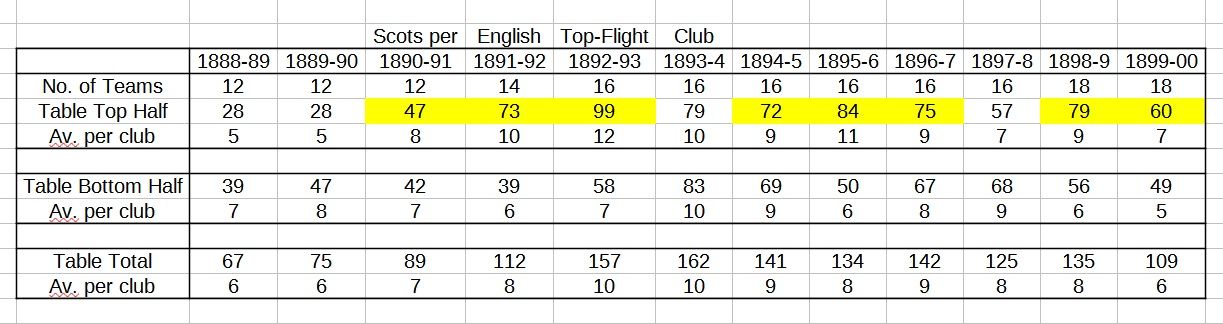
There is even an argument that the Football League First Division in England should on sheer numbers, notably between 1891 and 1896, be seen as a second Scottish League First Division. It might even be posited that since at that time Scottish club sides were still at "World Championship" level beating English clubs with Scots in them the English First Division was effectively a Scottish Second Division and the Scottish Second Division that would be introduced the following season would be the third tier.
But, second, whilst arguments over tiering might be interesting they are in reality purely academic and therefore fatuous. In fact what is more interesting in delving deeper into "penetration" is the insight it gives into English football immediately below the top-flight. On the creation of its Football League the alternative Football Alliance would emerge with in its single year of existence Scottish penetration a quarter that of its erstwhile rival but actual superior. And this difference of ratio, although it narrowed, continued as the Alliance morphed into the Football League Second Division. In simple terms the Alliance cum Football League's Second Division was half as "Scotch" as its First Division.
And when the Southern League came into existence the pattern would be similar. Scottish penetration of its First Division was between 50% and 60% of the Football League's First Division. In fact it would become a little bit more but roughly the same as the Football League's Second Division. But where there was difference was between the Southern League's First Division and its Second.
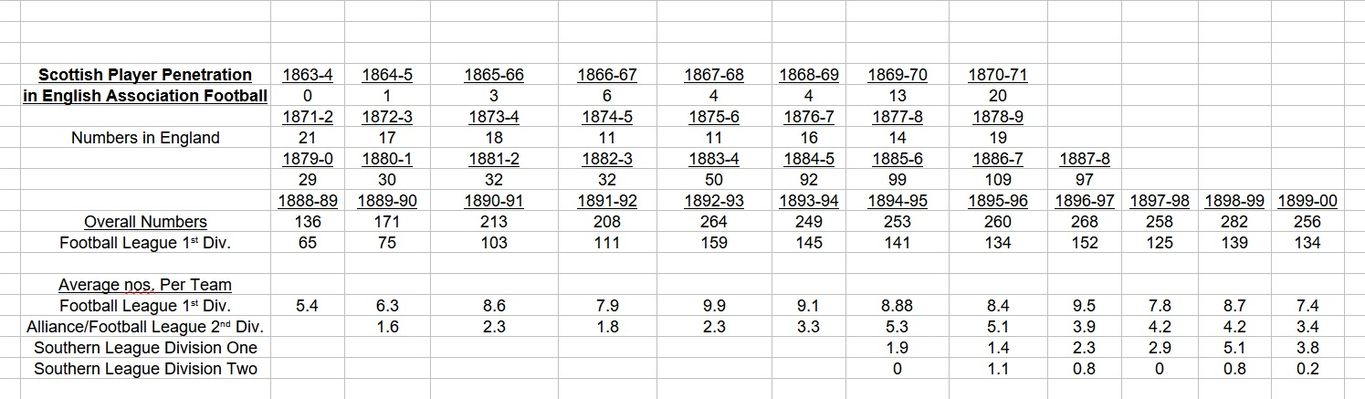
There, after the Scots Guards, yes the Scots Guards in English League football, came in in 1895 but dropped out in 1897, presumably because they were posted elsewhere, the ratio dropped to negligable and it effectively meant that three Association football styles were pursued. In the top-flight the Scottish game was played. In the next one down quasi-Scottish and in the third down English.
___________________________________________________________________________
The "Scotch Professor" III
Quality - Thinking and Tactics
Within the SFHG there is much argument about what constitutes a "Scotch Professor". At one end of the spectrum is anyone who came down to kick a ball no matter their age and therefore their maturity and experience. At the other is that a professor is someone with those same attributes at their core and not just a technician showing a degree of talent. In part the latter argument is promoted by the observation that many Scots footballer made the move South at or around the age of maturity, then twenty-one, so not when they might have naturally but were legally able to. Of course the argument cuts both ways. It may have been that the passing of the age of maturity released them before they were really ready, the move should have been later, but with the alternative that it held them back with their talent meaning they could and should have gone earlier.
And this dichotomy prompted a look at the situation not from the point-of-view of the players but of the clubs and what they were prepared to pay for. And the answers, with players identified in as many cases as possible and ages also established and grouped, seem to be varied.
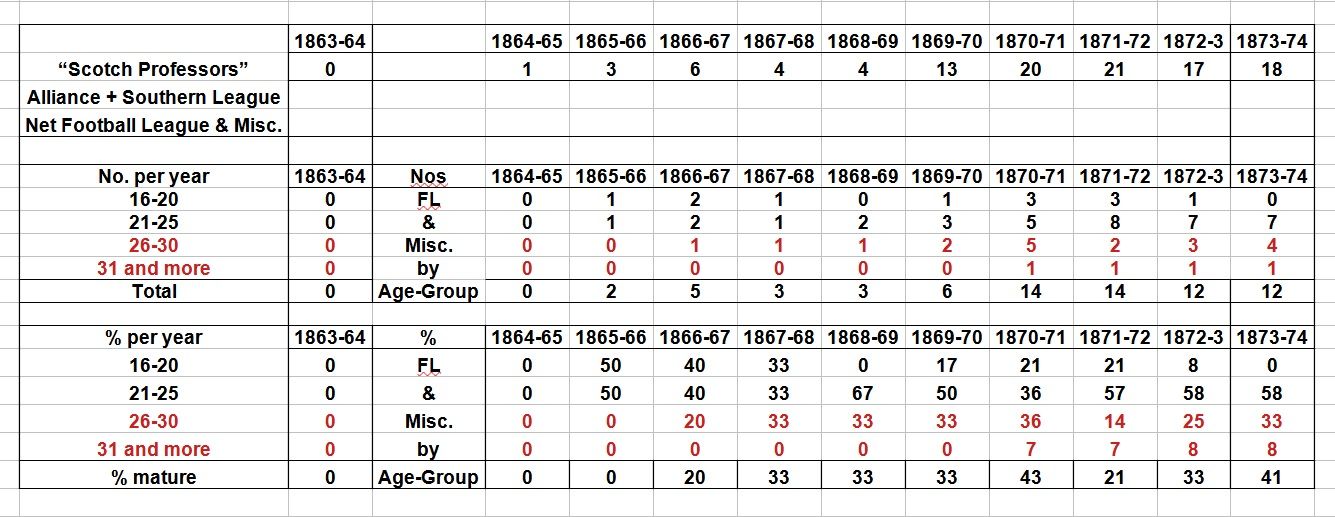
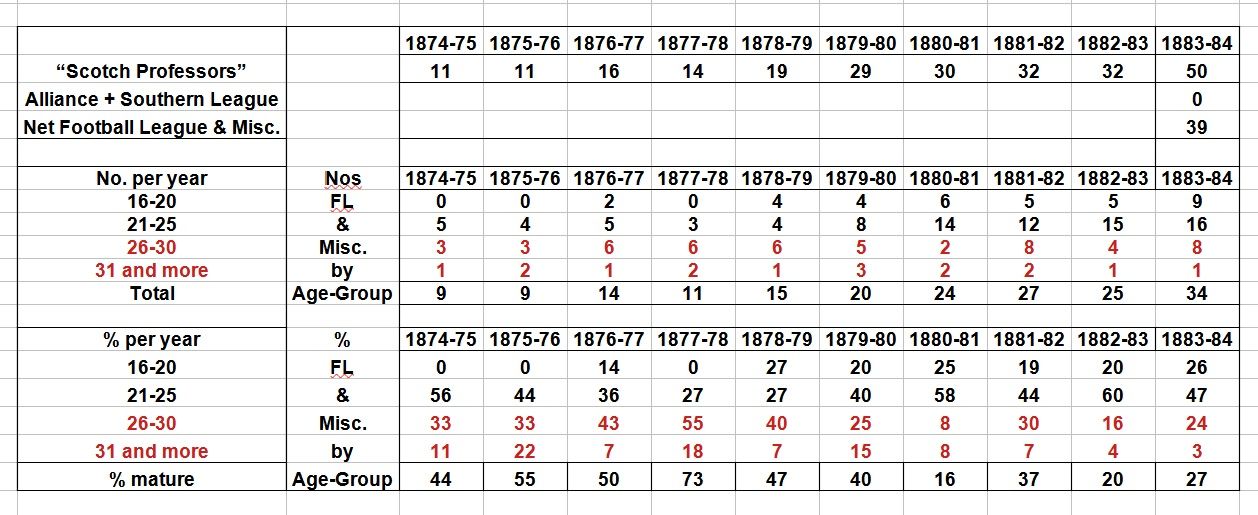
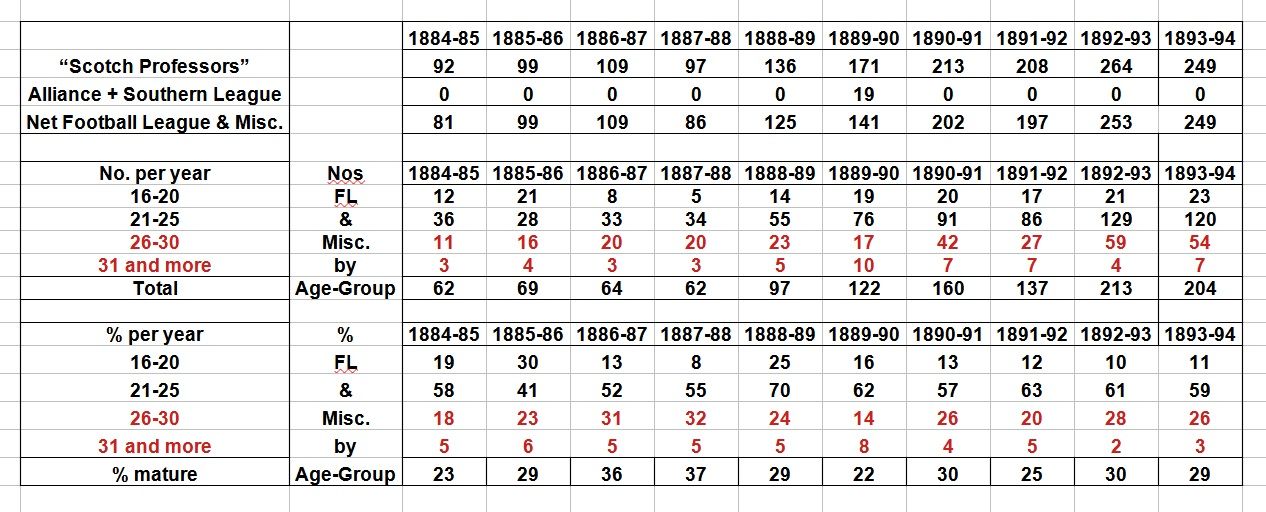
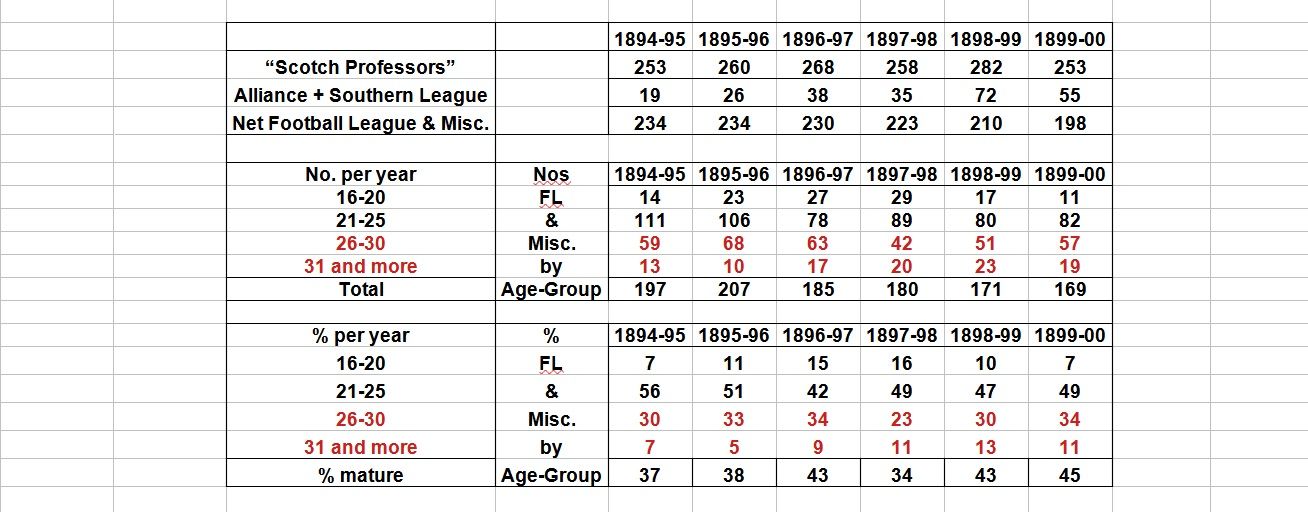
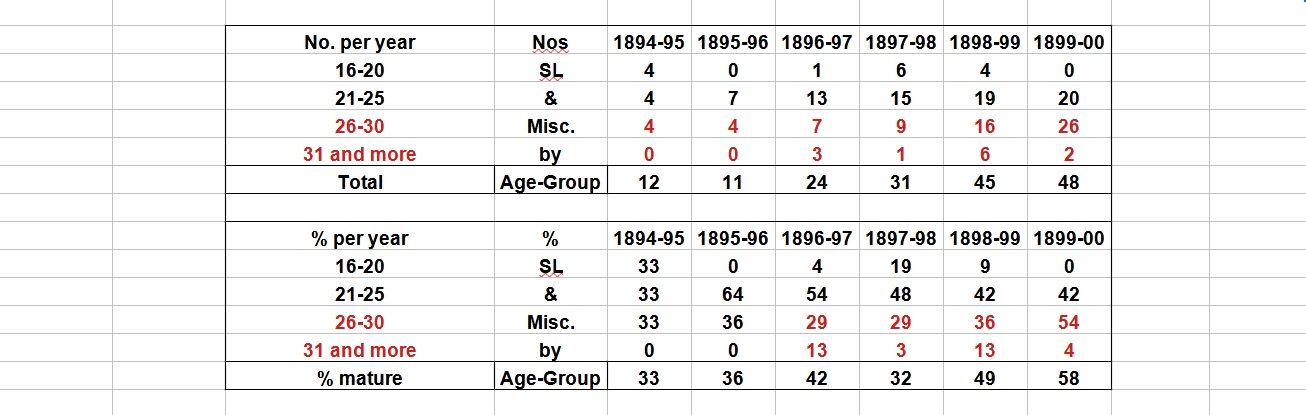
In the early days with the numbers small and the game new the participants are young but can be seen to age. That is until the movement of Scots into North-East England and some Midland clubs began and the age profiles tumbled, suggesting bodies over necessary ability, then matured once more only to drop again not with the coming of official professionalism but the English Football League and the somewhat manic pillaging of not so much the Scottish game but specifically the Vale. However, players will always age and the class of post-1888 would no different. It would lead to rises noticeably in 1896-7 and again in 1898-9 in the employment/retention of the over-thirties and recruitment/retention of those in or around what today in terms of technique, experience and fitness would be considered their prime. By the end of the century that group had for the first time passed the 50% mark with indications, with more work to come, that it would continue into the new one. Watch this space.
___________________________________________________________________________
The "Scotch Professor" IV
Impact
But for all the numbers of Scots players plying their trade in English football what really matters is whether they, and the Scottish managers (marked M), who also began to be involved, had an impact on the performances of the clubs that had hired them and on the major English trophies. And the analysis (see the table below) produces results of clarity, albeit that they appear to differ between the FA Cup and eventully the Football League. In terms of the knock-out former, whilst having Scots in the team does seem to have helped to get to the latter stages, it, either numerically by game or in terms of player inclusion cum concentration and as shown by the the intensity of the blue colour-coding, by no means guaranteed victory in the final. However, with regard to the latter and the long grind it is quite clear that for the first eight seasons a majority Scots squad was quite simply, and without a Scots manager, almost a necessity.
But what it also points to is that after that, specifically with the influence at Aston Villa of George Ramsay, a learning process may have not just taken place but embedded. Villa played a style of football that was largely Scottish in origin but with English players. Indeed all three elements - inclusion, management and learning - are perhaps best be illustrated by the addition to the table of the Tottenham Hotspur result in the 1901 FA Cup Final. Firstly the Spurs team played the Scottish way. In it were five Scots. Second the manager, innovatively the player-manager, was Ayr's John Cameron, who, thirdly, was known for his coaching of non-Scottish players to play the Scottish way. Perhaps the best example in the eleven that was day was the Welshman Ted Hughes at centre-half. Another example would be Herbert Chapman, one of several later brought by Cameron into the team as his own replacement at ball-fetching inside-forward. In fact it would be a tactical ploy that Chapman would re-use throughout his own managerial career, notably at Arsenal with first Dalkeith's Billy Blyth and then Bellshill's Alex James.
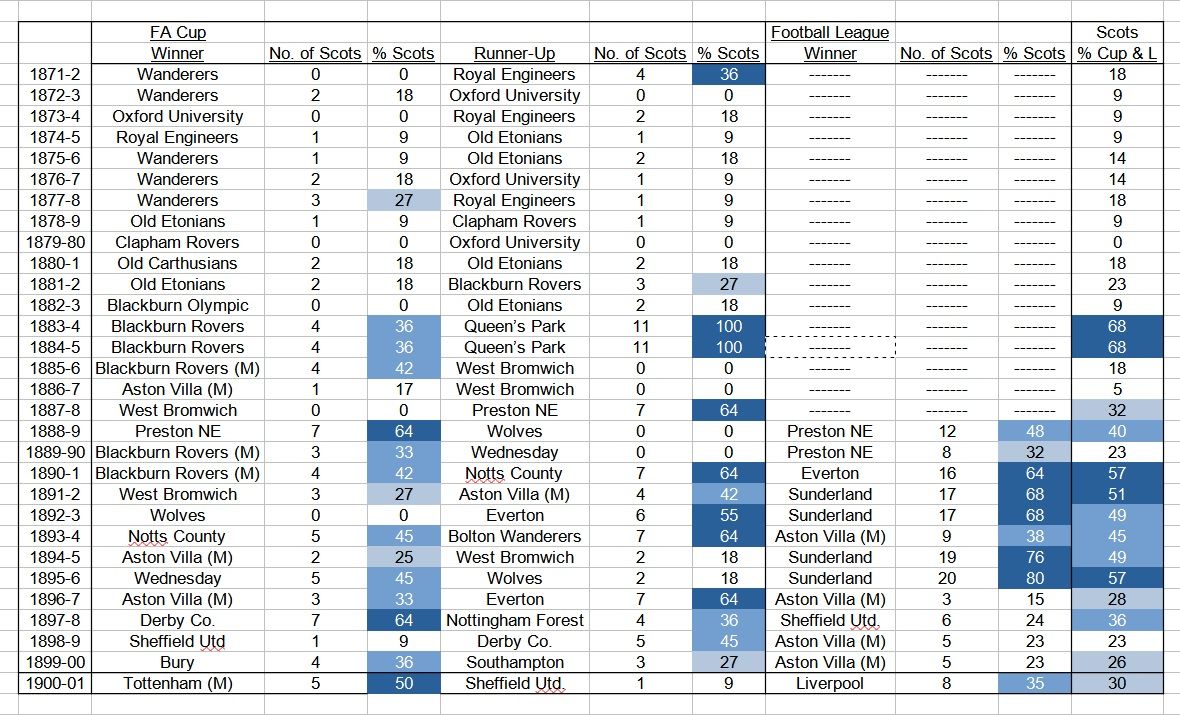
And more evidence still is offered by examination of the series of what have been called "World Championships", individual games that took place between Scottish and English club teams in the years from 1876 and 1904 with the addition of the first ever cross-border game in 1872. Here analysis is possible both in terms of Goal-Difference and Points, with slightly differing results. The former produces a surplus of twenty-two, on the face of it perhaps half-a-dozen games, in Scotland's favour but the latter only three points, or a dismissable single game, and again between "Championships" actually won there was over the whole piece little more than a cigarette-paper between beween the nations. (Twelve to Scotland, ten to England, the former doing best early-on, the latter later).
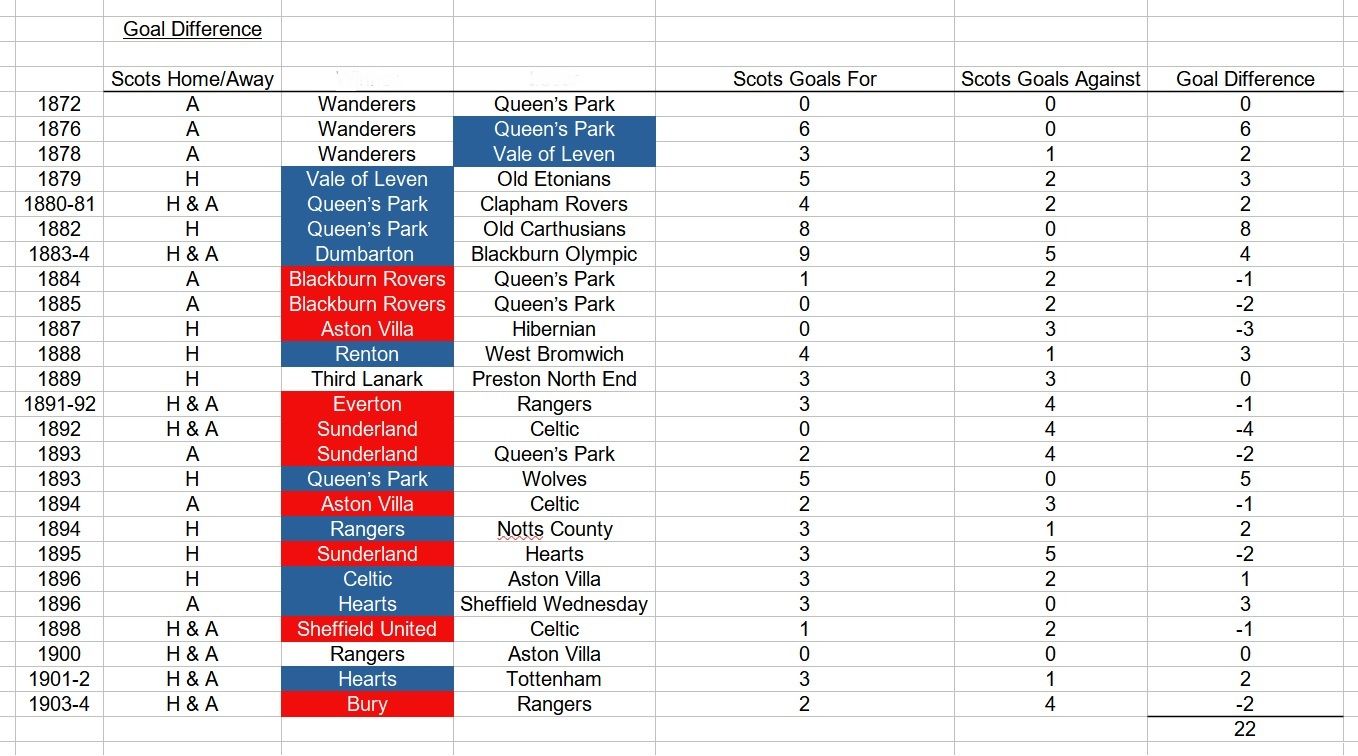
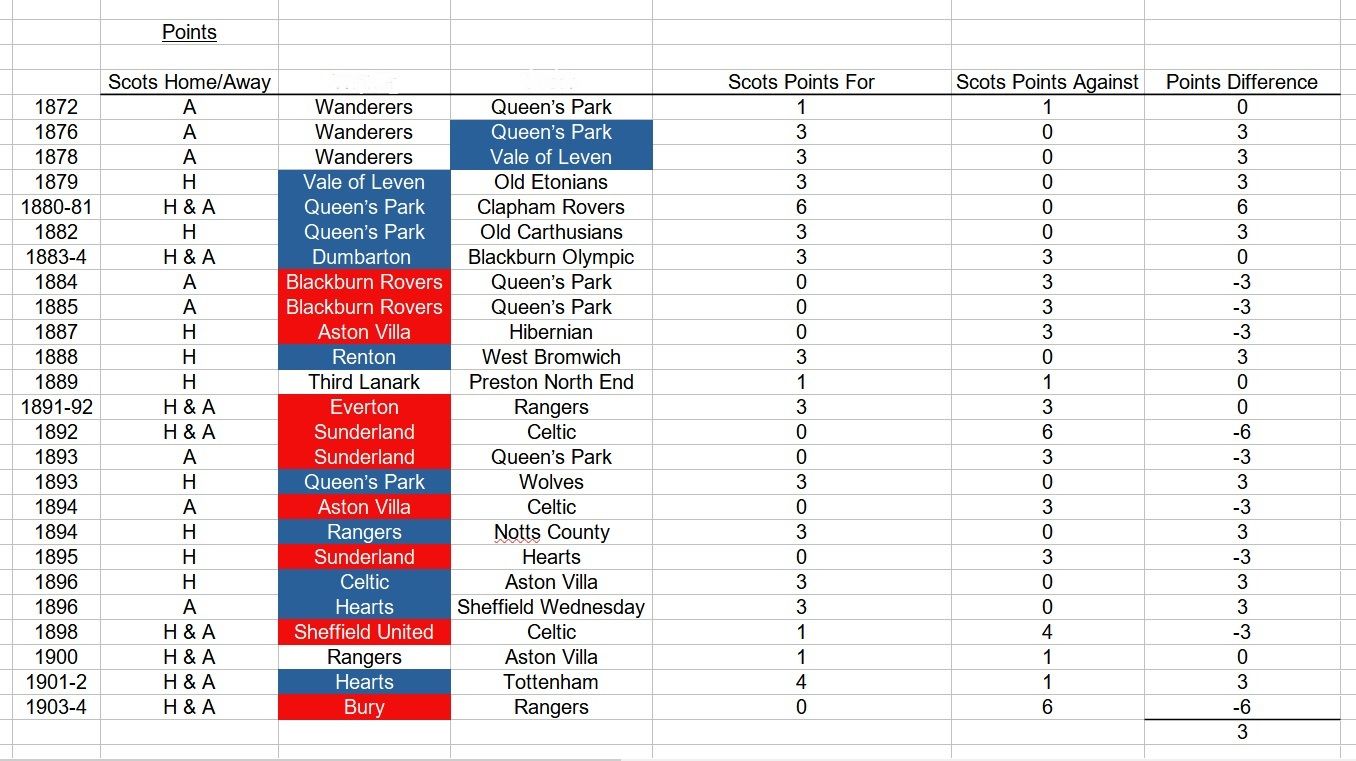
But once more, as is precisely the case with the recently suggested and compiled ELO similarly inter-club assessment from 1865 to 1887 (See below and with the first ten years of which there is no quibble, only the observation that it was not Assocaition Football), there is as with the above a serious analytical flaw. That is in addition to a completely obvious aberration. In 1880 ELO has the best team in Britain and therefore the World as Clapham Rovers. Yet that very year Clapham would be beaten by Queen's Park not once but twice, 3-2 in Glasgow, 1-0 in London.
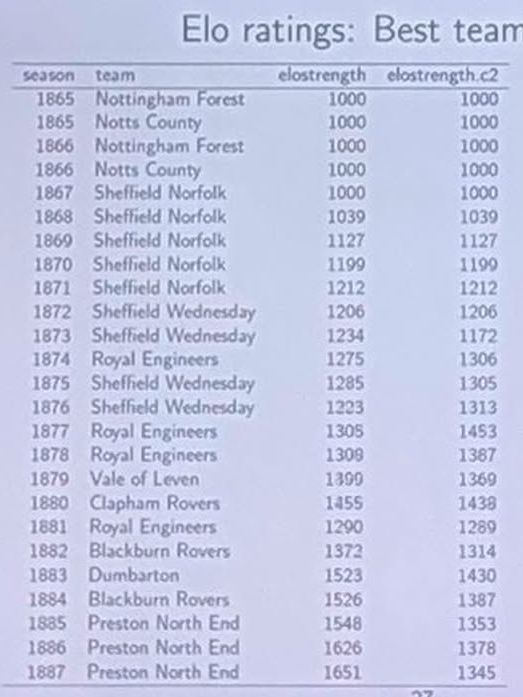
And that flaw is that no account is taken of who was playing for the teams in question, specifically the number of Scots. Include and weight by them and the pictures are transformed. (See below). Now the notional goal-difference nearly doubles and the points-surplus is increased by a multiple of almost seven. Moreover, the number of winning-teams now with at least a Scots-majority on-field becomes not twelve but sixteen with now just six being won by English equivalents.
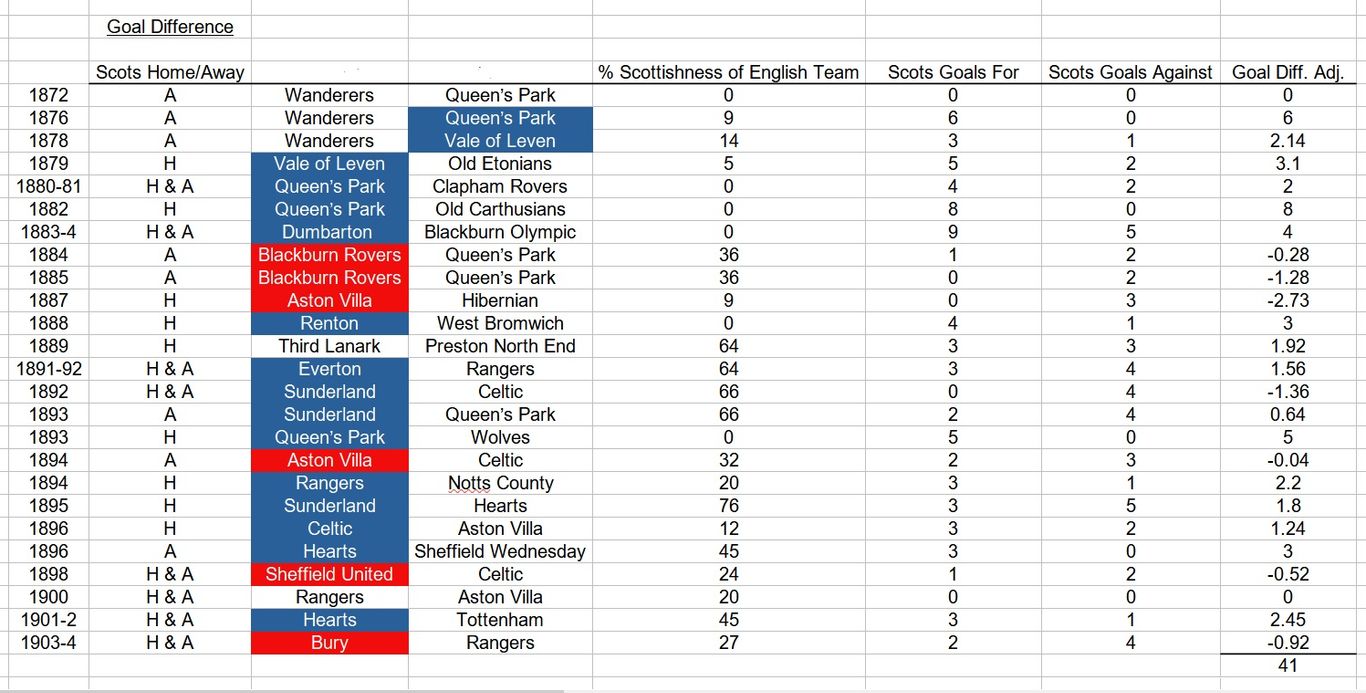
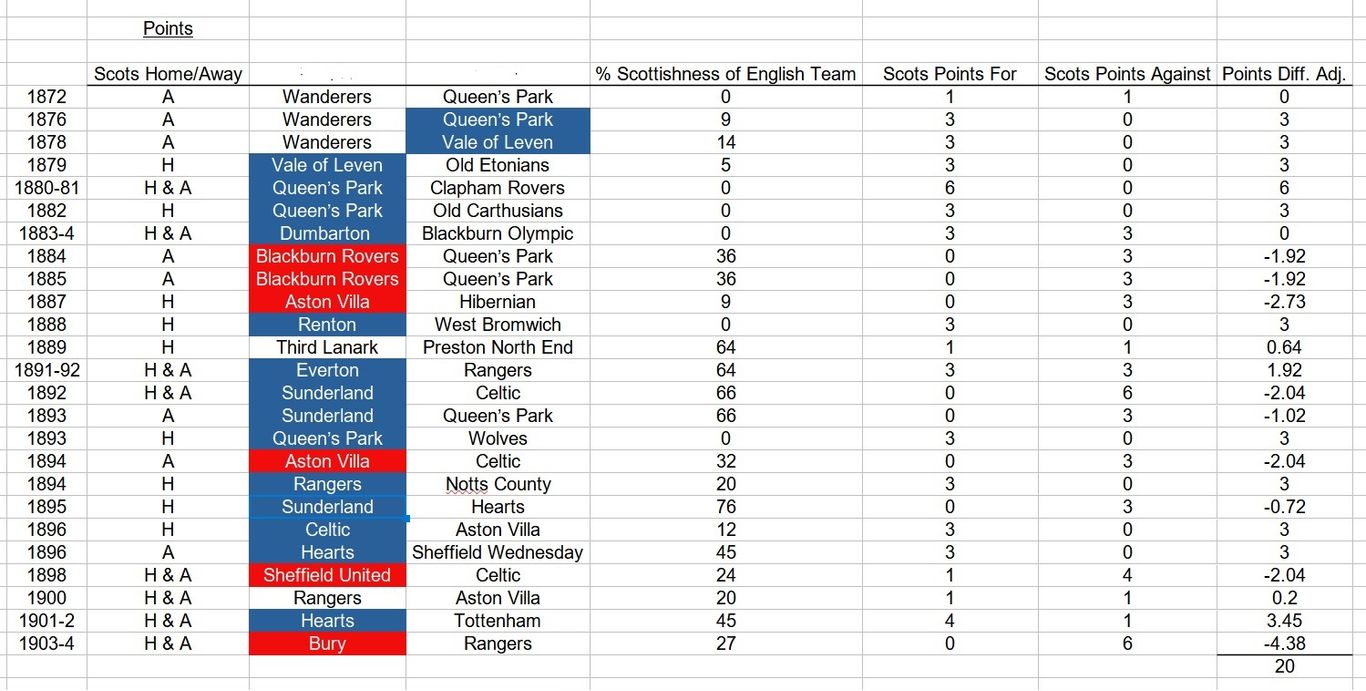
___________________________________________________________________________
Scottish Football into The World
But , of course, Scottish football outwith its home country, here called "Scots Football" would not be confined to and dominate in England alone. In fact, far from it. And there is a whole blog, compiled over the decade from 2016 by Iain Campbell Whittle, which chronicles the spread of the game globally, where home and Diasporan Scots or Scots football thinking was on each occasion the pivot. It's index is to be found on:
The list of countries, where implantation and generation took place extends to fifty and includes all the earliest footballing nations with one exception, France, although even then there is an argument for later re-implantation through Eastern European proxy. Each country has its own story but as good example of any is that of Brazil. And that is because it includes both the game itself and then emphasis not just on playing on-field and how that should be - style - but on how it should still on-field be officiated and off-field organised and administered. It even extends to ethics with the transference not in the form of an elite-only sport but in the Scottish Game one for all, indeed specifically working-class, and also not dependent on religion or race. The Irish-Catholic contribution to the game within Scotland was almost from arrival huge, and even today under-stated annd under-lauded. The way, in which football, particularly in South America, was under Scots influence to include native, mixed-race and Black players is exemplary. And remember the first known Black footballers in the World have both been pin-pointed to Scotland; the first recognised Black player and also the first Black Internationalist were both Scots.
So with all the above in mind and as an example there is below is reproduction of an article written for the The Scottish Field magazine but unused.
"Now there are few tales closer to my heart, one that has taken me a decade to pull back the sepals to the bud, than the taking of football to Brazil, particularly with Scotland once more in the World Cup and playing that country again, this time on 24th June and in Miami. When my Grandparents left Grangemouth in 1920 initially for Nova Lima, never to return except on leave, they did so because of no work in the home-land, so looming poverty, a gassing in The Great War for John and almost fatal tuberculosis for Janet. And across the ocean, especially in Ipanema in Rio de Janeiro, they found a good living, a benign climate, the warmth of a small but active Scottish community, with football enjoyed at Botafogo, and a more sedate passion for bowls. Cups won by both of them are still in the trophy room at Leblon’s Paissandu Club.
So by 1925 organised football was well-established but run although, because Brazil is a vast country, still at State level having arrived almost exactly thirty years earlier. And here merge myth, some misrepresentation and meme. The convention was that in the Brazilian Spring of 1894 Charles Miller, at just about twenty returned from a decade of private school in Southampton, bringing with him football equipment, Rules with about him three notable observations. For many years Miller was described as Anglo-Brazilian. He wasn’t. He was Scottish-Brazilian. His mother was from the British-Brazilian community in Sao Paulo, then a town of 130,000, now a city of twenty-six million or more. She was a Fox and probably with an Irish background. His father, John, was a railway-worker, the son of a labourer, later dock-porter, like my great-great grandfathers, so dirt-poor, his birth registered in Irvine, living in Fairlie by Largs and later in Greenock. There John worked as a clerk in a boatyard before finding his way to South America, probably with two of his brothers, and later setting themselves up as merchants. He would make essentially the same journey as my grandfather.
In Sao Paulo the Miller brothers were involved in 1888 in the foundation of SPAC, the Sao Paulo Athletic Club; it initially concentrating on cricket. Charles Miller was just fourteen at the time but it is noticeable he had been sent to football- and not rugby playing Bannister school, as per the Scots passion for the round ball game, and that he proved very good at it, also playing outwith Bannister and at a high level.
Now here comes more misrepresentation. Even before he had arrived back in Brazil and well before the first organised 11-a-side game in the country on 14th April 1895 football equipment had already reached the country and brought by a women. In the late summer of 1894 the former Elizabeth Montague had docked at the port of Rio to visit her husband, Tom Donohoe. He was a textile dyer setting up a mill in Bangu, then outwith the city, now a suburb. And whilst Tommy with the help of other mill-workers had cleared a small ground and erected goals, she came from home with a ball and his boots.
Donohoe had been born and grew up in the Renfrewshire village of Busby, the son of Irish immigrants. He had in his twenties been a prominent player with local Cartvale team, which had produced two Scottish internationalists, Robert Calderwood and Mick Dunbar, plus Celtic’s and Rangers’ Tom Dunbar. And it seems likely that with Elizabeth’s arrival probably six-a-side games were in place.
So it was that in 1894 in Bangu football was being played and in Sao Paulo in 1895 there was the 11-a-side game but not yet a football recognisable football club. In the former case it was due to the mill-management not sanctioning it. In the latter it seems to have been not until there was opposition, specifically in 1902, with the formation of the Sao Paulo Championship. And in the meantime there had been more developments and this time up-country.
By 1890 Tom Scott, another railway engineer, had taken himself again to Brazil for work. He had been born in Townhead in Glasgow in 1865, had a family in the city, which by 1897 had moved to the railway-town of Campinas in the middle of Sao Paulo State. And it was there, in the suburb of Ponte Preta that in 1900 he was instrumental in the foundation of a football-club of the same name. It, Ponte Preta Athletic Association, is still there. In fact it remains Brazil’s oldest, existing club, the equivalent of our Queen’s Park. But it is also renown for one other first. In its first teams was Miguel do Carmo. And whereas SPAC would be a wholly White team, Rio’s Fluminense militantly so, equally militantly multi-racial, Bangu A.C. would not exist until 1904, Donohoe, now forty-one, finally given the go-ahead, with there the Proctors from Dundee also in place, Thornliebank’s John Stark the team-captain, Campinas’s do Carmo became the country’ first, recognised Black player; one who would go on also to be its first Black administrator.
So by1904 there had been the arrival in Brazil, all through Scots, of the first football, the playing of the first and then the first eleven-a-side football games, the laying at SPAC of the first full-size pitch in 1898, the creation of the first club and the first multi-racial club and the playing of both White and Black players. And it was at this point doors somewhat opened.
In the 1905 wealthy club Paulistano had won the Sao Paulo Championship but slipped back in 1906. And to regain position it put out feelers for a British coach. Jock Hamilton, journeyman centre-half, Scottish pivot as a player and now Assistant Trainer at Fulham, was recommended and in April 1907 set sail for four months. And he clearly had effect. In 1908 Paulistano was once more top of the league but perhaps more important still was his influence of refereeing. He took change of a large number of games, embedding the standards that were expected in Britain.
And in the meantime there was a further Scots input, one which would define the Brazilian style of play for two generations. Also in the summer of 1905 the Paisley cotton-thread company, Coates, founded its factory in the Sao Paulo suburb of Ipiranga. Known even today as “the factory of the English” it, of course, wasn’t and isn’t. It was Scots and, as was the way, a number were sent out to set-up. Amongst them was a fitter and semi-professional footballer from Paisley, Archie MacLean, who first arrived in 1907 for two months, did some work, played a few games for local team, Germania, one against Charles Miller’s SPAC with Jock Hamilton the referee, and returned home.
But he had clearly been impressed. In 1912 he was back, bringing his family with him, staying forty years, and this time he went straight into the SPAC team before setting out on his own with in 1913 the formation of Scottish Wanderers. “The Wanderers” were in the three years of their existence before being forced out for “professionalism” never the strongest but they were known for the way they played, with again the Scottish pivot and a short-passing style, known as “A Tablinha”, which, as elsewhere, proved very effective on dry grounds. MacLean himself, and Bill Hopkins from Portsmouth, a town with a team also founded by Scots, formed a very effective right-wing partnership, one which saw them selected for Sao Paolo’s State team, might have seen them play for Brazil, had they been Brazilian-born, and would set the template far more widely in the country for its style. Or simply put – set the seal for no Scots, no unique Brazilian football."
The "Terassing-Teaser" Answer and Golden Eras
Between 1876, by when Scottish football had established that it was different, and 1900 by when it had been proven better eighteen effective "World Championships" were played between Scottish and English clubs. And using the three points for a win, one a draw and none for a defeat, Scotland's winning ratio was 52%. But then from 1885 it included games, in which up to the whole "English" opposition was Scots players too. To 1884 the same ratio was 87.5%. So the answer to the Terracing Teaser is neither of them.
However, in the international arena against England Scotland has enjoyed an era of fully-burnished Gold, one simply Golden and three gilded ones, i.e. golden eras without product in the way of major trophies or events. The most recent was 1960 to 1965, when, before his team was decimated by injuries and the death of John White, Iain McColl's ratio, after just 17% in the 1950s, was 67%. So there you have one of the TT answers; indeed you have three. The period just before the Second War from 1935 to 1939 with, amongst others, Bill Shankly in the team is another with the same ratio as are also the years from 1921 and recovery from The Great War to 1926, leading to The Wembley Wizards.
So what remains? There is the period of rebuild from the inclusion, finally, of Anglos in 1896 to 1903 and the move to the third Hampden; the years of Cowan and Raisbeck. But that was just 58%. Which leaves that from 1874 and the inception of competitive Association football North of the Border to 1887 and the serious stutter then over professionalism; the first decade and bit. It is there the 76% is to be found.
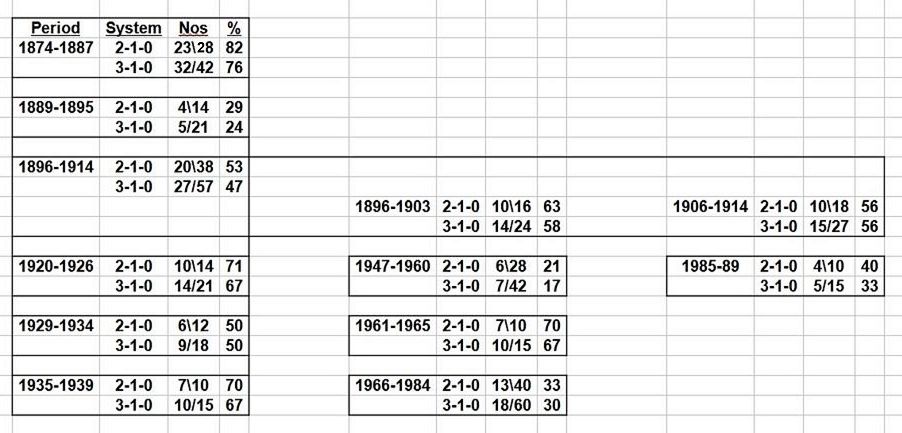
And by comparison for Steve Clark in taking Scotland to the 2026 World Cup it has been 54% and for the Spanish at the 2010 South African World Cup, perhaps the greatest team of the modern era, it was an astonishing but deserved 89%. But for context that was over just four years rather than Scotland's fourteen, albeit that Scotland's record over the equally four seasons from 1880 to 1883, indeed, over the five seasons to 1884, was 100% and with another, modern alternative comparison also available. For the French teams that took that country to two World Cup Finals in 2018 and 2022, winning one and losing the second, it was 78% for the first four year cycle, 71% for the second and 75% for the combined eight years. Or put otherwise one hundred and forty years apart yesteryear's Scotland was just now France plus and we should, retrospectively but legitimately, in the words of Alex Ferguson, or is it Jonathan Watson, "Be pwoud, be vewy, vewy pwound".
___________________________________________________________________________