Renton, The Vale and The Scottish-Game
Episode 3 - Our Scots 'First Eleven'
(with massive thanks to the incredible London Hearts Supporters Club archive)
On 13th December 1873 Queen's Park F.C. played a just third match ever at home at the First Hampden Park, the same Hampden that is just now under threat from rapacious philistinism. The Spiders won 2-0. It was in the initial Scottish Cup and could be seen as the first of the Scottish Game, the distinctive Scots Game. But it probably wasn't. And that was because this was third round and both teams had won at least twice already, very possibly employing the same formations as each used that day. And nor was it Queen's Park, as convention has been claimed for the last one hundred and fifty years, that tactically led the way. It was opponents Renton, a grouping of eleven, very ordinary, working men living within just a few hundred yards of each other in a Dunbartonshire village, who without them knowing were changing the World forever. And that was because they were taking the first steps, they were inventing not Association football itself but beginning the evolution of what has become the global phenomenon the Game is today.
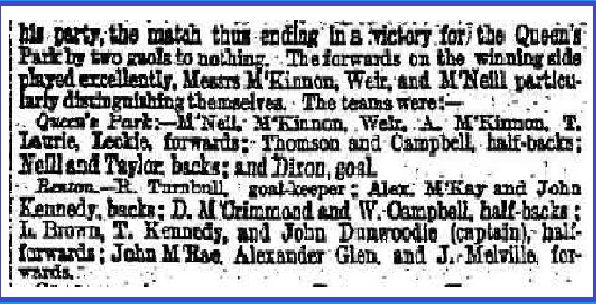
And the source of this claim is none other than The Scotsman newspaper. Its report of the match has Queen's Park taking the field as two full-backs, two half-backs and six forwards, a 2-2-6. It was the system that the previous season Vale of Leven, aka "The Vale", Renton's neighbours from just up the road, had made its own and preserved. This when Queen's Park after the Scotland-England international of November 1872 had reverted to playing the English, the failing English 1-2-7 or 2-1-7, but now seen the error of its ways.
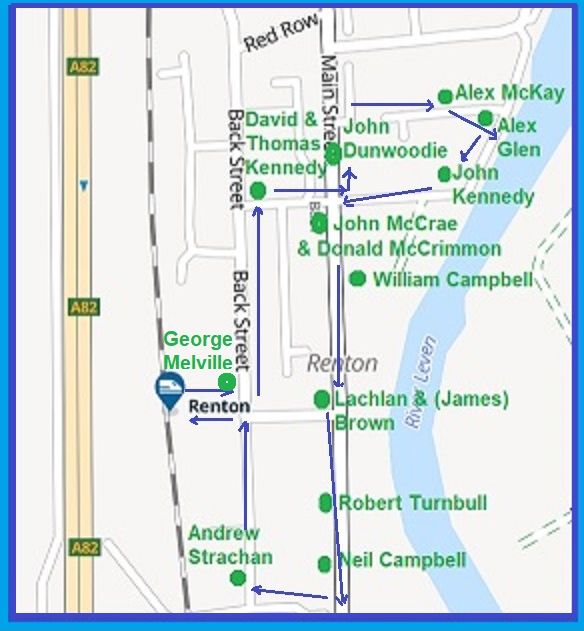
However, the paper also describes Renton, having not just followed The Vale's 2-2-6 example, but actually going further. It has set its attack as two rows of three, a 2-2-3-3, something also drawn from shinty and which it may have done for some two months already. It is just we do not have the confirmation. But the fact is that from December 1873 we do, in black and white. And there is more. The Scotsman would even name the eleven, who filled the positions, both old and new, including the captain on the day; a skipper and players who might be considered, after Robert Gardiner, the game's second, if utterly unknowing, wave of genius. After all, they were very probably doing not what they planned but what they already knew from whatever source, be it sporting or cultural
So who do we think they were and what became of them with passable answers to both question proving relatively easy to those who know how and where to look? In goal R. Turnbull, Robert Turnbull, was a Block Printer, aged at the time twenty-three or twenty-four and living on Renton's Main St. at number fifty-seven. He was Renton-born too, as was his mother but his father had come from Dunipace, fitba' country. He would marry a Kinloch (see Alex Wylie below) and his maternal grandmother was a Glen (See below also). And he would live to eight-two and die in 1930, still locally in Dumbarton. Then at full-back there were two presumably robustly powerful men, Alex McKay and John Kennedy, the former a Blacksmith, the latter then a Quarry Labourer. McKay was twenty-three or twenty -four. He had been born in Renton or possibly the village of Buchlyvie in Stirlingshire, so fitba' country once more, and again probably die in Dumbarton, in his case at eighty-six. But in the meantime he had married, would raise family in Renton and in 1881 would be living midst the Kellys and Kelsos, Lindsays and Bradys at 16, Thimble St., quite possibly the most important wee road in football history. And as to John Kennedy he was twenty-two or twenty-three, stayed just around the corner at 19, Burns St., was definitely Renton-born, would marry in the village and at some point after 1881 probably emigrate to Canada. His youngest daughter, Jessie, would in 1911 marry in Cobalt in up-country Ontario, her father now recorded as an engineer.
Then at half-back, in the engine-room, would be two men, who clearly also played shinty. They would both feature in the local teams that seven years later would take and then almost take the games' foremost regional trophy. The first, William Campbell, a Block Printer, had been born Bonhill in about 1850, so was twenty-two or twenty-three. But in the interim he had grown up in Renton at 129, Main St., his mother's home village, his father, a tailor, born in Argyll, so shinty country. And it appears he was the elder brother of George Campbell, a half- or a full-back too, who between 1888 and 1890 was to play, also for Renton, before three seasons with Aston Villa, two more as captain of Dundee, retirement in 1895 and an early death of heart failure in Dysart in 1898. The second was Donald McCrimmon, in 1871 a labourer in the dye-works, and living at 54, Main St. And his parents were both Highlanders. His father, a tailor once more, had been born in Klimarie on Skye, as was Donald, possibly in Stein, and his mother was a McCrae, from just across the water in Kintail. They were almost certainly Gaelic-speakers and steeped in shinty, with him, indeed both men, quite naturally transferring the skills, the passing and the combination, of what for both was a first not a second sport.
So to the half-forwards, novel to football at least and in shinty the link between defence and attack. On the right of the three was L. Brown, Lachlan Brown, a young, 17 or 18 year-old Yarn Works Labourer and also a shinty boy. He stayed at 103, Main St., the son of a Mclean mother born on Argyle's Cowal Peninsular and a father born in Kilmodan, slightly more west still. Marrying still on the Cowal before moving first to Old Kilpatrick and then Cardross, where Lachlan would be born, they too were steeped in the ancient game, as would be their children. But Lachlan, it seems would move on, perhaps on reaching twenty-one in 1876. And he would go South. He married in West Ham in London to Scots girl originally from Govan, in 1911 they were living in East Ham with three children. They later moved to Ilford and Romford, and it was in the latter that Lachlan would die in 1927. Then in the middle we have T., Thomas, Kennedy, his elder brother, David, also a Renton player that same season. David was a Block Printer once more and age 27 or 28. Tom, another tailor, was 23 or 24. Both had been born in Thornliebank, their father from Ayrshire and their mother from Neilston but had moved to Renton, living on the junction of King St. and Back St.. But by 1881 Thomas, having already in 1875 in Renton married Janet Thomson had moved, first with their young family to Alexandria, then more permanently to Glasgow. She would die there but he, curiously perhaps, passed away in 1915 on a trip to Australia. And finally on the left was John Dunwoodie, young at 17 or 18 but as captain presumably considered the best player or perhaps a driving-force in the club's foundation. He was a joiner, staying at 171, Main St.. And his background was that he had been born in nearby Kilmaronock in 1855, but of Irish parents so little shinty likely in the family. And even in Renton he would not stay long, seemingly soon also emigrating and again to Australia, where in Queensland in 1890 he had married a girl originally from Aberdeen but in 1897 died, aged just forty-three, to be buried, it seems, on Fife Island off the state's northern coast. It was quite a journey in such a short life.
And finally to the three forwards that led the new-style Renton attack - John Rae, Alexander Glen and George Melville. Starting on and with the left-wing Melville seems to have been the uncle of James McCall, a noted left-winger himself, indeed a future international, the youngest of the three McCall half-brothers who were to have so much to do with the success of the Renton team of a decade and half later. Whereas George and Archie McCall's mother was a Leishman, she had died in 1862 and her husband, George Snr. had remarried George Melville's sister. He himself had been born in Renton in 1846, their father from the village and their mother a Glaswegian McDonald, so in 1873 was already 25 or 26 , married and living just off Back St. But from the 1870s, a ship's carpenter to trade, he was also on the move. By 1881 he was living in Dumbarton, was there still in 1891 but be back in Renton in 1901, living now on Burns St.. Yet he might very well have died in England. There is no record of his death in Scotland and his wife, Mary McLeish Mckechnie, a name also to note, seems to have passed away there, in Leicester, in 1939.
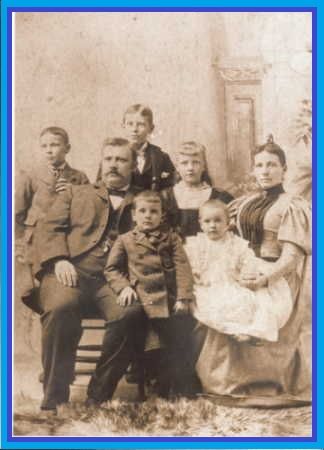
Then to the right. There there was a youngster, John McRae. He in 1873 was just seventeen, an Apprentice Pattern Drawer and staying with his widowed mother at 155, Main St. She had been born in Northern Ireland but had been in the village for some time, She and John's father had married there in 1848, he, originally from Glasgow, a Clerk in the Calico Print Works, who had died in 1871. John himself would marry in 1879 and in Alexandria, his wife Mary Taylor from the town, but around 1885 the couple, with by then two young boys, would emigrate to the USA. There they would settle in New York in Richmond, what is now Staten Island, where he continued his trade, first working as a Designer and later the owner of a Print Cutting Shop.
The house, where they lived on Warren St. in Clifton is no longer there but similar clap-board houses on either side are. There is even this photo of the family taken in about 1893. And it would be still on Staten Island that John would pass away in 1916 at the age of sixty.
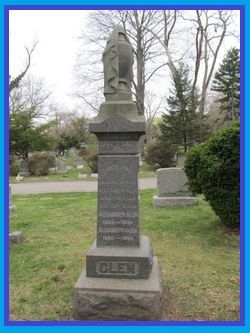
So finally we have the man who on the day led the line in that first uniquely Scots-style football team. He was Alexander Glen, another who would end his days in New York. He would die there in 1933 at eighty, also on Staten Island, and be buried there too, unlauded, in the Moravian Cemetery in New Dorp. But the grave with its magnificent stone is still there to be recognised and honoured by Scots and Scotland and, with the World Cup in part in America this coming year, perhaps the wider footballing World as a whole.
However, back in 1873 the young Alex, aged twenty or twenty-one, was an Apprentice, perhaps newly-qualified Engine Fitter and was yet another living on Thimble St., at number 33. His father was a Dye Works Labourer born on the shores of Loch Lomond in Luss, his McNee mother, from there also. But she would die still on Thimble St. in 1874, in 1877 Alex would marry Isabella Millar from Old Kilpatrick and in 1880 the couple would emigrate. Two sons would be born in America in 1882 and 1883.
Yet, Isabella would come home to Old Kilpatrick in 1884 and to die, aged just twenty-four, with Alex returning to and remaining in America, there in 1886 marrying once more. His new wife was Elizabeth Worth. They would settle on Wild Avenue in Travis-Chelsea , eight miles from the McRae's, he working as an engineer. And there they would have three children before again her early death in 1906, aged thirty-nine, with him this time not remarrying, continuing to work, now as a chief-engineer, until retirement and then living until his passing in 1933 not just with his two daughters but, from 1930 at least, his nephew, Daniel Glen, also Renton-born, a foreman in the local lino-factory, next door with his family. A wee Renton-enclave across the water.