Queen's Park F.C. -
and
the original cut of its cloth
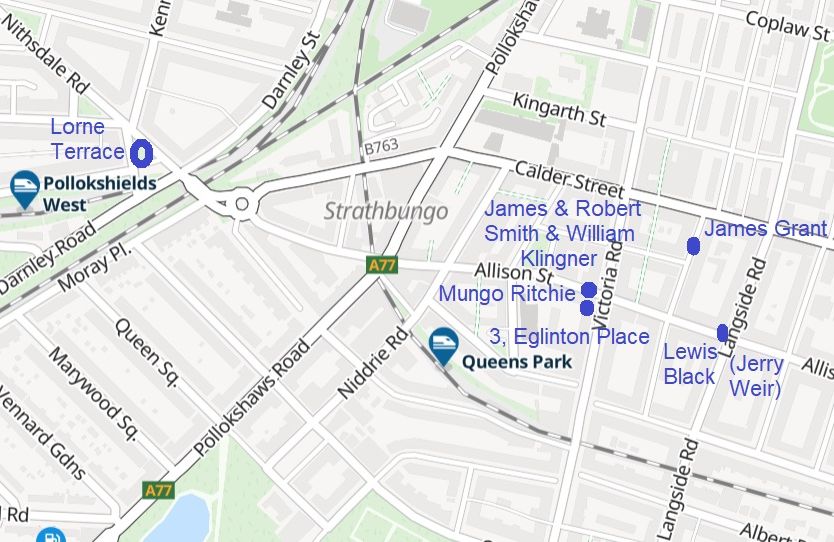
The foundation story of Queen's Park F.C. is well-known - some young men from the North of Scotland, from what today is Aberdeenshire, Moray and Highland, had come to Glasgow for work and there they met to practice "Highland" sports. And they did it to begin with at Lorne Terrace in Strathbungo before being forced off by the southern advance of Glasgow and the taking of the land for building. It meant a move to the open spaces of Queen's Park, where they came across a form of football and took to it. However, this raises three questions. The "North of Scotland" is a big area. They could not all have known each other in advance so what brought them together, why Strathbungo and might there actually have been some prior contact with the round-ball game, pre-Association?
The first formal meeting of the football club took place in the summer of 1867, on 9th July in fact. Its location is given as 3, Eglinton Place, which today is said to be 404, Victoria Road and less than half-a-mile from the site of Lorne Terrace. At that meeting Mungo Ritchie was chosen as the first president, Lewis Black as first team captain, William not Klinger but Klingner the Secretary and as Treasurer, Smith Senior, presumably James Smith, older by four years than brother Robert.
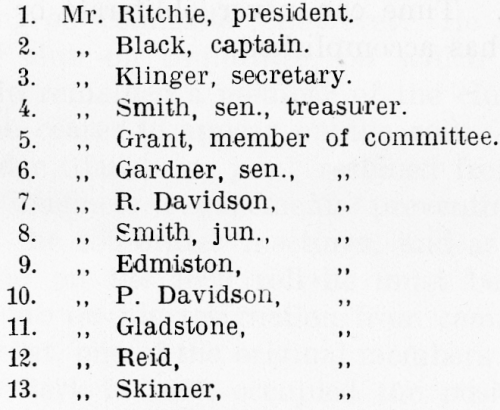
Ritchie was twenty-seven at the time, Black twenty-five, Klingner just eighteen, and the elder Smith twenty-three so three of the quartet were not by the standards of the day in footballing terms youngsters. And it can be seen, on the face of it, why Ritchie took on the lead role; he was the oldest. But there was probably another reason, indeed, perhaps two.
The first is that he lived at 22, Eglinton Terrace just round the corner on Allison Street, or at least in 1871 he did, by when in 1870 he had married, and he was a Draper, as he had been a decade earlier, already in Glasgow and would be, largely in Glasgow Southside but living in the Southern Suburbs, for the rest of his life. He would die in 1921 less than half a mile from Eglinton Terrace. But he was also something of an outsider because he was actually, like John Connell, Perthshire-born, the son of a farmer from by Madderty and by 1861 living on the north side of the Clyde on London St., now London Rd.. However, it was intriguingly just 200 yards from Glasgow Green, the known beginnings of the round-ball game in the city, indeed a few hundred yards from Connell himself, Thomas Lipton and Arnot Leslie, and potentially yet more.
But the question in 1867 was how did the non-Highlander Ritchie hook up with the others. And the answers are probably in a part cloth and also proximity. In 1872 Lewis Black from Cullen in Banffshire via Duthhill and Grantown-on-Spey married Agnes Weir. She lived at 1, Allanton Terrace, he at no. 11. He was a Commission Merchant, a broker, presumably in cloth because a decade earlier he had been an apprentice draper in Forres and a decade later he would be an Agent in Drapery Goods. And Allanton Terrace, now 1-10 Langside Road, is 250 yards from Eglinton Terrace. Which the takes us on to the Smiths. Robinson's History of Queen's Park states that the two brothers and Klingner, lifelong friends from school at Fordyce Academy, lodged, until in late 1870 two of them headed South, at 22, Eglinton Terrace, so at the same address as Ritchie and also yards from the first club gathering.
And then there was James Grant from Carrbridge, so Duthill also but also born in Grantown, and in 1867 aged twenty-five. However, by nineteen in 1861 he had also already arrived in Glasgow, was living on Hospital St. in the Gorbals, just across the river again from the football on Glasgow Green and working as a Drapers Assistant. And whilst he might have remained in that area for much of the following decade, as a warehouseman, a decade further on still, now a Merchant, he would in 1883 marry late, and from seemingly just 150 yards from Eglinton Terrace, then remain local before later in life moving deeper into the Southern Suburbs, recorded throughout as a Commission Agent (Drapery). In other words with his route to Strathbungo having parallels with Ritchie's and he another in same line of work it is natural the two, indeed, much of the group would have been literally close friends by location but also in a number of cases business colleagues.
And now we come to Gardner, with the question, if he was Sen., senior, then who was junior, with the possibility that the latter would be Scotland's first football captain but the former was his father. Robert Gardner, future goalkeeper, was by 1871 recorded as a Commercial Traveller living with the family in Tradeston but his father was a Porter of Cotton Yarn. In other words he worked in supplying the drapery trade and have had his interest sparked; enough for him to take an initial interest and for his the nineteen year old son to have joined too. And there would be more. Donald Edmiston was from Crathie in Aberdeenshire, near where the Smith's father had also originally worked on the Mar Estate, had in 1861 been a Draper's Assistant in Old Meldrum and after a brief time in Glasgow, would soon return to Aberdeenshire, back to Meldrum and as a Draper still. Futhermore, Gladstone might have been Alexander, a Merchants Clerk, perhaps again drapery, Reid, James Reid, a Salesman Draper from Aberdeen and Skinner, Joseph Skinner, from Banchory and a Woollen Draper, the last two also in the Tradeston.
Moreover, there might have be spin-offs. Having been a Power Loom Tenter in 1871 and 1881, but in 1861 a Apprentice Baker, by 1891 Robert Davidson was a Commission Agent and in 1901 a Commission Agent Drapery, living opposite Hampden Park. But he had been born in Airdrie, may therefore have been the link between Queen's Park and Airdrie F.C. for their early games, three in all, possibly even the same also to the Wotherspoon brothers, David, Thomas and John, whose father was a baker too. In addition the Wotherspoon boys had born in Hamilton, with David in Glasgow not just on-field but off-field as the Queen's Club Secretary the potential link to Hamilton Gymnasium and the four early matches played against the club, its ground less than a mile from the brothers' birth-place. Furthermore, they might even have been the link to John Carson, one of the instigators of Association football in Birmingham. David was in 1871 an Iron Merchant's Clerk. John Carson, originally from Helensbrugh, a Queen's team-mate 1870, arrived in The English Midlands to be an Iron Merchant's Clerk and Cashier but also in 1873 a founder of Calthorpe F.C..
But by then most of the originators of the club had moved on in life, business and therefore from active club participation both on- and off-field. Mungo Ritchie had married in 1870, Lewis Black, as already mentioned, in 1872 with only James Grant following later in 1883. And by early 1871 both Robert Smith and James Klingner had taken themselves first to London before in 1873 the pair oce more would emigrate to North America, the latter dying in Toronto, the former in Chicago.
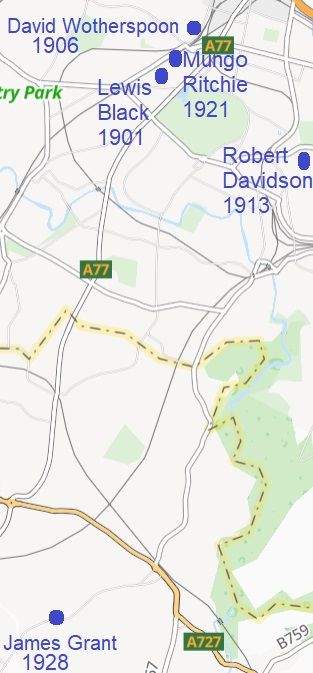
And meantime, James Smith would return to Scotland, there in 1876 at the family home back Urquhart in Moray passing away at the age of just thirty-eight. But he was to be almost the exception. Only Robert Gardner would be just a year older on his rather mysterious death from tuberculosis and in South Queensferry in 1888. But the younger Smith on passing in 1914 would be sixty-six, Klingner in 1911 sixty-three, with the longest lived of the those to have stayed in Scotland, but with no commemorative plaque in sight, being James Grant. He would die in 1928 in Clarkston, aged eighty-six, which leaves an almost life-time long, still-Queen's Park-Hampden cluster. Black, Wotherspoon and Ritchie would all pass away still in Strathbungo and Davidson actually over-looking the third and current Hampden Park.
Back to the SFHG Home page