The Reckoning
Background
Now that there has, finally after the best part of one hundred and fifty years of deliberate pretence from elsewhere, been the presentation of the strongest possible indeed nigh-one irrefutable argument that the source of modern, Association football was Scotland and not England - see: A New and Scottish Historiography of Association Football - and the proven case has been made that it was Scots, with some others, who took their game across the World making it the Global Game - see: Scots Football Worldwide - the time has come to turn attention to current matters, namely the disaster that the game's ostensible governing body, FIFA, has become.
FIFA came into being not to regulate but to coordinate the then emergent game in a limited, indeed then very small number of Continental European countries. It began with six members in its founding year of 1904. It now has some two hundred and eleven. And that it came into existence at all was a testament to the short-sightedness, indeed the stupidity of the British Home Nations as a whole but most of all to the one that assumed, presumably on seniority, for there was and had been little other justification, especially on the actual field-of-play. That is England. Moreover, the stupidity was doubly so not least because there was an "international" organisation already in place as guardian of the rules of the game, specifically set up in 1887 specifically to counter attempted English lordship of the game, and with the possibility that its scope could have been extended. That is IFAB, the International Football Association Board.
However, IFAB, made up on foundation by representatives of the four British Home Nations - England, Scotland, Wales and what was then Ireland, was at first parked and when remembered became what amounts to a bargaining chip in the developing rivalry between those same Home Nations and the by now emergent and far more confident FIFA. England, having at first declined, had joined the latter in 1905, then seen certainly by FIFA and presumably by both parties, as per the FIFA rules the representative of the whole United Kingdom, the softener being that the Englishman, Daniel Woolfall, immediately became President. Scotland in 1910 overcame its exclusion, apparently on the grounds that its was a province of England, Wales, it seems, the same year and Ireland apparently in 1911. But there were, its seems to have been a quid pro quo. In 1912 FIFA sent a letter to IFAB asking to be included. The application was initially rejected yet the following year was then accepted.
In fact it did not much matter. At the IFAB meetings of 1920, 1921, 1922 and 1923 FIFA representatives would be excluded because the Home Nations had left the organisation over a row about Germany and Austria's war involvement, then in 1924 it was back until 1828, when they all fell out again, this time over amateurism, and the two remained unreconciled until 1946.
At that point the IFAB voting system was two for for each of the Home Nations and two for FIFA also, so ten votes in total with eight votes required for a rule-change. Thus in effect the Home Nations could collude to block any FIFA-inspired one. But that all changed in 1958, it is said to have been to accommodate the expansion of the game fully worldwide. Under the new system each of the British Home Nations was reduced to one vote each with FIFA having four and six votes being the pass-mark. It meant the Home Nations could never impose a rule and to introduce one FIFA needed and still needs the backing of at least two Home Nations. It was also the point where things in the governance of the game started to go wrong.
The immediate effect was to reverse polarity. Whereas before 1958 control was with the countries where football had begun after that date it lay with FIFA and, it has to be said, has gradually been increasingly exploited to widen FIFA's influence and not without controversy. First, from the death after five fairly benign years in office of Arthur Drewry, came his Secretary at the English Football Association and former international referee, Stanley Rous, whose thirteen years in place were tainted by at the very least racism (South Africa) and, it might be argued, fascism. And from the rest of the World there was to be reaction. It came in the form of Jean-Marie "Joao" Havelange, a Brazilian but of Belgian origin, extremely wealthy from owning what was an estate just outwith the city of Rio de Jamaeiro and is now major, major real-estate within it.

And it was Havelange, who, in order to finance his promised expansion both into the women's game and globally, who first introduced commercialisation, notably Adidas and Coca-Cola, then televisation but was soon accused of corruption and exposed as having again fascist and also criminal connections.
Furthermore, it was also under Havelange that this FIFA process of only in-house promotion, begun with Drewry, continued. When the Brazilian announced in 1998 that he was to step down; he was by then eighty-two years old,; the main opposition to him and his activities was from UEFA, so from the European game, and its President, the Swede, Lennart Johansson. Yet the election, not without accusations of corruption, of the next President saw FIFA's General Secretary under Havelange, the Swiss, Sepp Blatter, step up.
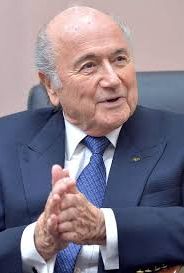
And, as we know, Blatter proved to be no better. In fact since his ejection from office in 2015 after seventeen years in position he has been suspended from all FIFA activities but frighteningly only until 2027; his failings being, as the Swiss court put it, "criminal mismanagement... and misappropriation". Yet from the debacle another insider, another Swiss of Italian origin, remarkably or not brought up in the neighbouring town to Blatter, emerged.
He is, of course, Gianni Infantino, lawyer and brown-noser, no photo necessary, who has just overseen an apparently for FIFA very financially successful World Cup in the USA, Canada and Mexico but one, with which local communities might not be so enamoured and in PR terms for what should be the "Beautiful Game" has been disaster. It has been made to look globally what increasingly the trend has been more locally, hyped and tacky plus now disrupted, over-coached from the sidelines and not the pitch, stuttering with the Rules not being broken exactly but bent to the max. Moreover, since then he has come up with the "interesting" idea of essentially the complete privatisation of the game; neo-liberalism applied to sport on the basis and justification that it will produce a "trickle-down effect". Come on!
Solution?
So where and what, if any, might there be a solution? The first observation is that FIFA, far from the Olympian, founding ideals of Jules Rimet, has for almost the last seventy years since 1958 proved itself increasingly lacking, shall we say, in self-control. It needs external regulation and trimming down or it needs to go financially with its organisational function being transferred elsewhere And here it gets, what some say, nationalistic.
Association football was a game invented in England in 1863 but it did not prosper. In fact it did not take off until another nation joined in and that nation was Scotland. Indeed a good argument can be made and increasingly proven that it was Scotland and then Wales and Ireland, which saved the British game from itself or rather the English. IFAB was the embodiment of that process and might once again be there for a repeat, this time not for the English but the World game.
The proposal is this. FIFA is reduced to its core of organising global, club and country tournaments but always according to IFAB rules, for example each half is 45 minutes with no "quarters" given. The argument should be, why should players from temperate climes be given an advantageous break when most of the World is used to playing in the heat. It has no choice and can handle it. FIFA might even be rebranded as, for example, GAFA, the Global Association of Football Associations. But GAFA is subordinate to IFAB. Moreover, the FIFA/Home Nations 50/50 split on IFAB is removed and the GAFA entitlement returned to the pre-1958 levels - each Home Nation has two votes, to allow for disagreement within that Home Nation and GAFA has two also for the same reason. Furthermore, Scotland, as the country that can be shown to have been far and away the greater contributor to the world-wide spread of the game but a small country, which is not one of the its global super-powers, as England is, yet through the Tartan Army has show what true support even of a minor footballing power can be, be made permanent chairman of the resultant committee.
And there is one further recommendation. The Irish representation currently on IFAB is Northern Irish only. When the island of Ireland was split the FAI, the Football Association of Eire made application to take up a seat at the table and was rejected. That should be redressed on two grounds. The first is that the whole-Ireland contribution to the entire British game has been huge. The first son of Irish parents, indeed the first Catholic, to play for Scotland was J.J. Lang as early as 1876. The English were a little slower but twas ever thus. The second is that Eire is a neutral country on many levels but would also be a fully integrated, directly European representative with the proviso that, if equally representative countries from other conferences with the agreement of its members wished to join then they should be accepted.
Thus a newly constituted IFAB would initially consist of five permanent countries - England, Scotland, Wales, Northern Ireland and Eire with one organisation, FIFA/GAFA but the door open for more elected and rotated from the conferences. Its role would be to stabilise World football, keep a firm grip on the Rules and removed from it not commercialism but its pernicious, particularly US variety. We do not want a repeat of the 1920's American Soccer Wars. It would, to start with at least, have twelve possible votes cast with decisions made on simple majority or on the casting-vote of the chairman. FIFA/GAFA itself would be run as a not-for-profit company. It could be decided whether or not Switzerland is actually a suitable location for it. There are others, Canada, for example, being one. And its CEO, who would not be Infantino, would report directly to IFAB and no other or others. Discuss.
Back to the SFHG Home page