The Spanish Score
- Scotland's "Vuelta de Espana"
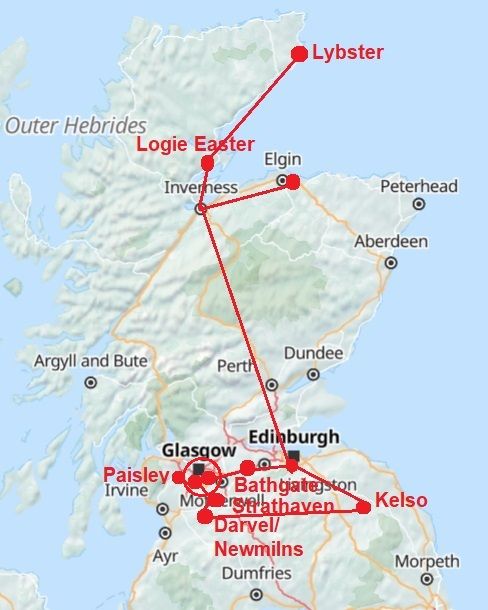
It is far from common knowledge, not least in Spain, the current homeland of the World Champions, that without Scots, be it as played or officiated, football might well exist in that country but not as it so successfully is.
Fact is that the doyen of Spanish clubs, the oldest still existing and soon to be one hundred and forty years-old, was founded by our countrymen, specifically William Alexander Mackay, Charles Adam and Gavin Spiers. Fact too is that the oldest football ground in the country, that of Aguilas F.C., the exquisite El Rubial, is still theoretically owned by now long deceased Scot, John Gray. And it is also fact that the country's first officially-recognised referee and winning-captain, Edward Farquharson Johnston and Hugh MacColl, were Scots. And still on officiating amongst the first actually to blow the whistle in Barcelona was William Mauchan from Pollokshaws, his sons following on from him with John Hamilton from Darvel first as players in the city and then men-in-the-middle.
And even then it does and did not end. One of the first two men to introduce football not just to the Catalan capital but Catalonia as a whole was Paisley's John Cochran. That was until he transferred his skills to Bilbao. And the first two goal machines for F.C. Barcelona itself were initially George Pattullo from Pollokshields and almost immediately after him Alex Steel from Newmilns.
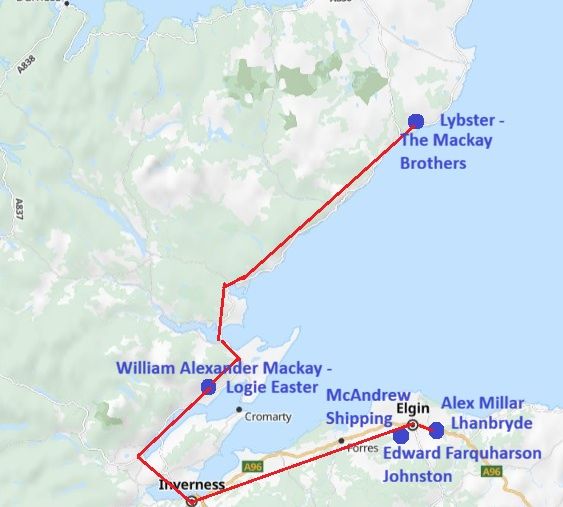
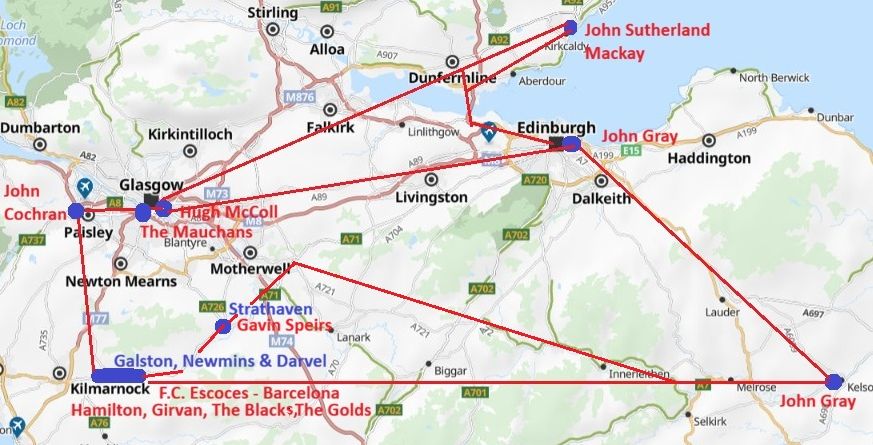
And the Scotland from which these pioneers were drawn is the width of the country and three hundred miles north to south. William Mackay was born in the far North in Lybster in Caithness, John (Juan) Gray in Kelso in The Borders. Farquharson Johnston was born in Lhanbyde by Elgin, the birth-place of his probable nephew, Alex Millar, an early Real Betis player, with MacColl from The Gorbals.
And not just Darvel but the other two main villages of Ayrshire's Irvine Valley, Galston and Newmilns, would in addition to John Hamilton be the sources still in Barcelona of much of his F.C. Escoces team; of Geordie Girvan, the Black brothers, Alex and Jo, and Willie Gold. And to compete the circle it would Ayrshire too that was the home county of Spain's first known team captain, Strathaven's Gavin Spiers.
_________________________________________________________________________________________________________
Plinths & Plaques
As with not just this but all our country-trails we believe that merely recording is not enough. To do justice to the pioneers, as several countries, to which they went, have done and in Scotland Busby has also in following the lead of Bangu in the case of Tommy Donohoe, there should be place for more plinths, and if not them then plaques. So, whilst we research and provide biographical details of as many of those, who through deed and feet spread the word, we also look at where some form of visual, outdoor recognition would be both appropriate and feasible.
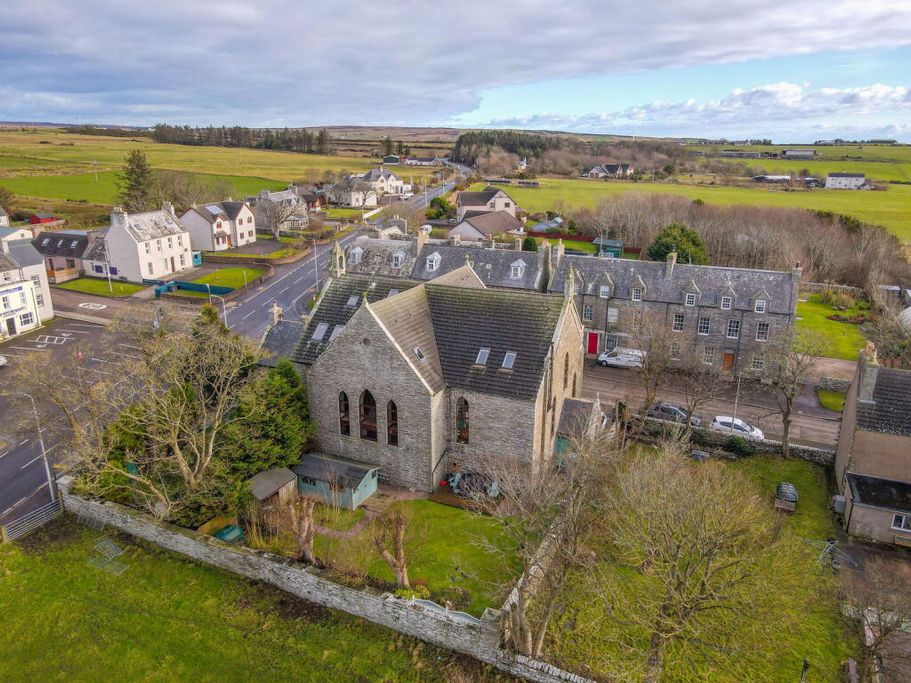
Old Free Church, Lybster
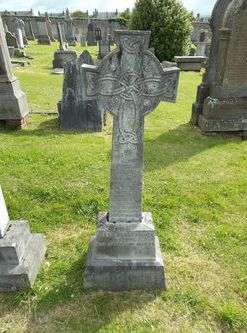
John Sutherland Mackay Grave, Kirkcaldy
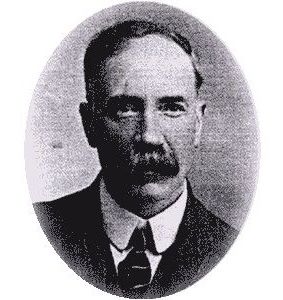
William Alexander Mackay
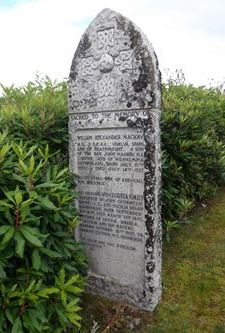
William Alexander Mackay Grave, Logie Easter
The Brothers Mackay
The two Mackay brothers, John, the elder, and William, were both born in Lybster in Caithness, sons of the local Free Church minister. And each would go on to be doctors, both as employees of the largely Scottish-funded, then nascent mining company, Rio Tinto, and moving to Spain, specifically the South, to Andulucia.
John Sutherland Mackay & Spain's first Club
John Sutherland, born in 1848 so twelve years the senior, would be the first to go in 1877-8 to be the resident doctor to the British-, mainly Scots-manned mining town of Minas de Rio Tinto, named, as is the company, for the local river stained red by traces of ore. And with the founding of the town's British Club he in 1878 became its first President, a town football team, the long-defunct Rio Tinto F.C., and intra-club games following on in short time.
William Alexander Mackay & Spain's Doyen Club
The Rio Tinto mining operation would prosper, the ores being carried on a specially-built trainline to the coastal city of Huelva. And with that growth a further doctor was required for there, William Alexander Mackay, John's younger brother from 1883 filling the role, being instrumental in the building a new hospital and in 1884 the foundation of a Society for Ball-Games, including football.
And it was from that society that first emerged the Huelva Recreation Club and in 1889 the formal Recreativo de Huelva. It remains Spain's doyen, its oldest existing club, the Spanish equivalent of Queen's Park and the loser in 1890 in Spain's first officially recognised match. William Mackay became its second President in 1896, remaining in position for the best part of three decades until his retirement back to Scotland in 1924.
By then his brother had also long returned. He had become a General Practitioner and then the Chief Medical Officer in Kirkcaldy in Fife. And that is where John Sutherland would be buried on his death, also in 1924, at the age of seventy-six.
And William Alexander would on coming home after having a street named for him in Huelva, one that is still there, himself settle in Easter Ross at Heathmount behind Tain and Invergordon. Indeed it would from there that he would on his passing, aged sixty-seven and in 1927, be buried at nearby Logie Easter Cemetery.
Charles Adam
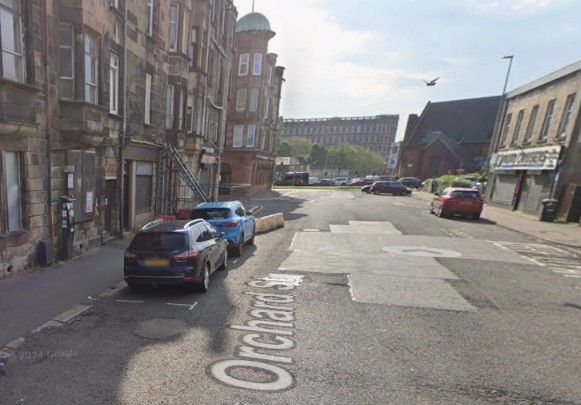
Charles Wilson Adam, sometimes mistakenly Adams, was born in 1848 on Orchard St. in Paisley and brought up largely in Ayr. He was a gas-engineer and draughtsman to trade, marrying twice, in Paisley 1873 from an address in Milan, Italy, and again in 1878, after the early death of his first wife, this time in Italy itself and to his Scottish-Italian, second wife, Henriette. And it was perhaps she who was instrumental in the newly-weds moving in 1879 to Spain, he to become the director of the new local gas-works the Andalucian city of Huelva, where they were to stay for thirty years.
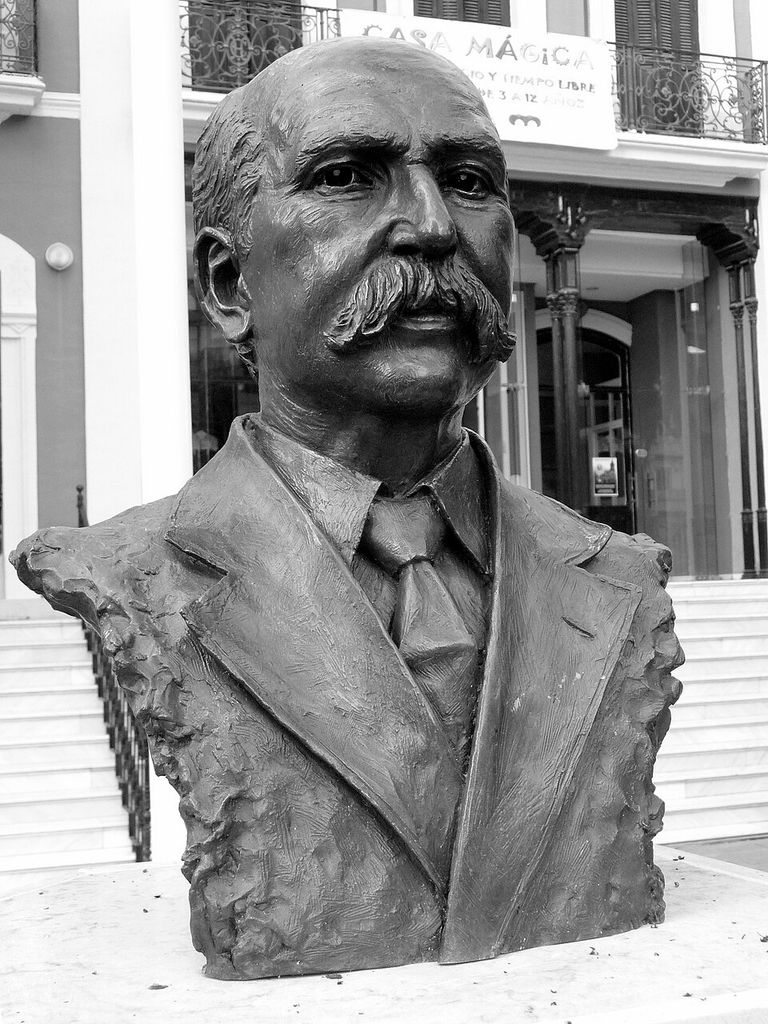
But away from gas Adam was also a fine cricketer and when William Alexander Mackay in 1883-4 asked him for the use of some gas-works land for sport including the red -ball game he readily agreed. It was that land which was to become the first ground for Recreativo de Huelva, of which he was elected President from foundation until 1896. Indeed so important was he to the creation of the club that in 2008 a bust of him was placed in front of the Cala Colon in the city centre; a plinth that might at least deserve a plaque in his native town.
Charles Adam and Henriette would have five children, all born in Huelva. And their two sons would remain in the city, the elder also a cricketer but the younger a footballer, indeed playing for Huelva until 1915/16, even as their father retired in his early sixties. He would return to Scotland first and then settle in England in Loughborough, where, aged seventy-five, in 1924 he passed away.
Gavin Spiers
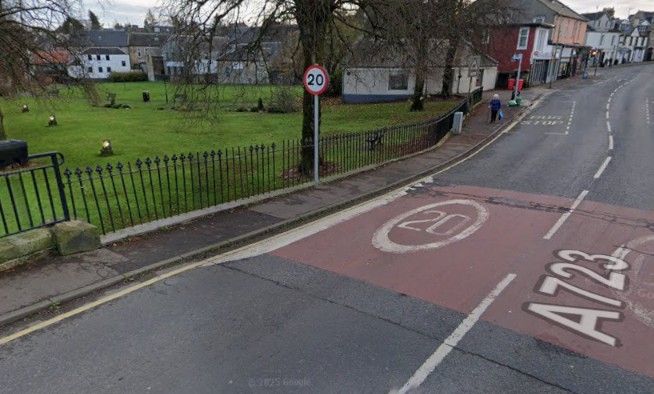
When Recerativo de Huelva was formed in 1889 Gavin Spiers would be variously listed as Vice-President and team captain. He might have been both. He was definitively at the time a twenty-seven year old engineer cum commercial agent for Rio Tinto, born of a weaving family in Strathaven, living there on Green St.(see right), who returned to England in 1892 to marry and settle officially in Claughton by Birkenhead but went back to Spain, back to Huelva, where in 1899 he was to die of pneumonia at the age of just thirty-seven.
_________________________________________________________________________________________________________
McAndrew Shipping
Few companies can have done more, albiet inadvertently and with a considerable time-lag, to take football to a country. Founded in 1770 in London by the McAndrews from the Lossiemouth and Elgin area, they developed a lucrative trade in fruit and metal ores from Spain to Britain, at the same time placing members of the wider family strategically in ports in both countries. William McAndrew went via Hull and London to Barcelona. Edward Farquharson Johnston and Alex Millar went from Moray to Seville and with them, as founders, players and officials, went football.
_________________________________________________________________________________________________________
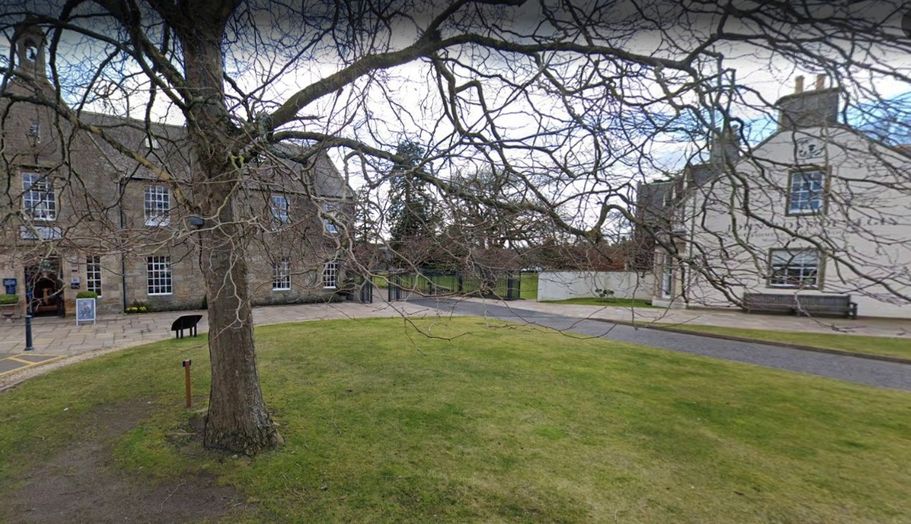
Johnston Woolen Mill, Elgin
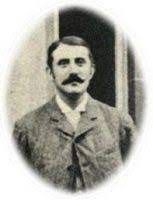
Edward Farquharson Johnston
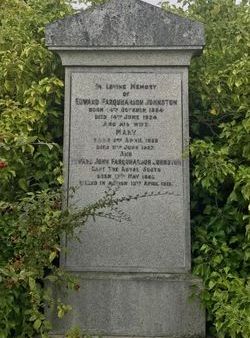
Edward Farquharson Johnston Grave, Elgin
Edward Farquharson Johnston - Spain's First Referee
In 1897 Alexander Johnston founded a wool-mill on the banks of the River Lossie in Elgin, a business taken on by his son James and in time his elder grandson, Charles. But there was a second grand-son, Edward, who would join the maternal family-connected McAndrew Shipping Line and be posted to Spain, to Seville.
And in that Andalucian city, where he would stay for over thirty years, Edward Farquharson Johnston would in 1879 at twenty-five become British Vice-Consul, whilst on the later foundation of its British Club be its first President. Moreover it would be in 1890 from the British Club, notably following a Burn's Supper so from Scots, that Seville Foot-ball Club but not as claimed the current Seville F.C. was founded, with Johnston, a well-known sportsman but by then aged thirty-five, again its titular head.
Seville Foot-Ball Club's first game, Spain's first officially recognised one, was to take place in March that same year, the result a home win, 2-0, reversed away three weeks later, and the opposition none other than Receativo de Huelva. Seville captain that day would Glaswegian, Hugh MacColl, and the referee, note not yet the man in the middle but until 1891 the arbitrator still in the stand, Farquharson Johnston. And he would continue in the role for some years to come. He is known to have been by then and now the man-in-the-middle as late as 1909 at the age of fifty-five.
Edward Farquharson Johnston would return to the UK at about that same time, but now to live in London. And it would be there at his home in Chelsea he would, a considerably wealthy man, die aged sixty-nine in 1924. But on his passing his body would be carried by train north back to Scotland, to Elgin to be buried there in the town cemetery.
_________________________________________________________________________________________________________
Hugh McColl - First Winning Captain
When Farquharson Johnston was from off-field refereeing that first game he was doing so with another Scot as the captain of his club's on-field team. He was Hugh MacColl, recorded on his birth-certificate as McColl, who had been born of Glaswegian parents in 1861 in Tradeston, where and in Pollokshields around and on Kenmure St. he was also to grow up, the son of a prosperous Tailor/Clothier.
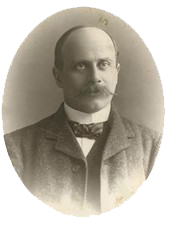
However, MacColl was to train first and then work as a draughtsman initially in Glasgow, then Hartlepool, Belfast and back on the Clyde, which led him somehow finding work as a Technical Manager at an English-owned foundary in Seville in Spain's Andalucia. It would in turn result in the city after a good Burn's Supper in he with others deciding to form a football team based on the local British club with him as its first captain. It would also result in a series of games against Recreativo de Huelva including the first, a 2-0 home-win, being Spain's first ever officially recognised match.
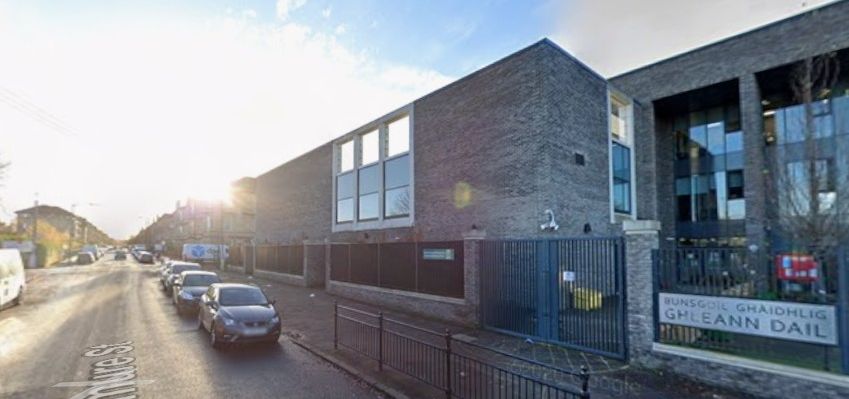
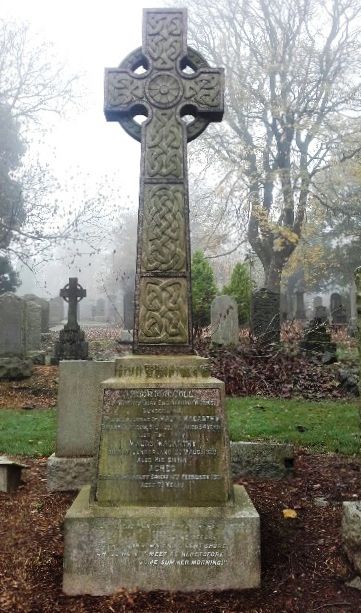
MacColl would remain in Seville until 1895 but return not to Scotland but to Sunderland to create with a John Jamieson a ship-repair company, Jamieson and MacColl. However, his fellow owner would pass away the following year, at which point MacColl then teamed up with Seville footballing team-mate, Gilbert Reid Pollock, a partnership that was to last until MacColl's death in 1915. It would take place on a visit back to Glasgow. He was just fifty-four and had left a wife, Maude, and two sons, the younger of whom went on to become a Labour MP. However, rather than a burial back in England's North-East he was to be interred just a few miles from where he had spent his youth. His grave is in Cathcart Cemetery, where he was joined respectively just five and nine years later by Maude and her sister, Agnes.
And Gilbert Reid Pollock
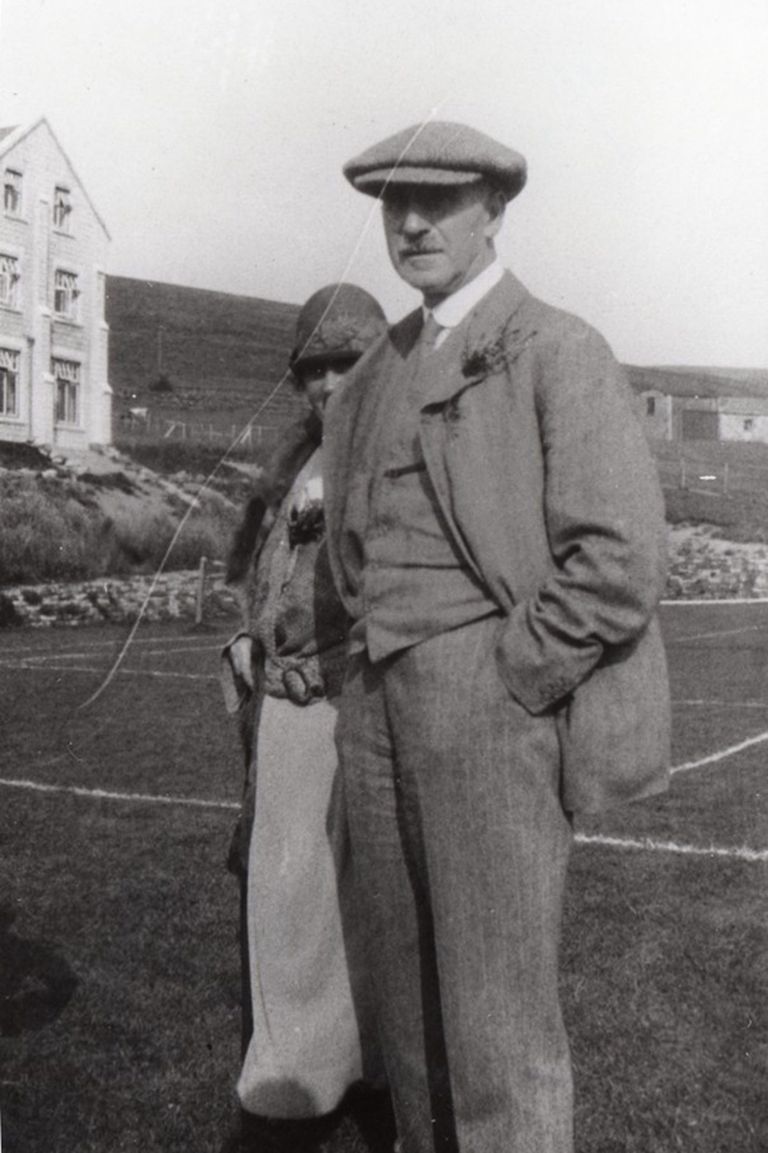
It is not clear if on the day of Spain's first official match Gilbert Reid Pollock was in the team. A player named Ritson is credited with the first goal. But Pollock was definitely there for the second encounter, at Huelva three weeks later. Indeed he is credited with opening the scoring, Spain's first ever away goal as Seville took the lead only to lose to two second-half replies. Reid Pollock, who in Sunderland would eventually go into partnership with Hugh MacColl, was yet another Scot, albeit one brought up latterly in England, but with a passion for the round-ball game. Twenty-five in 1890, Pollock had been born in 1865 in Upper Carradale in Argyll, from his parents' marriage presumably his mother's home village, his father Glasgow-born. He was a Mechanic at a Bleachfield in Grahamston, between Paisley and Barrhead and that was where the couple were actually staying and following month the birth of their son was actually registered.
And it was probably textiles that soon had taken the family down South, first to Ashton-under-Lyme by Manchester, where Reid Pollock's mother died in 1869, and then to Cheshire. There Pollock became an Engine- and Tool-maker, made his brief excusion to Spain, had returned by 1891, married in Stockport in 1894, entered into business with an also returned MacColl around 1896 and had moved to Sunderland by 1900. In fact he would, even after MacColl's death in 1915 very successfully run their company there until 1935, when at seventy he retired to the Isle of Man, dying there aged eighty-eight in 1954.
_________________________________________________________________________________________________________
Real Betis
Seville Foot-Ball Club was the city's first, Sevilla F.C., actually founded in 1905, its second and Real Betis, in full Real Betis Balompie (Ball-Foot|) its third. It was a formed in two parts, Espana Balompie and Betis Foot-Ball Club, named for the Latin for the river, now known as the Guadalaquivir, that flows through the Andalucian capital, and three stages, in 1907, 1909 and a merger in 1914.
And its Scottish or rather Scots-Irish links started early and continue.The colours of the Andalucian flag are green and white. It is said a founder, captain and coach of the club had studied in Scotland and had come in contact with Celtic, previously playing not in hoops but green and white stripes. Betis play in green and white stripes, indeed switching from plain blue and white.
Futhermore, amongst the players of the original Betis there was a tall, lanky man, said to be Alex Miller, a Scot and a nephew, also employed by McAndrew, of Edward Farquharson Johnston.
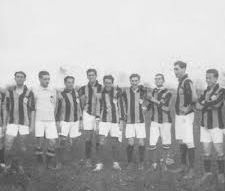
Alex Miller
_________________________________________________________________________________________________________
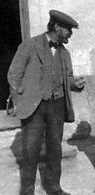
John Gray
Aguilas FC
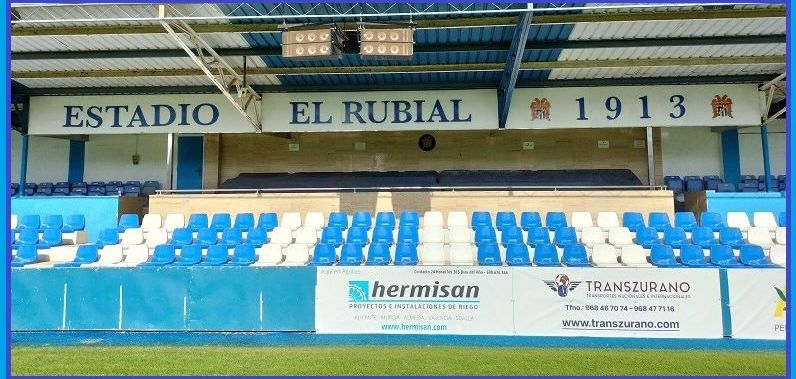
El Rubial Stadium, Aguilas
[El Rubial is as a stadium the second oldest in Spain in permanent use. Gijon's El Molinon was opened in 1908. But there is evidence that the terrain on which El Rubial stands on was in use as a place for football before that date making it the oldest football field or ground in the country; its Anwoth.}
John Gray and Spain's Oldest Ground
Between 1913 and 1915 a piece of land was bequeathed to the Murcian town of Aguilas in perpetuity as long as it would continue to be used for sport. Today it is the location of the 4,000 capacity El Rubial, the small but exquisitely still blue and white stadium of the town's current football club, Aguilas FC, and of two before it. The donor of the ground, Spain's longest in permanent use, was a then prominent, local business-man, who had introduced football to the area in 1896 and coached that first team to a twenty-six game, undefeated run.
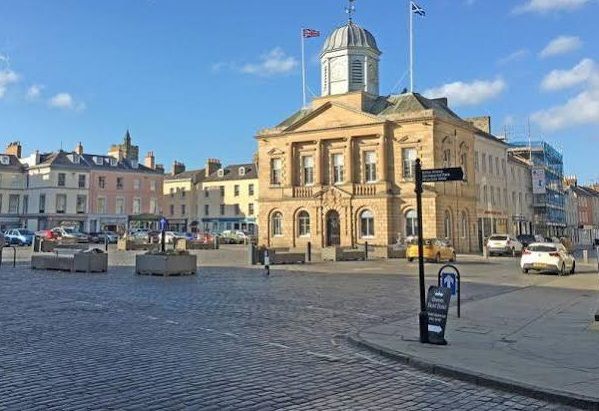
The Square, Kelso
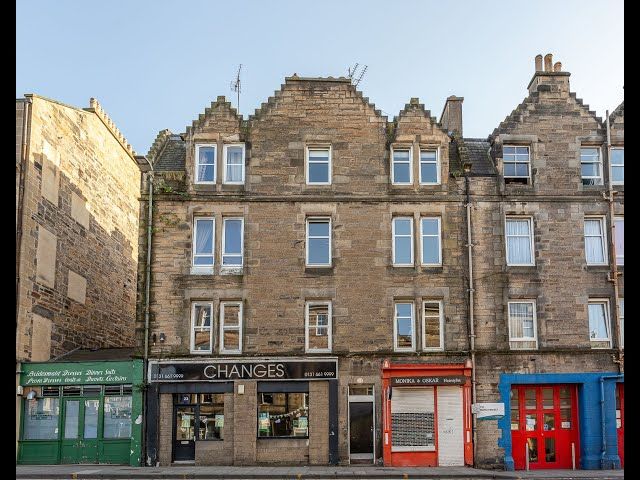
East Norton Place, Edinburgh
And the businessman in question, whilst he was known locally as Juan Gray, had been born John Gray, on The Square in Kelso in 1860, the son of draper, and grown up mostly in Edinburgh. That is before taking himself to Spain for thirty years or so, only known specifically to have come home in 1899 to marry just outside Edinburgh again but then return to the Mediterranean with his wife until about 1925 and retirement. And on that retirement the couple would settle not in Scotland but England in Droxford in Hampshire, his wife, Mary, dying there in 1948 and he following her in 1953 at the age of ninety-two.
_________________________________________________________________________________________________________
Barcelona (and Bilbao)
It is quite possible that the round-ball game did not arrive in Catalonia via Barcelona city but inland at Borgonya by Torello. It was there above the River Ter that in 1894 the Paisley cotton thread-company, Coats, began the constuction of mill and village with still at the latter's core three streets, Paisley, Escocia and Coats, and a railway-line to the coastal port. And already by the following year a sports club had been founded and the first of a series of games had been organised against the British Club in the Catalan capital with the up-country team, an eleven with a remarkable but unsurprising number of Scottsih names, as follows:
Cochran (Team Captain) Paton, English (Inglis), Munro, Lyle, Gerard, Cooper, Al. Nichol, A. Tong and/or H. Tong, Rushton and King
And from the British Club there would be also a number of almost equally interesting names, notably amongst them MacAndrews, William MacAndrew(s).
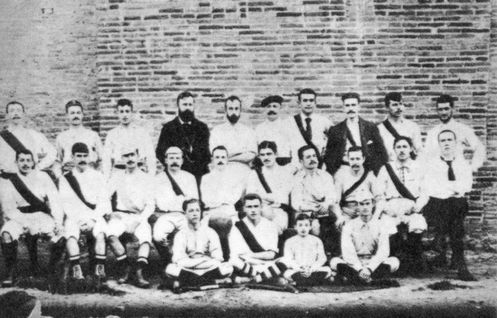
Barcelona British Club (with sashes) and Torello Teams, 1893
George Cochran, Borgonya/Torello Team
George Cochran
George Cochran was born in Bathgate in West Lothian. The year was 1870. But his family was on the move. The second child of Angus parents, his father, an insurance agent, from Dundee and his mother from Coupar, they would soon be on their way to Paisley. And it would be growing up in that Renfrewshire town, which would be the key to subsequent events.
In 1881 the family was living on Paisley High St., he a scholar. In 1891 he was a Clerk and it was probably as such that by 1892 he arrived in the Catalan capital, quite possibly in the advance party sent by the Paisley cotton-thread makers, Coats, looking to erect the Borgonya mill that would start production in Spain's north-east corner some two years later.
And it seems to have been in 1892 that, whilst still in Barcelona, Cochran met London-born James Reeves, the two instrumental in the formation late in the year of the Barcelona Football Club. The first known football game followed on Christmas Day, although it is not known if Cochran played. Conversely he certainly did play in the next in March 1893. It was an internal game within the club, Reds v Blues, possibly England v Scotland, with Reeves captaining the former and Cochran the latter.
Then in 1894 what is sometimes described as a split occurred at the club resulting in the formation of the Sociedad de Football de Barcelona and Torello Football Association, with Reeves in the former and Cochran and fellow Scot, William MacAndrews, said to be in the latter. In fact it was probably a marking of the move for Cochran and others inland to the mill. Certainly the following year Cochran played up-front and captained the Torello team that played two games against the new Barcelona entity. The first was in the Catalan capital. The result is recorded as both 6-3 and 8-3 for the home team but with Cochran scoring. The second was in Torello, perhaps even Borgonya, and the result was reversed. The mill-team won 5-3 with Cochran hitting a first-half hat-trick.
However, the two 1895 games remain the last to feature Cochran in Catalonia. Perhaps his contract, normally four years, was up and he returned to Scotland. But Spain clearly called him back, with his enthusiasm for football undimmed. In 1901 and aged thirty he seems to have joined the already extant Bilbao Football Club, formed almost a decade earlier and originally and still mainly a British team. His first known appearance for them is in early 1902 now at left full-back in a 4-2 defeat to the newly-formed Basque team, Athletic Club. And it was these two clubs, which first informally combined as Bizcaya in May that same year in winning the Coronation Cup, that year's and the first Copa de Rey. However, Cochran did not feature in any of the games. He only returned once the formal fusion of the clubs as the present-day Athletic Bilbao had taken place. In April 1903 in winning in Madrid the final of the second Copa del Rey he was there as one of just two Britons in the eleven but significantly at centre-half, Scottish centre-half. He might also have been there again the following year had the win for Athletic Bilbao not been a walk-over. He was certainly in the squad. And he may have been there once at centre-half in 1905 in defeat to Madrid F.C.
At that point and now in his mid-thirties his footballing seems to come to an end but he appears to have remained on Spain's northern coast perhaps almost until his death. He is said to have settled in Portugalete, the town at the mouth of the river that flows through Bilbao itself to the sea and across that river from Bilbao F.C.'s original ground at Lamiako. He also seems to have married a Josefa Laban and started a family. George Cochran Jnr. was born in about 1913. All this is revealed when in January 1929 all three Cochran's sailed from Santander to Britain, giving an address in Paisley. Perhaps George was already unwell and was coming home specifically, because at another address on the other side of town he was to die in April that same year, aged just fifty-eight, described as a Mercantile Clerk, his wife and son returning to Spain in July with where he is buried as yet unknown.
William MacAndrew
William MacAndrew, no "s", seems to have been a fourth-generation member of that same shipping family as Seville's Edward Farquharson Johnston and Alex Miller. He himself had been born in Hull in 1852, the son of Alexander MacAndrew, Elgin-born and a Steamboat Engineer, by 1871 himself a Ship Owners Clerk, one who by 1881 was in the same job but living in Hackney, London. And in 1901 he was in the south once more but in Eastbourne and a Ship Agent before by 1911 being back to London, now as a Shipowner on Cavandish Square, four years before dying at the age of sixty-three back on the Sussex coast and a very wealthy man. Yet in 1891 he is nowhere to be seen. Nor is his wife of nine years as maybe Barcelona was their temporary home.
William MacAndrew, British Club
_________________________________________________________________________________________________________
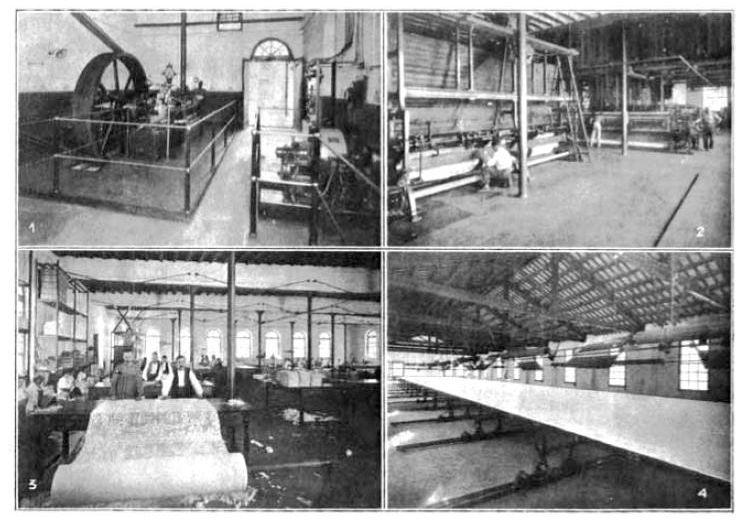
La Escosesa
La Escosesa & F.C. Escoces
If football came to Catalonia with cotton thread, Borgonya and the Barcelona British Club then it was imbedded by the Swiss, Hans Gamper, and lace. In 1893 a mill was opened in the city suburb of Pobre Nou, St. Marti. It was a joint-venture between Britain's foremost lace-weaving town, Nottingham, and Newmilns in Ayrshire's Irvine Valley, specifically there the village family concern, Johnston Shields & Co..
The factory, initially manned in part by weavers from Britain, notably Scotland, early on had acquired the name La Escocesa and teams raised from it were already by the winter of 1893-4 playing ad-hoc games against the British "Football Society of Barcelona". Willie Gold from Galston by Newmilns was the factory team-captain. And soon after Coats from Borgonya would extend its threads interests into the city by working with a local firm in the neighbouring suburb of St. Andreu de de Palomar, that cooperation being formalised in 1903 as Fabra i Coats. So, whilst that initial upsurge in football had died away, by late 1899 and with an influx of spinners from Paisley a works football team had emerged officially named St. Andreu F.C. for the location but known widely as Escoces F.C. for the origins of it eleven.
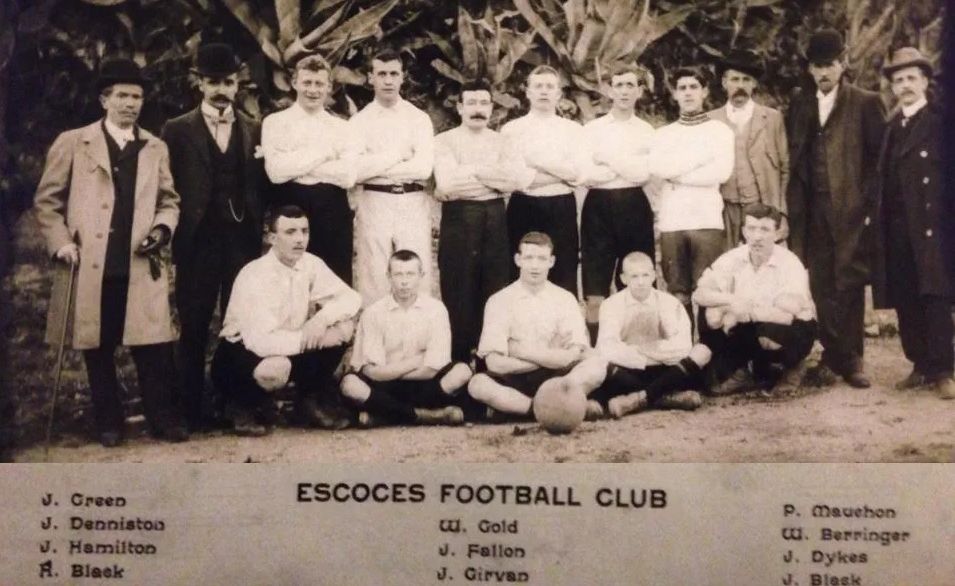
However, it was to play just ten games before folding, after getting involved in a disagreement with the one of the city's other emerging teams, Gamper's F.C. Barcelona, at which point a number of its players went to other teams, including eventually Barcelona itself, boosting that side of the game locally both with personal and therefore also tactically. Scottish players played Scottish style. After which at least two of their number would move into officiating, forming Catalonia's College of Referees.
John Hamilton
Captain of Escoces F.C. was John Hamilton. He was a Darvel-boy, or at least seems to have been. If identified correctly, he was born there in 1870, would die in the village in 1923 and is even buried in its Old Cemetery. But in between had been one of those important shapers of Spanish, specifically Catalan football, as player first and then referee.
He was the eighth of the nine children of Thomas Hamilton and Agnes Gemmell, his father a cotton weaver, also Darvel-born. It was a village that was producing more than it fair share of footballers. Nicol Smith, of Rangers and Scotland, was three years younger and lived a couple of streets away. Unrelated Alex Smith of the same club was born there in 1875. And there were others. The street kick-abouts, all within just a few hundred yards of current Darvel F. C.'s ground, must have been quite something.
It is therefore hardly surprising that Hamilton, although not of the Smiths' standard, in childhood and youth and as he began his working- and private lives, developed a life-long passion for the game. In 1881 he was still at school. In 1891 he was already a "calanderer", an operator of machine to press and finish fabric, in his case lace. And in neighbouring Newmilns on 6th May 1892 he married local lassie, Jeanie Wilson. Three sons would soon follow. Thomas, who would die in The Great War in 1917, arrived in 1893, John Jnr. three years later and Andrew three years later still. The first two were born in Newmilns, the last back in Darvel in 1899.
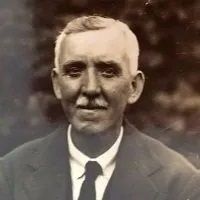
John Hamilton
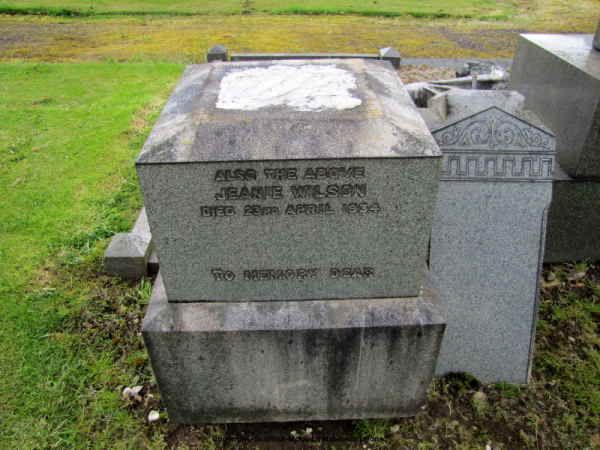
John Hamilton's Grave, Davel Old Cemetery
And John Hamilton would also be found in Darvel in 1901 and 1911. In both he is recorded as a lace warehouseman and again a decade later, two years before his death, as a lace manufacturer in his own right. Moreover, on his death in Darvel once more he would be buried in its Old cemetery with his son, to be joined by his wife on her death in 1934. The inscription on the grave reads "Erected By Jeanie Wilson Ilmo Her Beloved Husband John Hamilton, Lace Manufacturer D. At Rosemount, Darvel 5.10.1923 in His 54th Year. Also Their Beloved Son Sergt, Tom Hamilton 28.3.1917 Aged 24. Also the Above Jeanie Wilson D. 23.4.1934."
But back to the football. Presumably working for Johnston, Shields, the Newmilns lace-makers, he was in 1893 sent with others from Darvel/Newmilns to Barcelona and its new factory, soon to be known as La Escocesa, still there and now an artists' centre. Certainly in the winter of 1893-4 he featured as a goal-scoring forward for the Scots of Sant Marti against the English Colony of Barcelona, after which, with no other mention, he may have returned to Scotland. But he would be back. He was there in 1900 as a founder on the creation of Sant Andreu F.C., soon to be known as Escoses F.C. He would, now from goal, or as a defender, captain the team until its dissolution in November of that year. And he would also for the first time referee.
At that point the Escoces players went in several directions. Hamilton, perhaps after again a brief time at home, returned to join Hispania. There as a defender he enjoyed considerable success. The club would win the first Copa Macaya, the precursor of the Catalan championship, which began in 1903. However, in November 1903 Hispania too folded and Hamilton moved on once more, joining Barcelona, which with him in the squad would take the 1904-5 Catalan title.
Meanwhile Hamilton had continued to officiate. Indeed, whilst still playing on, in 1902 he had become the first President of the College of Catalan Referees. And he became more and more involved, perhaps, after his playing days came to an end, a fairly long interlude back in Scotland from 1905 to 1909 but a return, in this facet of the game. Having taken the whistle in games in that 1902-3 season but seemingly not again until 1909-10 he was then regularly in the middle. In 1912 he even refereed the final of the Copa del Rey, a 2-0 victory at the city's Camp de la Industria for his old team FC Barcelona over Madrid's Sociedad Gimnastica, with his last known appearance on Boxing Day 1916 at the age of forty-six, a permanent return to Darvel then perhaps prompted by his son's Great war-death.
Geordie Girvan
On 14th April 1901 in the game that would decide the first playing of the Copa Macaya, which would in 1903 become the Catalan Championship, there were at least three Scots on the field, perhaps even four, five or six. In the team of the runners-up that day, FC Barcelona, there were certainly three, - Alexander Black, Peter Mauchan and George "Geordie" Girvan. Whilst the champions-to-be, Hispania, had three in the squad, Joe Black, Alexander's brother, then Willie Gold and John Hamilton with probably all three playing. And just now it is the last of the Barcelona trio, Geordie Girvan that has our attention.
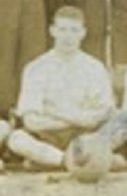
Geordie Girvan
A season earlier all six had been in the same team, Escoces F.C., as workers at the Scots cum Nottingham, Johnston, Shields lace mill implanted in the Catalan capital from 1893 and known as La Escocesa, The Scot. And it would be lace in particular that would be the thread that would run through the rest of Girvan's life, even unto death. George “Geordie” Girvan, was perhaps just 20 when he had arrived in Spain. He had been born in 1878 in Dalziel i.e. Motherwell but of parents from away, his father an engineer, from Newmilns, the home of Johnston, Shield's parent factory and to where they returned by 1891, via already by 1884 neighbouring Galston.
But before 1901, whilst the family was again living in Galston, George was already on his way. Indeed by 1900 he had married, in November that year in Barcelona with his first child, born but eight months later. His bride was Susannah Maria Zillah Tomlinson, she from Nottingham, suggesting that the two worked alongside each other. Moreover, a second son was soon born to the couple but neither he or his brother seemed to have survived beyond infancy and by 1904 the couple alone appear to have been back in Britain.
There a third son, George Jnr., the first to survive, was born to Susannah, but not in Scotland but in Nottingham, where George Snr. is recorded as a Twist Hand. But they were soon to return to north of the border, to Newmilns. Three more children would be born there in 1905 and 1912, including the second, a William, and a John. They in time would enter the lace-industry too. In 1911 George Snr is recorded as a lace curtain weaver, the boys at school. In 1921 he is a lace weaver for Steel and Co. at River Bank Works in Stoneygate Rd., where he had lived as a child, whilst George Jnr is a "Shuttler" at the same company and William, who would be killed in France in World War Two, the same but at Johnston, Shields' main works.
But amidst all this the young Geordie Girvan Snr. had already made an albeit brief but indelible impact on Barcelona, Catalan, even Spanish football. As an inside-forward after the dissolution of Escoces F.C. in 1900 and now in January 1901, recruited to F.C. Barcelona and featuring in eight fixtures in the season, he scored not only the club's first ever goal in official competition, that same Copa Macaya, but seven more. Moreover, for two more seasons, 1901-1903, he then joined none other than Hispania.
Furthermore, on his return to Scotland George Snr had almost a third life. Before dying still in Newmilns in 1968, aged a good 90, he became both the secretary of the Scottish Lace and Textiles Union and provost of his hometown. In fact on his death he is recorded as a Trades Union Official (Retired) and a widower. Susannah had died fourteen years earlier but for her, as it would be for him, the address had been on Girvan Crescent, the road, very much still there, named in his honour. Where he is buried is unclear but he is known to have been survived by son, John, who died still in Newmilns in 1991.
And there would be one last footballing twist. In 1957 Spain faced Scotland for the first time ever. It was at Hampden. Girvan was there for what would be a 4-2 home victory but wryly remarking at the end of the game, "I suppose I taught these guys how to play... and how to commit fouls."
The Blacks
Two Black brothers were in the Escoces team. Both were Scots, named as Alexander and Joseph, with the former probably the older. When the factory disbanded Alex would go on immediately to play for Barcelona for a season, with his brother turning out for a rival team/s, before moving across in 1904.
But no trace of the two boys together could be found Darvel/Newmilns quite possibly because "Joseph" was actually John, as deeper research by SFHG seems to have established, perhaps even "Jock", hence "Jo.." and Catalan confusion. In 1891 an Alex and a John Black were 9 and 7 respectively and staying at 13, Isles St. in Newmilns. In fact both their parents were Newmilns-born, their father, Alex Sr. a lace-weaver. But they had moved away to Glasgow before returning and it was the city that had seen both boys births.
However, by 1901, with their father still in Newmilns, neither of his sons were. They were, aged nineteen and seventeen more than likely in Barcelona, there both presumably also weaving lace. But they were also both to return, in 1911 staying with their widowed father at Borebraehead in Newmilns once more, and both Lace Curtain Weavers. Moreover, a decade later, they are still in the village, now both married, Alex a Drapery Salesman staying on Riverbank St. and John still weaving and for Johnston, Shields. In fact both would die still in the village, Alex aged fifty-five in 1936 and and John at sixty-four in 1947.
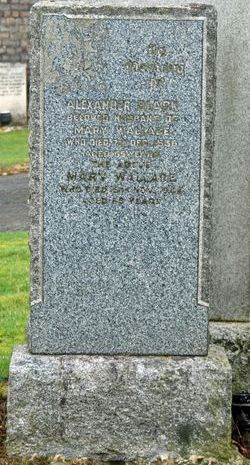
Alex Black's Grave, Newmilns
The Go(u)lds
That William Gold was in 1893 the captain of the team of mainly Scots from the Sant Marti suburb of Barcelona that against the city's British Colony played the first competitive football match in Catalonia is a known-known, as is his record as one of the first two players to be sent off in the same. However, who William Gold was had been a simple unknown, perhaps until now.
The Sant Marti team was drawn from the lace mill newly inaugurated there by Newmilns, Ayrshire manufacturers, Johnston, Shields and a partner from Nottingham. Indeed, Willie Gold was said to have been born in Newmilns but he was not. And the key to the truth, in fact the story lies in the 1921 Scottish census.
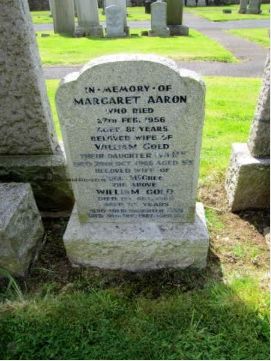
William Gold's Grave, Newmilns
There at 58, Jamieson Terrace, Newmilns is a Gold family, head-of-the-house Willie, his wife, Margaret, both aged forty-six so born in 1874-5 and two daughters. He is Lace Machine Tenter not for Johnston, Shields but by then Hood, Morton and Co. His wife is Newmilns-born but he is not. His birth was in neighbouring Galston. Moreover, whilst his 8-year old daughter, Mary, is Darvel-born, so the other side of Newmilns to Galston, the birth-place of his other girl, Agnes, aged eighteen so born in 1902-3, is "Barcelona, Spain".
That Willie Gold married Margaret Aaron is clear, but it seems not to have been in Scotland or even England. It points to Spain. That of neither of them seem to have been in Scotland in 1901 does the same. That in 1911 both are in Darvel with only Agnes, once more recorded as Barcelona-born, a British-subject by parentage, ties in with a known footballing presence in the city for young William from 1893 to 1903, perhaps without interruption. After something of hiatus, a retrenchment as James Reeves and George Cochran left the city in 1894-5, he would be part of its revival with the arrival of Hans Gamper in 1899 and the formal formation in January 1900 of Sant Andreu F.C., soon known as F.C. Escoces, with him in the team alongside other others mainly from the Irvine valley, George Girvan and John Hamilton. And when Escoces folded he would move on with Hamilton and yet another member of the team, "Joseph" Black, to Hispania, one of the then several local teams also to have emerged. That is until it too folded in 1903 and Willie seems to have given up the game entirely, although he stayed in city as the supervisor at La Escocesa, as the Sant Marti factory was known, until his return in 1908 to Scotland, to Newmilns, to retirement there and death too in 1969 aged ninety-five to be buried in the local cemetery.
But the above is not all. There is a further twist to this story. In 1934 a USA team with, like the 1930 team, several Scots in it took part in the second ever World Cup. It was held in Italy. And like the US team in that first World Cup it was managed by a Scot. His name is David Gould, David L. Gould to be precise.
He is said to have arrived in America in 1891, to be aged eighteen and to have settled in and around Philadelphia. He is then known to have played for John Manz F.C. from the city, winning the American Cup in 1897, also for Thistles, British-Americans and Eagles and before that is also said to have turned out for Philadelphia Athletic and the Phillies. But no record of a Gould exists for any of these teams, although several reports of Manz games included the name Gold and for the Phillies in 1894 there is also a Gold scoring from the left-wing.
Moreover, on hanging up his boots and in 1910 being notaly a "lace-worker" Gould in 1911 became assistant soccer coach at the University of Pennsylvania, retiring seemingly at sixty-five in 1938, although perhaps with an interlude back in the lace-trade. Still today the university presents each year's best player with the David L. Gould trophy. And he would also officiate. In 1926 he ran a line for the US-Canada international. He was also a well-regarded referee, serving as President of both the Referees Examining Board and the Referees' Association. As a result he was in 1953 rightly inducted into the US Soccer Hall of Fame.
Yet, whilst David L. Gould's role in US soccer is undoubtedly important, for our purposes it is in part peripheral. More to the point is that he is said to have been born in 1873 and in Galston. In fact his American death-certificate gives his birth-date as 4th January 1871, his father as John Gold and his mother as Mary Lindsay thus in 1891 he was not eighteen but twenty. Furthermore, in early 1891 at 8, Loudoun Rd in Newmilns and Greenholm the census records John Gold, a miner, his second wife, Jane, five of his children with her and three by his first wife, Mary Lindsay. This latter trio includes sixteen year-old William Gold, born 1874 and a "Truttler", and "Factory Worker", David L. Gold, aged twenty so born in 1871 and in precisely Galston. In the USA the name might have morphed, the age perhaps been a little "adjusted", Galston become simply Scotland but there seems little doubt that Willie Gold and David L. Gould, by Scots tradition, David Lindsay Gould , the former a Spanish footballing pioneer and the latter very much his equivalent in the USA, were full brothers.
The Mauchans
In early Spanish football, specifically in Barcelona, there is the known involvement of four Mauchans, of which Davie, pictured left, is only one. And there was confusion. It was thought that the same Davie had been born in Dumbarton but it has proved not to be the case. He was, in fact, Catalan-born, a Hispano-Scot, who, like his equivalent South American Diasporans, inherited his passion for the game from family, in this case his Scots-born father and siblings.
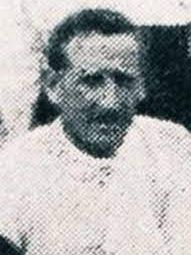
Davie Mauchan
Thus the story in fact begins with his father, William. William Mauchan Snr. was born William Machan in 1855 in Pollokshaws on the banks of the White Cart. His own father was a bleacher. And in 1879 still in Glasgow but now in the centre he married Elizabeth Stewart. With her he would have seven children, three, William, Peter and Archibald born in Glasgow, William dying young, two, Elizabeth and John in England, and two more, David, himself, and a second William in the Sant Marti suburb of the Catalonian capital.
William Mauchan Snr's birth-date meant that he grew up not just in the heat of the explosion in the 1870s of football in the West of Scotland but in part also just a few hundred yards from its hub in the 1860s at Glasgow Green.
Moreover, he, following in the foot-stps of his father, also became a skilled textile worker, a cloth-finisher, and it was this that took him first to Nottingham and its lace-industry. He was in the city in 1891, having moved there about 1885. And it was also lace that then took him Barcelona in the early 1890s, perhaps just too old to play football but still with a passion for the game that would express itself through a refereeing qualification and his growing and future sons.
In 1893 the Newmilns-based lace-makers, Johnston & Shields, in partnership with Nottingham-based Edward Steegmann, a footballer himself with Notts County, began lace production in San Marti. Forty workers mainly from the Ayrshire Irvine valley arrived to man the new facility and, amongst them it seems, the equally-Scots Mauchans, William now a foreman, were sent from the English Midlands. Indeed such was the Scots presence that the mill soon became known as La Escocesa, The Scot. The building is still there, now a centre for artists.
There, given the Scots passion for the game, football began almost immediately. That winter at least three games were played between a factory team, captained by Willie Gold from Newmilns itself, against Barcelona's English Colony, its involvement driven by James Reeves and George Cochran. However, Cochran would probably move to his employer's, the Paisley thread-makers, Coats, new mill inland at Borgonya in 1894 and Reeves left the city the following year so by 1895-6, whilst William Snr. is known to have refereed games in May 1895, official matches died away.
Yet, clearly football continued to be played and by the turn of the century the setting-up of an official team, Escoces F.C., based on La Escocesa and other local, Scots textile-workers, took place. It would be captained by Darvel's John Hamilton. William Mauchan Snr, would be its in-house official and his eldest, surviving son, 17/18 year-old Peter, a founder and team member. On 2nd February 1900 William Mauchan ran the line in Escoces first match. It was against also newly-formed multi-national Barcelona F.C. as was the second match, where Escoces combined with the strictly Catalan team, Catala. There Willie Mauchan took the whistle and in doing so became the first referee in Spain to issue a red-card, in fact two. Barcelona's Englishman, Sidney Harris, and Willie Gold himself clashed. Both were dismissed.
Perhaps as a consequence in Escoces' next game Mauchan seems to have been stood down. John Hamilton refereed and his place in the team seems to have been taken by a second Mauchan, presumably Archie, now aged 15/16 but by the end of the season the team because of external factors had folded with several of the players moving on. In January 1901 a Mauchan, Peter, was one of three in the Barcelona F.C. team that lost to Hispania, itself fielding two more. But he was not there the following season. However, William was and again not without controversy. In April 1901 he refereed the final game of the first playing of the Copa Macaya, with Tom Shields of Johnston, Shields the President of the organising committee. Hispania played Barcelona. Hispania needed a draw to take the title. Barcelona conceded an own-goal. Its founder, Gamper, equalised and then Mauchan disallowed a second Barcelona goal for off-side. The match finished 1-1. Barcelona were less than happy, which seems more than a little petulant, seeing as William was not the only Mauchan on the field that day. The Barca eleven included reappeared Peter.
At this point William Mauchan Snr. seems to have stepped back from the game completely. Peter also stepped down as a player but he too turned to refereeing. With John Hamilton, its founder in 1902, he was an early member of the College of Catalan Referees. But meanwhile his younger brothers were taking up the game. In 1909, John, aged twenty, would be instrumental in the emergence of a second team from San Marti, Jupiter F.C. one that exists to this day. There he would be joined by David and William Jnr. and with longevity. The latter's connection with the game in Catalonia would continue for another forty years as the organiser of tours there by British teams, St. Mirren in 1927, Burnley in 1949, this whilst John's role would be recognised fifty years later as guest of honour when in 1959 Jupiter played none other than FC Barcelona.
William Mauchan Snr. would have been sixty in 1915, sixty-five in 1920 and retirement took him back, and perhaps most of the younger family, not to Scotland but Nottingham. He would die there in 1927 at the age of seventy-two. Elizabeth, his wife, would follow him in 1943 in the same city. Peter had also returned and to England. He would marry in 1912 in Coventry, have a daughter there the following year and travel the world, notably to Spanish-speaking countries, for the next two decades at least as a Clerk cum Commercial Traveller cum Export Manager. Post the Great War it seems he and his family might even have settled for several years in Colombia before returning to live in Halifax, Yorkshire. And it was there in 1943 that he would die, aged sixty-one. Archibald would also return and to Nottingham once more. He would die there in 1937 without having seemed to marry. John was the only one of the siblings to remain in Barcelona. Davie on his return would enlist during the Great War, perhaps return initially to Glasgow post-war, marry in 1942 in Kettering to Phyllis Cooke but die in Nottingham in 1964, aged sixty-nine. And William Jnr. did return to Scotland long-term. In 1918 in Calton in Glasgow, a stone's throw from where his elder brothers had been born, he, recorded as an optical lens grinder, married Jeanie Joyce. Two children, also William and Jean, were born there in 1919 and 1920 with the four of them continuing to stay nearby at least until 1922. But then they too would move South, by 1939 staying in Manchester. And it would be still in that city that Jean would die in 1966 and William precisely a decade later at the age of seventy-nine.
Jim Dykes
Definitely three fellow Scots are known to have played in 1893 in the encounter between of the team from the Sant Marti suburb of Barcelona against the city's British Colony in what was the first competitive football match in Catalonia. One was Willie Gold. John Hamilton was the second and the third was Jim Dykes.
And of the third knowledge was limited. That is perhaps until now. A James Dykes died in Jeffery Place in 1904. He was twenty years old, married to Agnes Alexander and a Baker's Vanman, his death signed of by his brother John. He had married Agnes in Galson three years earlier, she from Darvel, he from an address in Rutherglen and it was there the couple had gone to live, he then recorded alternatively as a Power Loom and Lace Weaver. And he had grown up in Newmilns, born in the village in 1876, in 1891 a fifteen year-old Lace Shuttler, living at home with father and brother, both Johns, mother, Margaret and three two more siblings.
So might it have been him or a second James Dykes born in Darvel in 1875, raised in Glasgow's Tradeston, nowhere to be seen in 1891 but by 1901 married to Glasgow girl, Marion Roberts, back in Darvel on West Main St. and a Lace Card Cutter, who would pass away on Arran in 1940. Either is possible.
_________________________________________________________________________________________________________
And if in Barcelona the first wave was George Cochran and La Escocesa that would not be the end of the end of the flow. It would seem that once the eponymous football club had a taste of Scottish playing ability it did not stop there with Hans Gamper first finding almost by chance his next, indeed his first great goal-scorer, George Pattullo, and then clearly turning to Newmilns contacts to recruit with a short delay the next, Alex Steel.
George Patullo
Here was a man who arrived in Spain, in Catalonia, in Barcelona as a tennis-playing coal-merchant and left a year later a footballing hero with a goal-scoring record for the club that bears the city's name that is second to just two; and one of them is Lionel Messi.
The story is that Jorge Patullo, George Pattullo and not John Patullo as he is sometimes called, George Simpson Drynan Pattullo was discovered by Hans (Joan) Gamper/Kamper, the founder of Barcelona Football Club, playing as a ringer. He had been drafted in to make up the numbers for the former in a match in the city between a British eleven and a University team. As such he was stuck in goal, had five put past him by half-time, played the second half up front and scored five in what ended a 6-5 victory. The University wanted a rematch. It ended 4-4 , Pattullo scoring all his side's and a watching Gamper more than impressed.
Such is the stuff of football legend. The year was 1910 and it may have been that Pattullo had arrived in Catalonia not directly from Scotland but Newcastle. Certainly he was back there in 1914, joining the Tyneside Scottish Brigade for the Great War, being awarded the Military Cross and also being badly gassed. And he still there for much of the next decade and a half, on the face of it curiously from 1918 to 1920 living with a Georgina Pattullo, then alone for a year and for six more years until 1927 with an Agnes Pattullo.
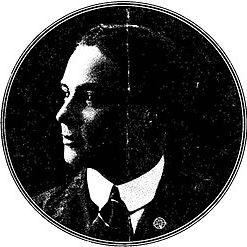
George Patullo
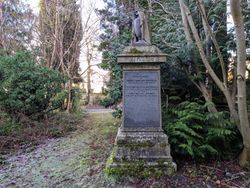
George Patullo Memorial, Cathcart Cemetery
But he had been born in November 1888 in Glasgow right in Crosshill, the son of a prosperous Oil Merchant, who had died eight months earlier in April. And grew up there almost within sight of Queen's Park and Hampden at a time when the Scottish game was at its second peak. In 1891 and 1901 he and his elder sister, Jean, the Newcastle Georgina, who married there in 1920, were staying either side of Maxwell Park with their maternal grandmother, Agnes Drynan, living on private means with their mother, again Agnes; which also suggests she might have been the one to have been with him again in Newcastle two decades later.
Thus it was that under Gamper's initial wing the man described as the club's "most important and influential Brit of all time" and therefore ranking him above Gary Lineker, Steve Archibald and Mark Hughes made his first appearance for Barcelona in September of the year of his arrival. He would play twenty-four matches for the club, twenty-three that season, and score forty-three times, forty-one in those twenty-three, and by the time the business that had brought from Britain meant he had to return there again it would win the 1910-11 Catalonian Championship.
And that would have seemed to be it. But he did return for one last game and flourish and two final shows. Firstly, Barcelona had reached the semi-final of the 1912, cross-border Pyrenean Cup. The game was against city rivals, Espanyol, and not only was he just able to make it to start but to score twice more in a 3-2 victory. It prompted the losing club to make Pattullo an offer to turn professional but he not only declined, ever the amateur, but also seemed to have left playing football, if not football itself, entirely behind. Secondly, in 1928 he returned to the Catalan capital and the then stadium, Camp de les Corts, taking the honorary kick-off of a Spanish Championship game between Barca and Oviedo, this in the year before the foundation of La Liga. The date was the 15th April, Barcelona would win 7-3, Samitier, Pattullo-like, scoring five and it was probably no more than pleasant break for the Scot en-route to Majorca. The gassing of two decades earlier had taken a toll on his health and the warmth and dry the Balearics was thought might be helpful. It probably was at least initially allowing him to dip a toe once more in the game. The move to the island allowed him in 1930 to manage, albeit briefly, Palma's Club Baleares.
It was also on Majorca that Pattullo is said to have married, although the marriage does not seem to have lasted. He was soon to have returned to the the UK, probably hastened by the outbreak in 1936 of the Spanish Civil War but it was neither to Scotland or even Newcastle but to London. In the meantime both his sister and his mother seemed to have moved south and he looks to have followed.
In London he seems to have settled specifically in the Notting Hill Gate area. In 1947, so in his late fifties, he was living in Lancaster Gate, with few other details except there might have been decline. perhaps even alcohol problems. Certainly he would die aged sixty-four in September 1953 with his address given as not far from that of 1947 but in then far less salubrious North Paddington.
However, that is not quite the end of the story. The death itself was registered not in North London but in Putney cum Wandsworth. The reason was probably that his ninety year-old mother would survive him by a year and, as she had been a decade earlier, was living there albeit she would die in Lancing in Sussex. But even there there is an explanation. Her daughter and George's sister was nearby. Her death in 1964 would be in Worthing.
However, there still remains one last quandary - George Simpson Pattullo's burial-place. In spite of his death down South it was thought that it had been in Cathcart Cemetery, Glasgow, just a short distance from his childhood homes. But the substantial plinth there is thought now to be a memorial- not a grave-stone, with as a final twist its erector and therefore Pattullo-honourer for now still unknown.
Alex Steel
As George Pattullo left Barcelona, city and football-club, for the second and final time in 1912 his footballing boots would prove hard to fill. FC Barcelona stalled a little and the search must soon have begun for a quality replacement.
And in searching Juan Gamper, founder and President, might well have turned to one of his ex-players, Darvel-born, neighbouring Newmilns-employed John Hamilton. The reasoning is thus. In Catalonia's capital Hamilton had become a top referee. He would officiate the 1912 Copa del Rey final. But, having recently spent time in his home-town, he would have become more than aware of three local brothers, the Steels.
From Newmilns all three were professional footballers. In England eldest, Danny, had seen Tottenham into the Football League in 1907 and was still there. Youngest, Bobby, had also just joined Spurs. And middle one, Alex, Sandy, having left the same club the previous year, had been at a loose end back at Kilmarnock. It was therefore probably not coincidence when he was signed by the Blaugrana.
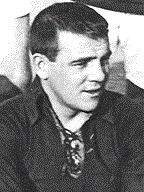
Alex Steel
Alex Steel had been born in 1886 so was twenty-six when he arrived in Barcelona. He was the youngest son amongst at least nine children, of locally-born parents, his father a Power Loom Lace Weaver. At fourteen Alex was already working, as a Lace-Shuttler, but football would provide him, as with his brothers, with a way out of the local industry. Albeit it would prove a precarious one.
At nineteen he would be signed as a right-half directly from his home-town club to Manchester City, there making thirty-two appearances in three seasons. But he never managed to cement a first-team place and that had proved to be the same at White Hart Lane. However, in Spain from February 1911 he was soon converted to forward and with considerable success. According to once source in forty-three games over fifteen months, mostly friendlies, he would net fifty-six times, from another it is sixty-two in forty-nine; better than Pattullo, better than Messi. As a result Barca won the Pyrenees Cup in 1912 and in 1913 it and both the Catalan and Spanish Championships.
It might perhaps have been expected that, given two such seasons, Steel might have returned to Britain in triumph. But it was not so. On leaving Spain in May 1913 he found employment for 1913-14, but only with Southend United in the Southern League, Division One. Then came The Great War, where he seems to have been recorded curiously as serving both in the Royal Navy and the RAF and after which, aged well into his thirties, he would manage only one more footballing season in the same league and division but at Gillingham. It would back in defence, after which he was not retained as the club stepped up to the new League Division Three.
On retirement Alex Steel seems to have settled back in London's Tottenham area and become a printer. Certainly he was recorded as such when in 1925 he seems to have married Hilda Olive Patmore in Edmonton. But at this point mystery sets in. Wikipedia reports him as dying in St. Albans in Hertfordshire in 1954. Elsewhere there is record of the death of an Alexander Steel, again St. Albans, in 1932. But this Alex is at forty-four two years too young. Additionally, whilst in 1938 an Hilda Olive Steel is recorded living with a Grace Patmore in Kent, the following year she is with her elderly Patmore parents again in Hertfordshire. Moreover, she is by then both perhaps a mother, of a fifteen year-old girl, Betty (Steel), so born in 1924, and already a widow, which means that both Alex's year and place of death, although probably in England, remain unclear but with certainly the former unlikely to have been the later of the alternatives.
Back to the SFHG Home page