Plinths & Plaques, Statues and Graves
As with not just this but all our trails, local, national and country, we hold the view that merely recording or even putting on-line is a start but not enough. To do justice to the pioneers, as have a few clubs, even countries, to which they went, as in Scotland in the case of Tommy Donohoe and following the lead of Brazils's Bangu, Busby has too and as has SHFG again in Scotland, but also in England and Northern Ireland, there should be, both at home and elsewhere, place for more statues, golden or otherwise, restored, maintained graves, busts on plinths and if not them then plaques.
So, whilst we research and provide biographical and other details of as many of those Scots, native and Diasporan, who through deed and feet spread globally and uniquely the footballing word, we also look at where, in places from which they came or they rest, and as visual expression of our contemporary, national pride in them and those same localities, some form of physical, outdoor recognition would be both appropriate and feasible.
The Dundee Trail
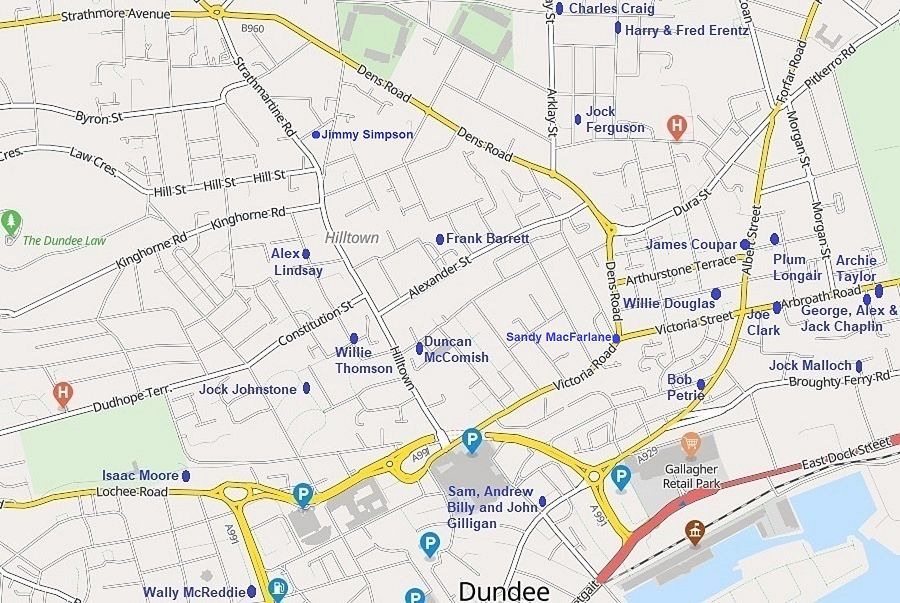
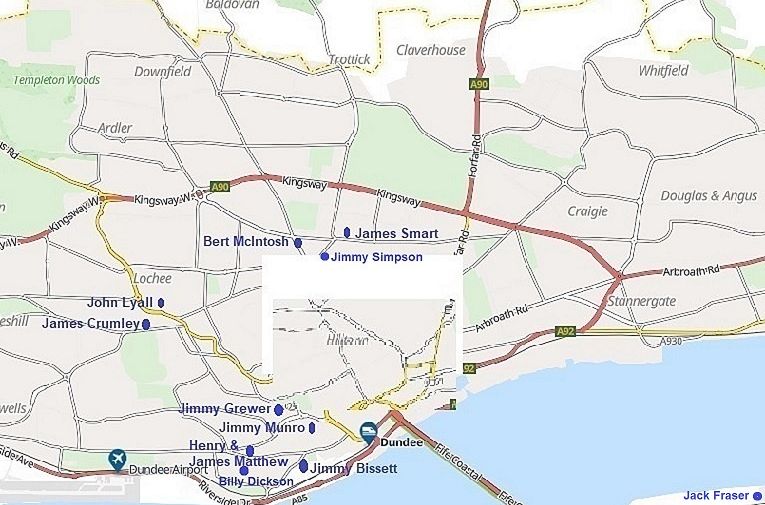
Football came to Dundee a little later than to the Central Belt. Clubs began from 1875 with the formation of St. Clements, Our Boys was founded in 1877, Dundee in 1893 and Dundee United not until 1909. As a result the flow of players into the national team and abroad, mainly to England but also to the USA, was also slow, at least to begin with. The first to gain a cap was "Kitie" Hamilton in 1891. However, by that time a Dundonian was already very successfully playing abroad. Prior to his departure to Denmark in about 1885 James Smart, James Young Smart, had been Secretary and Treasurer and well as turning out for his home city's Strathmore team before transferring his on-field loyalties to Copenhagen's Boldclub, claimed to Continental Europe's oldest. And in 1889-90 the twenty-seven year-old clerk, had with twelve goals already been the top-scorer in the city's league's inaugural year.
And nor would Smart be alone in taking the round ball game across the seas. By the end of the century football had just arrived in Mexico and the winner's of its first championship was the team from the calico factory at Orizaba, a founder and leading-light of which was Duncan McDonald McComish, born in Kirriemuir but brought up amongst the jute workers of the city of the Tay before emigration to and marriage and a family in Spanish America.
Others - to England and Beyond
And in time Dundonian players would take themselves and/or their skills, professional not amateur, to Engiish-speaking America too. First to go would be Jock Ferguson, who would grow up almost in site of Dens Park, play for Dundee, elsewhere in Scotland and in England until drawn across the Pond to Pennsylvania. There he became part,, on and off the field, of the first highly-successful Bethlehem Steel of the 1910s, then in the boom years of the 1920s becoming a stalwart of the same club, playing until well into his forties and even in 1925, already aged thirty-eight, winning a US cap.
Back to SFHGHome page