Glasgow's Football Square Miles
(If you've caught FSM, this is the antidote!)
Welcome to Proper Football History
This SFHG piece has specifically two purposes. The first is to correct the mistakes on the web-site Football's Square Mile. They, the least egregious being that it is actually over four square miles, have been pointed out to them. But for whatever reason nothing has been done and, as Scotland's pivotal role in the creation of the global game of modern Association football is better understood and beginning rightly to be celebrated, for the sake of fans and august organisations such as Historic Environment Scotland or the National Trust of Scotland alike, accuracy is important. The second is to counter the superficiality of that same site by providing a far deeper insight into the development in first inner and then outer Glasgow of both early forms of specifically of round-ball football and then the Association game.
And to do that we have created and added four trails to be followed either on-line or on the ground in person - two in the centre of the city, one with a side loop to Kinning Park, all best done on foot wth perhaps a little help from the Glasgow subway, a third, perhaps better by car but subdivided into four again walkable loops, all in the Crosshill, Queen's Park and Pollok Park areas. Here official designation and therefore a degree of preservation has recently been achieved for the second Hampden, Cathkin Park, and we await the final outcome for Hampden Bowling Club, the first Hampden. And there is a fourth, comprehensive trail for Cathcart, where designation has also just been achieved for perhaps the World's single greatest depository of early footballing history that is Cathcart Cemetery. Only Woodside Cemetery in Paisley comes close. But first a little ................
Context
In the middle of the 19th Century Glasgow was a city on the move. In 1750 it had about 30,000 inhabitants. In 1800 that had become around 80,000, by 1850 over 300,000 and by 1870 it had a population of 500, 000, half a million, drawn in from all parts of Scotland, from Ireland and even from South of the Border. Nothing illustrates that growth better than the map below. It is from 1879 with both St. Enochs and from that same year Central Stations in place and markers, Kinning Park, Hutchesontown and even Fleshers' Haugh more than embraced by building and Pollokshields urbanising. Yet also shown and in red is the extent of the city a century earlier in 1773. It had been almost all north of the Clyde, with a little across the river to either side of the road south, so no Tradeston, no Gorbals, and still open land to Glasgow Green.
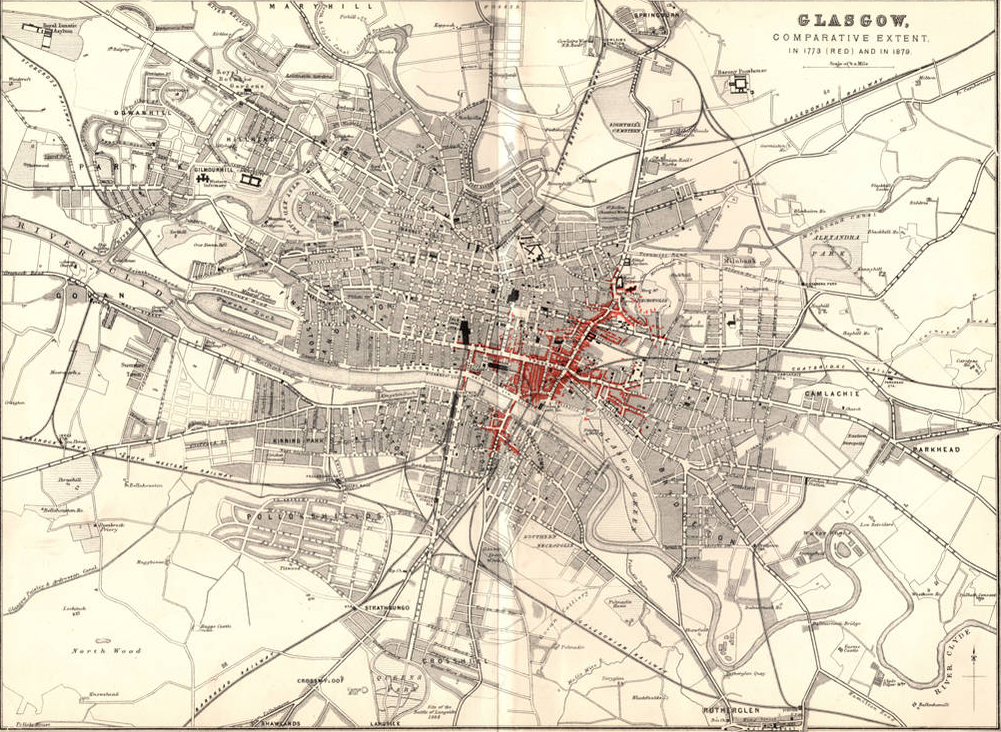
(Bridge St (1840), Southside (1848), St. Enoch's (1876) and Central Stations (1879)
And a substantial amount of that change over the century, particularly on the southern bank and as shown in both the maps below had taken place in just the previous decade and a half, the same fifteen years that from 1865 that had seen first the coming to the city of organised, team football, but not yet the Association variant, and then the arrival and embedding of the new, round-ball game. By 1865 building north of the river had reached out west and east. Fleshers' Haugh was now enclosed, whilst on the south bank, with the railways, the old Bridge St. Station finished in 1840, the former Southside Station from 1848 and actually at the bottom of Gorbals St., Tradeston, Laurieston and The Gorbals were already formed as Hutchesontown was forming.
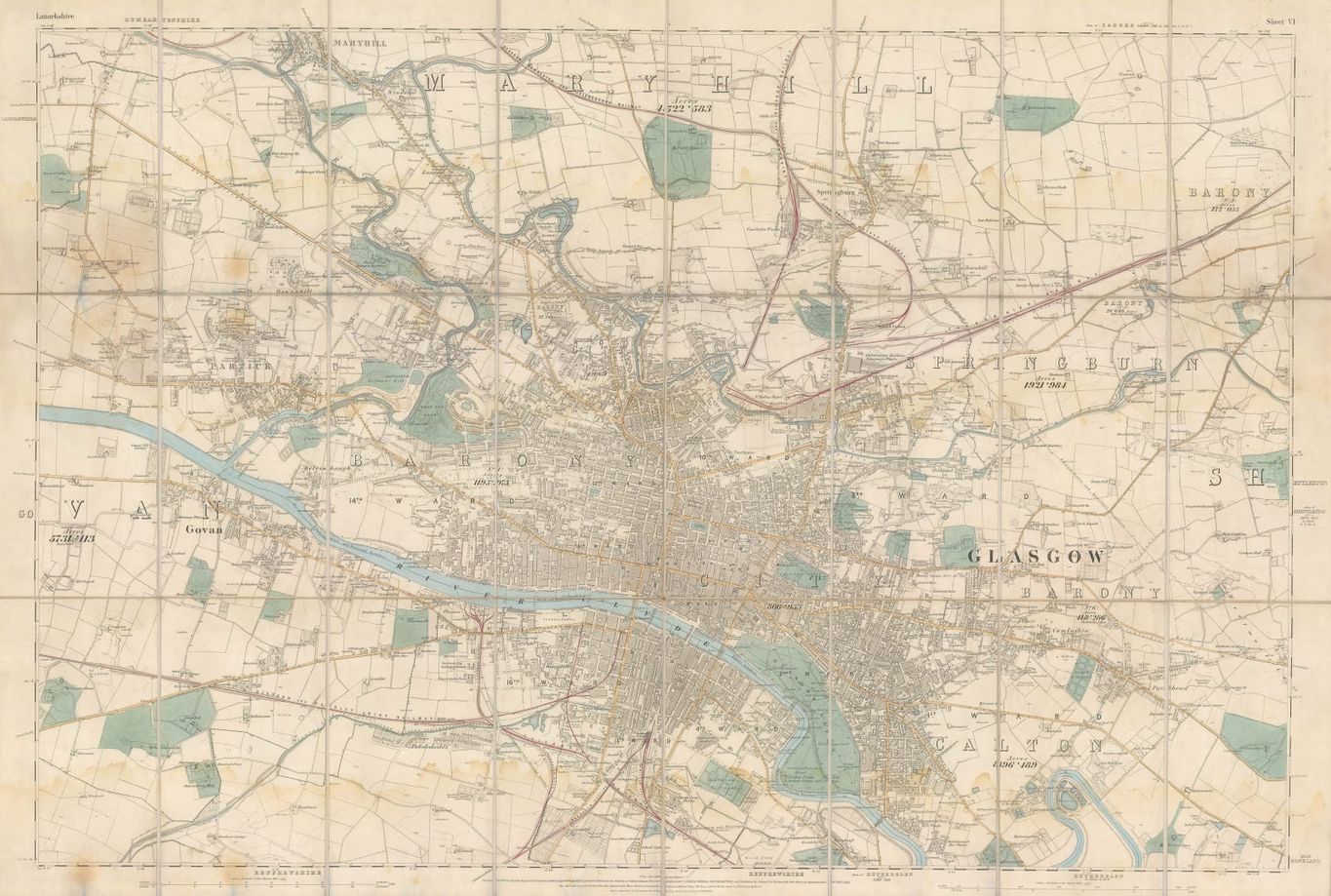
(Glasgow 1865 with Southside(1848) and Bridge Street Stations (1840))
Moreover, this urban growth was, as again below the map from 1869 shows, reinforced by the grapic also below, that even over the next four years visibly to advance both East into the area of Kinning Park, South to Govanhill and a little beyond and even, almost as a new town, into Pollokshields.
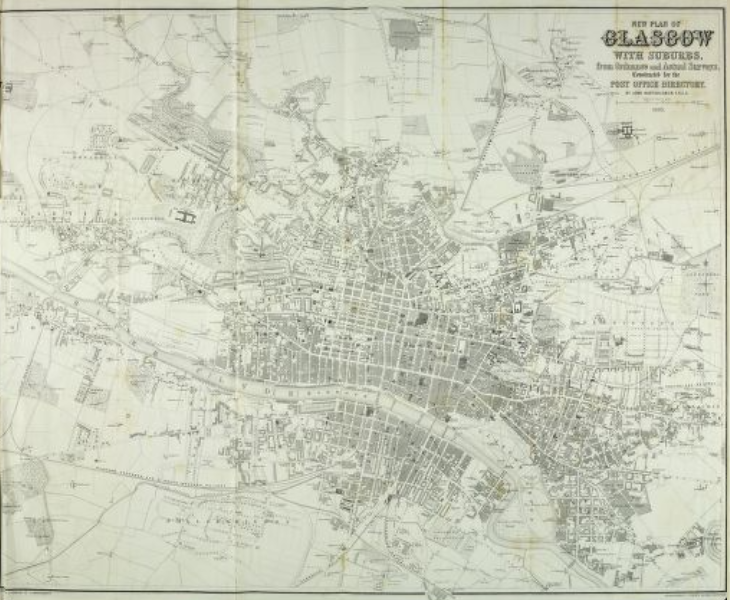
(Glasgow 1869 with Southside (1848) and Bridge Street Stations (1840))
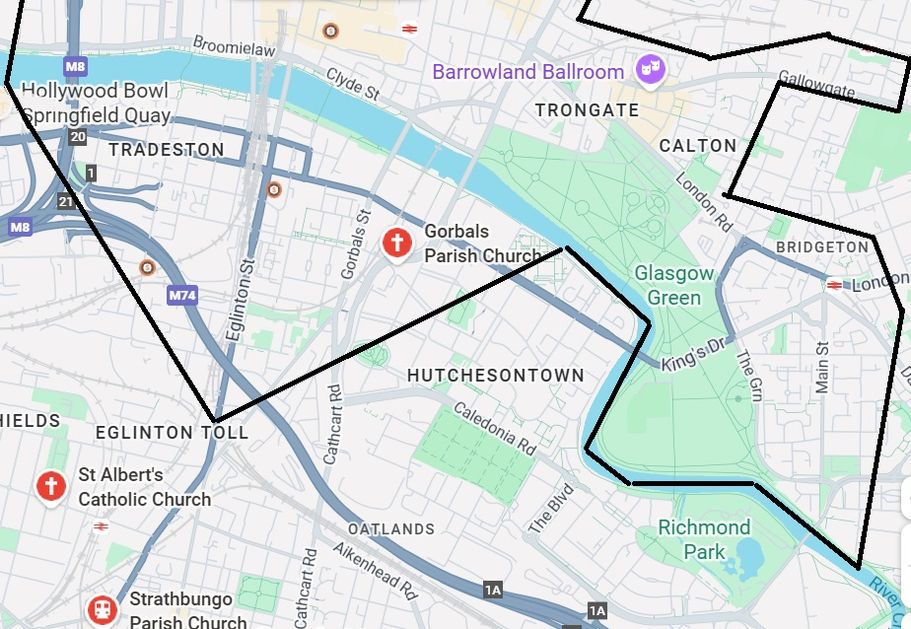
It meant that recently rural Strathbungo had by the mid-1860s already been encroached upon, forcing a group of "young" men, previously practising their athletic pursuits close to its centre, to look a little further south still for an alternative location and, it is said, for them and the kick-about first to come into contact. Whether this is strictly true is perhaps open to doubt. A number of them were not young by even the footballing standards of today, had been in central, southern Glasgow for the best part of a decade and surely seen and perhaps even played football on Glasgow Green. But this was new territory. Whilst organised, team games, albeit few in number, might have been taking place by the Clyde it was not yet the case in the parish of Cathcart.
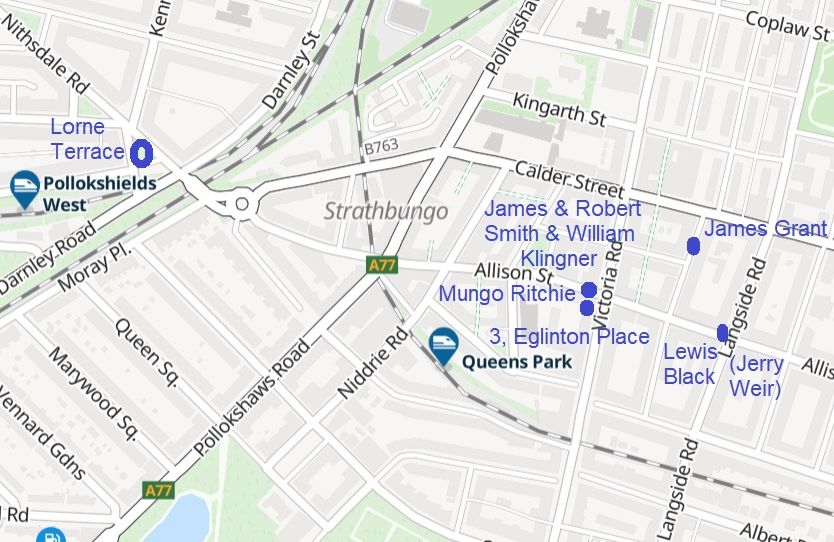
But that was to begin to change on 9th July 1867 when that small group of Strathbungo incomers, all just younger than thirty or in their late teens, met in or above a tavern in what was then Eglinton Terrace, on the corner of Allison St. and Victoria Rd.. Quite what the area looked like at the time is impossible to know. It is just pre-photo and there are no illustrations, maps show the terrace as somewhat isolated with much in all directions an actual or potential building site. And why these young men were drawn to the area is also difficult to fathom. They were, as it turns out but rarely stated, largely drapers and clerks, by location, as shown above, a concentrated group thrown together as much by circumstance and perhaps finances as anything else. Strathbungo itself had no railway link to Glasgow until 1877, but was a three-quarter of an hour's partly rural walk to the Clyde so commutable even on foot. However, out of that meeting was born Queen's Park Football Club, Scotland's doyen, named for the recreational space for Glaswegians, to which Victoria Road was the link from the city. But initially let us look at the birth of football in the city itself
Trail One - Early Doors - (Glasgow football 1860-1870)
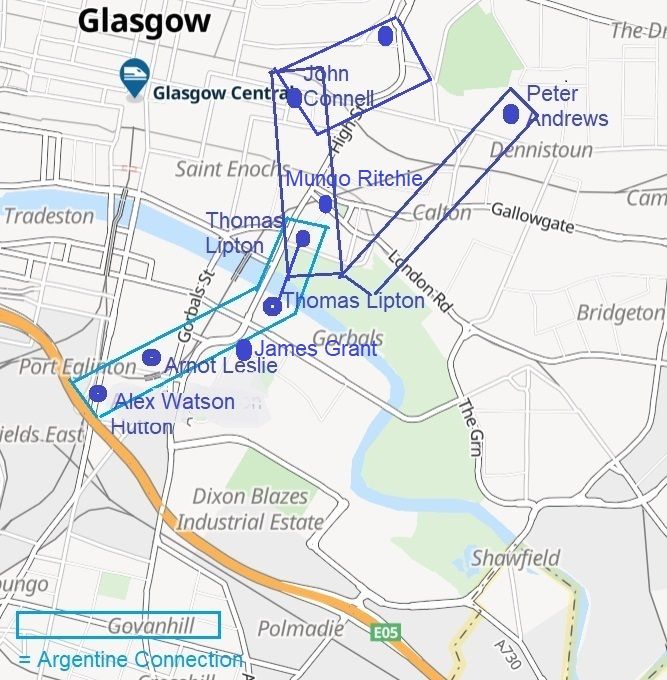
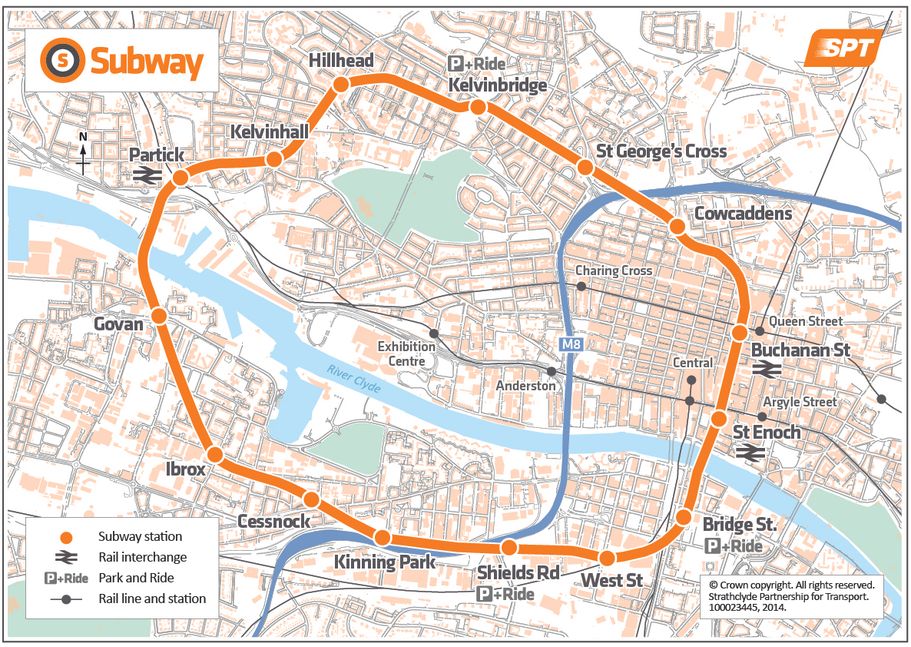
This first trail covers the decade from 1860 to 1870. As well as virtually, on the ground it can be followed separately to or with our second trail, for the period from 1870 to 1890, which itself can be as one or two loops. Both start and finish at Glasgow Central Station and can be done on foot with, if necessary, a little help from the Glasgow subway. Indeed, that is what is recommmended for the longer Trail Two. It is a mile out to Kinning Park, Subway partly out from West St. and back to Bridge St. or Buchanan St. then 3.5 miles in total or alternatively 2.5 miles for the northern loop and the same for the southern one. Trail One is less than two miles. And it begins with the coming to Glasgow of the round-ball game and in 1862 from Perthshire of.....
John Connell - (89, Taylor St.)
John Burns Connell, himself a future player of national significance, is, perhaps more importantly still, said to have arrived in the city with a ball he would make available for hire. It was to be the start for him of an organisational and on-field relationship based on Glasgow Green with first more generic, round-ball football and then from 1872 that based on Association rules; one that, for him with the Thistle, Drummond and Eastern clubs, would last a full decade and half, including as full-back a place in the representative team from the city against Sheffield in 1874 and being a reserve for the England-Scotland game the following season.
Connell would step back from the game in 1876 and in 1877 marry his German-born wife from 89, Taylor St.. It now sits at the centre of the Strathclyde University complex but even then not quite a mile from Glasgow Green, where he may well a decade earlier competed against or played with Thomas Lipton, Arnot Leslie and others
Thomas Lipton - ( 13, Crown St. ) & Arnot Leslie - (Norfolk Lane and 48, Bedford St.)
The Liptons were from Ulster and the Leslie's from Dunfermline and Perth but both the boys had been born in the then newly-built Gorbals, Arnot in 1840 and Tommy in 1848, the latter on Crown St. leading to the river, the former on Norfolk Lane. But by 1871 Lipton, aged twenty-two, was living living still on Crown St., at number 13, at his parent's small grocers, before opening his own shop across the river, the first of a grocery empire that would make him a millionaire, the remnant of which is still Lipton's tea. However, in the meantime the Leslies had moved to 5, Wallace St., on the corner of Eglinton St., and then to 48, Bedford St., Arnot now a tinsmith, a plumber, who in about 1866 and by then in his mid-twenties would emigrate with his wife and one daughter to Argentina and in Buenos Aires set up a successful plumbing business. Norfolk Lane and Crown St. are five minutes on foot from each other, Bedford St. and Wallace St. five minutes more.
Alexander Watson Hutton - ( 29, Eglinton St. )
And then there is the third figure in all this - Alexander Watson Hutton. Watson Hutton grew up, went to school, college and emigrated from Edinburgh. He would also meet both his wives there but he was born in Glasgow, in 1853 and at 29, Eglinton St. in The Gorbals, his parents from Fife, his father again Dunfermline. Eglinton St. is five minutes on foot from Bedford St. and ten from Crown. And the links are, firstly, Thomas Lipton was educated until 1863 two minutes away from home but just across the river at St. Andrew's Parish School on the corner of Greendykes St. and Turnbull St., so right on Glasgow Green. Football, Connell-football, was literally on his doorstep. Secondly, Watson Hutton went as a teacher also and, like Arnot Leslie but a decade and half later, to Buenos Aires, where he founded the English High School, and from where came first the school football team and the great Alumni one of the first decade of the 1900s. Moreover Watson Hutton, regarded as "Father of Argentine Football", in 1893 had been the first president of the second Argentine football league and his son, Arnold, would in 1906 become an Argentine internationalist. Thirdly, the southern Buenos Aires teams, Lomas F..C. and Lomas Academy, would carry that second Argentine League in the each of its first six seasons of its existence, with several of its players also going on to play for the country, including George and William Leslie, two of Arnot Snr's sons, both Buenos Aires-born. And it was the two Arnot Leslies, Senior and Junior, his first son born again Buenos Aires, who coached/managed the Lomases through their glory years, only ended when in 1899 Senior retired back not to Tradeston but Glasgow's Southern Suburbs. Indeed he would die on Monreith Road in Newlands in 1904, in the house he had named "Argentina".
But the real significance is that a year after Arnot Leslie Snr.'s death the by-then Sir Thomas Lipton, who incidentally is buried in Glasgow Southern Necropolis (see Tour 2) three quarters of mile from his childhood home , seemingly out of nowhere presented a cup to the Argentine Football Association, the Copa de Caridad (Charity) Lipton, to be played for by Argentina and Uruguay. Why? Fer Auld Land Syne, perhaps?
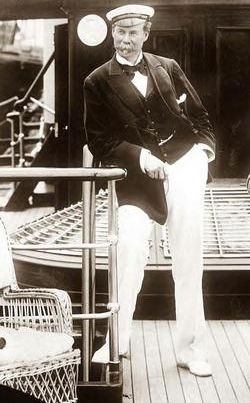
Thomas Lipton
__________________
Arnot Leslie
__________________
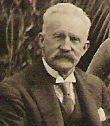
Alexander Watson Hutton
Peter Andrews - (5, Dunchattan St.)
Which leaves us in this tour with one final figure of note and two that are intruiguing. First, In 1876 Peter Andrews would be one of the first two Scots at much the same time to take the English shilling, at least to play football. The other, J.J. Lang, was twenty-five so, even though both went to Sheffield and to play to its rules, he had come into the game with the arrival to Glasgow of the Association variant. Andrews, originally from Ayrshire, was, on the other hand, already almost thirty-one and had been playing for the Eastern club, which had emerged Callander and before that Thistle, founded already in 1868 and with the involvement of John Connell. In fact Andrews and Connell were club-mates at Eastern, would be in 1875 in the Glasgow team that played and beat Sheffield with every chance that Andrews, a baker to trade, had been involved with Glasgow Green games from earlier than 1872. By 1871 he, his wife and family were living at 5, Dunchattan St., a fifteen minute walk from the open space and, whilst the couple had been married in Tarbolton in June 1866 they are both recorded as by that time already staying in the city. It means there is every chance that he from the age of twenty, perhaps younger, was already learning at least the rudiments of the sport that a decade later would briefly become his profession.
Mungo Ritchie - (69, London Rd.) & James Grant - (125, Hospital St. and 21, Warwick St.)
And finally there are Mungo Ritchie and James Grant. By 1861 both were already in Glasgow, the former from Perthshire and the latter Inverness-shire. Ritchie was twenty-three and a draper boarding with an uncle and aunt just north of the Clyde at 69, London Road and within 200 yards of Glasgow Green. Grant was nineteen, a draper's assistant, staying just a little further away to the south of the river at 125, Hospital St. in The Gorbals before moving by the following decade to nearby Warwick St., now gone. It seems inconceivable, given that half-a decade later Ritchie would be the first President of Queen's Park and Grant still active on-field as its first goalkeeper as well as third President, that they did not get to know each other then through work and their love of the game began there also. Moreover, Hospital St. is less five minutes was from Bedford St. and just 10 minutes walk from the Green right past the Liptons' shop, so again the likelihood that plumber, draper, draper's assistant and shop-keeper did not at least know each other in passing, be it on the street or football field, seems small.
__________________________________________________________________________________________________________
And with that this tour is completed and, on-line, there is Tour Two whilst, off-line, it is back to Central Station.
__________________________________________________________________________________________________________
Tour Two - Central & Southside
(Glasgow football 1870-1890)
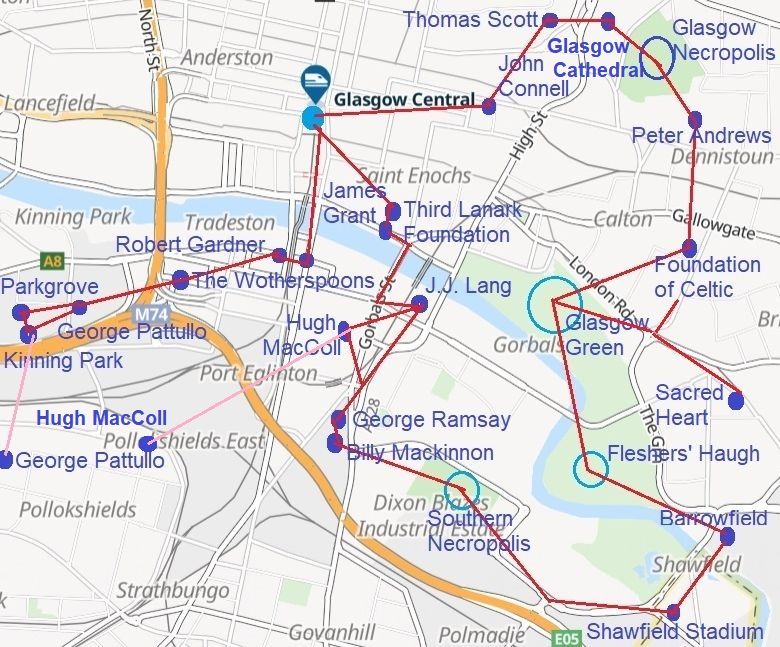
As with the first our second trail starts and finishes at Glasgow Central Station but moves on to cover the two decades from 1870 when the Association game became embedded and, whilst on-field it spread thoughout the city and beyond, off-field the centre of impetus and therefore power moved from Glasgow Green to the Southern Suburbs.
And this came about from two events. The first in three parts was in 1870 Queen's Park joining the Football Association in London with acceptance of and thereby formal agreement in their entirety to its rules, then an invitation to play in the first 1871 FA Cup. and, lastly, the first game in 1872. Any of them will do as a starting-point because the second event would not happen until 13th March 1873, notably precisely ten days after the formation, again in Glasgow, of the then Scottish Football Union and by the oval-ball game North of the Border.
This second move was due to a newspaper advertisment with responses to be sent to the home at 3, Valeview Terrace in Battlefield of Archibald Rae, the then Secretary of Queen's Park F.C.. Shown below and proposing the meeting's date and also place it interestingly seems to suggest and ask for expressions of interest not initially for an association but a Cup, mirroring the English FA Cup, the former then of necessity flowing from the latter and not the other way round.
The Scottish Cup and the SFA - (11, Bridge St.)
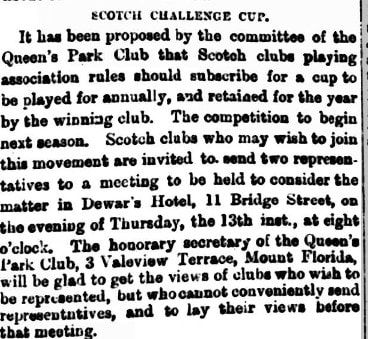
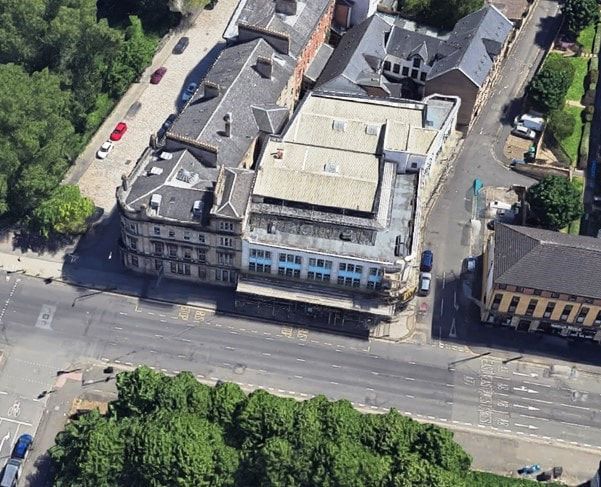
So what did Football's Square Mile do about all this? They had according to Mitchell outsourced their research, which identified the previous alcoholic Dewars and not the non-alcoholic one. The Scottish Football Association then did not double-check so a plaque marking its creation has been put up outside the former railway offices; so in the wrong place. Where it should be, if anywhere, is in front of an Art-Deco building across from and erected after demolition of the original building in the 1930s. So as a first stage of this trail, as you cross Glasgow Bridge to Carlton Place prepare yourself to look not FSM right but SFHG left by the bus-stop and you are there. It's where seven clubs in person and one more by letter kicked it all off, the Scottish Cup, official;y the Scottish Football Association Challenge Cup it seems first and, then to coordinate it, the Scottish FA. The only sadness, apart from the FSM and SFA foolish but potentially easily correctible error, is that of that first octet only two, Queen's Park and Kilmarnock, remain.
The venue was to be at 11, Bridge St. just on the south side of the Clyde by the then station of the same name. It was the Dewar's Hotel but this is where not simply confusion sets in but a major mistake is made. The story is best told by the inestimable Andy Mitchell in his blog, Scottish Sporting History. If you have not yet accessed it then should not only do so but read it "cover to cover". But the gist of the story is that the Dewar's Hotel did not exist. The Dewar family had prior to 1863 open several taverns in the area of the station, all called The Railway Arms. One of them at 16, Bridge St. was to be known colloquially as "Dewars Hotel". But in 1863 Alexander Dewar, the family head, was formally declared bankrupt and it was taken for railway offices.
However, Alex Dewar was soon able to clear his debts to the court's satisfaction and the family was able to find premises across the road at No. 11, Bridge St.. They were also formally The Railway Arms but, because this time no alcohol was served. soon earned the soubriquet, Dewars Temperance Hotel, shortened once more to simply "Dewars".
__________________________________________________________________________________________________________
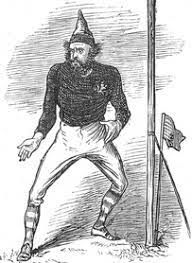
One of those present at that first SFA meeting and representing Queen's Park was Robert Gardner. By then, having developed from a forward into a fine goalkeeper, he was club and the first and until then the only national captain, having played in both the Scotland-England internationals, the second in London just a week earlier. It therefore seems unlikely that he, having also been the club's second ever Secretary, was there simply due to living closest. But he did. The Gardners, his father, Robert Snr and likely a founder member of the club, his mother, sister and brother-in-law, were all staying 50 yards away at 25, Clyde Place, Tradeston.
Clyde Place is still there but not as it was. When the railway was extended from Bridge St. station across the river to Central it was in the way and would be demolished. What remains is a road under the tracks eastward to Commercial St.. But first a little background. Within months, perhaps weeks Robert Gardner was to leave Queen's Park. One version is that it was because of what he would say at those first SFA meetings not being accepted by the rest of the then hierarchy. Perhaps it was because of tactical disagreements. Gardner was played other than in goal. The club, which had used a new Scottish 2-2-6 formation for both internationals then reverted the English 1-2-7 or 2-1-7. However, Gardener did not retire but joined rival club, Clydesdale, then at its Kinning Park cricket ground. And he did not go alone. There would also be the Wotherspoon brothers, with, when Gardner married in June that year, David Wotherspoon, a recent internationalist, as his witness, and Fred Anderson, a future internationalist. And with Anderson comes a third version of the ruction story. It has it that, as a sixteen year-old Fred, born in Glasgow but returning to it from England, he had joined Clydesdale F.C. on foundation but for the 1872-3 season switched to Queen's Park, did then not seem to get a game in the first team and returned to Clydesdale for 1873-4, with Gardner and the Wotherspoons not leading but following on. This version perhaps suggests Gardner, with a later reputation for bad-temper wanted Anderson in his team, was blocked and did not take it well.
__________________________________________________________________________________________________________
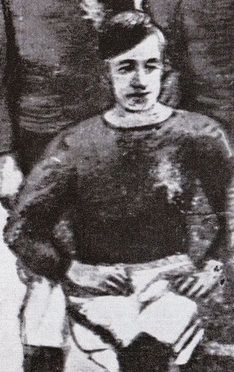
The Wotherspoons were from Hamilton. William, David, John and Thomas, all players, were born there, their father a baker, who had moved the family to north- of-the-river Glasgow in 1864 only to die there the following year.
But by 1871 the remaining family, mother, David the second eldest son, an Iron Merchant's Clerk, and his siblings were staying at 24, Paterson St., south of the river, less than half a mile from Clyde Place. And it is therefore probable that the slightly older Robert Gardner Jnr. and David Wotherspoon were neighbourhood pals.
It would explain why, given Robert Gardners Snr and Jnr connections with Queen's Park from its inception, David had joined the same club by 1870, already appointed Secretary in April that year, William played against Airdrie in June, he again against Drummond in July, against Airdrie September and he and John against Hamilton that same month. It would also explain that when there was a falling-out between Gardner and The Spiders in 1873, the Wotherspoons went too.
And they went to the then Kinning Park club Clydesdale.
__________________________________________________________________________________________________________
Kinning Park - Parkgrove & Rangers
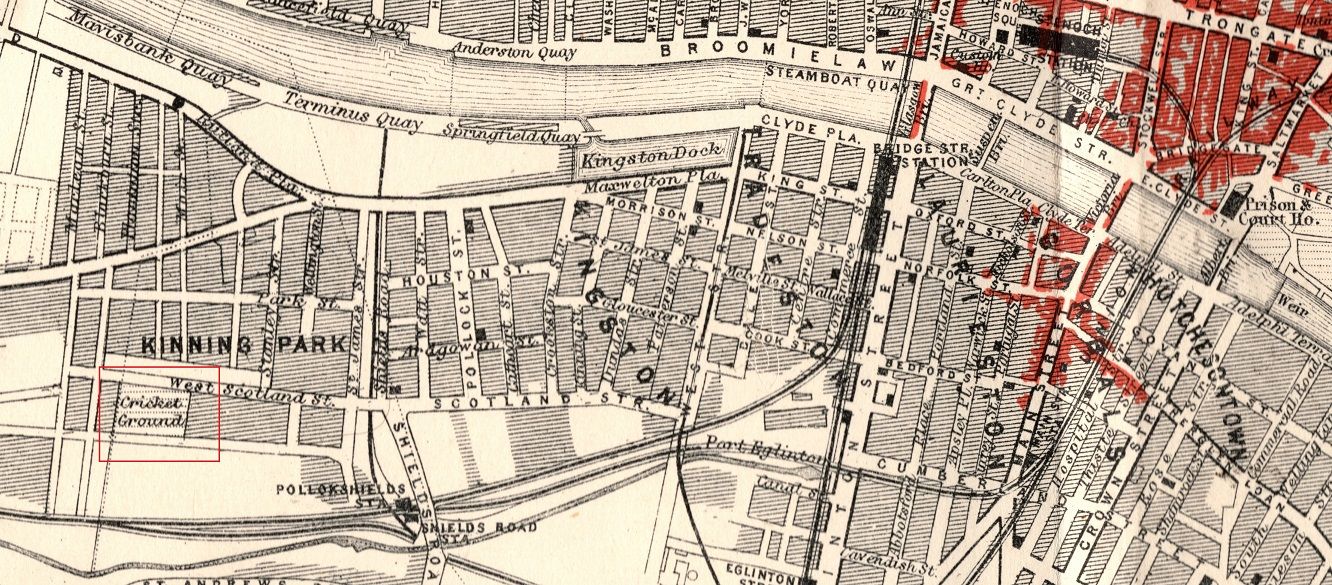
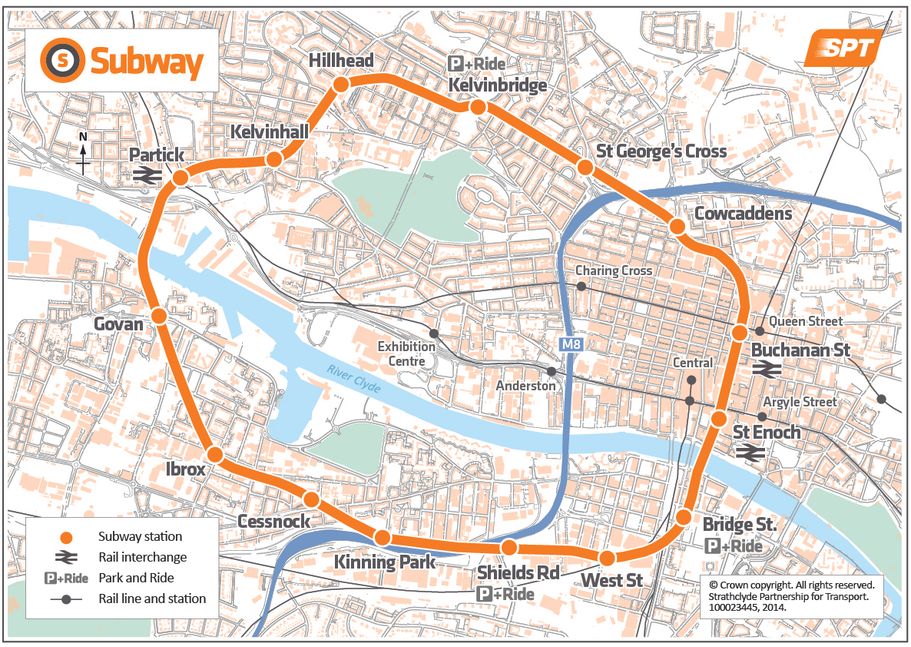
Kinning Park was in the mid-1800s an area of the city in transition. With the Paisley Canal and the railway into Bridge St. as a southern boundary and the river to the north the area between had been more and more urbanised over the previous decade. But when Clydesdale Cricket Club had been formed in 1848 its ground, now erased by the M8, had been countryside, accessed from 1840 via the old Pollokshields railway station, also gone. However, by 1879 it had been surrounded by building on three sides and on the fourth by a railway goods yard. It was long past a move and that the cricket club would make in 1873, by 1874 taking with it its football club, founded in 1872, and the field cum pitch being taken on from the 1876-77 season by a maturing and so improving Rangers F.C.. At the end of that season it would be a Cup finalist.
The Rangers we know today is very much a Govan club. But it began its formal life in 1873 in Kelvingrove cum Anderston and its on-field one, with a group of players that were then still only in their mid-teens, on an increasingly crowded Glasgow Green. From there it entered the Scottish Cup in its second playing in 1874-5, with seven teams sharing the Green up from four the previous year. It would be knocked out in the Second Round by Dumbarton. Then it moved, still on the north side of the river, to Burnbank, shared with 1st Lanarkshire Volunteer Rifles, for 1875-6 and again a Second Round exit to Third Lanark, before in south-of-the-river Kinning Park finding a ground of its own.
But Rangers were not the club to have taken over Kinning directly. From 1874 the ground was used by both Craigton and Parkgrove F.Cs., Parkgrove being a street just to the north of the Park itself. And it was an interesting club above all for being "motley", if surprisingly successful.


From its formation in 1874 Andrew Watson, Diasporan-Scot, eighteen and just moved to Glasgow from England for university, was a member. In fact he would develop on-field into a half- and full-back and off-field Secretary and remain at the club until 1878. It was four seasons that would see first a move in 1876 to Trinidad Park in Govan by the future Ibroxes, entry into the Scottish Cup from 1876-7, a First Round exit, followed by the Quarter Final in 1877-8 by when Robert Walker had been recruited from 1876 Cup-losing Third Lanark. And both Walker and Watson were Black, the first Black players known in British football with the former, probably the earlier, his father from Dumfries, twice being a Scottish international trialist (in both 1876 and 1877) and the latter a future winner of Scotland caps and captain also of his Ross-shire father's country. Moreover, Tommy Marten, the goalkeeper in 1876 and 1877, was half-Chinese, half-English/Dutch, born in Java with Scottish family connections via his aunt and in Glasgow to learn the Shipping trade.
Furthermore, with Walker stepping back but Thomas Britten joining in 1878 for a season, he already having been a reserve for England and a Welsh internationalist by birth on the border, it would be Third Round, albeit a heavy defeat and to Rangers at the old ground and then in 1879-80, Fifth Round. However, with the departure of Watson to Queen's Park, perhaps also his financial support, and other players joining newly formed Pilgrims, , fellow Govan from 1880 it is still said to exist but would drop out of the Cup and the picture before final dissolution but not before 1897.
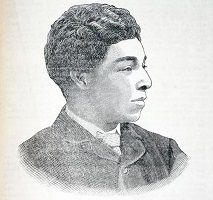
(Andrew Watson)
__________________
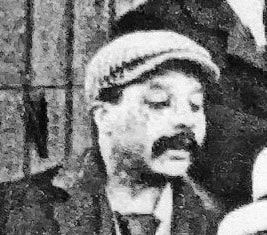
(Robert Walker)
__________________________________________________________________________________________________________
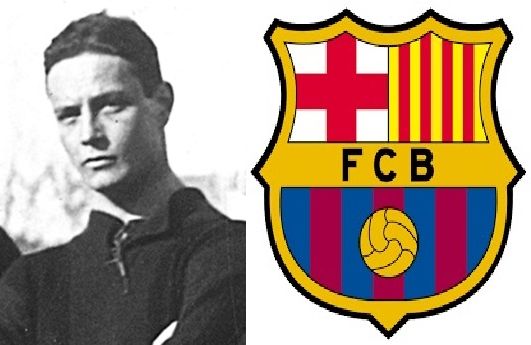
George "Jorge" Pattullo was a tennis-loving Oil-cum Coal-Merchant, who in his one season playing football for F.C. Barcelona, 1910-11, had with the Catalan club a goals-to-games ratio almost twice that of Lionel Messi. Pattullo''s was 1.78. Messi's 0.91.
Born in November 1888 in Albert Drive Pollokshields, by the East station, his father having died the previous April leaving money, he spent his comfortable first decade there and at the Kinning Park end of Shields Rd. and his teens back in Pollokshields itself in a fine villa on still impressive Matilda Rd..
But at twenty-one something, probably business took him to Spain, where, having, it is said, even in Glasgow played little football previously he was discovered by Hans Gamper, Barcelona's Swiss founder. And a whirlwind year followed, when even then he didn't play all the games, he still preferring the tennis court, yet the club swept all before it. And then he was gone to return the following season for a single fixture, the semi-final of the Pyrenees Cup against city-rivals, Espanyol,, which his team won, 3-2, he scoring twice.
After that he remained in the coal business but in Newcastle, returning to Spain on two known occasions. The first was in 1928 firstly to kick-off a Barcelona versus Real Oviedo match but also to remain some time because of his health. During The Great War he had served in the Tyneside Scottish Brigade, been awarded the Military Medal but also gassed. It was in that time in 1930 he briefly managed the Majorcan team, Club Baleares. The second was in 1935 again to Palma de Mallorca to marry a London-based, Danish widow, Margaret Plenger, on which they then moved to London. And it was there he died in Putney in 1953, but with a tomb, perhaps with his remains, erected for him and back in Glasgow in Cathcart Cemetery. (See Tour Four).
__________________________________________________________________________________________________________
John Connell - (39, Taylor St.)
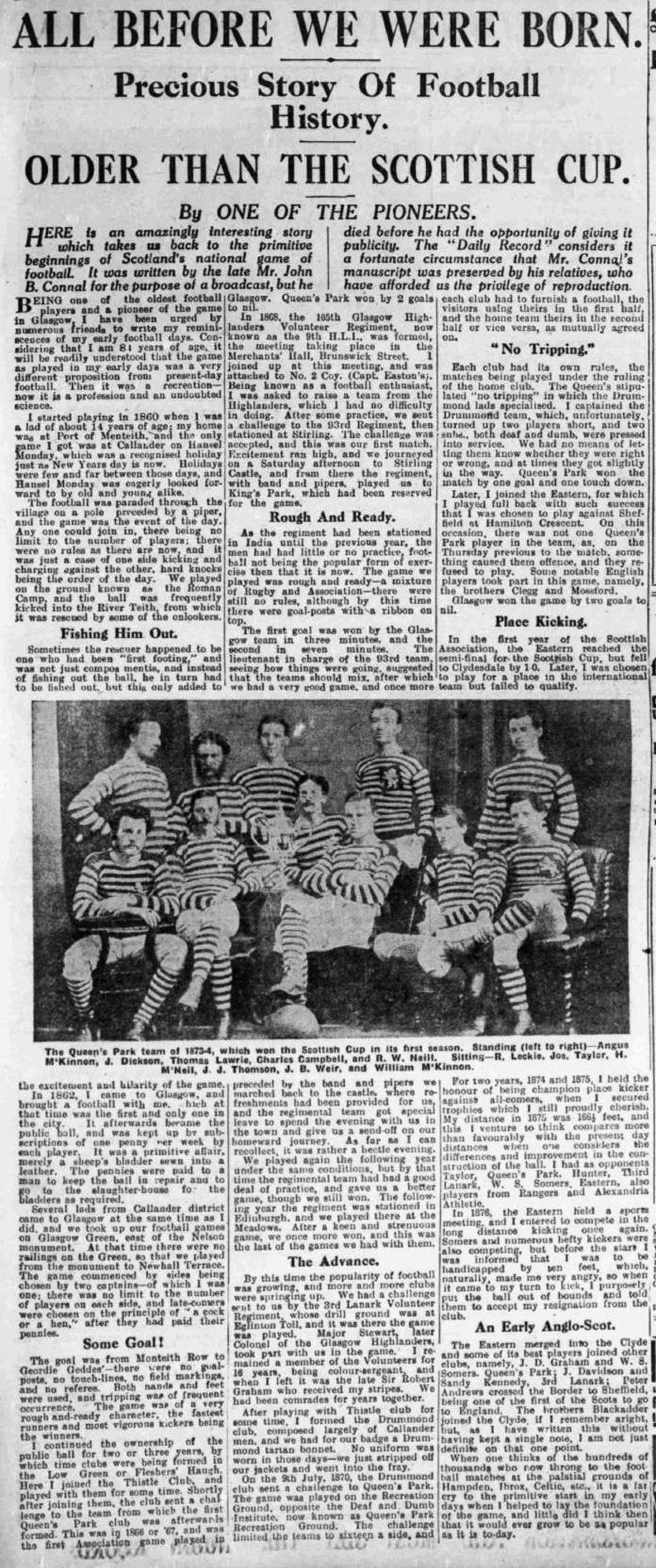

As mentioned in Tour One John Connell (click for more on article left) can be seen as the man to have brought organised, round-ball but, even though he would become a noted player of it, an almost-internationalist, not Association football to Glasgow. His place as a full-back reserve for the Scotland-England in 1875 is shown below and is more than enough to prove his prowess.
Born in Perthshire in 1846 he would arrive on the Clyde in 1862 with his ball for hire and steadily work at becoming integral to the games on Glasgow Green and then beyond. His final club, Eastern, which probably not coincidently would fold the season after he left, would play from Barrowfield (See below). And he lived, until later in life the family moved to Scotstoun, within a mile or so of the ground at first 89, Taylor St. and then Stirling St..
__________________________________________________________________________________________________________
Tom Scott - (109, Castle St.)
Three men took football to Brazil, all at about the same time 1894 give or take but to different parts of the country. One was a Diasporan, the son of a railway engineer cum merchant, who had married and made his life in Sao Paulo but was born in Largs. He was Charles Miller, who learned the game at school in Southampton before taking it back to his Brazilian-city home. The second was Tommy Donohoe fom Busby to Bangu by Rio de Janeiro, with his story an add-on to Tour Four. And finally there was the still least known, Thomas Scott, the one to take the game from his native Glasgow to the interior of Sao Paulo State, to Campinas and Jundiai.
Thomas Archibald McTaggart Scot was born in 1865 at 114, Glebe Road in Denniston, his father an engine fitter. But by 1871 the family had moved to 109, Castle St. just north of the cathedral and by 1881 to Springburn, where his father would by now work in the railway yard and fifteen -year-old Tom was an apprentice. And it was the railways that would then take the young man by 1890 at the age of twenty-four to Brazil, Nellie Cowie from Tradeston joining him that year and the two marrying in the British Consulate in Santos.
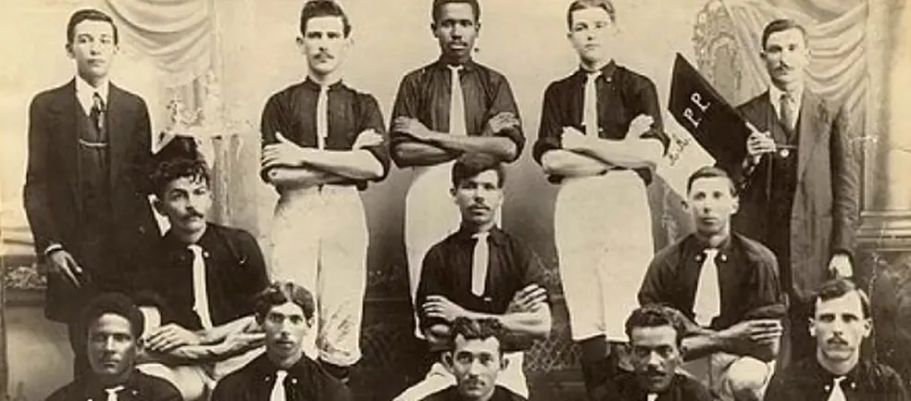
And from there work would take him north, by 1898 with his growing family to Campinas, to its Ponte Preta suburb, where, carrying the football contagion with him, he was instrumental in the foundation in 1900 of its club, Associacao Atletica Ponte Preta, now Brazil's oldest, its doyen, its equivalent of Queen's Park and also the first Brazilian club to play in Miguel do Carmo the country's first Black player. (See photo below: do Carmo, back-row, centre, Tom Scott, back-row, right)
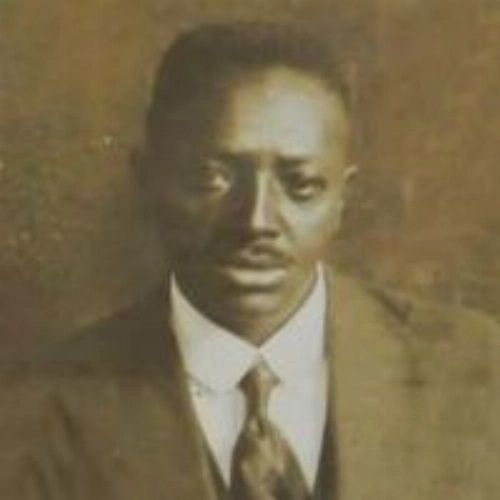
And the process of foundation was repeated when the family was in 1902 moved to Jundiai with now not Tom's but also his sons' involvement in the emergence there in 1909 of Paulista Futebol Club. Moreover, even when Tom died young in 1913, aged just forty-eight, to be buried in the only English-language grave in Jundiai's city cemetery and Nellie took the family to Sao Paulo before dying herself the next year to be buried beside him, involvement did not stop. His son's would play on in several of the city's better teams for the best part of two decades. In fact their decendents, an Archibald amongst them, still stay there.
__________________________________________________________________________________________________________
Glasgow Cathedral
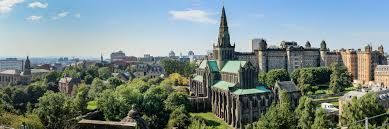
There is no known football connection to Glasgow Cathedral, beyond the memorials services to Jim Baxter and Walter Smith being held there and in 1971 that for the Ibrox disaster. But in passing from Tom Scott of Townhead and Brazil to the Glasgow Necropolis perhaps take some time to explore the lanes, alleys and squares of the oldest part of the city and also St. Mungo's interior. It is open pretty well daily, hours depending on season, is free entry but needs to be booked.
__________________________________________________________________________________________________________
Glasgow Necropolis
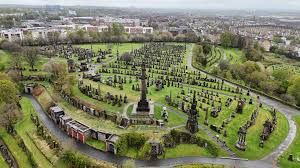
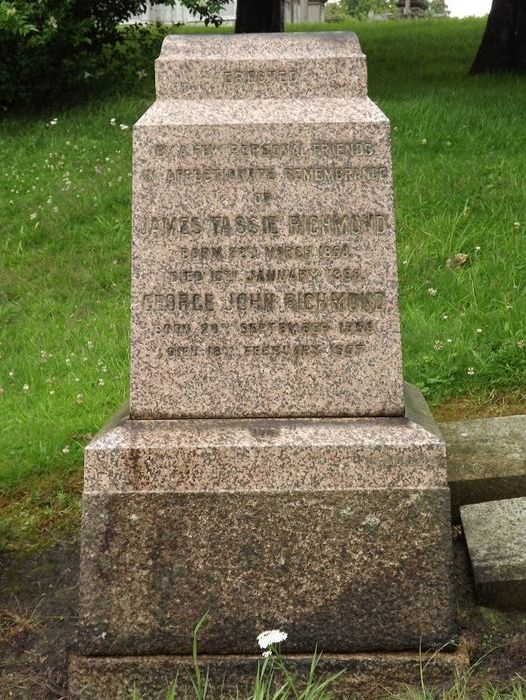
The Glasgow Necropolis, just east of Glasgow Cathedral, and island of calm in the city, was opened in 1833. And the Football Square Mile points out that William Dick, an early Secretary of the SFA is buried there, dying in harness in 1880 at the age of just twenty-nine. But what it does not say is it is also tha last resting-place of James Richmond and Don Sillars, two prominent players, internationalists, both also dying young. And furthemore it is the burial-spot of the man, Alexander Eadie, mostly likely to have provided the name of Queen's Park's and thus the World's first purpose-built football ground, the first Hampden Park, and therefore that of the two others which have followed.
Sillars, born in 1868, was a stalwart mainly of the Battlefield club in the late 1880s and then Queen's Park in the 1890s, the winner of four caps. His death aged just thirty-six was in 1905. Eadie had been born in 1841 in Auchinleck but had by 1861 moved to The Gorbals and started, as did his elder brother, George, as a joiner to trade and possibly early Glasgow Green footballer. And it was the brothers, as the developers, would a decade later build a terrace they would call Hampden. As to Richmond, he would be born in 1858 and on Sauchiehall St., had five years with The Spiders in the 1880s and was the winner of three caps. His passing was aged thirty-nine in 1898.
__________________________________________________________________________________________________________
Peter Andrews - (5, Dunchattan St.)
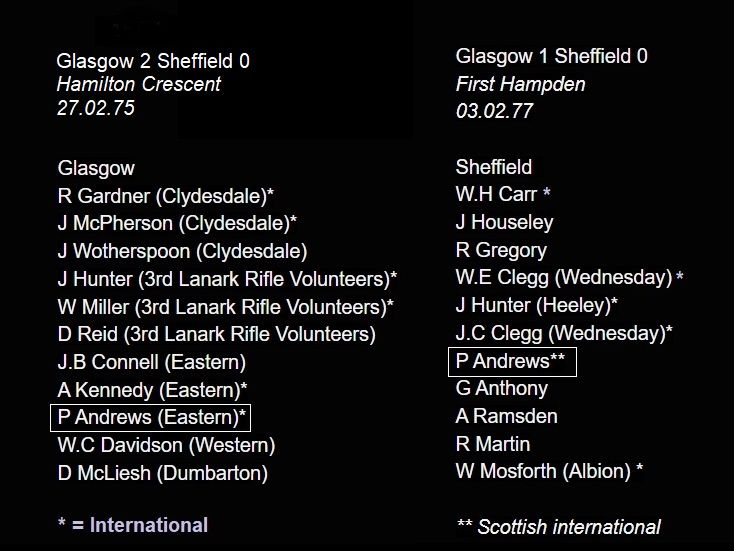
As already mentioned in Tour One Peter Andrews was an early footballing pioneer, Kilwinning-born, having moved to the city by 1866, the year he turned twenty-one. And staying close to Glasgow-Green, in 1871 he, his wife and child were at 5, Dunchattan St., it is highly likely that there he was a part, with John Connell, of the pre-Association scene before, like Connell, adapting to the new game. And so well did he do it that by February 1875 he, a forward, full-back with Connell would be in the Glasgow team to face Sheffield and the following month at twenty-nine not only win his only cap, against England, a 2:2 away draw, but score the equalising goal.
And such must have been the impression he made that the following season he was once more in the Glasgow representative team against the Yorkshiremen, this time alongside J.J. Lang, and the pair of them were then "invited" to join Sheffield clubs. Now much is made of Lang at Wednesday being openly professional but that Andrews' arrival at Heeley was via work, Leeds and even there playing rugby. It is unlikely. He was a baker to trade and bread was still being eaten in Glasgow. Moreover he was by then thirty with a wife and now two children to support so it is almost unimaginable that he would have travelled South on an amateur whim. Indeed so well would he integrate into the Sheffield Rules football scene that the family would stay until at least 1881 and he, meantime in 1877 and in only his second season, would even turn out for its representative team and against Glasgow.
In fact, Andrews's involvement in football would be a life-time's, continuing off-field when the family returned to Scotland, to stay in Paisley. There he would have a third, or is that fourth, career now as foreman in a cotton mill and be a director of the local football association until his death at sixty in 1916.
__________________________________________________________________________________________________________
Foundation of Celtic - (Abercromby St./Forbes St., Old Dalmarnock St.)
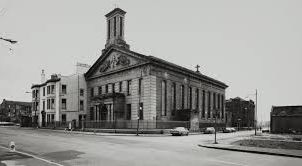
St. Mary's Church, Calton
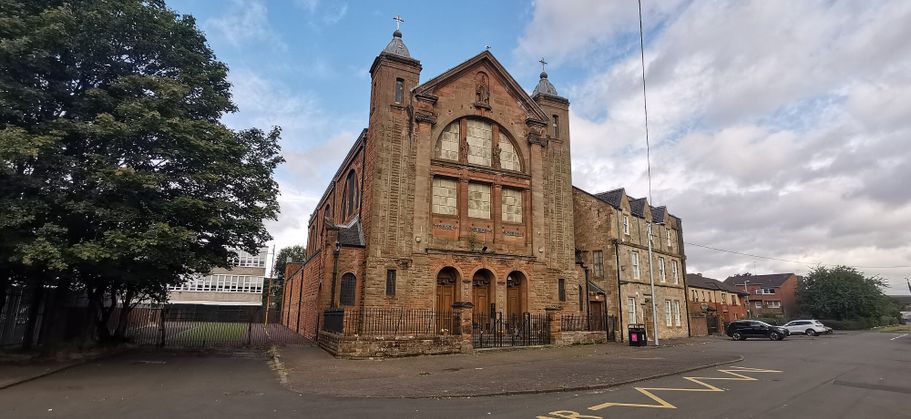
Sacred Heart Church, Bridgeton
The foundation of Celtic Football Club took place in November 1887. The impetus came from the victory the previous February of Hibernian in the Scottish Cup Final, with a celebration of it having taken place in the church-hall of St. Mary's Church on Abercromby St. in Calton. Brother Walfrid, priest and teacher at St. Mary's School and later the first head-master of the Sacred Heart School in Bridgeton, attended and came up with the idea of football, a club funding the care of Glasgow's poor, particularly its children.
The church-hall, which stood on just across Forbes St. from the church is no longer there, although it might be in the photo left. A later St. Mary's school building can also be seen on Forbes St.. Both sites are now housing. However, the Sacred Heart school still flourishes, now on Reid St. just to the back of the Sacred Heart Church on Old Dalmarnock St., half a mile from Glasgow Green and a mile from Celtic Park.
__________________________________________________________________________________________________________
Glasgow Green
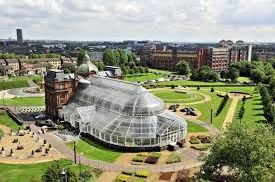
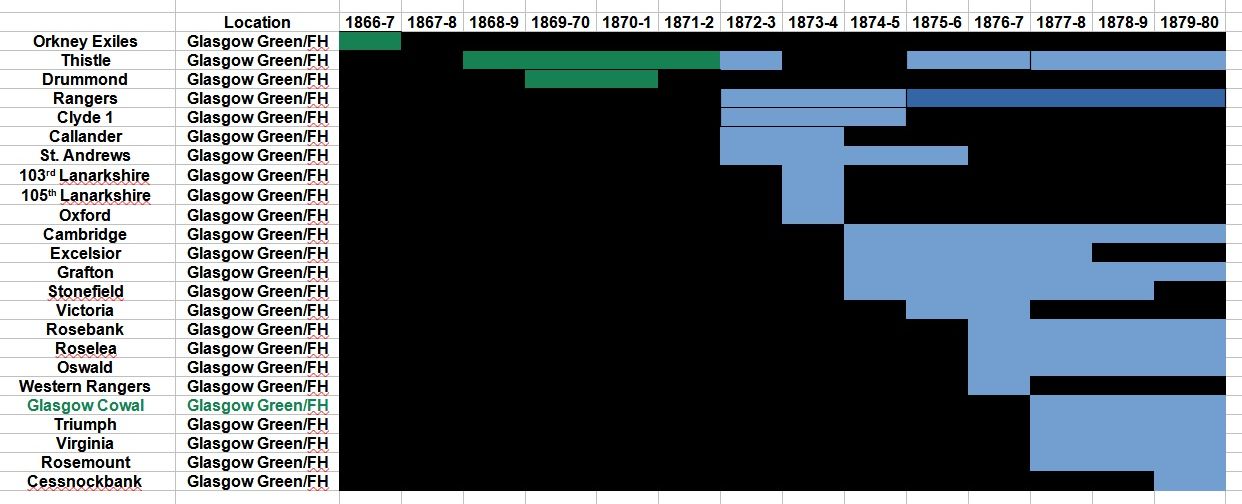
Glasgow Green has belonged to the city since 1450, being gradually transformed in the first half of the 19th Century from mostly swamp-land to the drained, flat park of today. So when round-ball football came to the city in the 1860s it proved the ideal location for first ad-hoc and then organised games, the first known just now being in 1866. But this was not yet the Association game and with its arrival in 1872 the still very few clubs operating would by 1875 see a rapid tripling with space clearly under pressure and some, notably Rangers and Clyde, in order to monetise their activity, from it and Fleshers' Haugh moving on.
Fleshers' Haugh
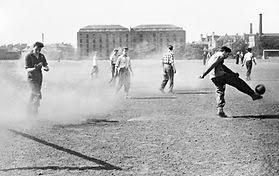
Fleshers' Haugh was added to Glasgow Green in 1792. Until then it was private land. And despite, as implied, being low-lying and prone to flooding, it would from early on from the Green itself be taken for the new game, becoming the inner city's "Football Centre", albeit for one hundred and twenty years an informal one.
And it began early on. Eastern, quite probably with both Connell and Andrews in its team, there beat a pre-Celtic Celtic in January 1873. Rangers' first game is said to have been played there in May that same year and by The Great War it was the venue for eighteen ash pitches maintained by the Corporation itself.
__________________________________________________________________________________________________________
Barrowfield - (Colvend and Carstairs Sts) & Shawfield - (Shawfield Drive/Rutherglen Rd.)
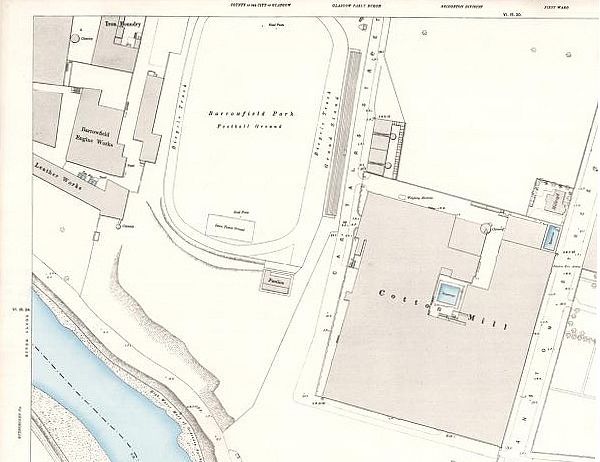
When the Eastern club was dissolved in 1877 its players are said to have joined two others. One was Stonefield, the second was Clyde, the Secretary of which was twenty-six year old, John Graham, a Spirits and Flour Merchant, later Baker, also a Queen's Park member, from an address at 24, Monteith Row at the northern limit of Glasgow Green. But by 1875 Eastern had already moved from there to Barrowfield, which stood a mile away by Dalmarnock on now brown-field land between Colvend and Carstairs Streets and the river. And it was that ground Stonefield, Clyde and a third team, Albatross, all initially and briefly shared.
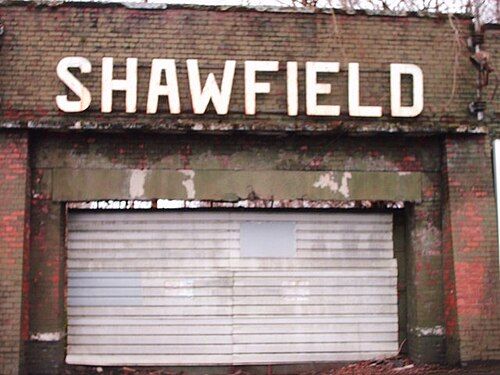
However, by 1897 with Clyde long the sole tenant and by then in the League's First Division, the lease on the Barrowfield ground coming to an end and the Rutherglen Bridge completed in 1896 a new open piece of ground was found just across it, less than a mile away, at Shawfield. And in 1898 the move was made with the club remaining there for almost a century until 1986, in a stadium, which would in time also host greyhound racing and speedway.
And it was the greyhound racing that would result in Clyde having to leave its by then long-term venue. Financial pressures in 1935 had led to the sale of the stadium to the Greyhound Racing Association and in 1983 the GRE decided it wanted to redevelop the land. The football club was then required to leave, eventually moving to Cumbernauld, then to Hamilton as a new home in the Glasgow area is sought; this as in the end the dog-racing did not in fact cease until 2020 and the stadium was finally demolished only in 2023, leaving only parts of the perimeter.
__________________________________________________________________________________________________________
Southern Necropolis
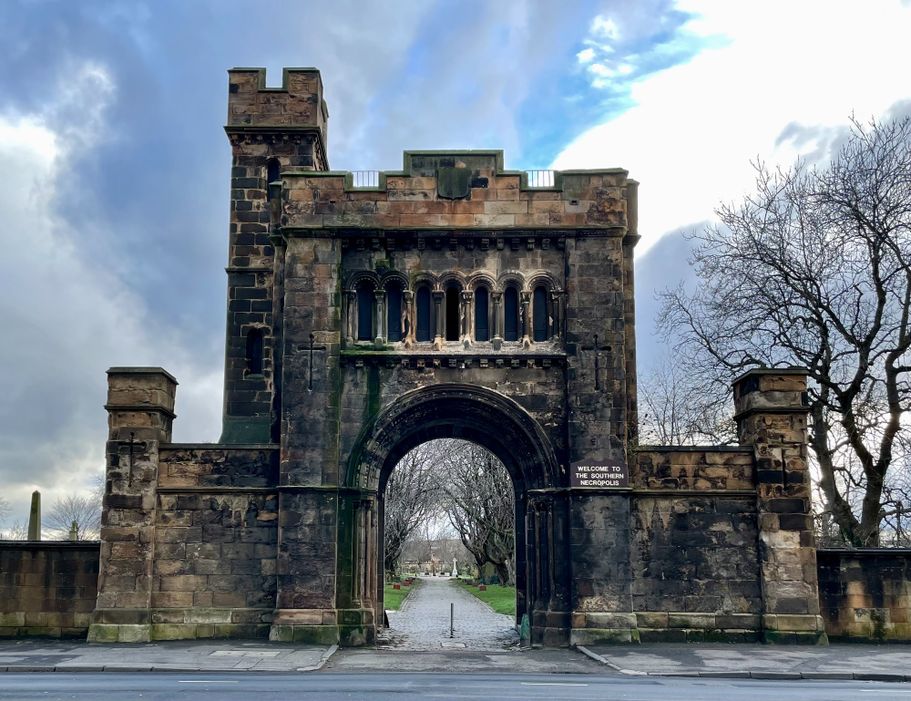
With the Old Gorbals burial ground full, in 1840 a piece of land on the then city's edge was purchased and named the Southern Necropolis. In it, according to the Football's Square Mile site, are two important graves. The first is that of Archibald Campbell, the Clydesdale representative at the initial meeting in 1873 of the Scottish Football Association and there elected as its first President. The second is that of none other than Thomas Lipton, with a mention of his Thomas Lipton Trophy, which by FSM is described as a forerunner of the World Cup but was a competition for clubs so wasn't but no mention of his inter-national Copa Lipton (See Tour 1), which was.
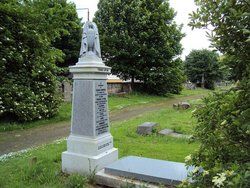
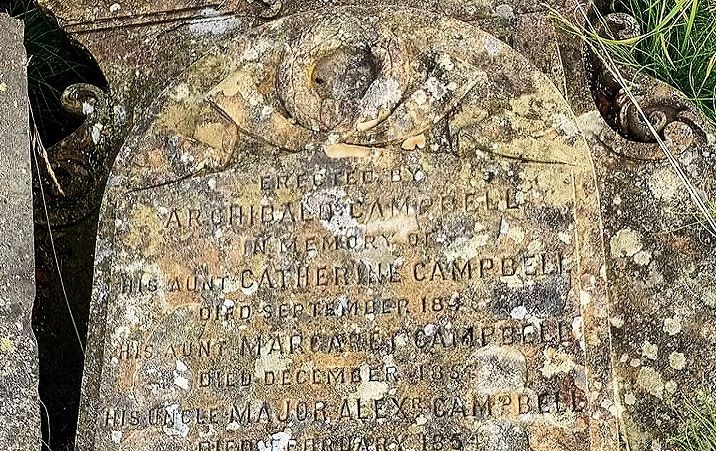
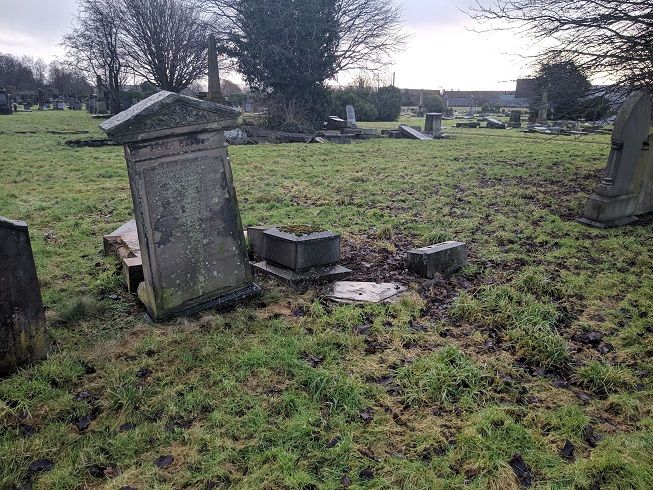
But there is also the grave of none other than David Wotherspoon, (See also Tour One above), Queen's Park (credited as the first to call them The Spiders), Clydesdale, Glasgow representative and international player, one of four footballing brothers, whose elder sister is even said to have embroidered the first red Lion Rampant badges on the Scotland team shirts.
But note the difference in the state of the graves. The first is of a man, who had a love for the game born of teenage years probably playing it but whose immense wealth means still that its condition is excellent. And the second and third are of important figures in an immensely wealthy game, by which on whose memory and memorials clearly little or nothing has been spent. The irony of priority is not lost.
__________________________________________________________________________________________________________
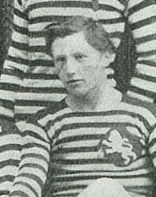
Billy MacKinnon was for a decade one of the great players of the early, Scottish game. Between 1872 and 1876 he, at centre-forward, a Queen's Park player throughout but for a guest appearance for Rangers' in its first ever match, would win three consecutive Scottish Cups and nine caps, including eight in a row against England.
But it might never have been. He was born in 1852 on Eglinton St. in The Gorbals so was first capped at twenty, then staying at 88, Abbotsford Place, another likrly to have learned the game on Glasgow Green with Connell, Andrews and Lang.
Physically he was not tall but athletic, the inventor of the overhead-kid, and clearly very talented; but not just with the football. William Mackinnon had a fine, tenor singing voice. By 1882 he had become a soloist for the Glasgow Choral Union but by then had already had an audition for La Scala in Milan, had passed, been invited to join the company but had turned it down because he wanted to stay in his home-town. And that he did, the longest lived of those very earliest players, dying in Cambuslang in 1942 at the age of ninety.
__________________________________________________________________________________________________________
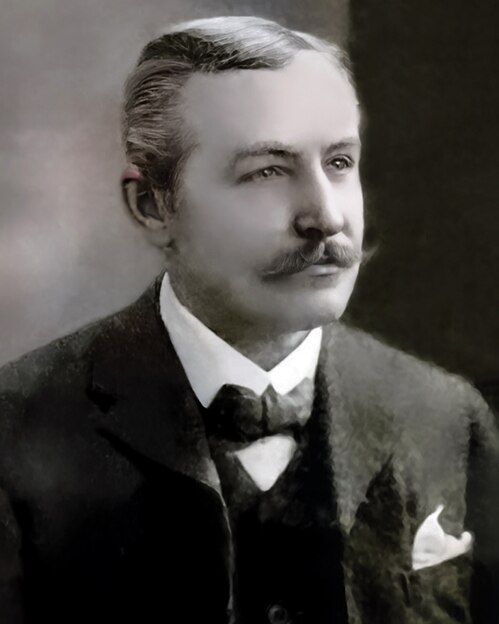
Today's Aston Villa is the legacy of George Ramsay. He was the man, who taught the local Villa founders how to play effectively, i.e. the Scottish way. He was a player for and captain of the club from 1876 to 1882, initially amateur and then shamateur. It was also when he found its first Perry Barr ground, brought in his successor, Ayrshire's Archie Hunter, and from 1886 for the next forty years, still today the period of its greatest success, returned to be the club's Secretary, i.e. its manager.
Yet he was born in 1855, half-Scots, half-English-Scots in The Gorbals at 14, Abbotsford Place before a childhood and teens spent in Crosshill just north of Queen's Park. See Tour Three.
__________________________________________________________________________________________________________
And with that this tour is completed and, on-line, there is Tour Two whilst, off-line, it is back to Central Station.
Hugh MacColl - (South Apsley St., Auburn Cottage, St. Andrews Rd. & 10, Kenmure St.)
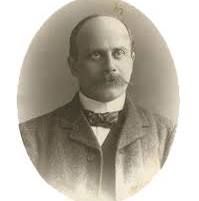
Hugh MacColl was an engineer, who in 1889 took on the technical management at the Portillo, White & Co. foundry in Seville. He was then aged twenty-eight, had already worked in Hartlepool and Belfast but what drew him to Spain is unknown.
Yet what he did there on the sporting field is clear. He stayed six years and in the second, 1890, presumably with a passion for and experience of football gained in his youth, he was captain at home of the winning, local British Club team, Seville F.C., against Scots-founded Recreativo from the nearby and also Andalusian city of Huelva. It is the first-ever, officially-recognised game in the country.
But for MacColl, although much of his later life would be spent very successfully in the ship-building and -repair business in Sunderland, his start and, as fate would have it, his death would be in Glasgow. He is another pioneer of the game to have been born in The Gorbals, in his case in 1861 at 30, South Apsley St., now Apsley Place, growing up in Pollokshields. And, returning to his home city in 1915 for hospital treatment, an operation, he would die there as a result to be once more buried in Cathcart Cemetery.
__________________________________________________________________________________________________________
J. J. Lang - (6, Mathieson St., 86, Thistle St. & 51, Commercial St.)
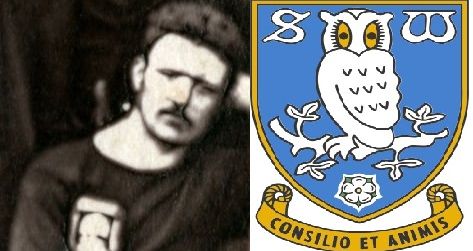
Ginger-haired, one-eyed James Joseph "Reddie" Lang would twice lose a Scottish Cup-Final; the first in 1874, alongside Robert Gardner, David Wotherspoon and Fred Anderson with Clydesdale, then again in 1878 with Third Lanark and Archie Hunter. Meantime, he would pick up city representative honours against Sheffield in 1876 with Peter Andrews and that same year the first of two caps, both against Wales, the second two years later. And still in that interim not only would the initial Welsh encounter probably make him the first Catholic to represent Scotland but he would also become not the first but the first, Scottish professional.
The World's first effectively professional footballer was probably Sheffield local-boy, Jack Hunter, who had joined the Heeley club in 1870, being paid to play from somewhere in the first part of that decade. And, with a pattern set, in 1876 the city's Wednesday club then persuaded Lang, with the offer of a sinecure job from one of its directors, to travel South. As such he, with Peter Andrews, became the first Scottish professionals, although they were required to play Sheffield and not Association Rules with it unclear when, after 1878, the replacement of the former by the latter was completed.
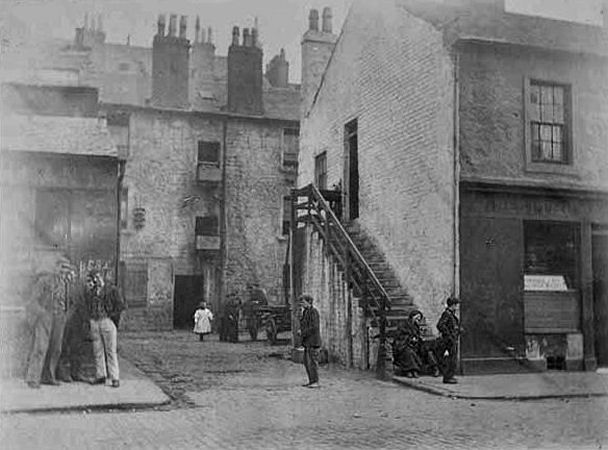
Thistle St. 1900
But whilst Lang, on hanging up his boots, would return for good to Scotland, dying in the north-west of the Glasgow in 1929, he had first learned the game, whilst staying at 6, Mathieson St. in The Gorbals with Lipton and others, even as he was in Yorkshire his family residence remained there still at 86, Thistle St., now part of City of Glasgow College, and on his return North of the Border was 51, Commercial St. in Hutchesontown.
__________________________________________________________________________________________________________
James Grant- (125, Hospital St. & 21, Warwick St.)
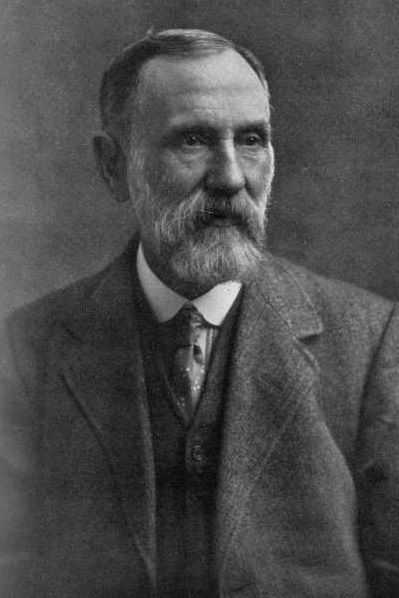
The claim to footballing fame of James C. Grant, James Cruikshank Grant, of whom there has already been mention in Tour One and there will be more in Tour Three, is as, for five years, Queen's Park F.C.'s first goalkeeper and also third President. He is said to have been from Carrbridge via Granton-on-Spey, in Glasgow originally a Draper's Assistant, living on first arrival for at least a decade in The Gorbals, at 125, Hospital St. and then 21, Warwick St.., one who then, a Commercial Agent in Drapery, moved out into the Southern Suburbs, to Strathbungo, first, then to Shawlands and finally to the Mearns Road by Cathcart. It was there he would die in 1928 aged eighty-six. But, according to the Robinson history of Queen's Park through his working life he maintained an office in town, latterly at 11, Maxwell St., fifty yards from the river, two hundred and fifty from the Green.
__________________________________________________________________________________________________________
Birthplace of Thirds - (Corner of Howard and Dunlop Sts.)
Third Lanark, one of the great clubs of the first century of football until its collapse in 1967, came out of the military, the 3rd Lanarkshire Rifle Volunteers. Its date of foundation was December 12th 1872, two weeks after and inspired by the first international. It was in 1873 an original member of the SFA and a participant in the first Scottish Cup, reaching the last eight. Then in 1876 it was the defeated finalist in that same Cup, and again in 1878, taking it for the first time only in 1889.
Two of the first ever Scotland eleven would also become members of The Thirds, Joseph Taylor and Billy Mackinnon (See above, and Tour Four). The club would also supply Dickson, the Queen's Park goalkeeper to replace Robert Gardner, whilst the first wholly Thirds player to represent the country would be John Hunter in 1874, he being Archie Hunter's elder brother. From almost its inception the club would play the original Cathkin Park in Crosshill, its then Renfrewshire drill-ground (see Tour Three). The present Cathkn Park would be its second and last stadium. And the foundation of all this took place in Glasgow at the regimental orderly room then on Howard St., a short distance from the river and the Green. The actual building has long been replaced but stood on what is now the corner of Howard and Dunlop Streets, adjacent to St. Andrew's Catholic Cathedral.
__________________________________________________________________________________________________________
And with that this tour is completed and, on-line, there is Tour Three whilst, off-line, it is back to Central Station.
__________________________________________________________________________________________________________
Tour Three
Queen's Park, Crosshill and Beyond
There is no doubt that Crosshill with the Queen's Park and Mount Florida to its south in 1872 became and from then until the present day has remained the administrative hub of Scottish football and from 1878 has been the de facto home of our national team. The foundation of the Queen's Park club took place at Strathbungo on its northwestern edge. It was, as the Association contagion took hold, there was southerly, urban creep, initally round the east side of Queen's Park itself, and countryside became villas and villas tenements, populated in those early days by clubs and grounds galore, some pop-up, others more permanent. All three of the Hampden Parks have lain within its boundaries. And it was immediately to produce players and more, who were literally to play pivotal roles in football both in Scotland and beyond.
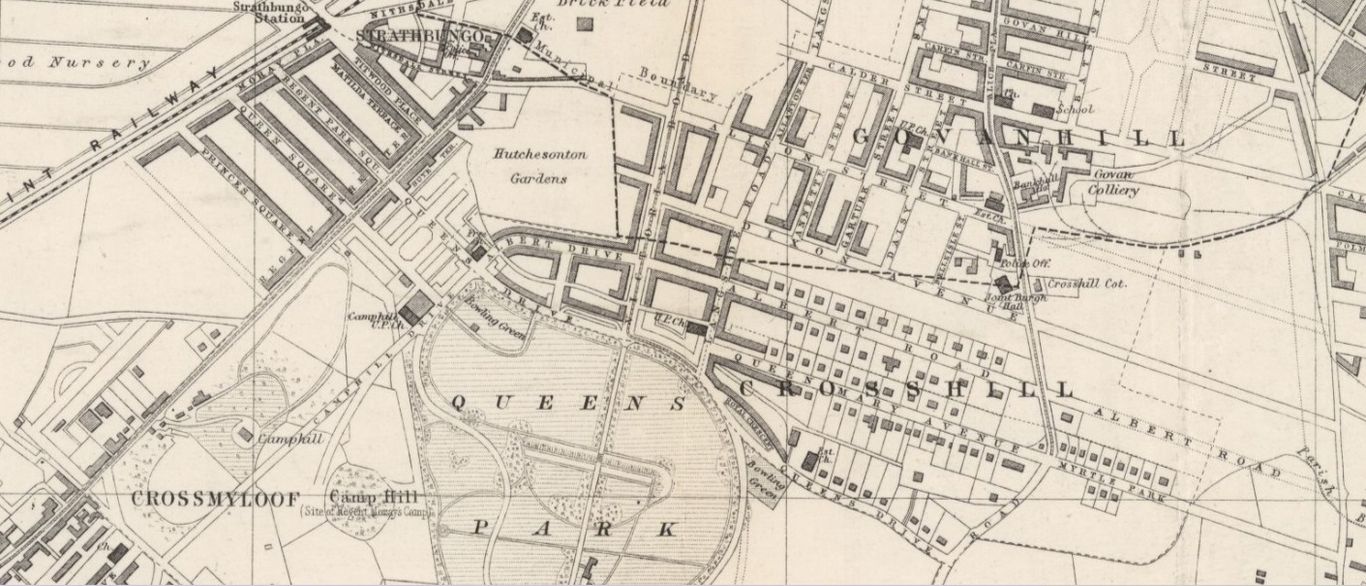
(Strathbungo, Crosshill and Queen's Park 1879)
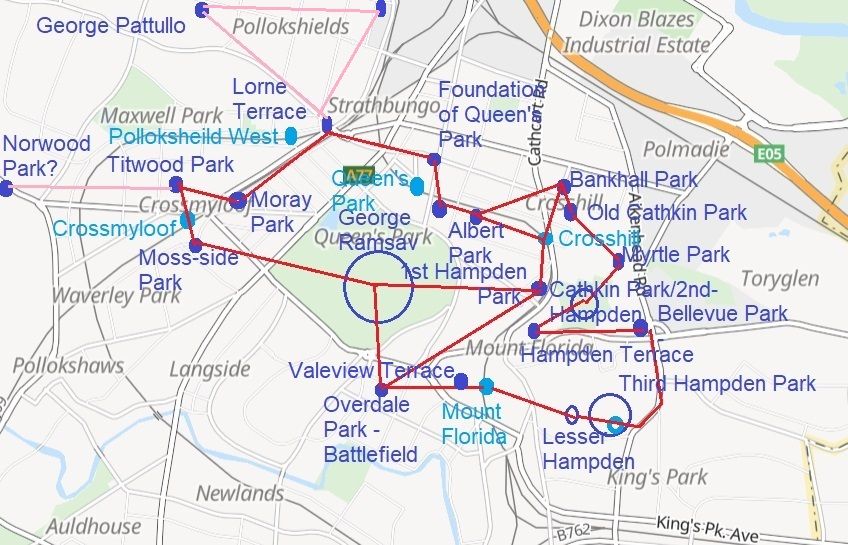
Tthis Tour Three aims, from a range of direct access-points from three directions and through a choice of three loops and/or, depending on time, two sections to give a far deeper and more accurate insight than just now available even through FSM into the actual spread of the Association game in the Southern Suburbs and to some of those involved. Starts to all can perhaps best be made from Queen's Park station with first focus on the actual Strathbungo founding of the Queen's Park club itself. The second then takes in Crosshill, Mount Florida, the three Hampdens and others, ending at the third and more particularly the Scottish Football Museum. And the third looks at Langside and the Queen's Park old Crossmyloof, the beauties of Pollok Park, Pollok House and its Burrell Collection before a return to Strathbungo once more.
__________________________________________________________________________________________________________
Loop 1 - The Birth of Queen's Park
The date and place of the foundation of the Queen's Park club and therefore in time the arrival of at least Association-like football in Scotland is well-known. It was 9th July 1867 at 3, Eglinton Place, since identified as 404, Victoria Road in the now Glasgow suburb but then still officially the Renfrewshire village of Strathbungo. Yet the question rarely asked is why there, with the answer being, it seems, a combination of shared business interest, the drapery trade, and an element of serendipitous proximity.
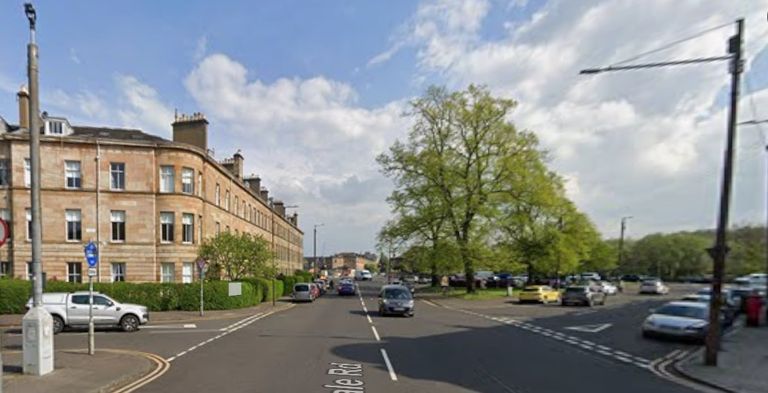
(Lorne Terrace)
To 1867 the founding group had practised not football but athletic sports on a small piece of open ground by Lorne Terrace. It lies at the very eastern end of Nithsdale Road, as it now meets Kenmure and Kildrostan Streets and Darnley St. and Road, little more than a couple of minutes walk west from Eglinton Place. And when, owing to development, they found themselves unable to use the patch Southside Park itself, as Queen's Park was also known, was the same distance south, was the obvious choice and it is there that, it is said, a round-ball game was first encountered and adopted. It is likely, knowing what we now do, to be a somewhat "fluffy" story and this is why.
Founders
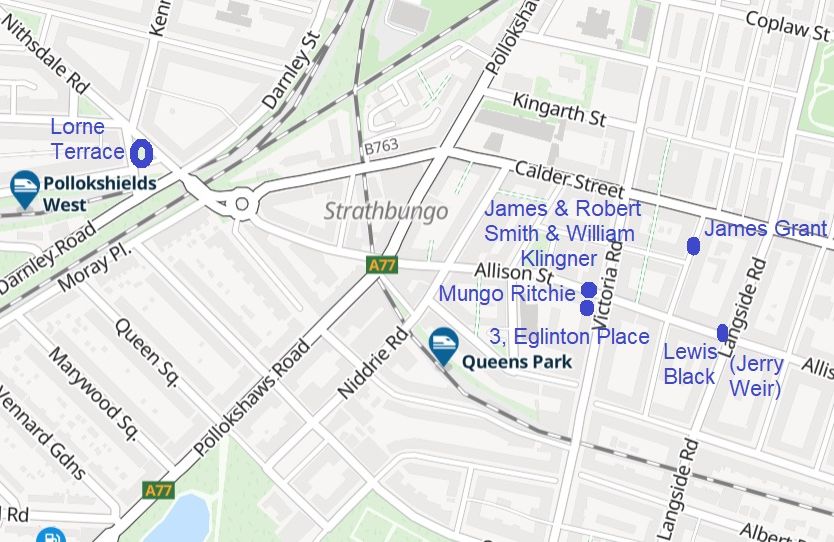
Mungo Ritchie, James Grant, Lewis Black, the Smith brothers, James and Robert, William Klingner, David Wotherspoon and Robert Davidson - (22, Eglinton Place, 1 & 11, Allanton Terrace & 3, Westmoreland St.)
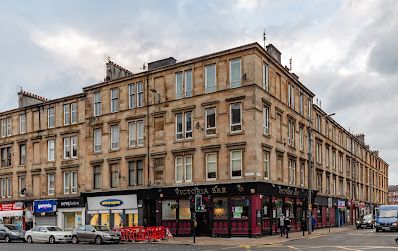
Eglinton Terrace (404, Victoria Road)

Mungo Ritchie
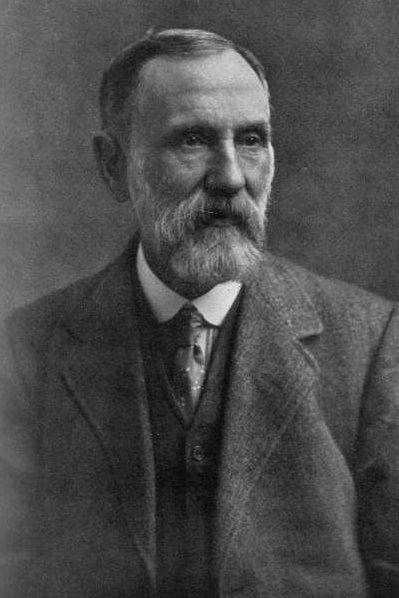
James Grant
At that first meeeting Mungo Ritchie would elected Queen's Park first Presdent. In part it was probably deference to age. At twenty-nine he was the oldest. But then he was also on the spot. He had a shop, a draper's shop, just round the corner on Allison St. at 22, Eglinton Place, also at that time the lodgings of the Smith brothers, James and Robert, and William Klingner, the club's first Secretary, all from what is now Moray.
Furthermore, Lewis Black, a Commission Agent again in drapery, the club's first captain and second President, stayed eventually within a hundred and fifty yards at Allanton Terrace. Indeed, it was from there in 1873 he would marry Agnes, the sister of Robert Weir, the terrace's builder-developer and also Jerry Weir, four time Scottish internationalist and one of Queen's Park's earliest great players.
And then there was also James C. Grant, on foundation a committee member and the club's third President, for two seasons, 1869-70 and 1870-71, with for almost the whole period his Secretary being David Wotherspoon, his Treasurer, James Smith, the team captain, Robert Gardner, and the decision taken by its conclusion for the club to enter the FA Cup, specifically the key to Association football in Scotland taking wing. Grant was at the time probably still living in The Gorbals (See Tour Two), as had been Ritchie and was Gardner with Wotherspoon close-by. But he would soon move. Firstly it was in 1871 to 10, Struan Terrace, no longer there but said to have been on Albert Road/Dixon Road, where fellow lodger was none other than Lewis Black. And then it was to just yards from Eglinton Terrace at 3, Westmoreland St. Indeed, in 1883, so a decade after Black, it was from where Grant himself married.
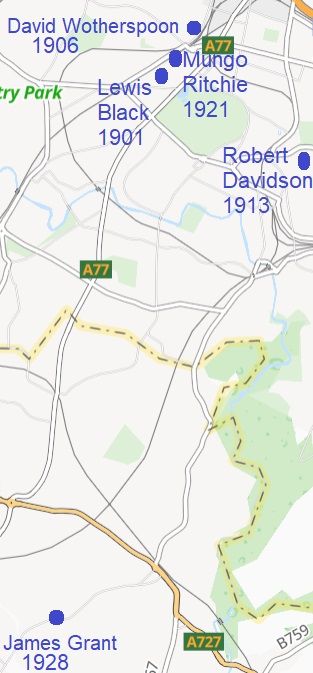
And it was still within the Southern Suburbs, indeed largely Strathbungo, that all between 1901 and 1928, would pass way. Wotherspoon, Ritchie and Black's deaths would be within a stone's throw of Lorne Terrace, Black's the earliest. Robert Davidson's, another of the founders, would be overlooking Hampden Park itself and Grant's, he having lived in Crossmyloof for many years, the last in 1928 and in Clarkston.
__________________________________________________________________________________________________________
Loop 2: Strathbungo to Queen's Park, Crosshill and Hampden Parks
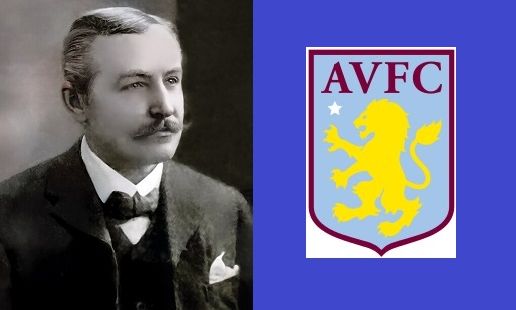
Our Tour Two included the birthplace in 1855 in The Gorbals and some of his pivotal involvement in Aston Villa F.C. of George Burrell Ramsay. But the Ramsay family, his father a prosperous, Glasgow-born iron-monger, his mother English-born but Campbeltown-raised, had by the time he was six moved into the city's Southern Suburbs and were living in Crosshill on Albert St., now Road, in a villa named "Dunedin". And there he would stay for at least the next decade and possibly until 1876, when he turned twenty-one and headed South.
But in the meantime, in his teenage years, he had involved himself in the locally burgeoning football scene, first for a season with Oxford F.C. then for a second with the Rovers club both at the time on Queen's Park itself so within a couple of hundred yards or so of his home. And it was from those two seasons in the Scottish game that would provide the expertise, which would so impress in Birmingham and lead to an almost unbroken fifty-year career as player and Secretary/manager in the English game.
And there is the question of the somewhat elusive Albert Park football ground, the first ground of Southern F.C., the first club to emerge. There is one, which is south of the Queen's Park in Langside, and is a possibility. But it is more likely from what we know that it somewhere on Albert Road itself, probably on what was then still open country at the what is now not just Crosshill but the Crosshill station end. It and several short-lived grounds in the area are further discussed below.
Southern F.C. and Albert Park
One of the first teams to emerge after the adoption in 1871 by Queen's Park of the Football Association in London's rules was Southern, founded already in 1871 out of the Southern Cricket Club. It is said to have played both to Association and Rugby-like rules and, whilst not amongst the eight founder members of the Scottish Football Association, it was an entrant, from its Albert Park, Crosshill ground (presumably on or near today's Albert Road), in the first Scottish Cup, albeit that it conceded a First Round walkover to very near neighbours 3rd Lanark.
However, it did a little better the following season before defeat, away, in the last eight to Renton, the eventual losing finalists, and might have been expected to progress. Yet, still in the Cup it was First Round defeat in 1875-6, this time to Clydesdale , after which the switch permanently to rugby seems to have been made, as well as a change of ground to Moray Park, later in 1890s the home-ground of both St. Andrews and Southern Athletic and of shinty club, Glasgow Cowal. It was to the south of Strathbungo towards the Crossmyloof end of Moray Place. (See Tour 4)
Queen's Park
Opened in 1862 Queen's Park, on previously Maxwell land, is a remarkable blend of one hundred and forty-eight acres, designed by Joseph Paxton, of open space, manicured lawns, gardens, green-houses and wild areas. It contains the site of the Battle of Langside, fought in 1568, and is named not for Queen Victoria, as might be expected, but Mary Queen of Scots, and the loser of that encounter.
Queen's Park + Recreation
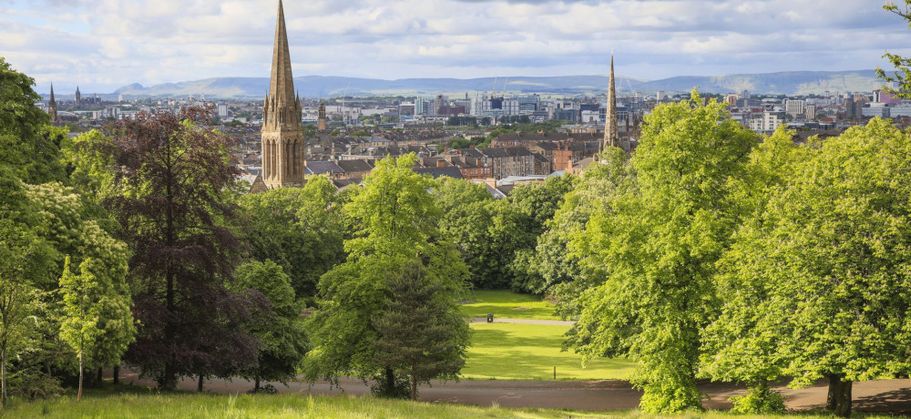
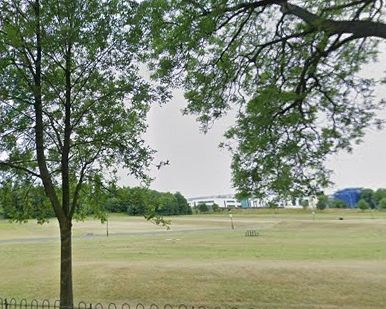
And it was to Queen's Park that the mainly North Scottish, future founders of the football club of the same name turned when moved on from Lorne Terrace. The story is then that on the park they observed a presumably round-ball, impromptu kick-about involving members of the YMCA, joined in and were bitten, with a first game, not probably to Association Rules, taking place on 1st August, 1868 against John Connell's Thistle visiting from Glasgow Green. In fact the first home game to the Association Rules, would only take place after Queen's Park formally joined the London organisation in November 1870. That would make it either in October 1871 against Granville from nearby Myrtle Park, although "touches" were still involved, or against the same club in April 1872, when they were not.
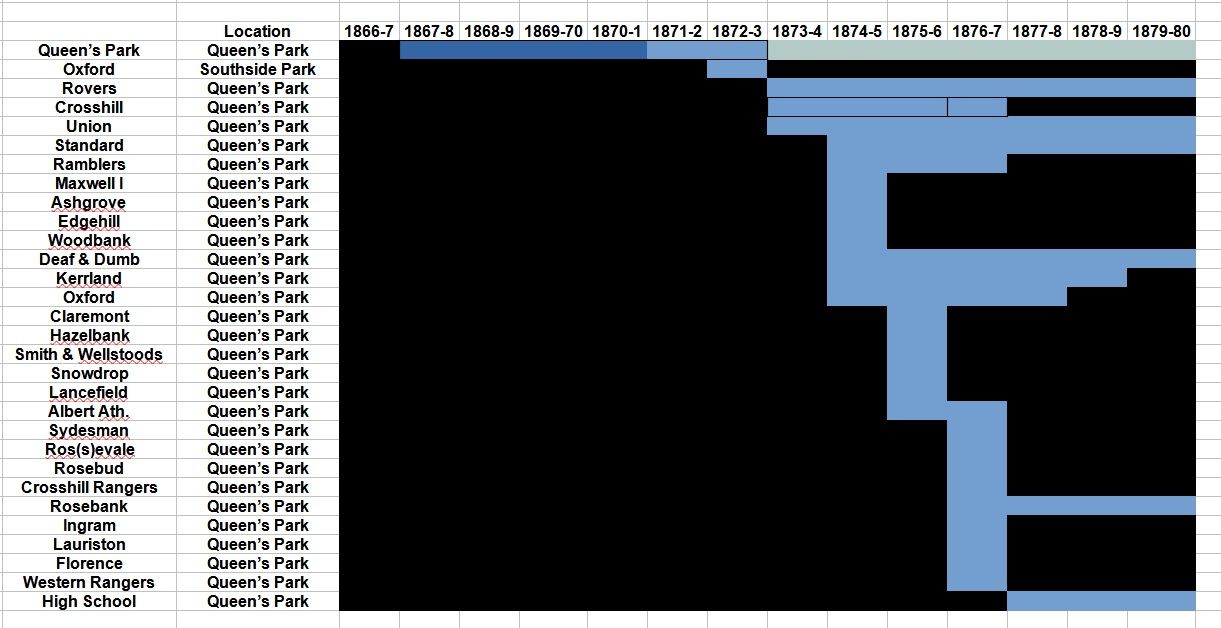
But it was from then that the new game began to take off and a second centre of Glasgow footballing began to form. Whilst Glasgow Green/Fleshers' would continue for the rest of the decade annually to host four to five teams, Queen's Park would become the home-ground, starting with George Ramsay's Oxford already in 1872, of year-on-year over the same period six to nine similarly senior clubs.
__________________________________________________________________________________________________________
However, within a very short period of its accepting the rules of the FA in London Queen's Park, with it own, unofficially accepted playing area across from the then Deaf and Dumb Institute, now the site of part of the New Victoria Hospital, came to the conclusion it needed a ground to itself, not least to maximise crowd-revenue. Not a few hundred but 2,500 would come to pay to watch the first Scottish Cup Final. And after a short search it was able, just to the north-east of the park itself, to secure a suitable piece of land that curiously it called Hampden Park. It was opened on 23rd November 1873 for a First Round game in that first Scottish Cup, against another of the Cup founders, Dumbreck, a match won 7-0 by the home team. It was named perhaps for no more reason that it was overlooked, albeit only somewhat, by the very newly-constructed Hampden Terrace, two hundred and fifty yards to the south, built by the Eadie brothers, at least one of whom is said to have been a Queen's Park member.
Hampden Bowling Club/1st Hampden Park (corner of Queen's Dr./Queen's Park Ave.)
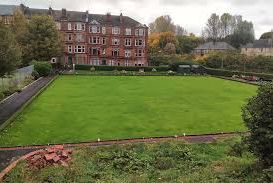
On the corner of Kingsley Avenue and Queen's Park Avenue Hampden Bowling Club, as it has been until recently, is the site of the much of that 1st Hampden Park, the World's first, purpose-built Association football stadium. It opened in 1873 and was left a decade later because a small part of the pitch but a large part of the spectator standing at one end of it was required for the present-day train-line. And from that point to 1905 its status, as it has been from February this year (2026), was nebulous. The situation just now is that part of what is now Kingsley Gardens might be designated, the bowling greem itself is unlikely to be.

__________________________________________________________________________________________________________
The Queen's Park
- The Southside Stable
In 1862 Queen's Park aka Southside Park was opened in the then Renfrewshire countryside soon to be Glasgow's Southern Suburbs. And recently the earliest known photograph of a part of it was rediscovered, one that by chance has the hugest relevance to the development of football not just in the city but in Scotland as a whole. Some might same it was the stable, in which Scots and therefore World football was born.
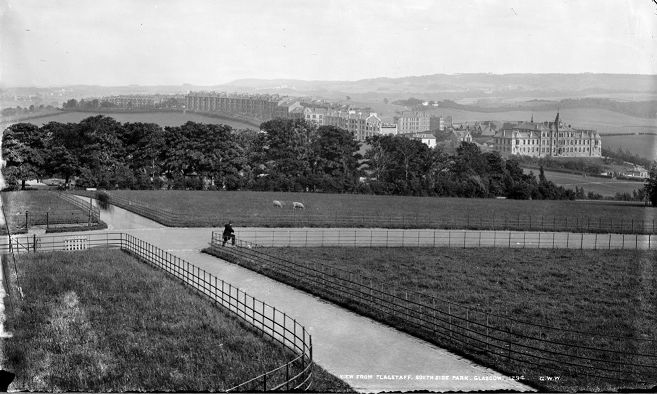
The view (lleft) was taken in about 1875 by a famous early photographer of the period, George Washington Wilson. It looks south from the flagstaff that is still in the centre of the park. In the middle-distance there is is what is now Hampden Terrace, still partly under construction it seems. To the right of it is the old Deaf and Dumb Institution, now the site of Victoria Hospital. And at the edge of the picture centre right is the Deaf and Dumb Institution's Gatehouse, where Queen's Park FC kept their kit, whilst in front of the Gatehouse is the piece of the Recreation Ground where the club played its earliest Association games i.e. the Vale of Leven games of 1872/3.
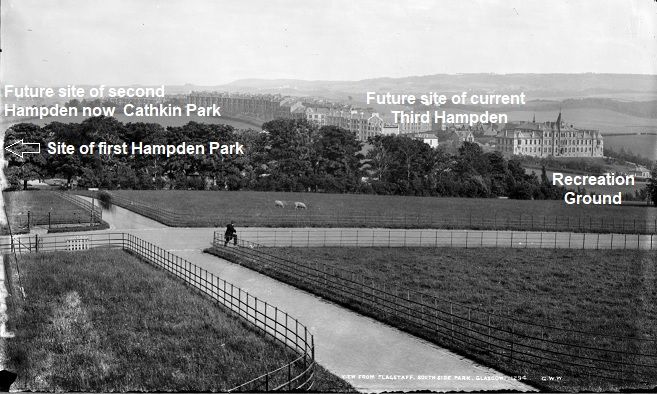
But the photogtraph reveals more. To the left two thirds back beyond the line of trees are the fields that would become the Second Hampden, now Cathkin Park, last year (2025) designated by Historic Environment Scotland for its Scottish and World footballing importance. And just left of those same trees off picture is the site of the First Hampden, part of which has this year (2026) also received designation for the same reasons.
And then on the hill beyond Hampden Terrace there is, of course, the future site of today's and the third, Hampden Park and also of lesser Hampden, respectively the national stadium and the current home not far from first home of that same Queen's Park F.C..
__________________________________________________________________________________________________________
Bankhall Park (Bankhall St.)
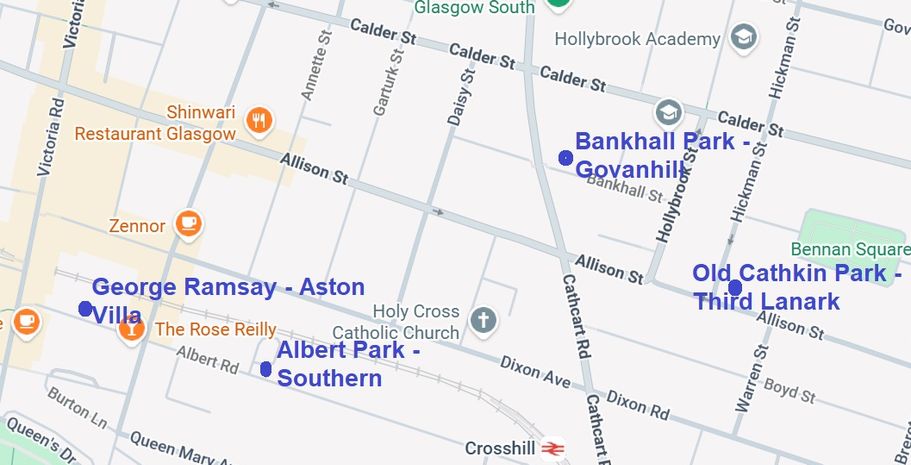
For at least part of the six seasons from 1876 Govanhill F.C. played at Bankhall Park. It no longer exists but two blocks south of Govanhill St. itself is Bankhall St.. It crosses the Cathcart Rd. with areas on either side of it large enough to accommodate a football field.
The club itself came out of the local lacrosse team of the same name, entered the Scottish Cup in 1878-9 and 1879-80 without ever getting beyond the First Round. And then it seems to have ceased to be a senior club, reverting to junior status and playing it matches on Queen's Park before dissolution in 1882.
And the reason for the decline may simply have been development. Calder St., the next to the north was being build by 1875. The Crosshill and Govanhill Burgh Hall, now Dixon Hall, 150 yards to the south, was built in 1879 and the now demolished Bankhall tenements were begun in 1880.
__________________________________________________________________________________________________________
Old Cathkin (Corner of Allison & Hollybrook Streets)
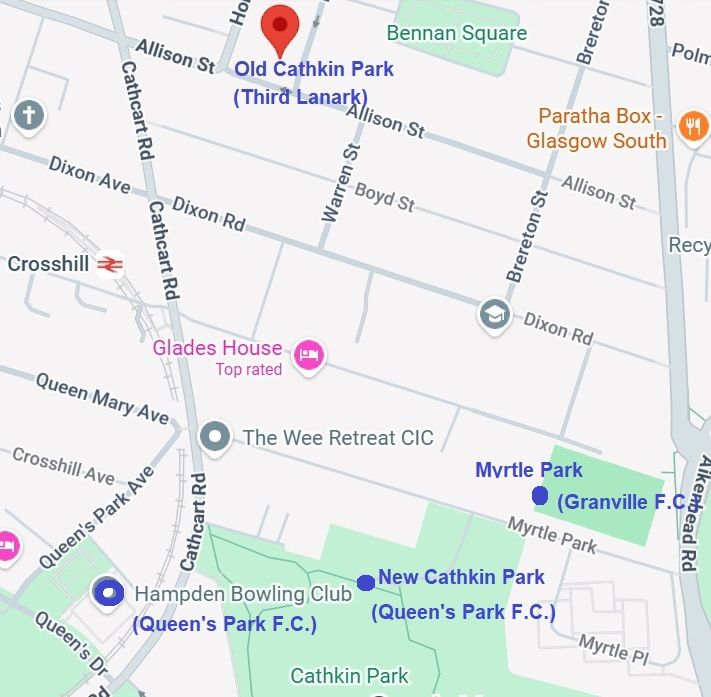
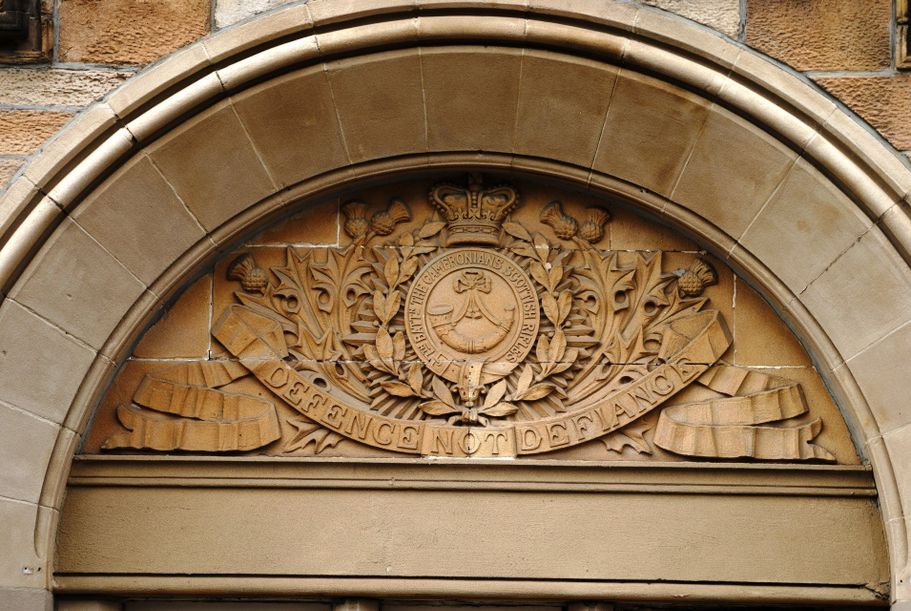
But the developmental pressures south-east around Queen's Park seem then to have eased somewhat. On foundation of the Third Lanark club in 1872 in the Regimental Orderly Room on Glasgow's Howard St. (See Tour 2), the drill ground on Kingarth St./Victoria Road north of Strathbungo would be used to train before a pitch would be developed at the junction of Allison and Hollybrook Sts., a mile away. That ground, just a hundred or so yards from Bankhall, perhaps less, and initially holding 8-9,000 but later up to 16,000, would become the first Cathkin Park, the venue for club games, occasional Cup finals and internationals too until in 1899 Queen's Park felt the need to leave its second Hampden Park, building the third up on Mount Florida (See this Tour below) from 1903. With that The Thirds simply moved across, completing the tranfer in 1904, re-naming its new home New Cathkin Park and leaving the old ground for by then in-fill housing development as the advance to the east of the Queen's Park of the Southern Suburbs continued. Queen's Park, Crosshill and Mount Florida stations and the line terminating at Cathcart had existed since 1886. The return loop to Glasgow Central via Shawlands and Maxwell Park then opening up the west side was opened in 1894.
__________________________________________________________________________________________________________
Myrtle Park
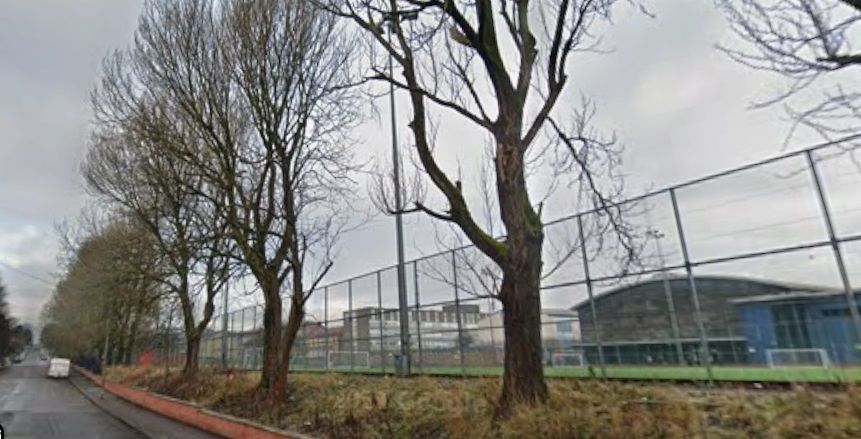
The club in Scotland against which Queen's Park had a first game to full, Association Rules game was probably near neighbour, Granville. It was formed in 1872 out of a cricket team of the same name with its ground, presumably for both sports, at Myrtle Park. Indeed, by 1873 the football section had almost as many members as Queen's Park itself, was a founder member of the Scottish Football Association and its Secretary, John C. Mackay, John Campbell Mackay, was the SFA's second, having already been on its first committee.
He was to be a pivotal figure not just at the one club but at second too. He had been born in 1849 in Glasgow, probably in The Gorbals so in 1874 was twenty-five, a commercial clerk, the son of an accountant from Golspie in Ross-shire. His childhood and early teens had been spent, like his near contemporary Billy MacKinnon, on Abbotsford Place (See Tour 2), so he may have been another to have got his first taste of the round-ball game on Glasgow Green. But by 1871 his family and he had moved to Govanhill, were staying in Kinning Park by 1881 but by 1891, he now a merchant, were back and on Calder St.. And in terms of football, whilst the Granville club lasted only two seasons to 1874, Mackay was in fact to stay on in his position at the SFA until 1875 and would remain a committee member beyond that, switching loyalty to Govanhill at Bankhall until its demise, being Secretary there too, before fading from the football scene.
__________________________________________________________________________________________________________
Cathkin Park
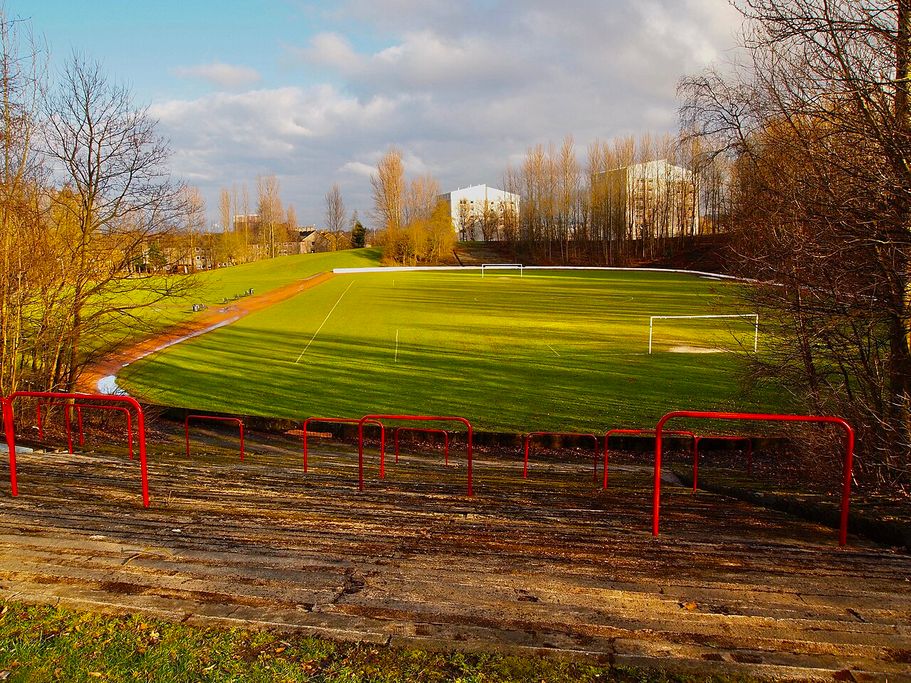
It seems football made Cathkin Park. Its name comes from Third Lanark's original ground a quarter of a mile or so to the north. It began life in 1883 as Queen's Park second Hampden Park and before that it was an unnamed piece of open land to the south of the villas of Crosshill's Queen Mary Avenue, north of Prospecthill Road with the imposing, decade-old Hampden Terrace, the only just developing Mount Florida behind and Bellevue House and its pitches to its south-east. Now, or at least the part of it that became a football stadium with a capacity of up to 50,000, it is finally a site of national importance, designated by HES, (Historic Environment Scotland) for its unique, iconic and resonant, tumble-weed terracing.
__________________________________________________________________________________________________________
Hampden Terrace and the Eadie brothers
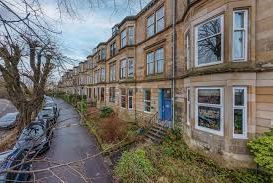
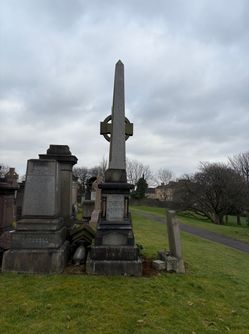
Constructed in 1870 what would be named Hampden Terrace after an English, Civil War parliamentarian must have been an imposing presence at the time; a 200 yard long stone edifice along the then Parish road, now Prospecthill Road, in what was then still mostly fields.
It was built by the brothers, George and Alexander Eadie. They had been born in Auchinleck, George in 1837, Alexander in 1841. But by 1861 the family was living on Crown St. in The Gorbals, the boys both working as simple joiners, before what seems to have been a decade of business success but also for one (based on age, Alex), or both of them perhaps football involvement on Glasgow Green once more.
Certainly again one of the brothers is then said also to have been involved with the game at Queen's Park, instrumental there in the Hampden name being adopted in 1873 for the club's first ground. But which it was is not known. By 1871 George and family was actually living at 1, Hampden Terrace, he recorded as employing 130., whilst Alex, now also married, then still on Caledonian Road in Hutchesontown, would be by 1877 staying at what is recorded as 3, Hampden Place, Mount Florida.
However, at some point the pair seem somewhat to have drifted apart. Whilst George would remain where he was, dying in 1921 in Hampden Park Villa, Alex would move to Aytoun Road, Kinning Park. In fact he would remain in Pollokshields until his own passing in 1927 but be buried with his late wife at Glasgow Necropolis.
__________________________________________________________________________________________________________
Bellevue Park
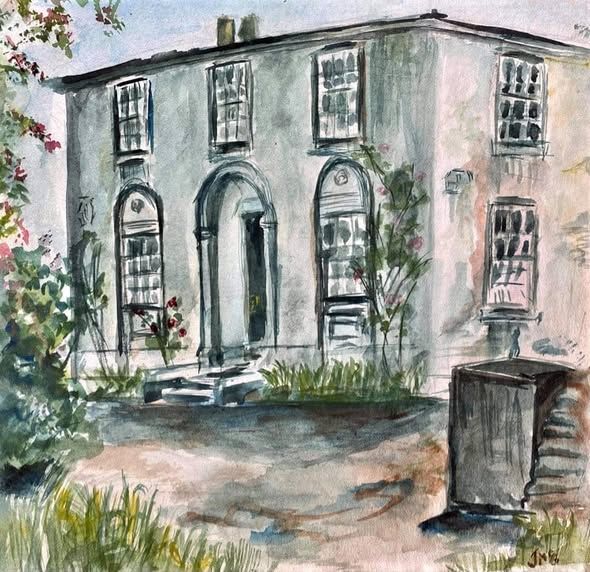
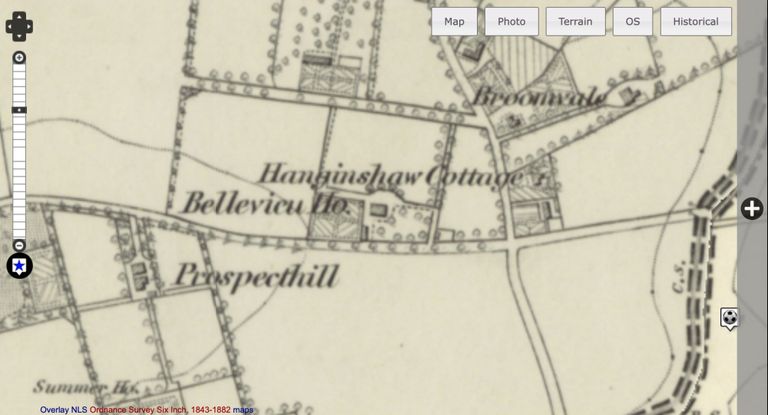
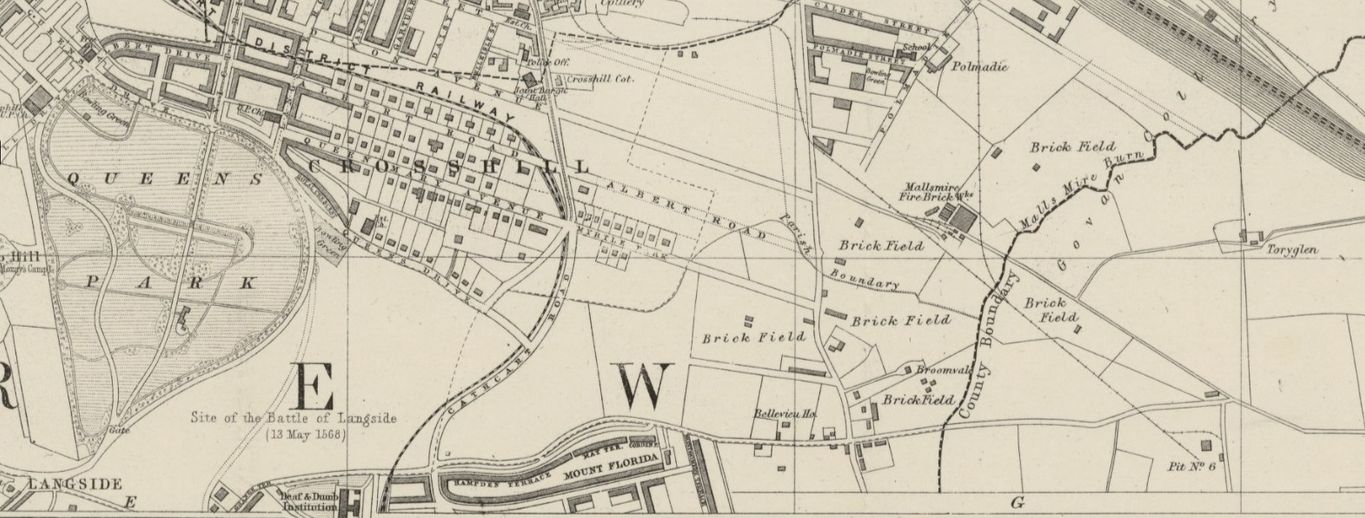
Bellevue aka Belleview House was once described as "the grandest council house in Glasgow". It stood to the north of Mount Florida at the junction of Prospect Hill and Aikenhead Roads, where today Police Scotland Cathcart is to be found, but was demolished some seventy years ago.
However, a century before it had been not only a small, country house with land as per the map, the home in 1871 of Robert Neil, future player with Queen's Park and Scotland, but also the home ground from 1873 of at least three local teams. First came Winton, from 1879 reconstituted and renamed Apsley and in 1878 Oxford, moving from Queen's Park.
__________________________________________________________________________________________________________
Hampden Park
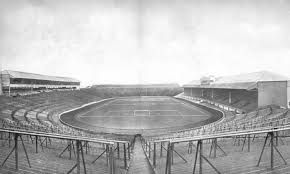
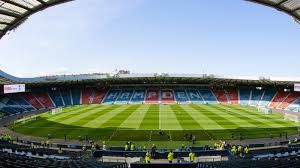
Hampden Park, the third Hampden was opened by Queen's Park in 1903. It was built as the result of more land to expand the second Hampden, now Cathkin Park not being available. On opening it had a capacity of 100,000, which was gradually increased to 150,000, the crowd at the 1937 Scotland-England international, a 3-1 home win, being at 149, 415, the highest officially recorded. The stadium, sold by the club a hundred and fifteen years after first being used by it, now for football matches can take just over fifty-thousand and also contains the Scottish Football Museum. It is certainly worth a visit but only if your football interest is post-World War Two.
__________________________________________________________________________________________________________
Lesser Hampden
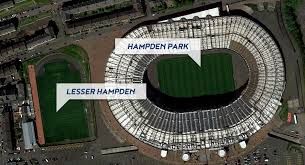
One of the quirks from 1923 of bygone Hampden Park was the pitch and stands Queen's Park erected on what had been the Clincart steading. It had remained to the west of the main stadium, its original farmhouse and byre retained as a pavilion and dressing room, the ground at its greatest having a capacity of 12,000.
At times the club would play its matches there, that is until 2018 when the SFA agreed the purchase of Greater Hampden, Queen's Park moved permanently to Lesser and whole series of problems followed on.
In terms of the club they continue to this day, despite the decision in 2019 finally to turn professional. In terms of the byre and farmhouse, they, the then oldest football-related buildings in Scotland, were with little or no consultation demolished in December 2021.
And once you have explored the content of the Scottish Football Museum it is time for a choice. You can either continue to Langside and beyond or take yourselves to Mount Florida station to make your way homeward.
__________________________________________________________________________________________________________
Loops 3 & 4 - Langside and Queen's Park plus Queen's Park, Polllok Park and Strathbungo
These are two loops which can be done either separately or as one. Both are best started at Mount Florida station but by taking the westward exit, using the path that descends to Battlefield Road and turning right. The first is short taking you back, south-east to north-west through Queen's Park itself to a conclusion at Queen's Park station or can continue still via the southern edge of Queen's Park east to west to Old Crossmyloof, to Pollok Park, Titwood and back to Strathbungo and Pollokshields West station. The first is perhaps a mile and a half, the second anything between two and three miles, depending on what is included. But both begin with Valeview Terrace.
Loop 3: Langside and Queen's Park
Valeview Terrace
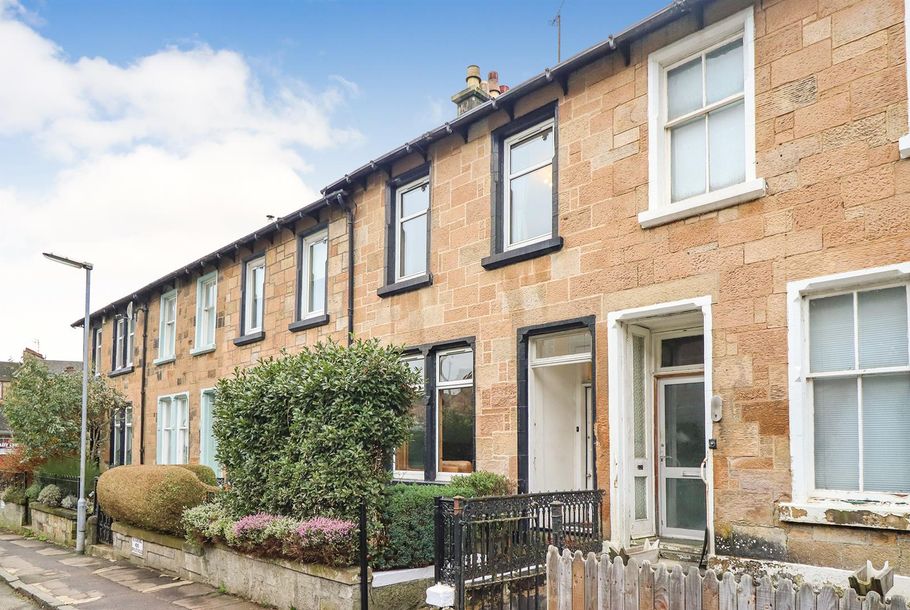
When in early 1873 Archibald Rae, then Secretary of Queen's Park, sent out a letter to other clubs proposing in this order the creation of a Scottish equivalent of the FA Cup and the formation of the Scottish Football Association, he did it from 3, Valeview Terrace on the border of Langside and Mount Florida, a house that is still there. It was the home he shared with parents and siblings before by 1881, still employed as a Marine Insurance Clerk, marrying and moving back to more central Glasgow, to just of Duke St., Partick and then just of the Byres Rd with an office in Renfield St.. And it would at Blythswood Sq. he would end his days, in 1911 to be buried in Craigton Cemetery.
Today's Langside only really began to form from 1862 after the opening of Queen's Park itself, the original village of weavers based around what is now Algie St., with by the middle of the 19th Century villas built along Mansionhouse Road. And with them already by 1873 football had arrived with, named for the site just to the north of the 1858 Battle of Langside, the formation of Battlefield F.C., aka The Battlefield, followed in 1876 by by the short-lived Langside club itself.

__________________________________________________________________________________________________________
Battlefield F.C. and Overdale Park
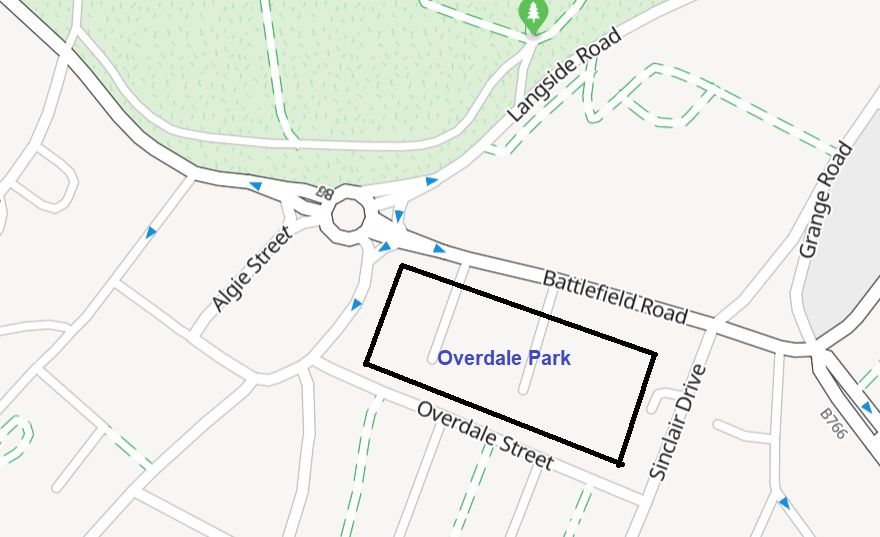
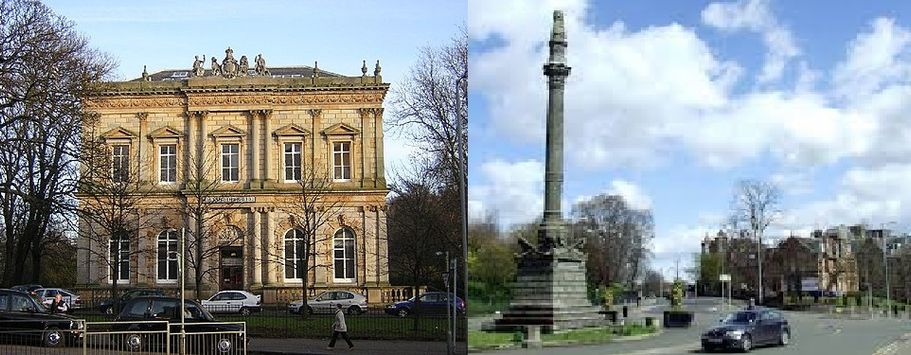
Battlefield F.C. is said to have been at the very least inspired by the Queen's Park club. Indeed, eight members of The Spiders were amongst the new club's original membership, and could be looked upon almost as "Spiders Plus". The club was known for being very "middle-class", presumably middle- or upper-middle, more so than lower middle-class Queen's Park, its team seen as "gentlemanly", with a reputation for clean play that "cultivat[ed] the science of the game". In ethos it sounds more or less London Corinthian, although predating it by a decade. And that aura was, whilst the club existed for almost a quarter of a century, only enhanced by it seeming, having been already founded in 1873, to play an external game for the first time only in October 1879, not entering the Scottish Cup until 1881-82, a First Round defeat to Partick Thistle, but soon causing waves.
In 1883-4 Battlefield would reach the Cup Quarter Finals, losing to Hibernian, and in 1884-5 did it again, to defeat by Cambuslang but defeating Queen's Park and at Hampden Park on the way.
And throughout certainly the first decade of Battlefield's existence it played at Overdale Park, another ground that is no longer there but of which there is a seemingly obvious trace. Just to the east of old Langside village along Battlefield Road itself is a block, 150 by 80 yards, bounded at its ends by Millbrae Rd. and Sinclair Rd. with today Overdale St. at its back. That is before in 1884 a move was made to what is called Mossfield Park but may have been Moss-side, half-a-mile away in Old Crossmyloof. (See below)
__________________________________________________________________________________________________________
And here the choice can be made to cross Queen's Park as the final part of Loop 3 or as the first section of the continuation.
__________________________________________________________________________________________________________
Queen's Park
Queen's Park + Recreation
And so it is back to in this case the finishing-point of the loop but, of course, the starting place for Association football in Scotland, Queen's Park. In the almost decade and a half from 1867 at least thirty clubs played on its pitches, up to a dozen in any one season with by the end of the 1870s perhaps at any one time the same around its periphery.
Numerically, if not ever technically and tactically, it became the hub of the Scottish and certainly the Glasgow game until really the creation of Celtic and from then through the 1890s once more a gradual concentration away from the Southern suburbs and towards those in the east and west (Parkhead and Ibrox) and the city more centrally (Clyde and Partick Thistle).
__________________________________________________________________________________________________________
Loop 4: Queen's Park, Polllok Park and Strathbungo
Moss Side Park
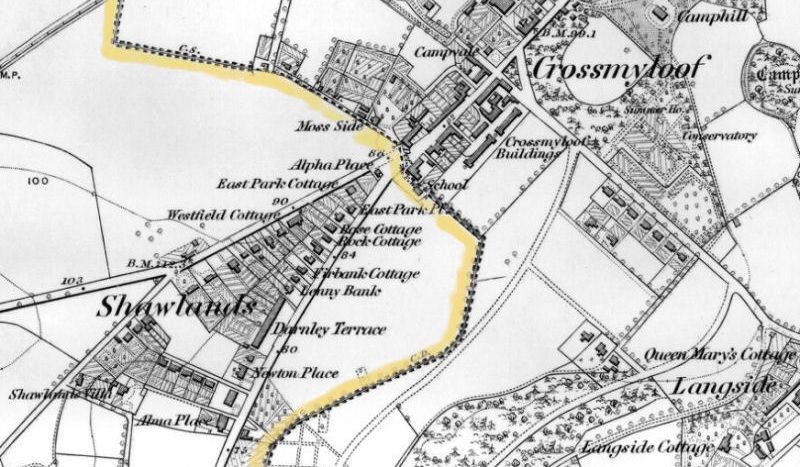
Crossmyloof is today associated with the railway station, built only in 1888, but the old village was a quarter of mile south-east between Queen's Park's easternmost corner and where Pollokshaws Road now splits into Kilmarnock Road. And it would be there that Moss Side House was to be found, where Mosside Park, the possible second home of Battlefield and later that of the Westbourne club, was located and what is the southern end of today's Moss-Side Road.
Westbourne F.C. was founded in 1879 but would only join the SFA in 1885, playing for the first time in 1885-6, an 11-0, First Round defeat to Thistle from Dalmarnock. It then lost to Rangers the following year in the Second Round, again heavily to Partick Thistle the season after that in the First Round once more and by the start of the 1888-9 season was dissolved.

__________________________________________________________________________________________________________
Pollok House, Pollok, Norwood and Maxwell Parks
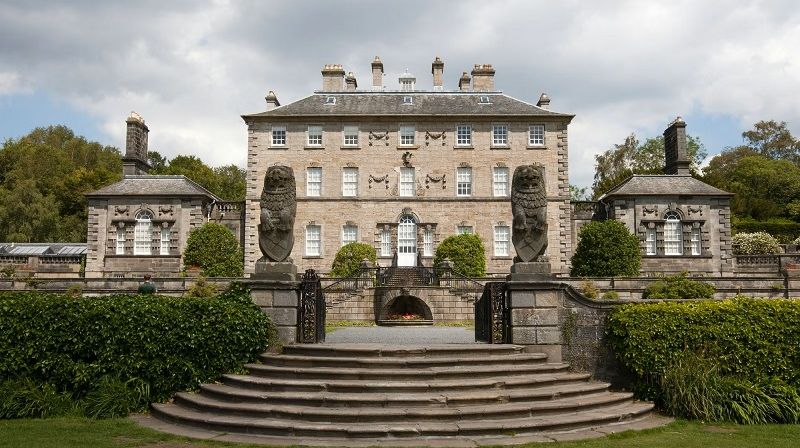
In spite of a great deal of original research into his life done by SFHG and also the preservation of the grave of Andrew Watson (see Tour one) there remain mistakes in his biographical details. One, indeed, is in his Wiki entry, which has the clubs he played for before Queen's Park the wrong way round. In fact he began with Parkgrove and then is said to have spent at least a season with the Maxwell club. If correct, it was one of at least four based at Norwood Park, which was to be found near Haggs Castle on the Dumbreck Road, so likely close to the current playing fields.

The others teams were initially Granton and the private club, Sir John Maxwell, later followed by Shawlands and Pollokshaws Harp. The ground was used until 1891 and was on land owned by the Maxwell family. And it is that same family that also gifted Maxwell Park and Pollok Country Park, a day out in itself and, with Pollok House and the Burrell Collection at its centre, one possible end to this section of the tour or the half-way point of the fuller itinerary south of Queen's Park.
__________________________________________________________________________________________________________
Clydesdale
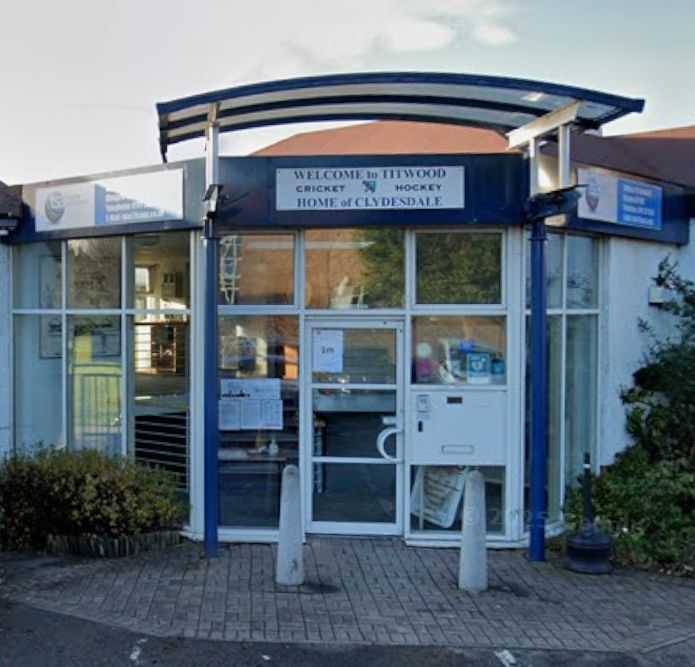
Clydesdale would begin as a cricket club and, briefly, between 1872 and 1877, be a very early and top-flight football team. It was a founder member of the Scottish Football Association, having in Archibald Campbell its first President, being the losing finalist in the initial Scottish Cup Final and only defeated in the semi-final the following season having held the lead twice and by an own-goal in the replay, both times to Queen's Park. Yet, whilst it would continue with the winter game until 1881, there would be from then not just reversion to the summer game but continuation of it only to the present day.

The club's first ground would be Kinning Park (See Tour Two), then in open country, but as the city encroached it was used first by Parkgrove and then acquired by Rangers. Clydesdale, cricket and football, albeit the latter only temporarily and briefly, would meantime move to the Titwood ground in Pollokshields, where, semi-distant from Crossmyloof and Maxwell Park stations, it, since 2007 with ODI international status, still remains.
__________________________________________________________________________________________________________
Camphill, Moray Park and Melville
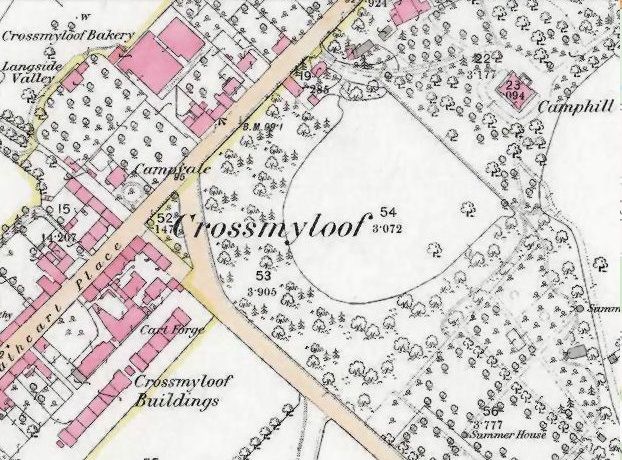
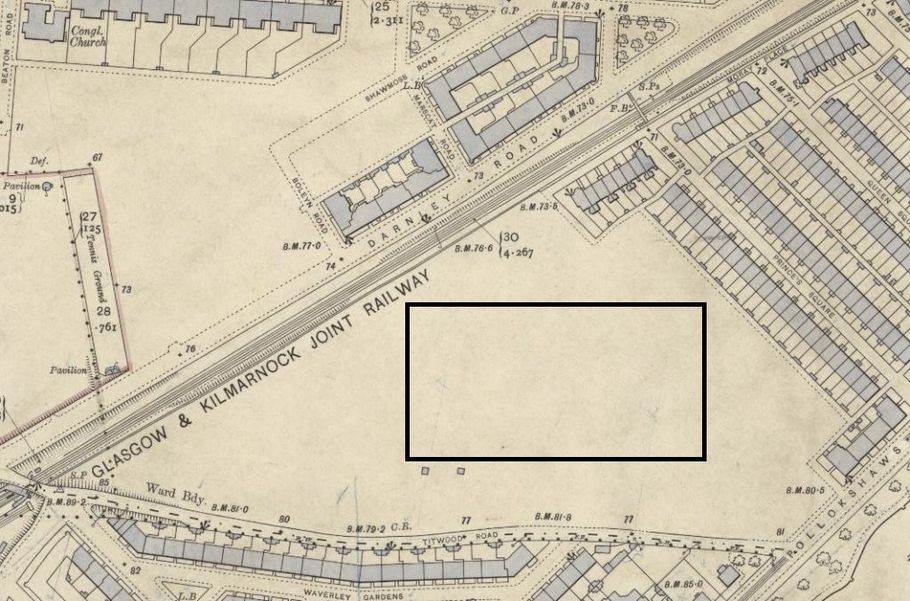
One of the first teams to emerge, albeit for just a season, from the east side of Queen's Park, and presumably named for Camphill House, on the eastern edge of the park itself, was Camphill in 1877, ground unknown.
And then there was something of a hiatus, that is probably until 1885 when reports on various sports began to appear; rounders, football and rugby, after Southern changed codes, even shinty, when Glasgow Cowal moved from Glasgow Green. Various football teams were involved - St. Andrews, Cambridge, Southern Athletic - none with any particular success. In fact the one figure to emerge from the era was George Morrell. He, it is said, came through from local junior team, Glenure Utd., whilst training and then working as a dentist, to manage at first Greenock Morton from 1904 and then from 1908 Arsenal. And it was he, who was not only in charge when the London club moved from Woolwich to Highbury in 1913 but also at the end of the season become the first and only manager to see that club relegated.
And Glenure, St. Andrews, Southern Athletic, Cowal and later others would play at Moray Park. It was at the south-western end of Moray Place, on a triangle of ground between the railway, Titwood Road and the lane back of Carswell Gardens to and up leafy Moray Place back to Strathbungo and Queen's Park or Pollokshields West stations.

__________________________________________________________________________________________________________
Tour Four
Cathcart and Beyond
SFHG's Cathcart Trail starts at its station and returns there. It is a loop, takeable in either direction, of about a mile; we go anti-clockwise; and to which should be added to as much distance you want to cover in the forty-three acres of Cathcart Cemetery, beautiful, for all its content, just designated for its historical importance and one of the two or three greatest sites for Scottish and World footballing history.
Cathcart had been very much a rural village with a dye-works on the banks of the river its token industry. And, even , when the railway had arrived in 1886 it was still so, even as from the north the suburbs of an expanding Glasgow were approaching by then just a couple of miles away.
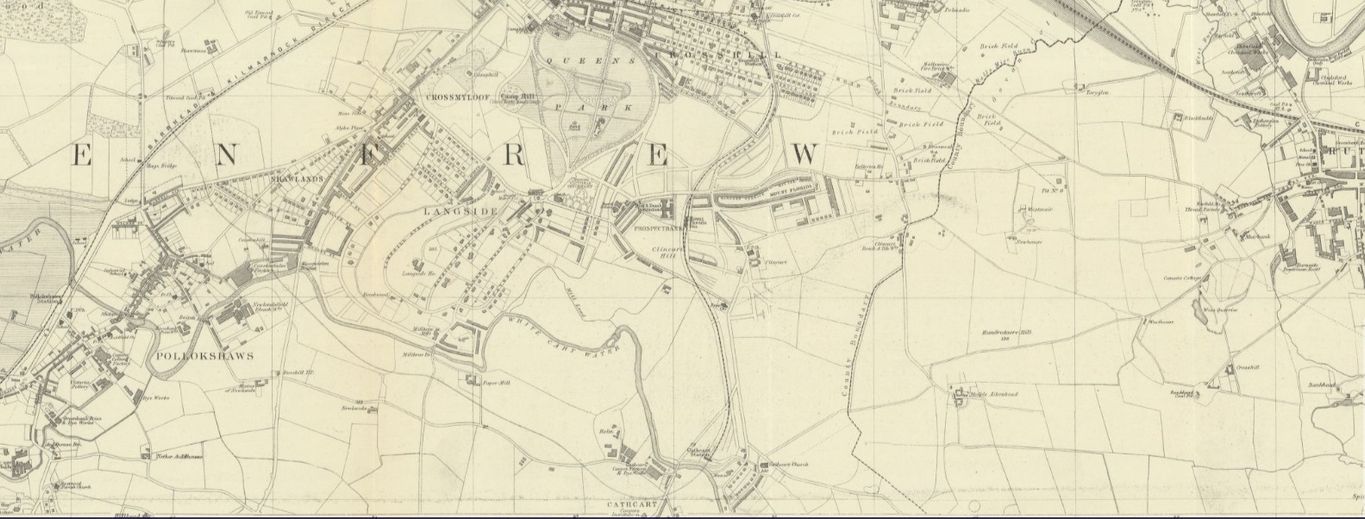
But such was the strength of the football contagion that by 1873, the first year of the Scottish Cup and therefore the Scottish Football Association, Cathcart had its first team, the 23rd Renfrewshire Volunteers. Its part in the story is stop three but we start by, almost straight from the platform, crossing the top of the Clarkston Road just south of Cathcart Bridge into Holmhead Crescent and World, specifically Uruguay's, football.

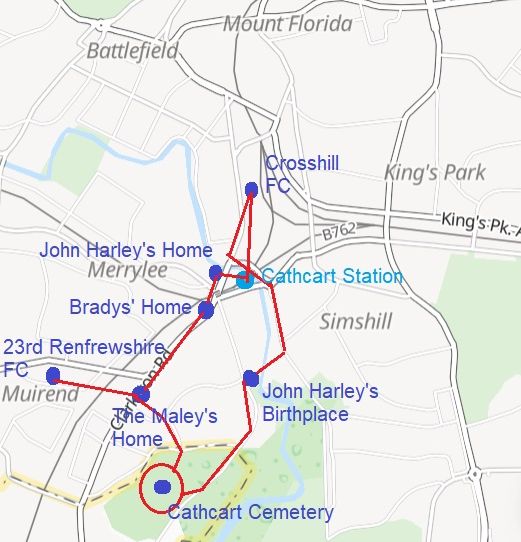
__________________________________________________________________________________________________________
Football would arrive in at least four of the five large, southern, South American countries through Scots. And in two of them, Brazil and Uruguay, in each creating distinctive, different styles of play, it would be in two waves. In the former after Donohoe, Scott and Miller that second standard-bearer would be Paisley's Archie McLean. In the latter after William Leslie Poole and Willie John McLean it was Cathcart's John/Juan Harley, aka El Yoni.
He was born in 1886 in the village, at Braehead, went to school there and for much of his child-hood, brought up by his widowed father, stayed at 2, Holmhead Crescent, a stone's throw from the station.
And it was in the village too that he began to learn his football that he would further develop as he trained as a railway engineer in Springburn and, as his working life began, take first to Argentina and then across the River Plate to Montevideo. The Harley position on-field was Scottish centre-half, The Pivot controlling the game with his position and passing. And his great gift was once particularly on joining the Central Uruguyan Railway Cricket Club now Penarol Football Club in Uruguay, to adapt it to the drier, harder pitches of his adopted home. It would very quickly make him a an Uruguayan internationalist then national captain before stepping down at the age of thirty-four just before the first ever South American Championship in 1916. He unable to play because he was not Uruguayan-born. But the team, one that took the trophy, had been moulded and with several players brought through by him, including his replacement as Pivot, Juan Delgado, one of the country's, in fact South America's first Black internationalist; this as Harley had created his adopted land's unique style of play, one that would from 1924 to 1950 win it gold medals at first two Olympics and then the first two World Cups it was able to enter.
__________________________________________________________________________________________________________
Then it is back out onto the Clarkston Road, turning right and continuing under the railways. Thornbank, the starting point for the "Brady Bunch" is above you on the right.
There are two Scottish footballers of the late 1880s and 1890s, both forwards, who should have played for the national team but never did. One was John Goodall, the elder of two footballing brothers, sons of a soldier, who, although raised almost entirely in Kilmarnock, could, because of accident of birth, only play for England. His brother, Archie, similarly could only play for Ireland. And the other Alex Brady, who, because he was so good so young, was at sixteen already employed as a professional in England and therefore ineligible.
Alex Brady was one of five footballing brothers. The eldest,James, was born in 1866, Alex in 1870, the youngest, Joseph, also briefly a professional in England, in 1872, all in Cathcart, their father a Block Printer to trade, probably working at the Geddes Dye-Works. It, surrounded by workers' cottages, stood on the same land that soon would become John Harley's Holmhead Crescent. John Geddes, himself, had built a house "Thornbank", now flats, close by at the foot of Monreith Rd.. Thornbank was the address, at which the Bradies were actually recorded in 1871. Perhaps the cottages were known as that too. William Geddes's home was actually Holmhead House itself, three hundred yards away and now 7, Rhannan Terrace.
__________________________________________________________________________________________________________
Now continue down the Clarkston Road, passing the Couper Institute, until you arrive at its junction with Merrylee Rd.. Look right and ahead and there on the farm that was once there was the ground of the 23rd Volunteers, continue on for another fifty yards, look left and you will see not just their source but that of a major part of the foundation of Celtic F.C. and its next fifty years of success.
Home of the Maleys + Muirland Park - (327 & 329, Clarkston Rd.)
The Irishman, Thomas Maley Snr., had in 1869 at the age of forty ceased to be a serving soldier, become a Drill Sergent and taken his family permanently to stay in Scotland,. There they settled in first Thornliebank before a transfer by 1875 to Cathcart, second son Tom, aged ten, third son, Willie, six and Alex born that same year and just south of the village itself in New Cathcart.
There, at Argyle Place, half a mile from today's Cathcart station, stood the drill- hall of the 23rd Renfrewshire Volunteers, which in 1873 had formed the first, local football club, its ground, Muirend and/or Muirland Park, a short distance away on what was then part of the Marylee Farm. And, whilst the 23rd RV would seemingly be dissolved in 1879, until then for the four pevious seasons, coincidently or not, from the arrival of Maley, it would take part in the Scottish Cup, although never advancing beyond the Second Round. Indeed, whilst the club was still in place, Tom at least, sixteen in 1881 and by 1884 at nineteen, training as a teacher in Glasgow and already turning out for Partick Thistle, would receive his grounding in the game. The 23rd Renfrewshire Volunteers dissolution might even explain why Willie, clearly a future footballer of great ability, was first known as a runner before only in 1887 becoming involved with the round-ball game and with Third Lanark.
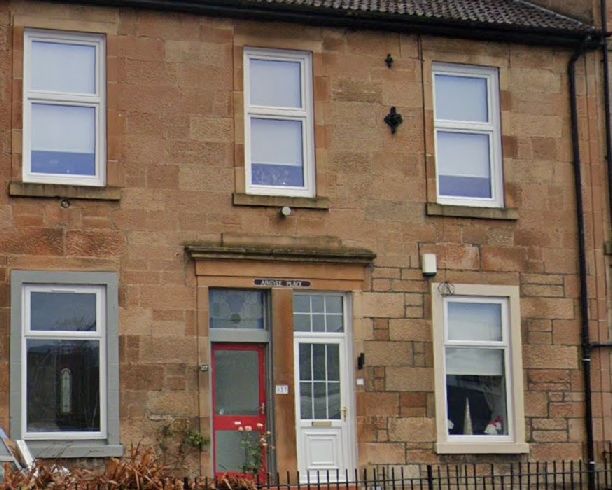
Thus it was that in the 1881 census the Maley family was recorded actually staying at Argyle Place itself. And a decade later in 1891 the family would still be there. Moreover, even today there is a pair of houses, in about the right place, bearing exactly that same Argyle Place name. It seems, therefore, highly likely that these houses, now nos. 327 & 329, Clarkston Road would in 1887 been at the dawning of one of the most important events in Scottish football, the creation of Celtic F.C..
In short the story is that in December, barely month after the club's foundation, a deputation from it went to Cathcart to try to recruit Tom Maley, found him not at home so signed up Willy, instead. Tom would later also join but Willy as player and then manager would be with the club for the next half century.
__________________________________________________________________________________________________________
Now continue down the Clarkston Road for another hundred yards, turn left into Clarkston Avenue and it will take you directly to the main gates of Cathcart Cemetery.
Cathcart Cemetery
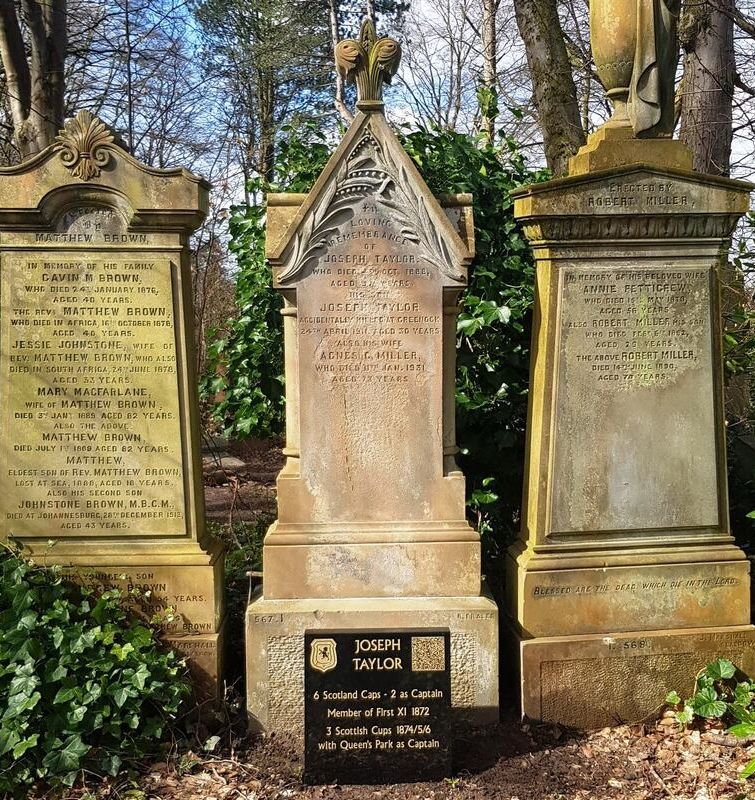
Joe Taylor
Kenny Anderson
Cathcart Cemetery, (click here for more coverage) for which historical designation has finally and only recently been granted, together with neighbouring Linn Park and Crematorium is an island of tranquillity but also much more. It is the resting-place of Willie Maley, alongside his father and mother. And it is also the burial place of many important figures more widely, including over twenty from football, amongst them a further fifteen former internationalists, Ranger's William Wilton, Hugh MacColl and a memorial to George Pattullo. SFHG specifically looks after the resting-place of Joseph Taylor, Scotland's first-ever full-back, the contrast with other graves, e.g. that of fellow internationalist, Kenny Anderson, is there to be seen, left. Moreover, in addition a further ten internationalists have passed through Linn Park's gates, making in Scotland and, perhaps, world-wide it comparable in terms of early history of the game only to Woodside in Paisley.
__________________________________________________________________________________________________________
On exiting the cemetery both front and right and rear and left will take you to the roundabout at the mid-point of Netherlee Road. Depending of approach turn left or continue into the lower half for Netherlee itself, continuing on for two hundred and fifty yards to the confluence of Snuff Mill Road, Brunton Ave. and Rhannan Road. Then turn around and right there is now the birthplace of John Harley.
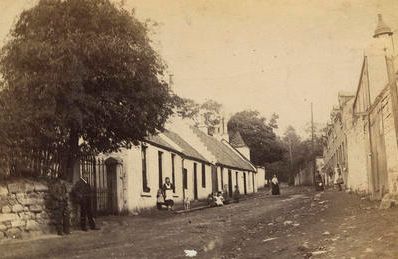
It has been a long-running struggle with South American football historians, notably those in Argentina, to get them to understand the poverty, into which the Scottish pioneers of their game were largely born. And John Harley is the most illustrative and illustratable example, one perhaps more important than even Alex Watson Hutton.
Harley's birth in 1881, one that cost his mother her life, was in Braehead just across the still existing Snuff Mill Bridge over the White Cart river from the old village. And almost uniquely we have a picture of what it looked like more or less then; basic stone cottages beside a dirt track that, one way or other, lead to the Cemetery.
__________________________________________________________________________________________________________
Snufffmill to Kilmailing Park
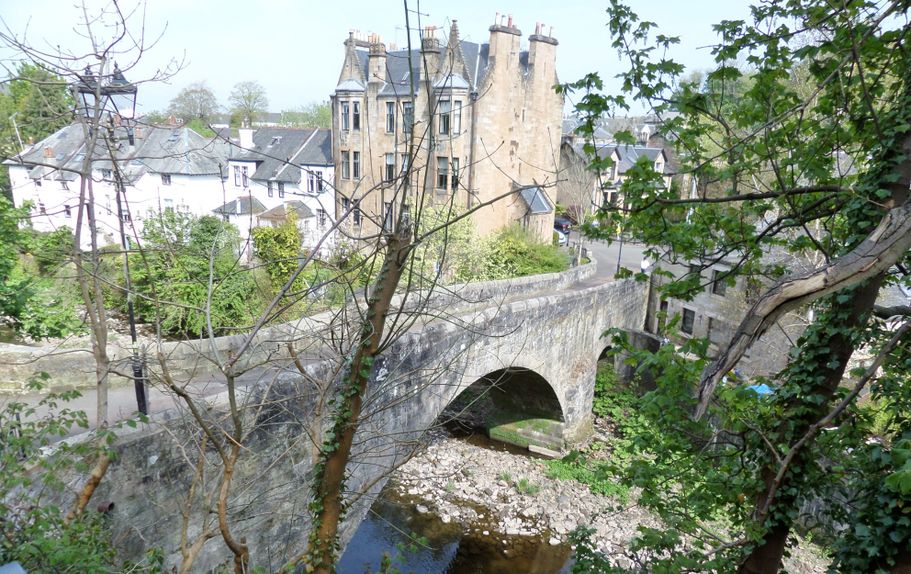
And so to the path back to the station but first a wee diversion. It is a short drop from Braehead down to the Snuff Mill Bridge across the White Cart river. Cross the bridge. The site of what very little remains of Cathcart Castle is up Greenock Ave. to your right. To your left, continuing on you reach the old village. if you are thirsty The Old Smiddy bar is to the left and it is that direction you go, with or with pause, past Kirkwell Rd. to look left at 60, Old Castle Road.
George Morrell (60, Old Castle Road)
Whilst George Morrell was born in Glasgow on Rottenrow by the Cathedral and spent his childhood and youth in Calton, training as a dentist, specialising in dentures, something took him seemingly to Moray Park in Strathbungo for football. There he is said to played for the junior club, Glenure, before becoming a referee. In 1898, so aged twenty-seven, his name was added to the Scottish League list.
And that seems to have led by 1904 to him at thirty-three being appointed Secretary of Greenock Morton before in 1908 going South, to a struggling Arsenal still then in Woolwich.
And it was Morrell, who would be in charge of the club, when, he living in Plumstead, in 1913 it moved from south of the Thames to Highbury. Furthermore he would remain in place with even when at the end of that same season now North London but still very financially-constrained Arsenal was relegated for its first and only time. He was not fired; quite the contrary. In fact it could be argued, with debts largely cleared by and from the new Chairman, Henry Norris, but real undertstanding still of the monetary knife-edge on which the club remained, that it was Morrell, who over the next two seasons in terms of player-numbers and day-to-day expenditures not only steadied the ship but insured the new Arsenal's survival.
But in 1915 George Morrell would, as the English league was suspended, return to Scotland, becoming in 1917 the Secretary this time of Third Lanark for the next four seasons, taking the club from thirteenth to eighth place. Meanwhile the family, he still officially recorded as a dentist, would settle in nearby Cathcart, in fact at the Old Castle Road address, he remaining there until passing aged fifty-nine in 1931, to be buried not in his case in the village's cemetery but the Eastern Necropolis.
And now you continie to turn next right into Kilmailing Road.
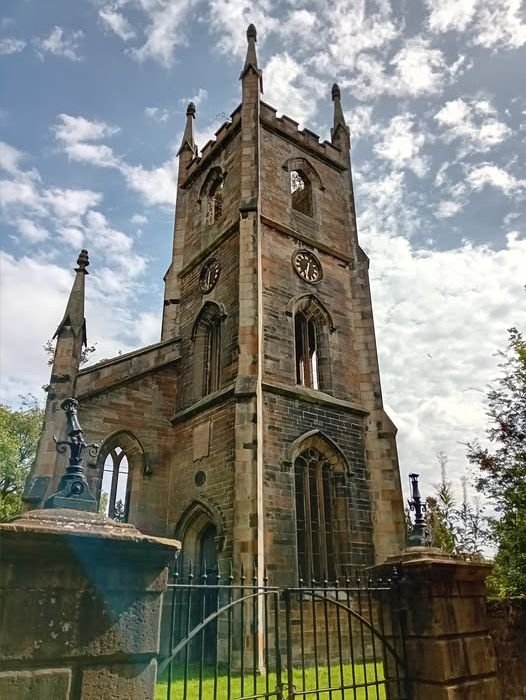
And it was to there from Queen's Park that in 1876 the Crosshill club moved. The ground, Kilmailing Park, was reported by no less than Charles Alcock to be 100 yards from the village omnibus-stop. With that known to be at the foot of Manse Rd. it means the former pitch lay on one side or another of Kilmailing Rd. before the lovely cut- through past the Old Cathcart Parish Churchyard and its remaining tower to what is now the Manse Road roundabout.
And from the roundabout it is an eighty yard drop down Manse Brae to the river once more, over that roundabout to cross the Devlin Road bridge, from where an entrance to the Cathcart station platforms is fifty yards down on the left.
__________________________________________________________________________________________________________
Busby
And to follow on from Tour Three's John Harley and Uruguay there is, and still in the parish of Cathcart a bus-ride down the road to Busby, a second part, after Glasgow Townhead's John Scott of Tour Two, of the three tales that tell the story of how football went to Brazil; the third being Charles Miller to the city of Sao Paulo, his father and his two uncles, merchants/engineers in the city but Largs-born. And that second figure is Thomas Donohoe, the son of immigrants from Ireland, who took permanently not just his skills as a textile-dyer, honed in what was then rural Renfrewshire, to the New World but also a deep, cultural passion, know-how and on-field ability for the round-ball game.
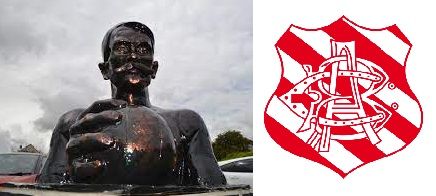
When Tommy Donohoe arrived in early 1894 at the age of thirty-one to the then town of Bangu, now a suburb of Rio de Janeiro in Brazil and where he is honoured with a thirty-foot-high, gold statue, he did so as a committed player but with no football. Born in the then Renfrewshire village of Busby, where a bust of him is now in place, he had worked at the local dye-works, where his father and brother were successively foremen. And he also turned out for the local Cartvale team in its hey-day; a tall (he was over six feet) forward. In 1883-4 it would reach the Scottish Cup quarter-final, to be beaten only by Queen's Park. Moreover, he would do so with two contemporaries and fellow-forwards, Robert Calderwood and Mick Dunbar, also locally-born, both of whom would go on to play for Scotland, and with Tom Dunbar, a defender who would with his brother become Celtic stalwarts.
But in 1890 Donohoe had married Eliza Montague and it was actually she, with a nice twist, who on joining him in Rio in the late summer of 1894 brought ball and boots, actually enabling the game in Rio, even Brazil as a whole.
Back to the SFHG Home page