Plinths & Plaques, Statues and Graves
As with not just this but all our trails, local, national and country, we hold the view that merely recording or even putting on-line is a start but not enough. To do justice to the pioneers, as have a few clubs, even countries, to which they went, as in Scotland in the case of Tommy Donohoe and following the lead of Brazils's Bangu, Busby has too and as has SHFG again in Scotland, but also in England and Northern Ireland, there should be, both at home and elsewhere, place for more statues, golden or otherwise, restored, maintained graves, busts on plinths and if not them then plaques.
So, whilst we research and provide biographical and other details of as many of those Scots, native and Diasporan, who through deed and feet spread globally and uniquely the footballing word, we also look at where, in places from which they came or they rest, and as visual expression of our contemporary, national pride in them and those same localities, some form of physical, outdoor recognition would be both appropriate and feasible.
Glasgow South-Side
Glasgow South-Side is for us the area on the south side of the river on the Renfrewshire bank just immediately opposite the old Lanarkshire city. It is not the current Scottish parliamentary constituency, the one without the hyphen, the southernmost two thirds of which are for our footballing purposes in the Southern Suburbs. Nor does it include Ibrox but stretches between Cessnock and Plantation in the west, Oatlands to the east and Eglinton and Oatlands at its south. And in between lie Tradeston and Laurieston, The Gorbals and Hutchesontown, or at least what is left of the teeming streets and tenements of a century and half ago, from where a steady stream of round-ball talent emerged to supplement our football, domestic and international, and beyond our borders to help drive the British and global games.
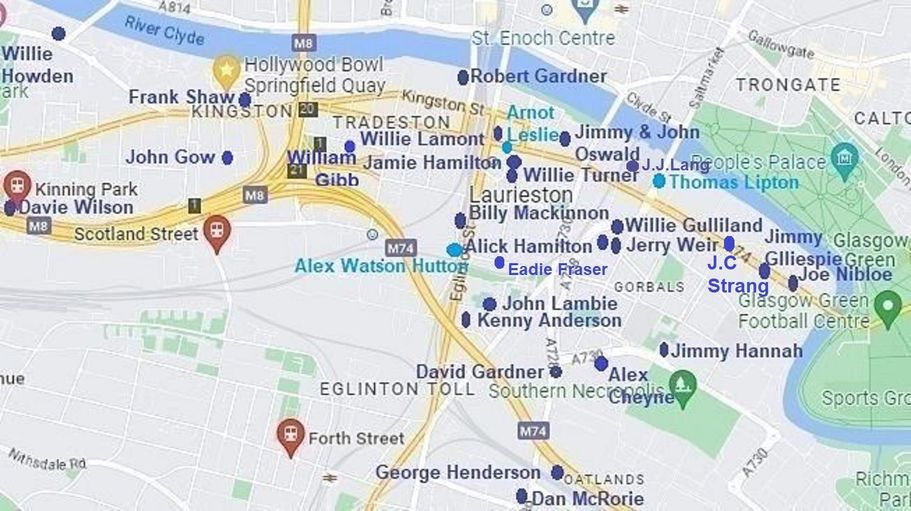
Other South-Side Players in Scotland and England